AI Edge Computing Gateway (Full-Factor Predictive Monitoring Terminal)
Edge-intelligent terminal for pump stations, water plants, drainage networks and water-intake monitoring: power fingerprint, station dynamics model, s...
Key Features
Performance Metrics
| Electrical sampling | Dedicated energy-metering chip; per-second three-phase V/I/power/energy |
| Signal inputs | Three-phase CT inputs (IA/IB/IC); multiple 4-20mA analog inputs; AC220V supply with voltage sampling |
| Communication | Multiple RS485 (Modbus) ports; 4G cellular uplink |
| Outputs | Relay (alarm/interlock), analog/pulse outputs for existing control systems |
Key Features
Positioning
No new flowmeter. No pipe cutting. Let every pump tell you its own flow. The AI Edge Computing Gateway computes flow at the edge from the electrical fingerprint and the pump-station dynamics model, assesses operating conditions and gives early warning of electromechanical faults — a "second pair of eyes" alongside the pump station's existing metering.
Overview
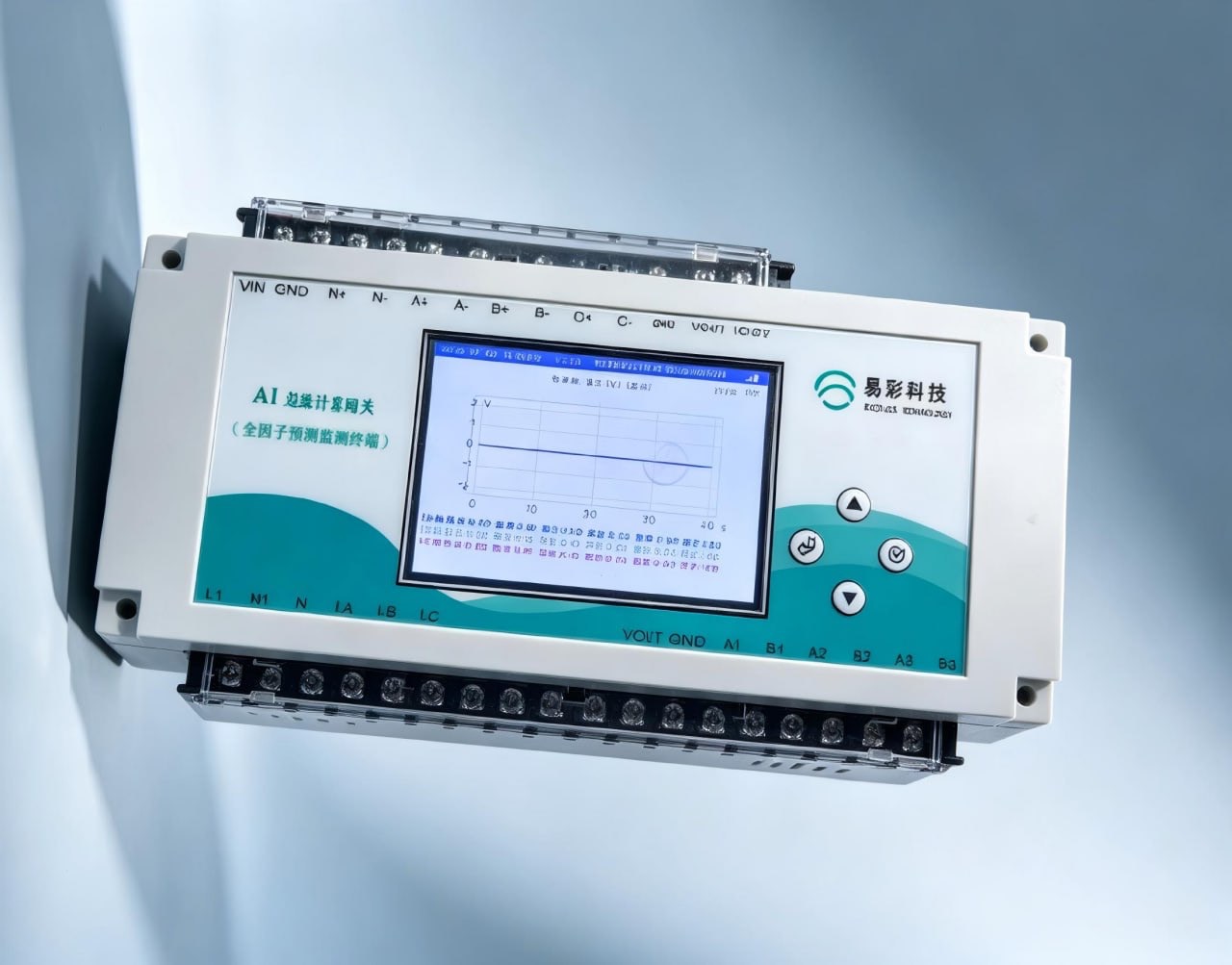
The AI Edge Computing Gateway (Full-Factor Predictive Monitoring Terminal) is an edge-intelligent terminal for pump stations, water plants, drainage networks and water-intake monitoring. It connects directly to the pump's three-phase current transformers (IA/IB/IC) and supply voltage (L1/N1) via wiring terminals, aggregates pressure, level, flow and VFD data over multiple RS485 buses, and runs "one pump, one model" self-learning algorithms on its built-in edge computing engine for flow soft-sensing, condition assessment and predictive maintenance.
The device features an industrial LCD and a 4-key panel for local trends, parameters and alarms; relay and analog outputs integrate with existing SCADA and control loops. DIN-rail installation matches standard low-voltage practice; data survives power loss, the device runs autonomously offline and re-uploads on recovery.
Devices in this family have been field-proven for long-term operation in pump stations, water plants, drainage networks, water-intake monitoring, city distribution networks and wastewater treatment plants, with the Ecolor IoT platform completing the chain of device management, time-series storage, alarm push and OpenAPI subscription.
Core Technology
Power Fingerprint — read the pump's health from its current waveform
Every pump has a unique three-phase current waveform, like a fingerprint: a healthy pump draws steady current with clean features; impeller wear, cavitation, rotor eccentricity or mechanical jamming produce distinctive distortion and fluctuation. A dedicated energy-metering chip samples all three-phase voltage, current, power and energy every second, extracting features and building fingerprint models:
- Non-intrusive sensing: clamp-on CTs on the distribution circuit only — no pipe cutting, no downtime, no fluid contact;
- Early warning: electromechanical anomalies surface on the power fingerprint before process parameters degrade;
- Zoned learning: feature baselines are built per load band, preventing "averaging" from masking local anomalies;
- Continuous health profile: long-term tracking of each pump's fingerprint evolution supports planned maintenance.
Station-wide Dynamics Model — from single-point data to a station-wide picture
Looking at one pump's current only tells you how much power it drew. Pumps follow modelable hydro-dynamics (the P-Q-H curve): shaft power, head, flow and efficiency are mathematically related. The gateway puts all station factors into one physical framework:
- Physics-constrained modeling: electrical parameters as input, head (inlet/outlet pressure) as boundary conditions — computed flow and efficiency obey physical law, not black-box fitting;
- Multi-factor cross-validation: pressure, level, flowmeter and VFD data corroborate the power-fingerprint estimates — deviations trigger alerts that point to the meter or the process, so no sensor gets blamed unfairly;
- Station energy assessment: unit energy consumption, efficiency distribution and operating-strategy advice for every pump — which pump to run and how to combine them for the lowest energy bill.
Soft Sensing — "virtual measurement" without sensors
Beyond fingerprint and dynamics modeling, soft sensing answers the customer's biggest question: know the flow without installing a flowmeter. Every additional physical meter adds a probe, an installation point, maintenance burden and a failure chain. Soft sensing replaces part of the physical instrumentation with models: easy-to-measure inputs (electrical parameters, pressure) continuously solve for hard-to-measure quantities (flow), displayed alongside real instrument readings.
- Lower capex: the purchase and wet-tapping cost of one large electromagnetic flowmeter covers this gateway solution at multiple monitoring points;
- No shutdown: wire it up and go — no pipe cutting, no production impact;
- Built-in backup (shadow metering): soft and hard meters run in parallel — compared constantly to catch drift early, and during meter "blindness" the model keeps delivering flow estimates for dispatch and internal statistics — and when the model is unsure it says so rather than inventing numbers;
- Confidence gating: self-assessed quality — trustworthy estimates are published; insufficient samples or anomalous baselines are clearly marked "learning";
- Local visualization: the LCD shows soft-vs-hard meter comparison trends in real time.
One Pump, One Model — the longer it runs, the better it knows your pump
No two pumps are identical: the same model differs by installation, piping and impeller wear. Instead of a one-size-fits-all template, the gateway builds a dedicated model per pump:
- Learning from power-on: automatically identifies the pump's actual characteristic curve from operating data — no manual nameplate entry;
- Adapts to new conditions: a sliding sample window with forgetting keeps the model tracking the pump's "current state", not its historical average;
- Cloud calibration layer: rolling-window cloud calibration plus four-state confidence management (learning → trusted → drift warning → frozen protection) protects against being "taught by bad data";
- Continuous self-correction: the model follows slow performance drift from wear, preventing error accumulation from "model aging";
- Data privacy: model training happens at the edge — process data never leaves the station;
- Scale by replication: each gateway carries its own compute; new monitoring points are plug-and-play with no per-point modeling on the platform.
Typical Applications
| Scenario | Pain point | Gateway solution |
|---|---|---|
| Water plant / pump station metering backup | Electromagnetic flowmeter failure means blindness | Shadow metering keeps data flowing through failures |
| Metering data trust | Single-meter drift goes unnoticed | Electrical x pressure x flow cross-validation |
| Predictive pump maintenance | Reactive repair after breakdown | Power-fingerprint early warning, health trends |
| Pump-station energy saving | Experience-based pump scheduling, energy black hole | Station dynamics model + unit energy assessment |
| Aging pump-station retrofit | Hard to shut down, high capex | Non-intrusive, wire-and-go installation |
| Water-intake metering & supervision | Scattered intakes, low metering coverage | Non-intrusive electrical sampling, edge computing + cloud |
| City distribution network monitoring | Branch-flow blind spots, costly metering | Multi-point soft sensing for dispatch decisions |
| Wastewater treatment monitoring | Harsh conditions, heavy meter corrosion | Cross-validation detects meter anomalies early |
Key Specifications
| Category | Specification |
|---|---|
| Electrical sampling | Dedicated energy-metering chip; per-second three-phase V/I/power/energy |
| Signal inputs | Three-phase CT inputs (IA/IB/IC); multiple 4-20mA analog inputs; AC220V supply with voltage sampling |
| Communication | Multiple RS485 (Modbus) ports; 4G cellular uplink |
| Outputs | Relay (alarm/interlock), analog/pulse outputs for existing control systems |
| Display & operation | Industrial color LCD + 4-key panel (local trends/parameters/alarms) |
| Installation | DIN rail / wall-mount, transparent terminal cover |
| Edge computing | On-device model training and inference; offline autonomy; data re-upload |
| Platform | Ecolor IoT platform; MQTT/Ecolor protocol; OpenAPI subscription |
Why Ecolor
- Field-proven at scale: volume deployments running long-term in real production environments — not lab prototypes; in typical stable duty the long-run deviation between soft-sensing and the physical meter stays low (internal O&M reference, not a metering-accuracy claim); intermittently operated stations simply show a longer learning period, honestly labeled;
- Platform-delivery capability: the same soft-sensing technology extends to drainage-network platform products (level-inverted flow, dual-engine backup) — from single devices to station-wide platforms;
- Full-stack in-house: core algorithms, firmware, IoT platform and software are all developed and maintained in-house — retrofits never wait on a third vendor's schedule, from wiring terminals to the management dashboard.
Scope note: this terminal is for operational monitoring and maintenance reference; custody-transfer metering remains subject to verified physical instruments.
Contact Us
Need a custom solution? Our engineers are ready to help you design the perfect system.
Get In Touch