Home / Products / pH/ORP Analyzer
Back to Products
pH/ORP Analyzer
Water Quality Instruments

pH/ORP Analyzer

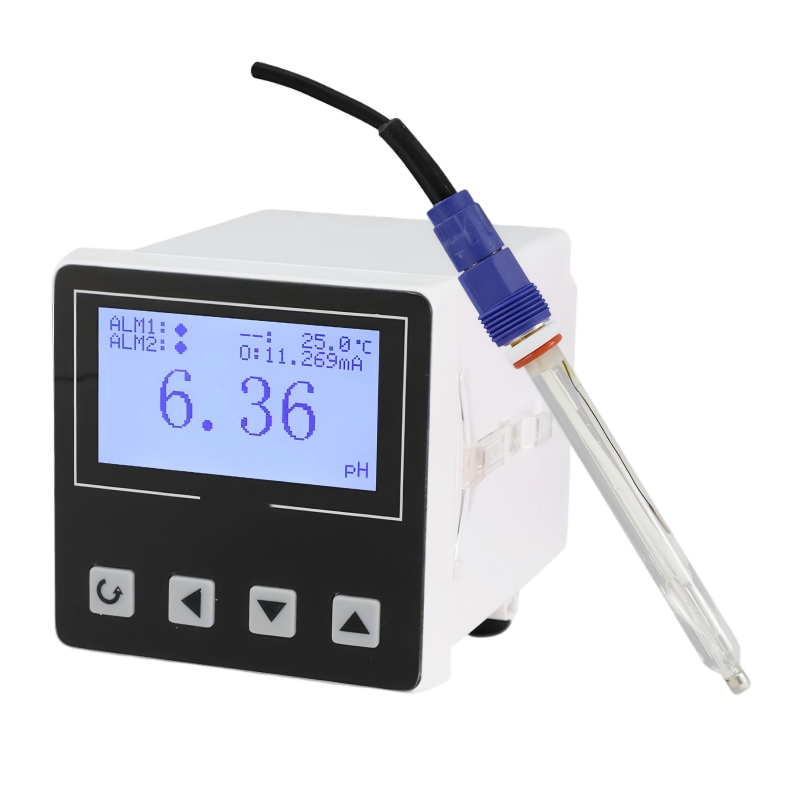
A precision instrument for testing and controlling liquid pH value and oxidation-reduction potential (ORP). Featuring electrochemical principle, micro...

Key Features

Modular circuit design
Isolated transmitter output for minimal interference
Capable of pH/ORP measurement and temperature measurement
Configurable manual and automatic temperature compensation
Configurable high and low alarm functions
Configurable buzzer on/off function

Performance Metrics

Operating Temperature 0 ~ 50 °C
Power Supply AC 85-265V / DC 24V ±10%
Temperature Compensation Manual/Automatic (NTC 10K)
Temperature Measurement Accuracy ±0.5 °C

Key Features

Modular circuit design
Isolated transmitter output for minimal interference
Capable of pH/ORP measurement and temperature measurement
Configurable manual and automatic temperature compensation
Configurable high and low alarm functions
Configurable buzzer on/off function
Auto-return function after key operation timeout
Isolated RS485 communication
pH ORP Analyzer for online monitoring in industrial applications

Online pH ORP Analyzer for Continuous Solution Monitoring

The pH/ORP Analyzer is a critical instrument designed for the precise online monitoring of pH and ORP values in various industrial processes. It reliably transmits measured data to control rooms for recording and storage via robust communication interfaces like RS485 or isolated current output.

This analyzer is essential for industries requiring stringent control over solution chemistry, enabling continuous remote monitoring and data logging for informed process management.

Wide-Ranging Industrial Applications of the pH ORP Controller

The versatility of this pH/ORP controller makes it a staple across numerous sectors. It is extensively applied in thermal power plants, chemical fertilizer production, and metallurgy for process optimization.

Furthermore, it plays a vital role in environmental protection, pharmaceutical manufacturing, biochemistry, food processing, and tap water treatment systems, ensuring consistent quality and safety through continuous monitoring.

pH ORP Analyzer modular design and display interface

Core Features and Advantages of the Analyzer

This analyzer integrates multiple advanced features to deliver reliable performance. Its modular circuit design enhances maintainability, while isolated transmitter outputs ensure signal integrity by minimizing electrical interference.

The device is capable of simultaneous pH/ORP measurement and temperature measurement, providing a comprehensive view of solution conditions. User-configurable settings offer great flexibility for specific application needs.

Key Technical Specifications

Measurement Parameters:
pH, ORP, Temperature
Output Signals:
Isolated 4-20mA, RS485
Temperature Compensation:
Manual / Automatic
Communication:
Isolated RS485 Modbus

Configurable Control Functions

Alarm Functions:
Configurable High/Low Limits
Audible Alert:
Buzzer On/Off Option
User Interface:
Auto-return after timeout
Design:
Modular Circuit Architecture
pH ORP measurement system with temperature compensation

Advanced Measurement and Compensation Capabilities

The analyzer's capability for pH/ORP and temperature measurement is fundamental for accurate process control. The configurable manual and automatic temperature compensation features ensure readings are accurate regardless of solution temperature fluctuations.

These features are crucial for applications in biochemistry and food processing where precise pH control is directly linked to product quality and safety standards.

Smart Alarms and User Interface Design

To enhance operational safety and convenience, the pH/ORP controller includes configurable high and low alarm functions. Users can also set the buzzer on/off function according to their environmental needs.

The intuitive interface features an auto-return function after key operation timeout, preventing unintended setting changes and simplifying operation for technicians in demanding industrial environments.

Isolated RS485 communication for remote pH monitoring

Reliable Data Transmission for Remote Monitoring

Continuous monitoring data is seamlessly transmitted via isolated output signals to recorders and control systems. This enables reliable remote monitoring and recording, which is essential for modern distributed industrial operations.

The inclusion of isolated RS485 communication provides a robust and noise-resistant digital connection, perfect for integrating the analyzer into larger SCADA or plant control networks in thermal power or water treatment facilities.

Industrial pH ORP Analyzer installation and setup

Robust Design for Harsh Industrial Environments

Built to last, the analyzer's design prioritizes durability and interference resistance. The modular circuit design not only eases maintenance but also improves overall system stability.

The isolated transmitter output is a key feature that minimizes signal interference, ensuring data integrity even in electrically noisy environments common in metallurgy and chemical plants, guaranteeing long-term, dependable performance for continuous monitoring tasks.

Contact Us

Need a custom solution? Our engineers are ready to help you design the perfect system.

Get In Touch
Downloads

User Manual for pHORP Controller.pdf
PDF • 765.9 KB

Related Questions

View All
How to select electromagnetic flowmeter liner materials for different media applications?
View Answer
<p><strong>Electromagnetic flowmeter liner selection</strong> is crucial for measurement accuracy and instrument longevity. Ecolor Technology's LGF series electromagnetic flowmeters offer various liner materials tailored to specific media characteristics.</p><ul><li><strong>PTFE/F46 Fluoroplastic Liners</strong>: Ideal for aggressive acids and alkalis, temperature range -40℃ to +180℃, excellent chemical resistance for corrosive applications</li><li><strong>Rubber Liners (Neoprene/Polyurethane)</strong>: Suitable for general water, wastewater treatment, cost-effective with good abrasion resistance, operating temperature -10℃ to +80℃</li><li><strong>Ceramic Liners</strong>: Designed for highly abrasive media like slurries and mining applications, hardness exceeding HRA90, extended service life</li><li><strong>Stainless Steel Liners</strong>: Food-grade applications, hygienic design, easy cleaning and maintenance</li></ul><p>Selection criteria include media pH, temperature, pressure, abrasiveness, and conductivity to ensure optimal <strong>electromagnetic flowmeter</strong> performance with ±0.5% accuracy.</p>
What is the measurement accuracy of Doppler radar flowmeters and what are the main factors affecting accuracy?
View Answer
<p><strong>Doppler radar flowmeters</strong> typically achieve measurement accuracy of ±2-5%, and can reach ±1% under ideal conditions. Ecolor Technology's <strong>HZ-KSLF series radar flowmeter</strong> demonstrates excellent measurement accuracy in practical applications through optimized algorithms and multi-band technology.</p><p>The main factors affecting <strong>radar flowmeter measurement accuracy</strong> include:</p><ul><li><strong>Flow conditions</strong>: Water velocity, turbulence level, and surface wave fluctuations directly impact Doppler signal quality</li><li><strong>Installation parameters</strong>: Radar antenna mounting height, angle, and position significantly influence measurement results</li><li><strong>Environmental factors</strong>: Temperature, humidity, and atmospheric pressure affect radar wave propagation characteristics</li><li><strong>Water body characteristics</strong>: Suspended particle content and surface reflection properties impact signal strength</li><li><strong>Equipment calibration</strong>: Regular calibration and parameter optimization are crucial for maintaining accuracy</li></ul><p>Through proper installation design and integration with <strong>RTU remote monitoring systems</strong>, measurement accuracy and data reliability can be significantly improved.</p>
How does rainy weather affect the measurement accuracy of Doppler radar flowmeters?
View Answer
<p><strong>Rainy weather</strong> does have certain impacts on Doppler radar flowmeter measurements, but modern <strong>multi-band radar flowmeters</strong> can effectively address these challenges through advanced technology. Ecolor Technology's <strong>HZ-KSLF series</strong> maintains high measurement accuracy even under rainy conditions.</p><p>The main impacts of rain on <strong>radar flowmeters</strong> include:</p><ul><li><strong>Raindrop interference</strong>: Raindrops cause scattering of radar waves, potentially affecting signal strength and quality</li><li><strong>Water surface disturbance</strong>: Rainfall increases surface wave activity, affecting Doppler signal stability</li><li><strong>Atmospheric attenuation</strong>: Rain increases radar wave propagation losses in the atmosphere</li><li><strong>Signal noise</strong>: Rainy conditions may increase background noise levels</li></ul><p>Countermeasures include: <strong>Multi-band technology</strong> automatically selects optimal frequencies, intelligent filtering algorithms exclude interference signals, and <strong>EC32/EC60 RTU systems</strong> provide real-time data correction. Combined with <strong>visual fusion radar level meters</strong> for water level compensation, ensuring measurement reliability in adverse weather conditions.</p>
What's the protection rating of Doppler radar flowmeter in harsh environments? Can it work normally under extreme weather conditions?
View Answer
<p><strong>Doppler radar flowmeters</strong> feature excellent environmental adaptability with IP68 protection rating, enabling stable operation under various harsh environmental conditions. The <strong>HZ-KSLF multi-band radar flowmeter</strong> is specifically designed for outdoor harsh environments with all-weather working capability.</p><p>Environmental protection features include:</p><ul><li>Operating temperature range: -40℃ to +85℃, suitable for extreme cold and high temperature environments</li><li>IP68 waterproof and dustproof rating, completely preventing dust ingress and water immersion effects</li><li>Wind-resistant design capable of withstanding Category 12 typhoons and extreme weather</li><li>Lightning protection with built-in multi-stage lightning protection circuits and grounding protection</li><li>Corrosion-resistant housing materials suitable for chemical and marine corrosive environments</li></ul><p>Compared to traditional <strong>ultrasonic flowmeters</strong>, radar flowmeters are not affected by fog, dust, temperature variations, and other environmental factors, maintaining high-precision measurement during sandstorms, heavy rain, and haze conditions.</p>
What are the advantages of Doppler radar flowmeter compared to ultrasonic flowmeter? Which one is better to choose?
View Answer
<p><strong>Doppler radar flowmeters</strong> offer significant technical advantages over <strong>ultrasonic flowmeters</strong>, particularly suitable for flow measurement under complex operating conditions. Both technologies have their characteristics, and selection depends on specific application scenarios.</p><p>Main advantages of Doppler radar flowmeters:</p><ul><li>Higher measurement accuracy: Unaffected by temperature, humidity, and atmospheric pressure changes, offering superior measurement stability compared to ultrasonic</li><li>Strong environmental adaptability: Fog, dust, wind speed, and other environmental factors do not affect measurement results</li><li>Lower maintenance costs: Non-contact measurement eliminates the need for regular probe cleaning, reducing maintenance workload</li><li>Strong anti-interference capability: Multi-band technology effectively avoids electromagnetic interference and multipath effects</li><li>Wide application range: Can measure various flow patterns including laminar, turbulent, and suspended particle-laden flows</li></ul><p>We recommend choosing <strong>HZ-KSLF multi-band radar flowmeter</strong> for open channel and river measurements, while ultrasonic flowmeters are more suitable for clean liquid measurement in pipelines.</p>
How does Doppler radar flowmeter handle data logging and export? What data formats are supported?
View Answer
<p><strong>Doppler radar flowmeters</strong> feature comprehensive <strong>data logging and export capabilities</strong> designed for hydrological monitoring and industrial applications. The HZ-KSLF series offers multiple data management options:</p><ul><li><strong>Local data storage</strong>: Built-in high-capacity memory stores flow rate, velocity, water level parameters for over one year, with power-failure data protection</li><li><strong>Real-time logging</strong>: Configurable sampling intervals from 1 minute to 24 hours, automatically recording instantaneous values, cumulative totals, maximum and minimum statistics</li><li><strong>Export formats</strong>: Supports standard formats including CSV, Excel, TXT for easy data analysis and processing</li><li><strong>Remote data transmission</strong>: Integration with EC32/EC60 RTU series enables remote data upload via 4G/LoRa communication protocols</li><li><strong>Historical data queries</strong>: Advanced search and export functions by time period, parameter type, and custom criteria</li></ul><p>Accompanying PC software provides graphical data analysis interface with trend plotting, report generation, and professional data visualization tools for comprehensive flow monitoring solutions.</p>