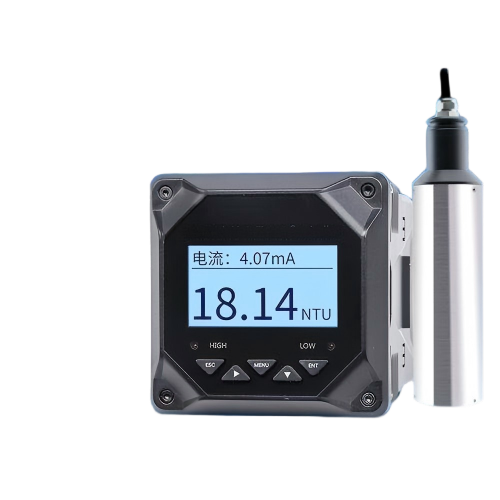
Home / Products / Sludge Concentration Meter / Turbidity Analyzer
Back to Products
Sludge Concentration Meter / Turbidity Analyzer
Water Quality Instruments

Sludge Concentration Meter / Turbidity Analyzer

The suspended solids/sludge concentration meter is designed for online monitoring of suspended solids concentration in municipal and industrial wastew...

Key Features

Sensor utilizes dual-beam infrared scattered light photometer detection technology for excellent repeatability and stability.
Infrared light scattering technology is applied to eliminate interference from sample color.
Built-in self-diagnostic function ensures data accuracy and reliability.
Optional automatic cleaning brush accessory significantly reduces sensor maintenance requirements.
Sensor allows for quick and convenient field installation with plug-and-play functionality.

Performance Metrics

Ambient Temperature (0 ~ 45)℃ (non-freezing)
Dimensions Diameter 60mm * Length 256mm
Flow Velocity ≤2.5m/s, 8.2ft/s
Ingress Protection IP68/NEMA6P

Key Features

Sensor utilizes dual-beam infrared scattered light photometer detection technology for excellent repeatability and stability.
Infrared light scattering technology is applied to eliminate interference from sample color.
Built-in self-diagnostic function ensures data accuracy and reliability.
Optional automatic cleaning brush accessory significantly reduces sensor maintenance requirements.
Sensor allows for quick and convenient field installation with plug-and-play functionality.
Sludge Concentration Meter and Turbidity Analyzer product overview

Sludge Concentration Meter / Turbidity Analyzer

The Sludge Concentration Meter and Turbidity Analyzer is an intelligent online chemical analyzer designed for continuous and precise monitoring. It is widely used in thermal power, chemical fertilizer, metallurgy, environmental protection, pharmaceuticals, biochemistry, food, and tap water treatment industries.

This key instrument is essential for optimizing wastewater treatment processes, ensuring effluent compliance, and enabling automated process control. Its robust construction and intelligent features guarantee long-term stable operation in demanding industrial environments.

Core Measurement Technology

Turbidity sensor using infrared scattering technology

Advanced Infrared Scattering Principle

The turbidity and sludge concentration sensor operates on a combined principle of infrared absorption and scattered light measurement. This dual-method approach ensures highly accurate and reliable readings for continuous process monitoring.

The application of infrared light scattering technology is a key feature that effectively eliminates interference from the sample's color, providing a true measurement of suspended solids and sludge concentration.

Key Product Features & Benefits

Dual-Beam Detection

The sensor utilizes dual-beam infrared scattered light photometer detection technology, which provides excellent repeatability and long-term stability for your online turbidity analysis.

Intelligent Self-Diagnosis

A built-in self-diagnostic function continuously checks the sensor's health, ensuring the data accuracy and reliability required for critical process control decisions.

Reduced Maintenance

An optional automatic cleaning brush accessory is available, which significantly reduces sensor maintenance requirements and ensures consistent performance in challenging wastewater applications.

Easy Installation

The sensor is designed for quick and convenient field installation with plug-and-play functionality, minimizing downtime during setup or sensor replacement.

Sludge Concentration Meter installation and maintenance

Robust Design for Harsh Environments

Engineered for durability, this sludge concentration analyzer maintains stable operation even in the most demanding industrial settings, from chemical plants to municipal wastewater treatment facilities.

Its intelligent design not only provides precise data but also contributes to automated process control, helping plants meet strict environmental compliance standards for effluent quality.

Application Scenarios

Turbidity Analyzer in industrial wastewater treatment

Wastewater Treatment & Process Control

This analyzer is a cornerstone device for optimizing sludge concentration control in activated sludge processes and clarifying effluent turbidity. It enables real-time adjustments for efficient chemical dosing and process automation.

Beyond wastewater, its application extends to ensuring product quality in the food, beverage, and pharmaceutical industries, as well as monitoring feedwater and cooling water in power and metallurgy plants.

Online chemical analyzer for various industries

Multi-Industry Monitoring Solution

The versatility of this online turbidity analyzer makes it suitable for a broad spectrum of industries. It provides reliable data for environmental protection monitoring and tap water safety assurance.

Its robust performance ensures that whether in a biochemical reactor or a large-scale industrial cooling loop, operators can trust the accuracy of their sludge and turbidity measurements for critical decision-making.

Technology Summary

Product Name
Sludge Concentration Meter / Turbidity Analyzer
Measurement Principle
Combined Infrared Absorption & Scattered Light
Key Technology
Dual-Beam Infrared Scattered Light Photometer
Color Interference
Eliminated via Infrared Scattering
Core Feature
Built-in Self-Diagnostic Function
Maintenance Aid
Optional Automatic Cleaning Brush
Installation
Plug-and-Play, Field Installable
Primary Application
Wastewater Treatment Process Control & Optimization

Contact Us

Need a custom solution? Our engineers are ready to help you design the perfect system.

Get In Touch
Downloads

TurbiditySludge Concentration Meter.pdf
PDF • 734.3 KB

Related Questions

View All
What media can electromagnetic flowmeters measure? What are the conductivity requirements?
View Answer
<p><strong>Electromagnetic flowmeters</strong> are designed specifically for measuring conductive liquids with specific conductivity requirements. Measurable media include:</p><ul><li><strong>Industrial Water</strong>: Tap water, process water, cooling water (conductivity ≥5μS/cm)</li><li><strong>Chemical Liquids</strong>: Acids, alkalis, salt solutions and other corrosive media</li><li><strong>Wastewater Treatment</strong>: Domestic sewage, industrial wastewater, sludge</li><li><strong>Food & Beverage</strong>: Fruit juices, milk, beer and other food-grade liquids</li><li><strong>Slurries</strong>: Mineral slurries, pulp containing solid particles</li></ul><p><strong>Cannot measure</strong>: Pure water, deionized water, petroleum products, gases and other non-conductive media. Ecolor's <strong>LGF series electromagnetic flowmeters</strong> feature PTFE lining and 316L stainless steel electrodes for excellent corrosion resistance and accurate measurement of various conductive liquids.</p>
Can the LGF-PA66 electromagnetic flowmeter measure bidirectional flow accurately in sewers with frequent backflow?
View Answer
<p>When tidal backwater or a rising downstream level pushes flow backwards in a storm or sanitary sewer, the metering point must measure in both directions. The LGF-PA66 works on Faraday's law of induction: the polarity of the induced voltage follows the flow direction, so the velocity signal carries a natural sign — it measures forward and reverse flow without any mechanical direction-sensing device.</p><p>The converter keeps separate forward and reverse totals and also outputs net flow (forward minus reverse). Reports can show the reverse volume separately, which quantifies external water intrusion and backflow frequency. With the EC32 RTU the forward total, reverse total, net flow and instantaneous direction all enter the data stream, so the platform can analyse backflow patterns by pumping-station operating period and support interception decisions.</p><p>Installation points:<ul><li>Choose a pressurised, always-full section such as a pump discharge line. Electromagnetic meters cannot measure partially filled gravity pipes — for those use a Doppler radar flowmeter or an ultrasonic open-channel solution instead.</li><li>For bidirectional flow keep straight runs of at least 5D on both sides so the flow profile is stable in each direction.</li><li>Sewage deposits sludge easily: place the meter close to the pump station so pump scouring keeps the tube clean, and inspect the electrodes periodically.</li></ul></p><p>Bidirectional operation does not change the accuracy specification — the LGF-PA66 holds ±0.5%(DN50-100) of reading in both directions and runs reliably for years with empty-pipe detection enabled. For more information, please visit our product page or contact our technical team.</p>
Is the LGF-PA66 magnetic flow meter suitable for wastewater treatment plants? How to select it for influent and return sludge duties?
View Answer
<p>Plant influent carries fibrous debris and return sludge is concentrated and abrasive, so the LGF-PA66 should be specified separately for each process duty.</p><ul><li><strong>Influent and lift stations</strong>: the medium contains large solids, so specify abrasion-resistant rubber lining with 316L electrodes. Wastewater conductivity is typically above 500μS/cm, making magnetic metering more stable than ultrasonic. Sizes of DN300–DN800 are common; install where the pipe runs full, clear of the turbulent drop zone at headworks weirs.</li><li><strong>Return and waste activated sludge</strong>: sludge concentrations of 8–15 g/L behave as non-Newtonian fluids; keep line velocity above 1 m/s to prevent deposition. The LGF-PA66 has no obstruction and no moving parts, so it cannot foul or jam like a vortex or turbine meter. Choose hardened-alloy electrodes for abrasion resistance, and scraper-type electrodes where sludge wear is severe.</li><li><strong>Effluent metering</strong>: where effluent is used for billing or discharge totalisation, select the ±0.5% accuracy class and submit the meter for periodic verification per the applicable regulation.</li></ul><p>For sludge duties, set up an electrode-fouling inspection routine and use the transmitter's coating alarm to catch build-up early — far cheaper than pulling the meter for cleaning after the fact. Small chemical dosing points are covered by DN15–DN50 LGF-PA66 units.</p><p>For more information, please visit our product pages or contact our technical team.</p>
Which flow meter suits reclaimed water pipelines? Is the LGF-PA66 right for recycled-water duty?
View Answer
<p>Reclaimed water is aggressive: residual chlorine, suspended solids, algae, elevated conductivity and often flocculant carry-over. Metering it demands corrosion resistance, fouling tolerance and stable accuracy at the same time.</p> <p>Why the LGF-PA66 fits:</p> <ul> <li><strong>Corrosion</strong>: the aviation-grade PA66 composite body is chemically stable in weak acids, alkalis and chlorinated water — it suffers none of the chloride pitting that kills 304/316L stainless bodies, the dominant failure mode in reclaimed-water service.</li> <li><strong>Fouling</strong>: no moving parts, no cavities where sludge collects; light electrode coatings are compensated by the excitation scheme, which keeps the zero stable. Specify a PTFE liner with 316L or Hastelloy electrodes matched to the water chemistry.</li> <li><strong>Accuracy</strong>: ±0.5% covers internal reclaimed-water accounting; use the ±0.2% version at custody-transfer points with reuse customers, verified periodically under JJG 1033.</li> </ul> <p>Typical deployment: LGF-PA66 (DN50–DN300) at the reclamation plant outlet and at each industrial offtake for billing; at park branch points the meter feeds an EC32 RTU that uploads instantaneous and totalized flow plus pressure to the reuse-management platform for quota control and leakage screening. In valve pits, order the IP68 submerged configuration with the split converter and RTU in a pit-side cabinet.</p> <p>For more details, please visit our product page or contact our technical team.</p>