Home / Products / Inline Ultrasonic Flow Meter
Back to Products
Inline Ultrasonic Flow Meter
Flow Meters

Inline Ultrasonic Flow Meter

The inline ultrasonic flow meter features intuitive data reading, plug-and-play installation with no need for additional parameter settings. It requir...

Key Features

Flexible installation: sensors can be installed inline, insertion, or clamp-on style.
Utilizes ultrasonic time-of-flight principle with accuracy up to 1.0%.
Strong anti-interference capability, stable and reliable operation, rich interfaces.
Components designed to high protection standards, suitable for harsh working environments.

Performance Metrics

Pipe Diameter DN32 ~ DN6000 mm
Protection Rating Sensor IP68
Data Storage SD card for timed storage of set parameters and measurement results.
Repeatability ≤0.2%

Key Features

Flexible installation: sensors can be installed inline, insertion, or clamp-on style.
Utilizes ultrasonic time-of-flight principle with accuracy up to 1.0%.
Strong anti-interference capability, stable and reliable operation, rich interfaces.
Components designed to high protection standards, suitable for harsh working environments.
Easy installation, plug-and-play, no complex parameter setup required.
No moving parts or obstruction, zero pressure loss, energy-efficient.
Low start-up flow, wide measurement range, excellent long-term stability.

Inline Ultrasonic Flow Meter

The Inline Ultrasonic Flow Meter is a precision metering device directly installed on pipeline systems to measure the volumetric flow rate of fluid in closed pipes using the ultrasonic time-of-flight principle. It offers significant advantages including simple installation, low starting flow rate, high measurement accuracy, and zero pressure loss, making it ideal for industrial process control, energy metering, and municipal water supply applications.

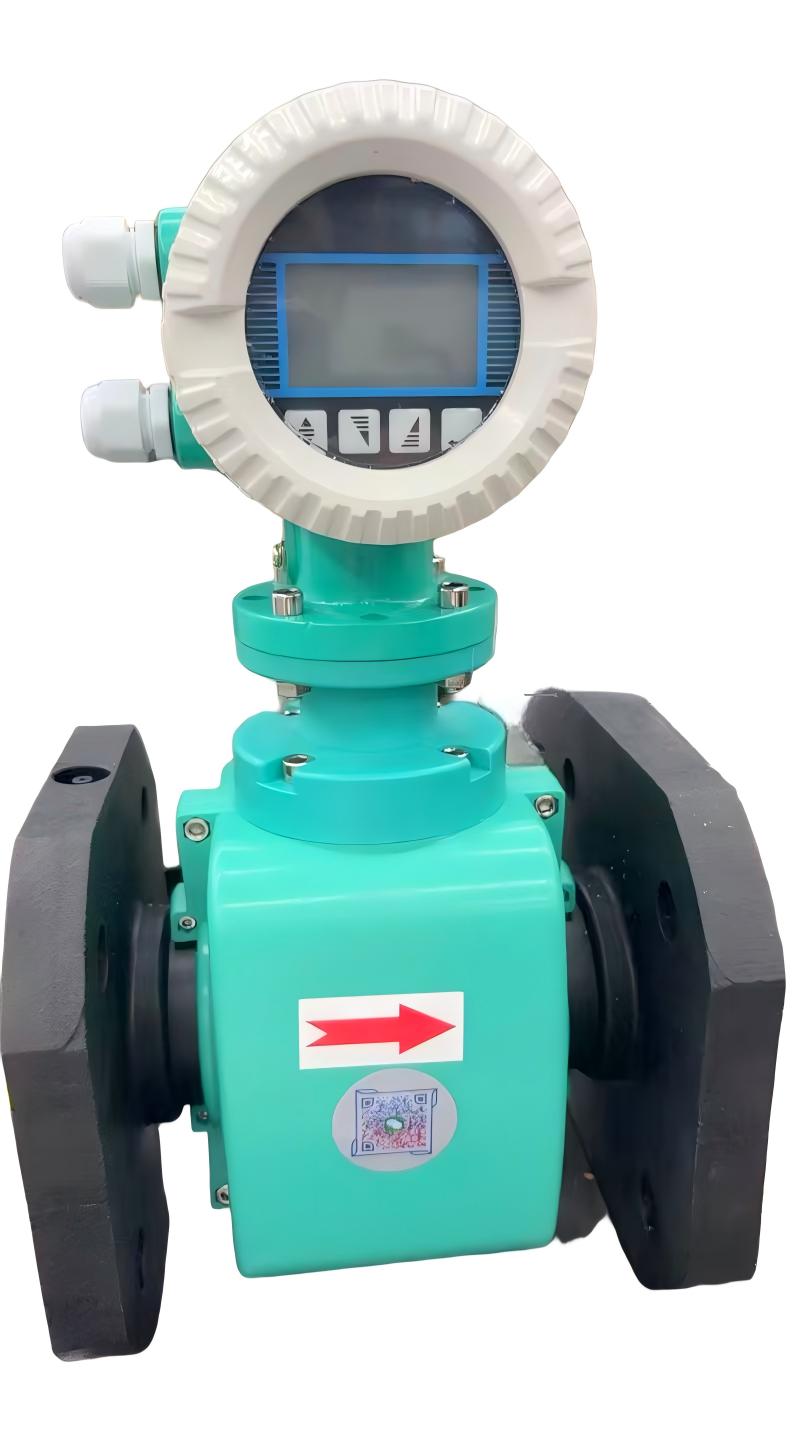
Inline Ultrasonic Flow Meter host and pipe-section sensor components

Inline Ultrasonic Flow Meter Design and Composition

This ultrasonic flow meter consists of a host unit and a pipe-section sensor. For smaller pipeline sizes, models DN15 through DN32 utilize a compact π-type pipe-section sensor design.

For larger diameter pipes, models DN40 and above are equipped with a standard pipe-section sensor, ensuring optimal performance across a wide range of industrial and municipal pipeline systems.

Core Advantages of Ultrasonic Flow Measurement

High Accuracy & Stability

Features low zero drift, measurement accuracy up to 1.0%, a wide turndown ratio, and excellent long-term stability for reliable data.

Zero Pressure Loss

With no moving parts or internal obstructions, this flow meter ensures energy-efficient operation with no pressure drop in the pipeline.

Robust Performance

Engineered with strong anti-interference capability and high protection standards for stable operation in harsh industrial environments.

Advanced Technology for Industrial Environments

The flow meter employs advanced multi-pulse technology, sophisticated digital signal processing, and intelligent error correction technology. This technological suite significantly enhances the device's adaptability to challenging industrial field conditions.

It delivers convenient, accurate, and stable volumetric flow measurement, providing a reliable solution for closed-pipe flow monitoring in various demanding applications.

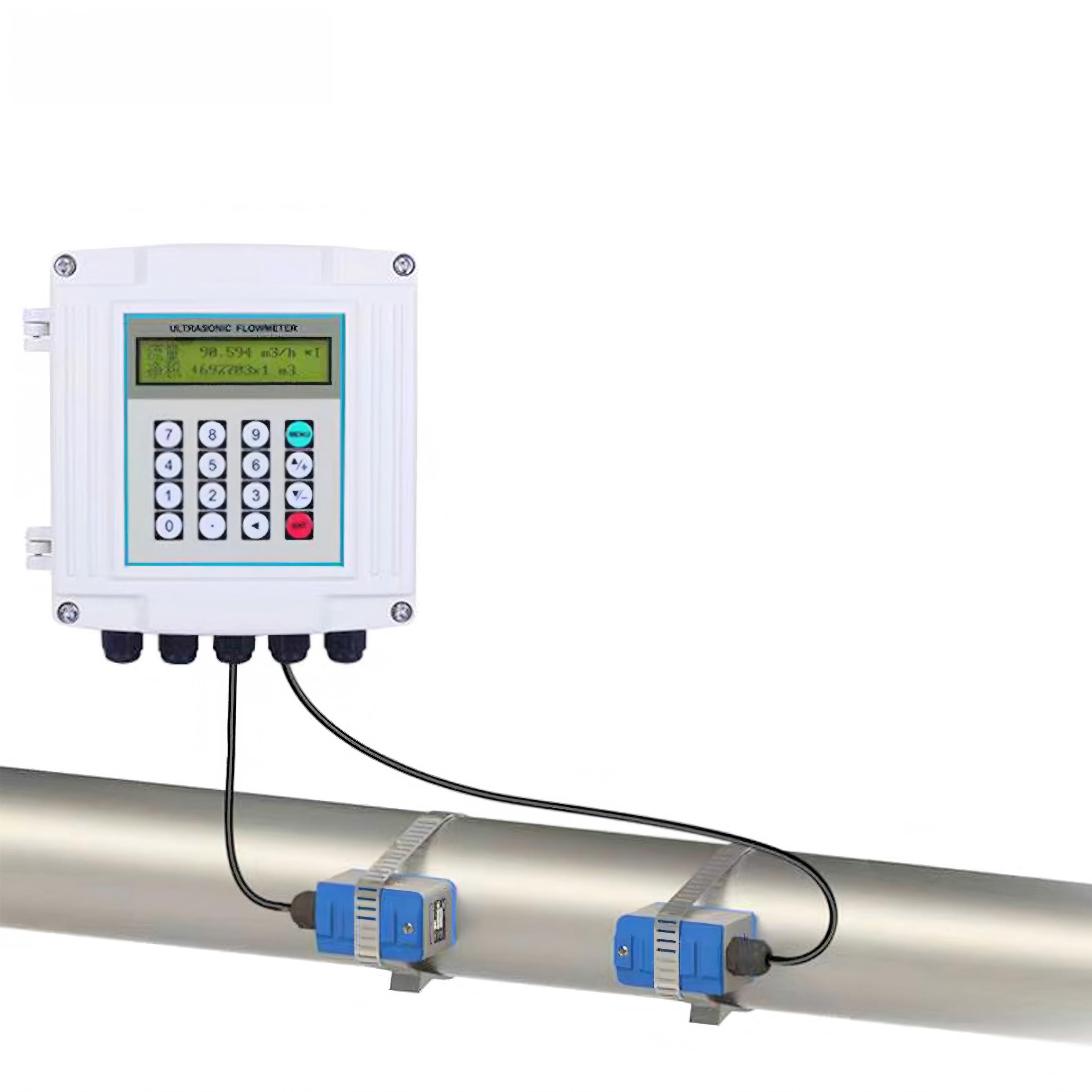
Installation example of an Inline Ultrasonic Flow Meter on a pipeline

Flexible Installation Options for Flow Meters

A key feature of this ultrasonic flow meter is its flexible installation capability. Sensors can be configured in inline, insertion, or clamp-on styles to suit different pipeline configurations and access requirements.

This versatility simplifies the integration process into existing systems, making it a practical choice for retrofit projects and new installations alike. The setup is designed for ease, essentially offering plug-and-play functionality without the need for complex parameter configuration.

Technical Specifications and Product Features

Parameter Description / Specification
Measurement Principle Ultrasonic Time-of-Flight
Typical Accuracy Up to ±1.0%
Pipe Section Models DN15-32: π-type sensor; DN40+: Standard sensor
Pressure Loss Zero (No moving parts or obstruction)
Key Features Low start-up flow, wide range, high stability, rich I/O interfaces

Operational Benefits and Application Suitability

The core design philosophy eliminates any throttling elements, guaranteeing no pressure loss and contributing to overall system energy efficiency. Its low start-up flow and wide measurement range make it sensitive and versatile.

Components are built to high ingress protection standards, ensuring durability and reliable performance even in harsh working environments commonly found in industrial and municipal settings.

Inline Ultrasonic Flow Meter in an industrial process control setting

Wide Application in Industrial and Municipal Fields

The reliability and accuracy of this inline ultrasonic flow meter make it widely applicable across several critical sectors. It is a preferred solution for precise industrial process control, where consistent flow data is essential for automation and quality.

Furthermore, it is extensively used for energy metering and in municipal water supply networks, providing trustworthy measurement for billing, distribution management, and leak detection without impeding flow.

Close-up detail of the ultrasonic flow meter sensor and electronics
Ultrasonic Flow Meter showing rich interface and connection options

Contact Us

Need a custom solution? Our engineers are ready to help you design the perfect system.

Get In Touch
Downloads

tubular ultrasonic flowmeter.pdf
PDF • 523.1 KB

Related Questions

View All
How many sensors can one RTU handle simultaneously? What types of flow meters and level sensors are supported?
View Answer
<p>The <strong>EC32 RTU series</strong> supports up to 32 analog inputs and 16 digital inputs, while the <strong>EC60 RTU series</strong> can handle up to 60 mixed signal channels for large-scale monitoring stations. Supported sensor types include:</p><ul><li><strong>Electromagnetic flow meters</strong>: LGF series integral/remote types with 4-20mA or pulse signal inputs</li><li><strong>Ultrasonic flow meters</strong>: Clamp-on, inline, insertion, and ultrasonic water meter configurations</li><li><strong>Radar flow meters</strong>: HZ-KSLF multi-band Doppler radar for non-contact measurement</li><li><strong>Level sensors</strong>: Visualized radar level meters, ultrasonic level sensors, submersible pressure transducers</li><li><strong>Water quality sensors</strong>: pH, dissolved oxygen, turbidity, conductivity parameters</li></ul><p>The RTU features <strong>multi-protocol conversion</strong> capabilities, simultaneously handling Modbus, Hart, 4-20mA interfaces. Built-in intelligent algorithms provide data preprocessing, anomaly detection, and edge computing to optimize cloud data transmission efficiency for water treatment and industrial monitoring applications.</p>
How does ultrasonic flowmeter transit time difference method work for flow measurement?
View Answer
<p>The <strong>transit time difference method</strong> is the most widely used principle in ultrasonic flow measurement technology. This method operates by measuring the time difference of ultrasonic signals traveling upstream and downstream through flowing fluid.</p><p>The measurement process involves:<ul><li><strong>Transducers A and B</strong> alternately transmit and receive ultrasonic signals</li><li>Downstream transit time: t1 = L/(c+v·cosθ)</li><li>Upstream transit time: t2 = L/(c-v·cosθ)</li><li>Flow velocity calculated from time difference: Δt = t2-t1</li><li>Flow rate determined by: Q = v·A (velocity × cross-sectional area)</li></ul></p><p>Ecolor Technology's <strong>ultrasonic flowmeter series</strong> utilizes advanced transit time algorithms achieving ±1.0% accuracy, suitable for industrial pipeline flow monitoring applications worldwide.</p>
What accuracy can transit-time ultrasonic flowmeters achieve and what factors affect measurement precision?
View Answer
<p><strong>Transit-time ultrasonic flowmeters</strong> can achieve measurement accuracy of <strong>±0.5% to ±1.0%</strong>, representing the highest precision among ultrasonic flow measurement technologies. Ecolor Technology's transit-time ultrasonic flowmeters utilize advanced time-of-flight measurement principles to ensure superior accuracy.</p><p>Key factors affecting <strong>measurement precision</strong> include:</p><ul><li><strong>Fluid conditions</strong>: Clean liquids in fully filled pipes provide optimal accuracy</li><li><strong>Flow profile</strong>: Fully developed laminar or turbulent flow patterns required</li><li><strong>Installation requirements</strong>: Upstream 10D and downstream 5D straight pipe sections needed</li><li><strong>Temperature compensation</strong>: Built-in temperature correction eliminates sound velocity variations</li><li><strong>Pipe vibration</strong>: Excessive vibration can interfere with ultrasonic signal transmission</li></ul><p>Compared to clamp-on ultrasonic flowmeters, <strong>transit-time design</strong> eliminates interference from pipe wall material, thickness, and scaling, providing enhanced measurement stability for industrial applications.</p>
Can ultrasonic flowmeters accurately measure high sediment content water? What are the requirements?
View Answer
<p><strong>High sediment content water</strong> presents unique challenges for ultrasonic flow measurement, but with proper technology selection and implementation, accurate measurement is achievable. Ecolor Technology offers specialized solutions for high-turbidity applications.</p><ul><li><strong>Sediment Impact Assessment</strong>: Suspended particles scatter ultrasonic signals; measurement becomes challenging when sediment exceeds 25,000ppm</li><li><strong>Frequency Optimization</strong>: Lower frequency transducers (below 0.5MHz) provide better penetration through sediment-laden media</li><li><strong>Signal Enhancement</strong>: Increased transmission power and optimized receiver sensitivity ensure adequate signal strength</li><li><strong>Doppler Technology</strong>: For extremely high sediment content, Doppler-principle ultrasonic meters may be more suitable</li><li><strong>Installation Requirements</strong>: Position after settling tanks in relatively clean sections, avoiding heavy sedimentation zones</li><li><strong>Maintenance Protocols</strong>: Implement frequent cleaning schedules and regular calibration checks</li><li><strong>Alternative Solutions</strong>: Consider electromagnetic or radar flowmeters for excessive sediment conditions</li></ul>
How to design drainage network online monitoring systems with electromagnetic flowmeters and RTU devices?
View Answer
<p><strong>Drainage network online monitoring systems</strong> require precise flow measurement and reliable data transmission. Ecolor Technology offers comprehensive solutions:</p><ul><li><strong>LGF Series Electromagnetic Flowmeters</strong>: ±0.5% accuracy, DN10-DN2000 diameter range, perfect for sewage and stormwater pipeline monitoring</li><li><strong>EC32/EC60 RTU Series</strong>: Ultra-low power consumption with solar power support and 4G wireless communication for continuous 24/7 operation</li><li><strong>Ultrasonic Flow Meters</strong>: Clamp-on installation for retrofitting existing pipelines without excavation</li><li><strong>Radar Level Sensors</strong>: FMCW technology for accurate water level monitoring and flood prevention</li></ul><p>The integrated system enables real-time monitoring of flow rates, water levels, and pressure parameters, providing essential data for urban drainage management and flood control strategies.</p>
How to implement channel flow measurement and gate automation control in irrigation district information management systems?
View Answer
<p><strong>Irrigation district information management systems</strong> achieve precision irrigation and optimal water resource allocation through intelligent equipment. Ecolor Technology provides comprehensive irrigation automation solutions:</p><ul><li><strong>Ultrasonic Flow Meter Series</strong>: In-line and clamp-on installation options for various irrigation channel flow measurement with low maintenance costs</li><li><strong>LGF Integrated Electromagnetic Flowmeters</strong>: Installed at key nodes of main and branch canals for real-time irrigation water consumption monitoring</li><li><strong>Radar Level Sensors</strong>: Monitor channel water level changes to provide data support for gate control operations</li><li><strong>EC32 RTU Series</strong>: Ultra-low power design with solar power and 4G communication, connecting gate actuators for remote control</li></ul><p>The integrated system enables irrigation planning, water usage statistics, remote gate control and other functions, improving irrigation efficiency and achieving water-saving and yield-increasing goals. Compatible with upper-level water management platforms.</p>