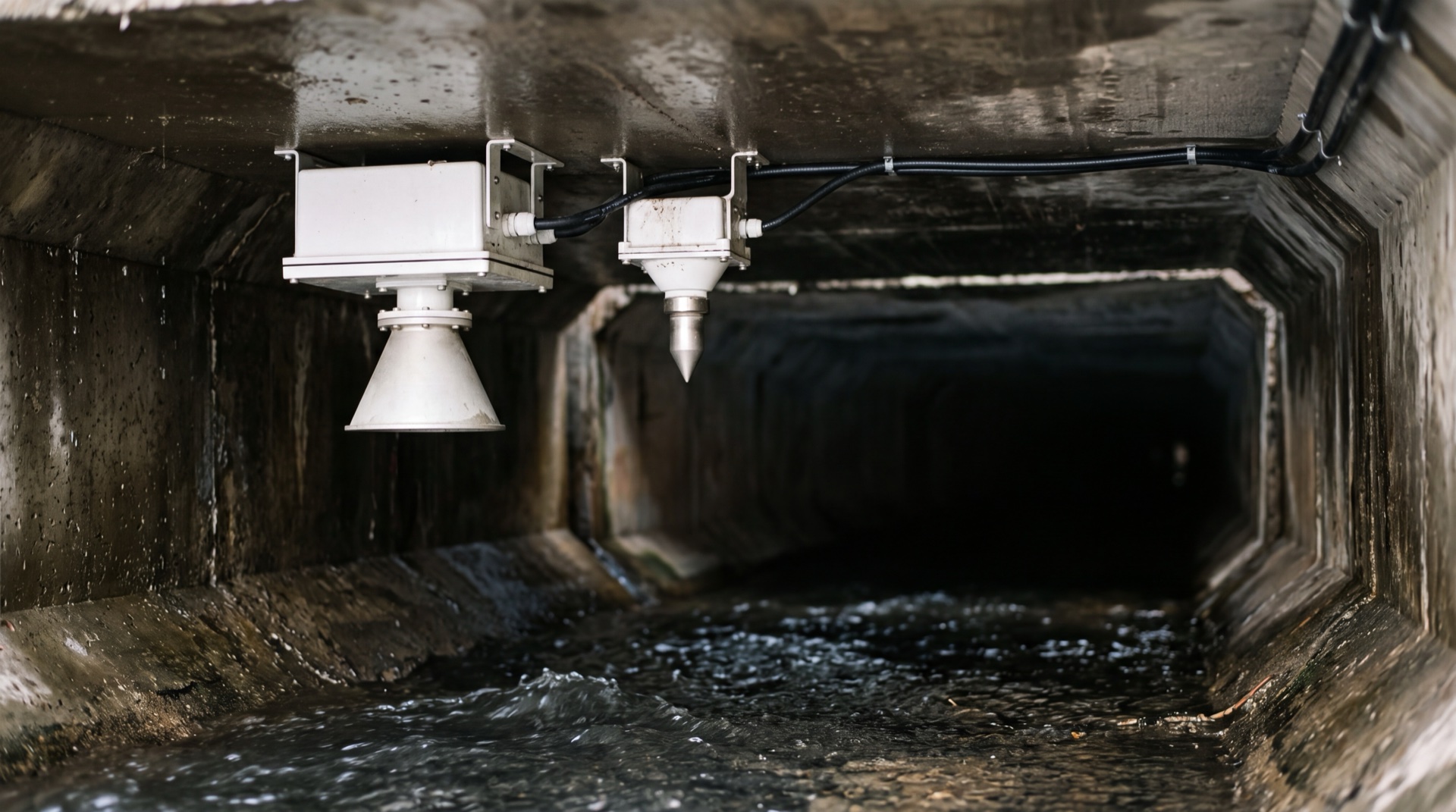
Non-Contact Doppler Radar Flow Meter Solution for Urban Culvert Drainage Monitoring
Urban stormwater culverts and box culverts are confined, humid and hazardous spaces that are difficult for personnel to enter. The Doppler radar flow meter measures water surface velocity without contact from the culvert ceiling, paired with a radar level sensor, and computes drainage flow by the area-velocity method. With RTU telemetry and 4G/NB-IoT transmission, it delivers continuous online culvert flow monitoring and flash-flood early warning for urban drainage networks.
Overview
Summary
Urban stormwater culverts and box culverts are confined, humid and hazardous spaces that are difficult for personnel to enter. The Doppler radar flow meter measures water surface velocity without contact from the culvert ceiling, paired with a radar level sensor, and computes drainage flow by the area-velocity method. With RTU telemetry and 4G/NB-IoT transmission, it delivers continuous online culvert flow monitoring and flash-flood early warning for urban drainage networks.
Key Advantages
Challenges
- Confined culvert space with hazardous gases restricts human entry
- Contact probes foul and corrode quickly — low survival, frequent maintenance
- Flow can surge within minutes during storms; fast capture and warning required
- Power and wired network are limited along culvert sections
- Data must integrate with drainage regulatory and flood platforms
Results
- Surface velocity range 0.1–8 m/s; level accuracy at ±3 mm class
- Non-contact mounting — sensors never touch water, maintenance greatly reduced
- Minute-level refresh; flash-flood alarm pushed within 5 minutes
- Solar off-grid sites sustain ≥15 days of continuous bad weather
- Data integrity ≥98%, supporting capacity assessment and CSO accounting
Solution Details
Non-Contact Doppler Radar Flow Meter Solution for Urban Culvert Drainage Monitoring
Urban drainage culverts — box culverts, arch culverts and road-underpass conduits — are key conveyance structures for stormwater, combined sewers and flood drainage. Yet their interiors are confined, permanently humid and corrosive, with hydrogen sulfide and methane accumulation, making human entry hazardous. Contact-type flow instruments face installation, maintenance and survival difficulties in such spaces. The Doppler radar flow meter, mounted on the culvert ceiling, measures surface velocity without touching the water; combined with a radar level sensor and the area-velocity method, it provides a reliable non-contact path for culvert flow monitoring.
Core Challenges in Culvert Flow Monitoring
Hostile confined environment: Poor ventilation, near-saturated humidity and toxic/flammable gases make frequent human entry unsafe under confined-space regulations, driving up the cost of installing and servicing contact instruments.
Low survival of contact sensors: Suspended solids, grease and sludge foul probe surfaces; corrosion and signal drift are frequent in the humid environment, leading to short maintenance cycles and poor data integrity.
Rapid flash-flood response needed: During storms, culvert water level and flow can multiply within minutes, creating surcharge risks; sensors must respond fast with a wide range and trigger waterlogging warnings.
Limited power and network: Many culvert sections lie beneath roads or green space, with no nearby power or wired network; equipment must be low-power and wireless.
Platform integration required: Flow data must feed the urban drainage monitoring platform and flood command system in standard protocols to support CSO control and flood dispatch.
Doppler Radar Flow Meter System Architecture
A three-layer architecture of "non-contact sensing — telemetry — platform":
Non-contact sensing layer: A Doppler radar flow meter is suspended from the culvert ceiling, directing a microwave beam onto the water surface and measuring surface velocity from the Doppler shift of the echo. A radar level sensor measures water level without contact. No sensor touches the water, eliminating fouling, corrosion and submersion damage.
Telemetry layer: An RTU acquires velocity, level and temperature, computes instantaneous and cumulative flow from cross-section parameters, and transmits via 4G/NB-IoT with store-and-forward; mains+UPS or solar+battery off-grid power is supported.
Platform layer: The drainage monitoring platform provides real-time data, trend curves, flow reports, flash-flood alarms and waterlogging warnings, with interfaces to the drainage GIS platform and flood command system.
Measurement Principle and Configuration of Radar Flow Meter
Area-velocity method: Flow Q equals cross-section area A times mean velocity V. Water level is converted to wetted area via the culvert's geometry (rectangular box, arch or circular); the radar-measured surface velocity is corrected to mean velocity with a section coefficient tuned during trial operation.
Recommended configuration: One Doppler radar flow meter plus one radar level sensor plus one RTU per section; critical or bi-directional culverts may use dual sections for cross-checking.
0.1–8 m/s
Surface velocity range
IP67+
Protection rating
4G/NB-IoT
Wireless telemetry
Deployment Key Points for Culvert Drainage Monitoring
Section selection: Choose straight, geometrically regular reaches with steady flow, away from inlet/outlet turbulence, drops, bends and backwater.
Mounting and protection: Mount radar units on corrosion-resistant brackets clear of drip lines and condensation; IP67 or better; cables in conduit; lightning grounding for outdoor cabinets.
Power and communication: Mains+UPS where available; solar+battery elsewhere, sized for ≥15 days of continuous bad weather.
Calibration and acceptance: Verify against current-meter or volumetric checks during trial operation and tune the section coefficient; acceptance is based on data integrity and flow error.
Typical Application Modes for Doppler Radar Flow Meters
Trunk culvert metering: Routine flow metering on main drainage culverts to assess conveyance load and guide upgrades.
Waterlogging warning: Flash-flood alarms at underpass and low-lying road culverts, linked to traffic control and drainage dispatch when thresholds are exceeded.
CSO accounting: Continuous flow on combined-sewer reaches for overflow volume accounting and interception dispatch.
Technical Advantages of Non-Contact Radar Flow Measurement
- Non-contact, low maintenance: Ceiling-mounted sensors never touch the water — no fouling, corrosion or submersion damage — ideal for confined spaces.
- Humidity- and corrosion-tolerant: Radar penetrates mist and saturated air reliably.
- Dual-parameter sensing: Velocity and level at one section cross-validate for higher data reliability.
- Fast response: Minute-level refresh captures flash-flood hydrographs and triggers timely warnings.
- Low-power wireless: Low-power RTU with solar off-grid option and 4G/NB-IoT fits power-free culvert sections.
- Open integration: SL651, HJ212 and custom APIs connect to drainage and flood platforms.
Typical Application Scenarios
- Online flow monitoring of trunk stormwater culverts and box culverts
- Flash-flood warning at underpass and low-lying road culverts
- Flow accounting on combined sewer overflow (CSO) reaches
- Metering of river make-up water and outfall culvert gates
- Conveyance capacity assessment and upgrade acceptance
- Flood dispatch and urban waterlogging risk analysis
Deployment Recommendations for Culvert Flow Monitoring
- Site survey: Inventory candidate culverts; verify headroom, cross-section type, mounting and power conditions; select monitoring sections.
- Section survey and parameter setup: Survey culvert geometry; configure cross-section equations and area-velocity parameters.
- Installation and commissioning: Mount brackets, align radar, lightning grounding and power works; verify signal quality on site.
- Network trial and calibration: Connect to the platform, run comparison calibration, tune the section coefficient, evaluate flow error and data integrity.
- Acceptance and long-term O&M: Issue the acceptance report; establish periodic inspection and remote diagnostics for sustained operation.
? Reference Sources
- Doppler Radar Flow Meter Technical Specifications — Non-Contact Surface Velocity Measurement
- Urban Drainage Monitoring Standards — Area-Velocity Flow Computation Methods
- SL651 / HJ212 Protocol Documentation for Drainage Platform Integration
Approach
How we implement intelligence into your infrastructure step by step.
Site survey & siting
Verify headroom, cross-section type and mounting conditions; select straight regular reaches.
Section survey & parameter setup
Survey culvert geometry; configure cross-section equations and area-velocity parameters.
Installation & commissioning
Ceiling mounting and alignment, lightning grounding and power works; verify signal quality.
Network trial & calibration
Platform connection, comparison calibration, section coefficient tuning, error/integrity evaluation.
Acceptance & long-term O&M
Acceptance report, periodic inspection and remote diagnostics for sustained operation.
❓ Related FAQs
Related Solutions

Ready to Optimize Your Business?
Contact us, and our professional team will provide customized solutions to help your business achieve digital transformation.
Get In Touch