How a Water Group Achieved Cost Reduction and Efficiency Through Drainage Network Monitoring
As extreme weather events grow increasingly frequent and intense, urban flood resilience has become a critical priority for municipal infrastructure management worldwide. Recently, an intelligent drainage network monitoring project—developed with deep technical support from Ecolor Technology—was successfully commissioned and fully operationalized in the core urban area of a major southern coastal city in China.
Leveraging precision data acquisition and Internet-of-Things (IoT) technologies, the system enables real-time, high-fidelity situational awareness of underground drainage infrastructure. It now serves as a foundational data backbone for the city’s flood prevention and emergency response systems—transforming reactive crisis management into proactive, evidence-based decision-making.
1 Project Background: Aging Infrastructure Under Climate Stress
The city’s central district hosts over 1.5 million permanent residents and relies on approximately 1,200 kilometers of aging stormwater and combined sewer networks. Many sections were constructed decades ago under outdated design standards, with limited capacity to handle today’s intensified rainfall patterns.
According to municipal records, during the 2022 monsoon season alone, the area experienced 14 severe urban flooding incidents—characterized by average ponding depths exceeding 40 cm and maximum drainage durations surpassing four hours.
These events disrupted public transportation, compromised road safety, and imposed significant economic losses on local businesses and residents. In response, the Municipal Water Authority partnered with Ecolor Technology to launch the “Smart Water Management: 24/7 Intelligent Drainage Network Monitoring” initiative—a comprehensive upgrade aimed at transforming legacy infrastructure into a resilient, data-driven asset.
2 Technical Challenges: Overcoming Subsurface Monitoring Barriers
Deploying large-scale, reliable online monitoring across complex underground environments presents formidable engineering hurdles. First, the physical conditions are exceptionally harsh: humidity levels routinely exceed 95% in wastewater and combined sewers, while corrosive gases—including hydrogen sulfide—accelerate material degradation. Sensors must therefore meet stringent requirements for hermetic sealing, chemical resistance, and long-term stability.
- Connectivity: Utility vaults and manholes often lie in cellular dead zones, with no access to grid power—making robust wireless connectivity and multi-year battery life non-negotiable.
- Hydraulic Variability: Conditions fluctuate dramatically: from near-stagnant flow during dry periods to full-pipe surges during storms—accompanied by sediment accumulation, debris, and organic obstructions that readily foul conventional sensor probes.
3 Integrated Solution: Multi-Source Sensing Meets Low-Power IoT Architecture
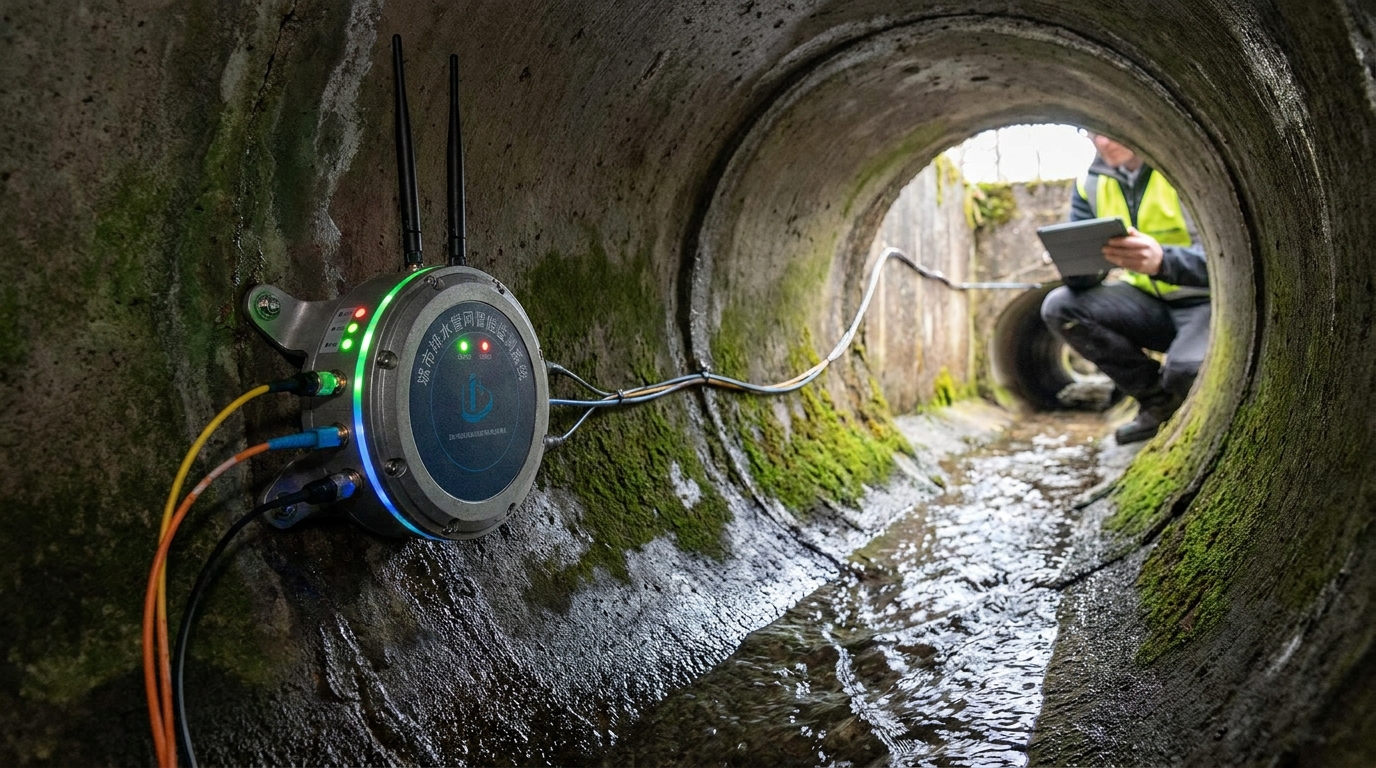
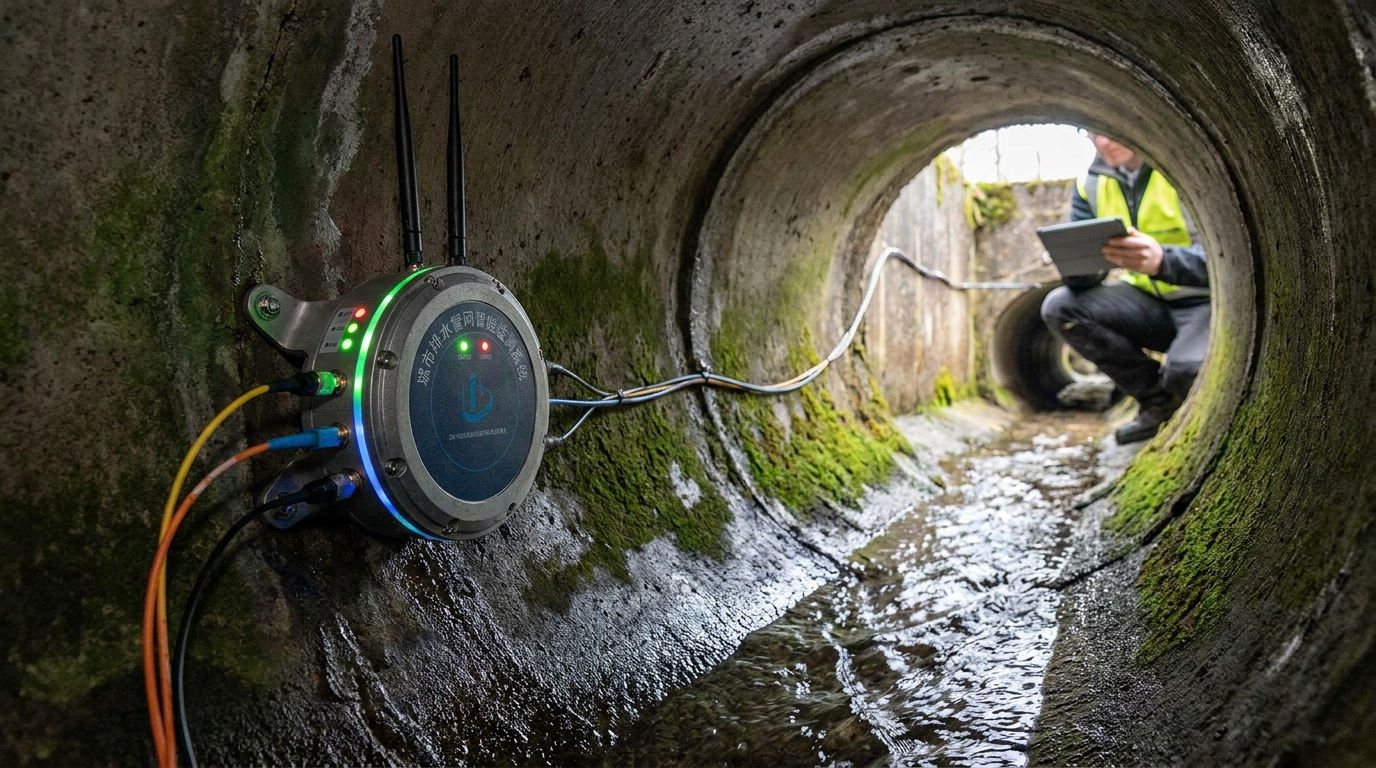
To address these systemic challenges, Ecolor Technology deployed a holistic architecture centered on three pillars: multi-source sensing, edge intelligence, and ultra-low-power IoT connectivity. At its core lies a dual-sensor configuration—high-precision radar-based level sensors paired with Doppler ultrasonic flow meters—strategically calibrated for dynamic hydraulic conditions.
Hardware Durability
All field devices feature IP68-rated, corrosion-resistant housings with seamless encapsulation, ensuring operational reliability even under continuous submersion in aggressive wastewater environments.
Power & Connectivity
A dual-path NB-IoT + 4G LTE redundancy architecture, augmented by high-gain external antennas. Coupled with industrial-grade lithium-thionyl chloride batteries, each node delivers over three years of maintenance-free operation.
Crucially, embedded edge-processing modules run proprietary algorithms trained to distinguish genuine hydraulic signals from noise caused by floating debris—ensuring high-fidelity, actionable data on water level and flow velocity.
4 Implementation: Precision Placement and System Integration
The five-month deployment was executed in three tightly coordinated phases: geotechnical surveying, hardware installation, and system integration. Ecolor’s engineering team collaborated closely with municipal planners to conduct hydraulic modeling and vulnerability mapping across 85 historically flood-prone locations, 32 inter-zonal drainage boundaries, and 15 primary pumping station inlets.
This rigorous analysis informed the strategic placement of 150 intelligent monitoring nodes—each installed at hydraulically critical junctions where early warning signals carry maximum operational value. Field execution demanded adaptive engineering: teams customized mounting brackets for diverse pipe diameters and irregular vault geometries, ensuring optimal probe alignment and measurement accuracy.
Upon completion, all endpoints fed seamlessly into the city’s centralized Smart Water Management Platform (“Water Brain”), followed by a rigorous 30-day cross-validation and metrological calibration process aligned with China’s national hydrological measurement standards (SL 651–2014).
5 Operational Impact: From Data to Decisive Flood Response
During its first typhoon season, the system faced its ultimate stress test: an extreme rainfall event delivering 120 mm/hour—well beyond historical design thresholds. The platform automatically escalated to high-frequency mode, updating measurements every five minutes across the entire network.
Real-World Performance Proved Transformative
When radar sensors at a key arterial intersection detected water levels rising to 85% of the pre-defined alert threshold—and Doppler flow meters simultaneously registered a sharp velocity drop indicative of upstream blockage—the system triggered an automated “pipeline obstruction” alert to the city’s Flood Command Center 40 minutes before surface flooding occurred.
Based on this precise, time-critical insight, operators preemptively activated downstream pump stations for drawdown and dispatched vacuum trucks to the suspected blockage site. As a result, street-level inundation was reduced by over 70%, and traffic flow remained uninterrupted—marking a paradigm shift from post-event recovery to anticipatory infrastructure management.
By integrating advanced IoT sensing with robust edge computing, Ecolor Technology has demonstrated how data-driven insights can turn vulnerable urban infrastructure into a resilient, responsive lifeline.