When Water Infrastructure Meets the Unforgiving Field
For a procurement manager tasked with monitoring remote river discharge or a utility engineer responsible for urban drainage pipes, the edge of a tropical storm is not a theoretical challenge—it's a test of every seal, circuit board, and battery connection. In these moments, instruments must function when submerged, baked by desert sun, or encased in ice. The core question is not just accuracy; it's extreme environment reliability.
This demand has pushed a new generation of IP68 sensors and telemetry units to evolve far beyond basic waterproofing. Ecolor Technology, through its SITUMAN sensor line and HuaYu ZhongNeng system integration, has engineered a family of IP68 radar flowmeters and RTUs that turn hostile field conditions into routine data points—without sending crews into danger.
The True Cost of Corrosion and Moisture Ingress in IP68 Sensor Systems
Corrosion silently eats away at equipment in wastewater plants, coastal estuaries, and agricultural canals. According to a Salt Spray Test reference from ASTM B117 standards, the duration before rust appears directly depends on coating integrity; a more corrosion-resistant coating lengthens the test window dramatically. The hydrostatic level sensors market is responding: around 42% of manufacturers are now exploring new materials like titanium alloys to improve corrosion resistance, as noted in a 2035 global market research report.
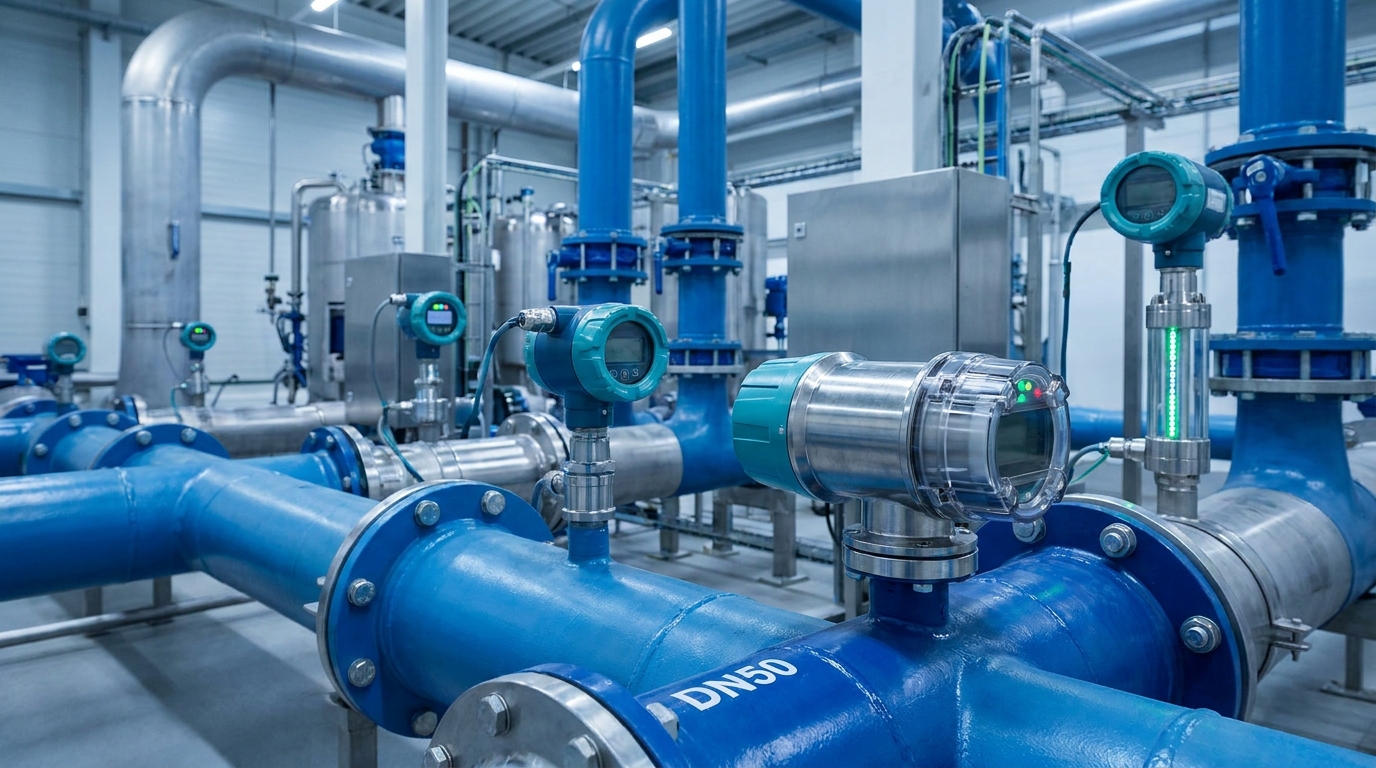
Even in less aggressive settings, moisture absorption becomes a hidden killer. Printed circuit board studies show that standard FR-4 epoxy absorbs only 0.15% water by weight, while polyimides can absorb significantly more, impairing breakdown voltage and dielectric parameters. In contrast, Teflon-based laminates absorb just 0.01%, a property that makes them ideal for sensor electronics that must survive condensation cycles inside IP68 enclosures.
Even consumer products like smart pool monitors—WaterGuru SENSE S2, for instance—rely on optical technology and sealed compartments to measure free chlorine daily while floating in chlorinated water, underscoring that sensor survival starts at the material level.
The lesson is clear: IP68 is not just a rubber gasket; it requires a full-stack anti-corrosion strategy—from nanocoated PCBs with ultra-low water absorption to titanium alloy wetted parts.
IP68 Under Siege: Testing Beyond the Code for Extreme Environment Performance
IP68 rating implies protection against continuous immersion under conditions specified by the manufacturer, but real-world field conditions often combine submersion with thermal shock, UV radiation, and biological fouling. A radar sensor mounted in a combined sewer overflow must survive not only floodwater at 3 m depth but also the abrasive impact of grit and the chemical cocktail of industrial discharge.
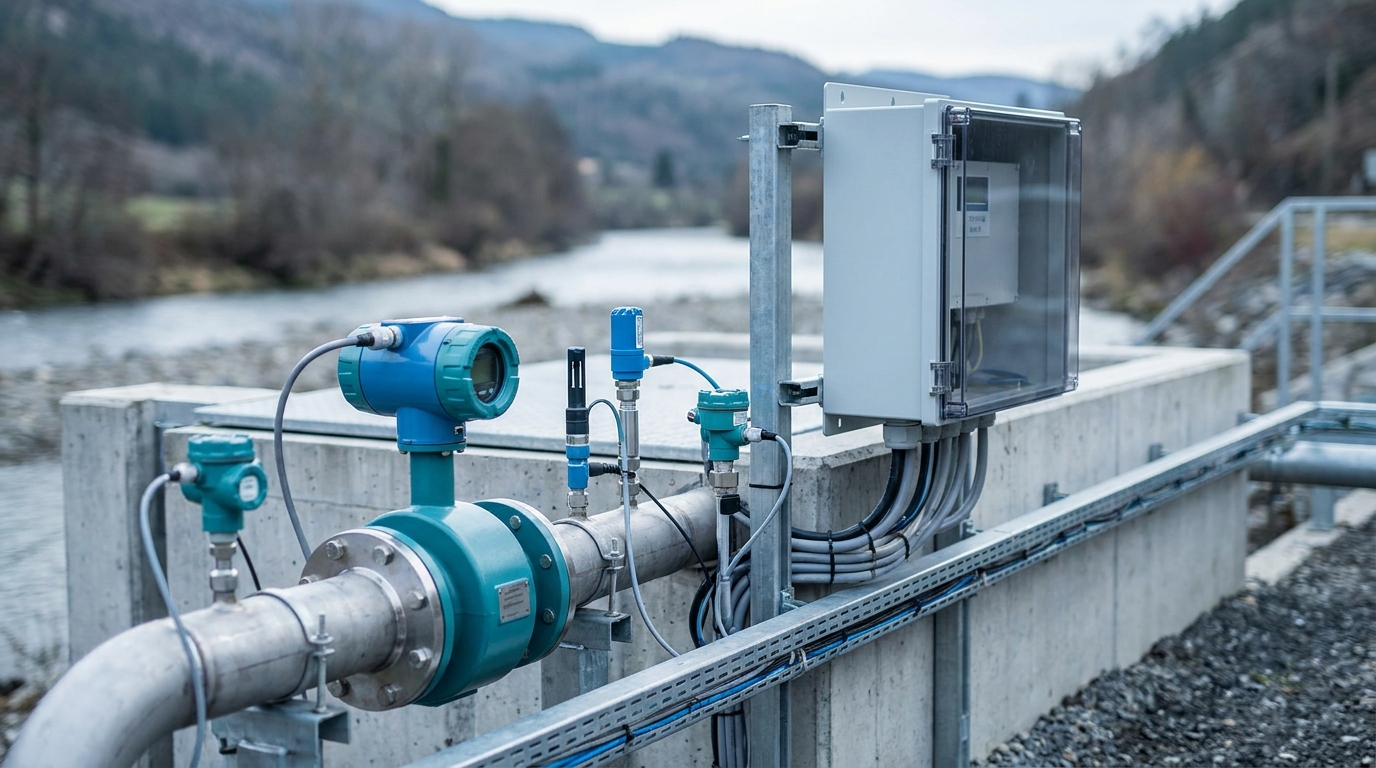
Ecolor's SITUMAN multi-band Doppler radar flowmeter achieves this through a fully sealed non-contact design. There are no electrodes in the flow, no submerged pressure diaphragms—just a radar beam from above the water surface. This is the world's only urban drainage downhole non-contact measurement solution that allows installation via a simple pole and expansion screws without personnel entering the well. The built-in motor adjusts radar angle remotely, so the beam stays clear of floating debris, sludge, or high-flow turbulence.
Material Intelligence in PCB and Enclosure Design for IP68 RTU Reliability
Referring back to the PCB moisture absorption data, Ecolor's IP68 RTUs employ advanced laminate materials and conformal coating stacks that keep ionic contamination and conductive anodic filament growth at bay. The enclosure design also reflects the salt spray logic: multiple O-ring barriers, Gore-vent breathers that equalize pressure without letting liquid water in, and grade 316 stainless steel hardware resist pitting corrosion even when exposed to coastal salt fog for years.
This approach lets a solar-powered IP68 RTU operate unattended from -40°C to +85°C, accepting direct sunrise heat in the Gobi Desert or a Siberian ice freeze.
SITUMAN Multi-Band Doppler Radar Flowmeter – IP68 Non-Contact Sensor
Integrates level gauge, flowmeter, and HD camera in one unit. COSP hydraulic model for precise discharge calculation even in partially filled pipes.
Adjustable radar angle via built-in motor; IP68 rated with no wetted parts. Ideal for urban drainage, hydropower ecological flow, and smart agriculture.
Optional external water quality sensor for flow + quality monitoring. Remote camera diagnostics confirm field conditions without site visits.
Radar and RTUs Engineered for Thunderstorm Resilience and Lightning Protection
Lightning strikes can induce catastrophic surges in signal and power lines, instantly destroying unhardened electronics. Ecolor's IP68 RTUs integrate multi-stage surge protection rated for direct burial and outdoor cabinet deployment. The entire monitoring station—radar flowmeter, camera, telemetry unit, and solar charge controller—is designed as a single-potential grounding system to withstand typical mountain ridge lightning exposure. This anti-lightning engineering is crucial for ecological flow measurement at remote hydropower stations where substations are far away and earthing meshes are rudimentary.
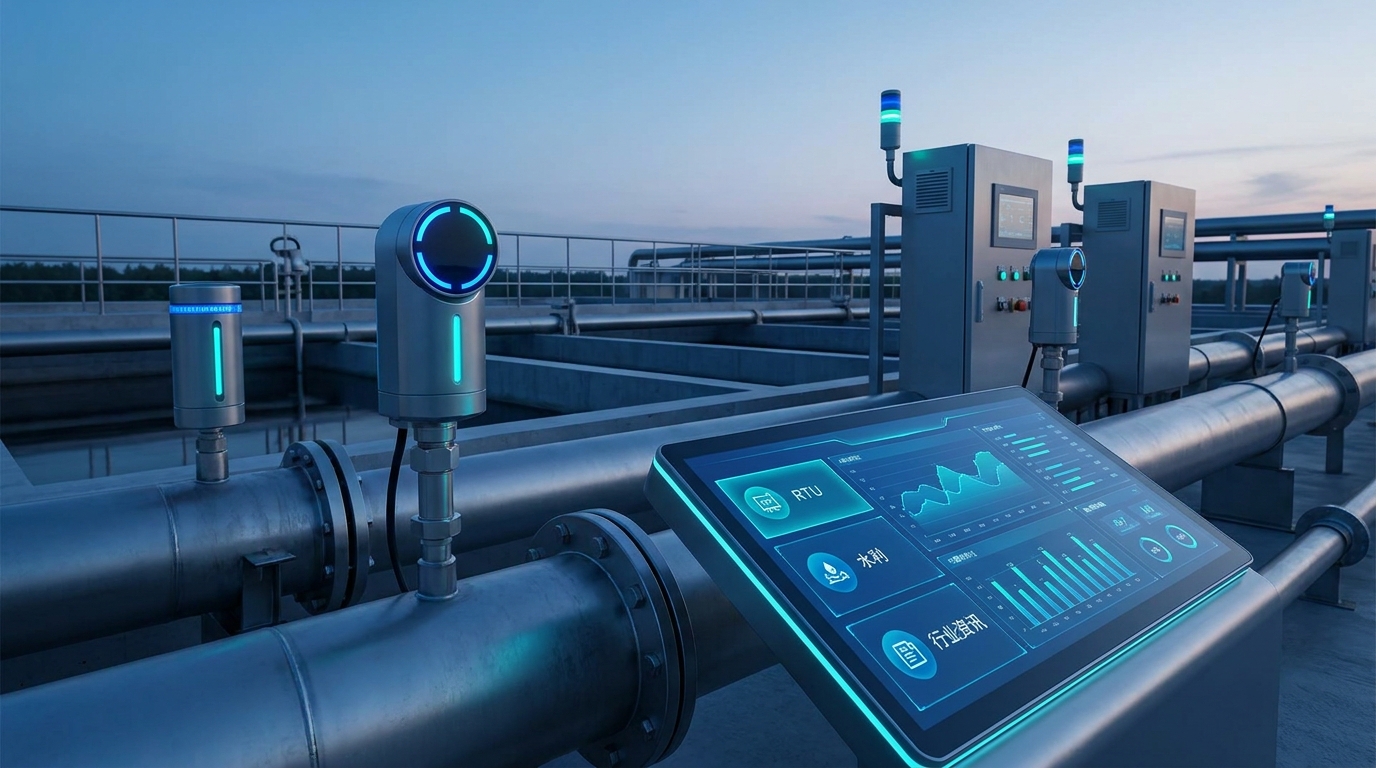
The system's power autonomy is another pillar of extreme reliability. A solar panel and lithium battery array sized for worst-case winter insolation keep the IP68 RTU transmitting data via 4G/NB-IoT every 15 minutes, even during week-long blizzards. With around 58% of new sensor products now featuring IoT integration, according to the hydrostatic sensor market analysis, the ability to push real-time data to cloud SCADA platforms is the new baseline.
Ecolor's RTU family supports native SL651-2014 hydrological protocol, Modbus, and MQTT, ensuring seamless data injection into water authority systems without additional protocol converters.
Case in Point: Urban Flood Waterlogging Monitoring with Non-Contact Radar Sensors
In a city prone to sudden rainstorm flooding, traditional submerged pressure level sensors are frequently buried in silt or fouled by oil and garbage within weeks. Ecolor's non-contact radar flowmeter, suspended from a manhole cover by a quick-mount pole, measures velocity, level, and captures a time-lapse image during the flood peak—all while the electronics stay completely dry above the water line.
The camera's snapshot provides visual verification so utility managers can distinguish between an actual blockage and a sensor anomaly. No confined space entry, no regular cleaning. This dramatically lowers OPEX and safety risk.
Ecolor IP68 RTU – Solar-Powered Remote Terminal Unit for Unattended Stations
Full IP68 cast aluminum enclosure with Gore vent. Operating temperature -40°C to +85°C. Redundant solar charging with MPPT controller, anti-lightning design.
Supports SL651, Modbus, MQTT, and TCP/IP. Built-in IO for rain gauge, water quality sensors, and radar. Local 16 GB storage for data logger backup.
Made for unattended mountain hydrology stations, irrigation canal gates, and coastal stormwater outfalls.
Material Lessons from Unlikely Places: From Bathroom Fixtures to Military-Grade IP68 Sensors
Even residential vanity lighting sold at retailers like The Home Depot must withstand high bathroom humidity to prevent premature rust and electrical failure—an everyday reminder that moisture resilience is a universal design requirement. What differs in industrial water monitoring is the intensity: months of continuous immersion, acidic mine drainage, or salt-laden marine air.
Ecolor leverages material science that turns these lessons into military-grade field reliability. Titanium alloy sensor housings, hydrophobic vent membranes, and opto-isolated communication ports mirror the trajectory seen across 42% of the hydrostatic sensor industry, while surpassing commodity solutions with extreme-temperature rated radar transceivers.
"The only non-contact, motorized-angle radar flowmeter that can be installed in a manhole without anyone climbing down—that's the breakthrough that rewrites safety protocols for urban drainage networks."
A Future-Proof Monitoring Investment: Integrated IP68 Radar and Multi-Parameter RTU Solutions
For project managers evaluating total cost of ownership, the equation shifts when a single IP68 radar unit replaces three discrete sensors (level, velocity, camera) and eliminates confined-space entry permits for maintenance. Add external water quality sensors, and the same RTU becomes a multi-parameter station for ammonia nitrogen, dissolved oxygen, or turbidity—all powered by the same solar array.
Ecolor's integrated "flow + water quality" ecosystem brings single-vendor accountability from sensor edge to cloud data lake, with the slogan that says it all.
See What You Measure: Deploy Reliable Extreme Environment Water Monitoring Systems
As climate volatility intensifies, water utilities and environmental agencies need monitoring assets that won't quit when the storm hits. IP68 radar flowmeters and solar-powered RTUs from Ecolor Technology deliver that resilience—from the salt spray chamber to the flooded manhole.
Explore how your next extreme environment station can be built on a foundation of non-contact measurement and corrosion-proof intelligence at www.cssoc.com or reach out to sales@cssoc.com to schedule a remote demo.
Recommended Products
Ecolor Technology provides professional instruments for smart water, environmental monitoring & industrial automation: