Introduction: Low-Carbon Parks Move from Policy Compliance to Systemic Energy-Efficiency Competition
Against the backdrop of China’s dual-carbon goals and the advancement of new-type industrialization, industrial parks are becoming concentrated carriers of industrial, transportation, and building energy use. Public industry data shows that industrial energy consumption has long accounted for more than 60% of total societal energy use, while users in manufacturing, electronic information, food processing, cold-chain logistics, and data centers are mostly located within industrial parks. Low-carbon parks are therefore no longer merely a green investment-attraction label, but a business variable shaped jointly by electricity costs, carbon allowances, supply-chain carbon footprints, and ESG disclosure.
In the past few years, low-carbon park projects often began with single-point engineering works such as rooftop photovoltaics, LED lighting, and variable-frequency-drive retrofits. As electricity tariff mechanisms, carbon-emissions accounting, and green trade rules evolve, owners are paying attention to more systemic energy efficiency: whether utility and auxiliary equipment operate at low load for long periods, whether compressed-air pipe networks contain hidden leakage, whether steam condensate is wasted, whether photovoltaic and energy-storage revenues can cover investment, and whether carbon data can support product exports.
In this trend, energy-saving retrofits, energy performance contracting, and energy-efficiency diagnosis constitute three key pillars. Energy-efficiency diagnosis determines whether a project can identify genuine energy-saving potential; energy-saving retrofits determine whether that potential can be implemented; and energy performance contracting determines whether a project can obtain long-term returns without significantly increasing capital expenditure. The combination of the three shifts low-carbon parks from “engineering procurement” toward “continuous operation.”
News editors at Ecolor Technology observe that competition among low-carbon parks is shifting from “who has photovoltaics” to “who can organize energy, carbon, data, and equipment assets.” In the future, a park’s energy system will not only be energy-supply infrastructure, but will also become an entry point for corporate carbon management, electricity demand response, and green supply-chain collaboration.
Market Trends: Demand Stratification Pushes Low-Carbon Parks into a Refined Stage
From a market-demand perspective, low-carbon park customers can be divided into three categories: first, manufacturing parks constrained by energy consumption, carbon emissions, and environmental regulations; second, food, cold-chain, and data-center parks with a high share of electricity costs and complex utility systems; and third, local park platforms that need green investment attraction and brand endorsement. Different customers assign different priorities to energy-saving retrofits, but they share a common expectation: projects must be measurable, auditable, financeable, and replicable.
Industry practice shows that park energy-use structures have clear commonalities: utility and auxiliary systems such as central air conditioning, air compressors, pumps, fans, lighting, and power distribution typically account for 30% to 50% of park electricity use, and this share may be even higher in electronics, food, and cold-chain scenarios. By comparison, process equipment is more difficult to control directly, so utility and auxiliary systems often become the preferred entry point for energy-saving retrofits and energy performance contracting.
From a project-type perspective, the market is shifting from equipment replacement to system optimization. Early projects focused on replacing high-efficiency motors, luminaires, or air compressors, while mature projects focus on chilled-water plant group control, compressed-air network balancing, steam-trap repair, waste-heat recovery, distribution power-factor optimization, rooftop photovoltaic consumption, and energy-storage peak shaving. The energy-saving rate of a single piece of equipment can reach 10% to 25%, but system-level optimization depends more heavily on operating strategies and data closed loops.
Investment models are also changing. Park owners are increasingly inclined to convert energy-saving retrofits into operating expenditure rather than one-off capital expenditure. Energy performance contracting, energy cost trusteeship, equipment leasing, and integrated energy services are therefore receiving greater attention. For small and medium-sized enterprise parks, this model reduces technology-selection and operation-and-maintenance risks, and makes energy-saving returns more acceptable to finance departments.
Policy Impact: Carbon-Emission Constraints and Green Electricity Mechanisms Reshape Park Cost Structures
At the policy level, the dual-carbon goals provide a long-term direction for low-carbon parks. According to relevant targets in the 14th Five-Year Plan, energy consumption per unit of GDP and carbon-dioxide emissions per unit of GDP are to decrease by about 13.5% and 18%, respectively; in recent years, Government Work Reports have also set a reduction of about 3% in energy consumption per unit of GDP as an important binding indicator. As units of industrial agglomeration, parks have become an important lever for local implementation of energy-saving and carbon-reduction targets.
A deeper change is that dual control of energy consumption is gradually shifting toward dual control of carbon emissions. Mechanisms such as project carbon assessment, corporate carbon management, local carbon performance evaluation, and product carbon-footprint accounting are becoming increasingly complete. This means parks must not only control the total volume and intensity of energy consumption, but also pay attention to energy mix, emission factors, and Scope 1 and Scope 2 carbon data. Energy-efficiency diagnosis therefore extends from an energy-saving tool into the foundation of carbon accounting.
Green electricity and carbon-market policies are also changing park cost structures. The expansion of green-certificate issuance and green-electricity trading enables parks to reduce indirect emissions by purchasing green electricity, building their own photovoltaic systems, and participating in renewable-energy consumption responsibility weights. The national carbon market is gradually bringing industries such as steel, cement, and aluminum smelting under management, making carbon-allowance costs for high-energy-consuming enterprises within parks more directly influential on energy-saving retrofit investment decisions.
For export-oriented parks, external rules such as the European Union Carbon Border Adjustment Mechanism will drive verification of supply-chain carbon footprints. In the future, the value of low-carbon parks will not be limited to compliance; it will also include helping tenant enterprises obtain green orders, reduce carbon costs, and improve financing ratings. The overlap of policy, market, and international trade rules is transforming energy-saving retrofits and energy performance contracting from optional projects into park operating infrastructure.
Technical Directions: Energy-Efficiency Diagnosis, Energy-Saving Retrofits, and Digital Systems Evolve in Synergy
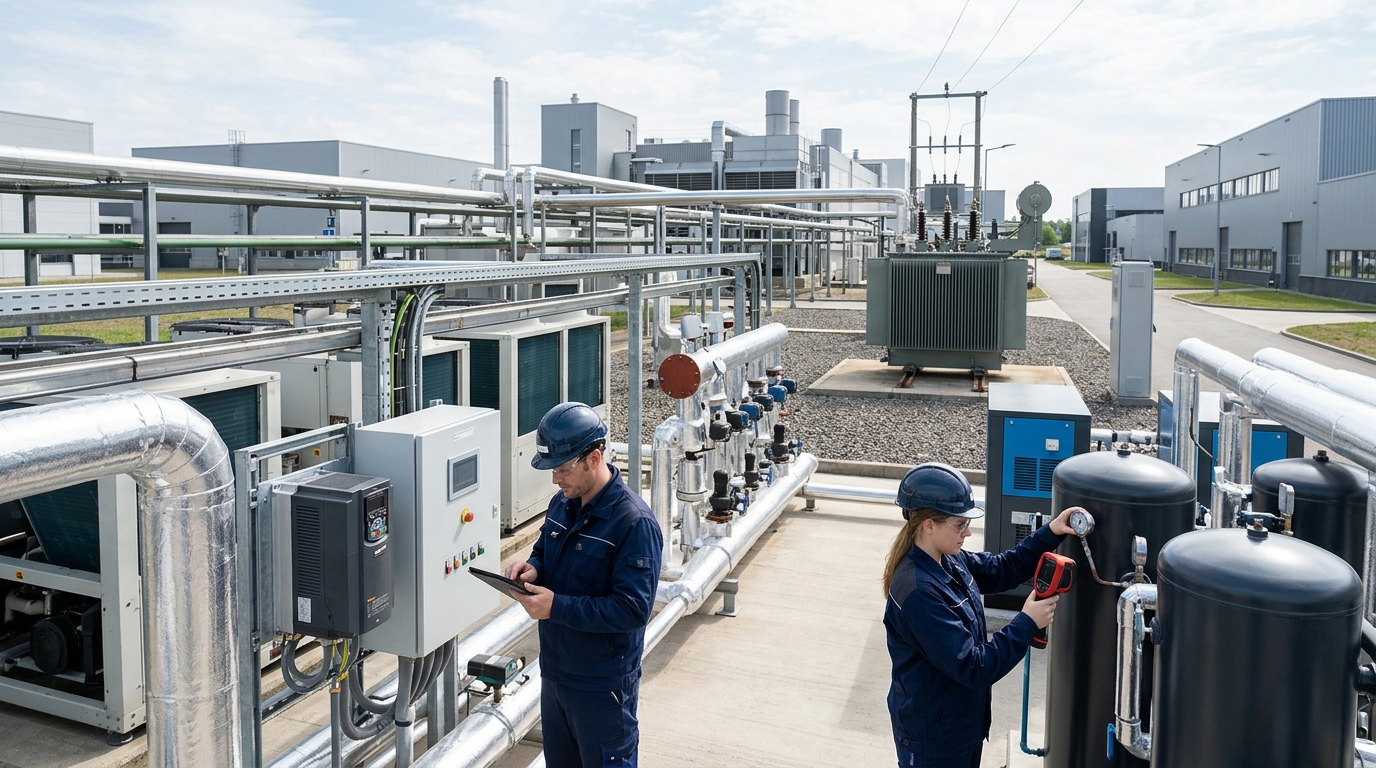
In terms of technical direction, energy-efficiency diagnosis is moving from on-site inspection to online diagnosis. Traditional diagnosis relies on infrared thermography, ultrasonic leak detection, power-quality testing, steam-trap inspection, water-system balancing, and building-envelope inspection. Next-generation diagnosis uses energy-management systems to collect minute-level or 15-minute-level data, identifying inefficient equipment operation, load mismatch, abnormal start-stop behavior, and energy waste, thereby making energy-saving potential more traceable.
In utility and auxiliary system retrofits, key parameters determine project returns. Taking a central air-conditioning chilled-water plant as an example, if the comprehensive energy-efficiency ratio EER or coefficient of performance COP improves from 3.0 to 4.5 or 5.0, the energy-saving rate can typically reach 15% to 30%. If a compressed-air system reduces leakage from more than 20% to 5% to 8%, and combines variable-frequency group control with pipe-network optimization, the annual electricity-saving potential can reach 10% to 25%. Through steam-condensate recovery and steam-trap repair, a steam system can improve boiler thermal efficiency by 3 to 8 percentage points.
Renewable energy and energy storage are becoming important components of park energy systems. Taking an industrial factory building as an example, a 10,000-square-meter rooftop can typically install about 1 MW of photovoltaic modules, generating about 1,000,000 to 1,300,000 kWh per year. Based on grid emission factors, this can reduce carbon-dioxide emissions by about 550 to 780 tonnes. Energy-storage projects focus more on cycle efficiency, capacity degradation, peak-valley price spread, and safe operation and maintenance. A 1 MW / 2 MWh energy-storage system is suitable for peak shaving, valley filling, and demand optimization.
A more forward-looking technical route is integrated source-grid-load-storage. Through energy-management systems, forecasting algorithms, and edge control, parks coordinate photovoltaic output, energy-storage charging and discharging, air-conditioning loads, charging facilities, and production scheduling, transforming the energy system from “passive power supply” to “active regulation.” Under this framework, energy-saving retrofits are not merely about reducing energy consumption, but about improving output efficiency and carbon efficiency per unit of energy.
Energy Performance Contracting: From Energy-Saving Revenue Sharing to Park Energy-Asset Operation
The value of energy performance contracting in low-carbon parks lies in converting energy-saving technologies into economic models that can be shared, verified, and operated over the long term. Common models include energy-savings guarantee, energy-cost trusteeship, and finance lease. Owners can leverage the equipment, capital, and operation-and-maintenance capabilities of professional service providers, converting the capital-expenditure pressure of energy-saving retrofits into revenue sharing during the operating period.
The core of project economics is the baseline and measurement boundary. In industry practice, energy performance contracts typically agree that energy-savings deviation should be controlled within plus or minus 5%. Revenue-sharing ratios are commonly 80:20 or 90:10, and contract terms usually range from 3 to 10 years. For highly standardized systems such as chilled-water plants, air compressors, lighting, and pumps, energy savings are relatively easy to verify; for process-side retrofits, more careful boundary setting is required.
The risks of energy performance contracting lie not only in technology, but also in data, property rights, and operating management. Whether equipment continues to operate at the original load after retrofit, whether production-plan changes reduce energy savings, whether electricity-tariff policy adjustments affect revenue, and how assets are transferred after expiry must all be clearly defined in the contract. Third-party verification, online metering, and digital energy-management systems are becoming important tools for reducing disputes.
In the future, energy performance contracting may overlay revenues from green electricity, carbon assets, and virtual power plants. Park service providers can not only share energy-saving revenues, but also participate in rooftop photovoltaic investment, energy-storage operation, demand-response subsidies, and carbon-emission-reduction management. This integrated energy trusteeship model will upgrade low-carbon parks from single energy-saving projects into long-term energy-asset operation projects.
Case Observations: Energy-Saving Retrofits Are Shifting from Single-Point Engineering to Systemic Closed Loops
Case observations show that energy-saving retrofit paths differ significantly across parks. An electronics manufacturing park in the Yangtze River Delta has a building area of about 120,000 square meters and annual electricity consumption of about 28,000,000 kWh. Energy-efficiency diagnosis found a compressed-air leakage rate of about 22% and a chilled-water plant comprehensive efficiency of about 3.1. The project adopted variable-frequency-drive retrofits, pipe-network optimization, chilled-water plant group control, and lighting upgrades, achieving annual electricity savings of about 2,400,000 kWh, reducing about 1,370 tonnes of carbon-dioxide emissions, and delivering a static payback period of about 5.8 years.
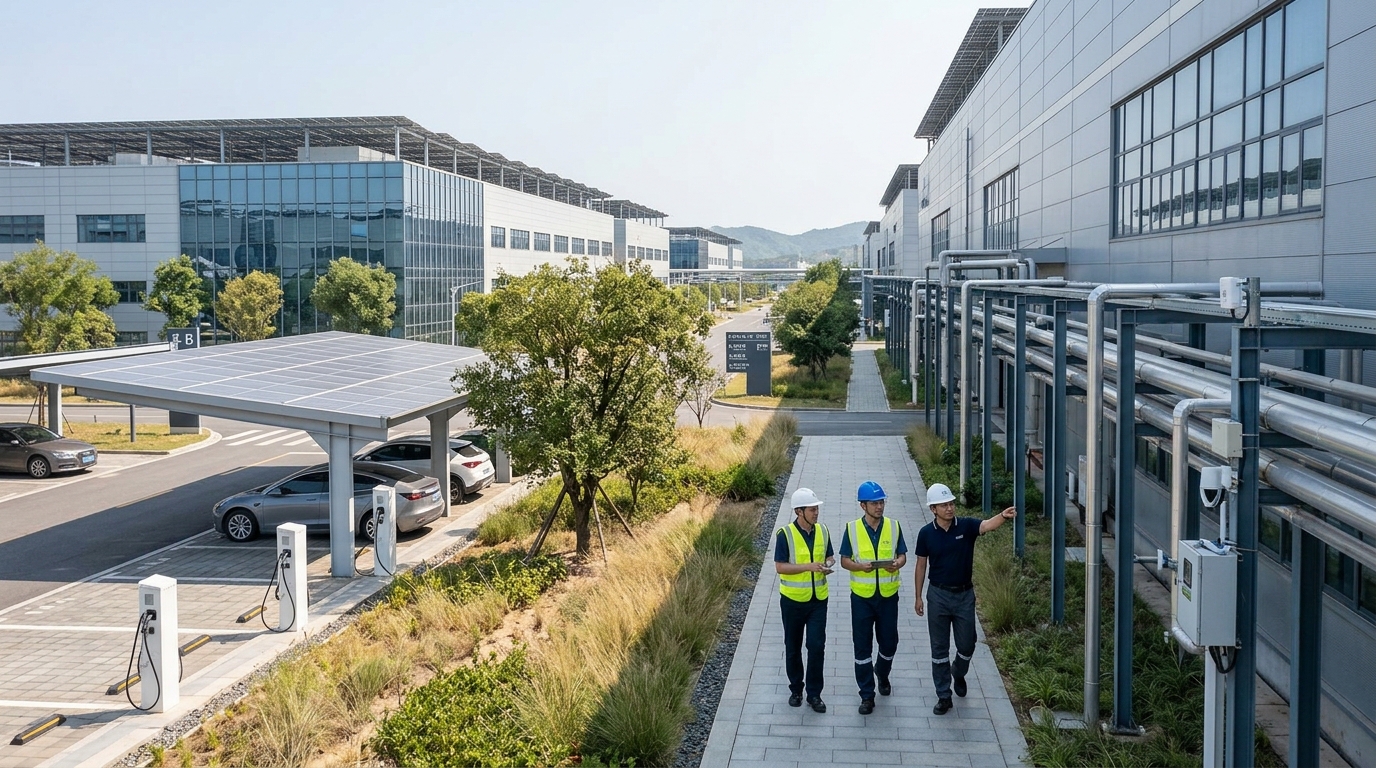
A logistics park in the Pearl River Delta adopted a “photovoltaics + energy storage + charging” combination. The park’s rooftop covers about 20,000 square meters and is equipped with about 2 MW of photovoltaics, generating about 2,200,000 kWh per year. Based on grid emission factors, this reduces about 1,250 tonnes of carbon-dioxide emissions. The park is configured with a 1 MW / 2 MWh energy-storage system, participating in peak shaving, valley filling, and demand optimization under a peak-valley price spread of 0.7 to 1.0 yuan per kWh, while also providing flexible power support for electric forklifts and charging facilities.
A food-processing park in Southwest China focused on steam and refrigeration systems. Diagnosis found that boiler thermal efficiency was about 88% and condensate recovery was insufficient. The project used flue-gas waste-heat recovery, condensate recovery, steam-trap repair, and refrigeration-system optimization to raise boiler thermal efficiency to about 94%, saving about 450 tonnes of standard coal per year, reducing about 1,170 tonnes of carbon-dioxide emissions, and achieving an investment payback period of about 4.2 years. This case shows that energy-saving potential in high-energy process parks often comes from waste within system boundaries.
The common lesson from these cases is: diagnose first, retrofit later; utility systems first, process systems later; measurable systems first, complex systems later. Energy-saving retrofits are not simply replacing equipment with higher-efficiency units, but maintaining long-term performance through operating strategies, data closed loops, and maintenance management. Energy performance contracting is easiest to implement in standardized utility systems, but energy savings, carbon-reduction volumes, and operation-and-maintenance responsibilities must all be incorporated into contract design.
Outlook and Concluding Perspective: Low-Carbon Parks Will Move Toward Integrated Operation of Energy, Carbon, and Data
Looking ahead, the first key variable for low-carbon parks over the next three years is the explicitization of carbon costs. As carbon-emissions statistical accounting, product carbon-footprint requirements, and green supply-chain demands advance, enterprises within parks will more clearly see the carbon cost behind every kWh of electricity, every cubic meter of steam, and every piece of equipment. The returns from energy-saving retrofits will no longer be reflected only in lower electricity bills, but also in carbon allowances, green orders, and financing costs.
The second variable is parks shifting from energy consumers to energy-regulation resources. Distributed photovoltaics, energy storage, adjustable loads, and charging facilities enable parks to meet the conditions for participating in demand response and virtual power plants. In public electricity-market practice, the larger the park’s adjustable load capacity, the higher the response accuracy, and the more credible the metering data, the easier it becomes to obtain additional revenue. Energy-efficiency diagnosis and energy-management systems will become the infrastructure supporting this capability.
The third variable is that data quality determines the energy-saving ceiling. Low-carbon parks will accumulate multidimensional data on equipment operation, energy consumption, carbon emissions, production scheduling, and environmental parameters. Without reliable data collection, boundary definitions, and algorithm models, energy-saving retrofits may remain one-off engineering projects; with data closed loops, parks can continuously identify inefficient equipment, abnormal operating conditions, and deviations in operating strategies.
Concluding perspective: competition among low-carbon parks is not competition in a single technology, but competition in system energy efficiency, carbon efficiency, operating models, and organizational capability. Energy-saving retrofits provide the pathway, energy-efficiency diagnosis provides the entry point, and energy performance contracting provides the mechanism. Truly resilient parks in the future will integrate energy, production, carbon management, and data governance into a single operating map, forming a long-term balance among compliance, cost reduction, and green competitiveness.