Energy-Efficient Procurement and Maintenance for Industrial Parks: How Much Does an Energy Retrofit Cost?
A comprehensive guide to diagnostics, retrofit costs, maintenance variables, and energy performance contracting in modern industrial zones.
I. Industrial Park Energy Efficiency Enters a Phase of Refined Operations
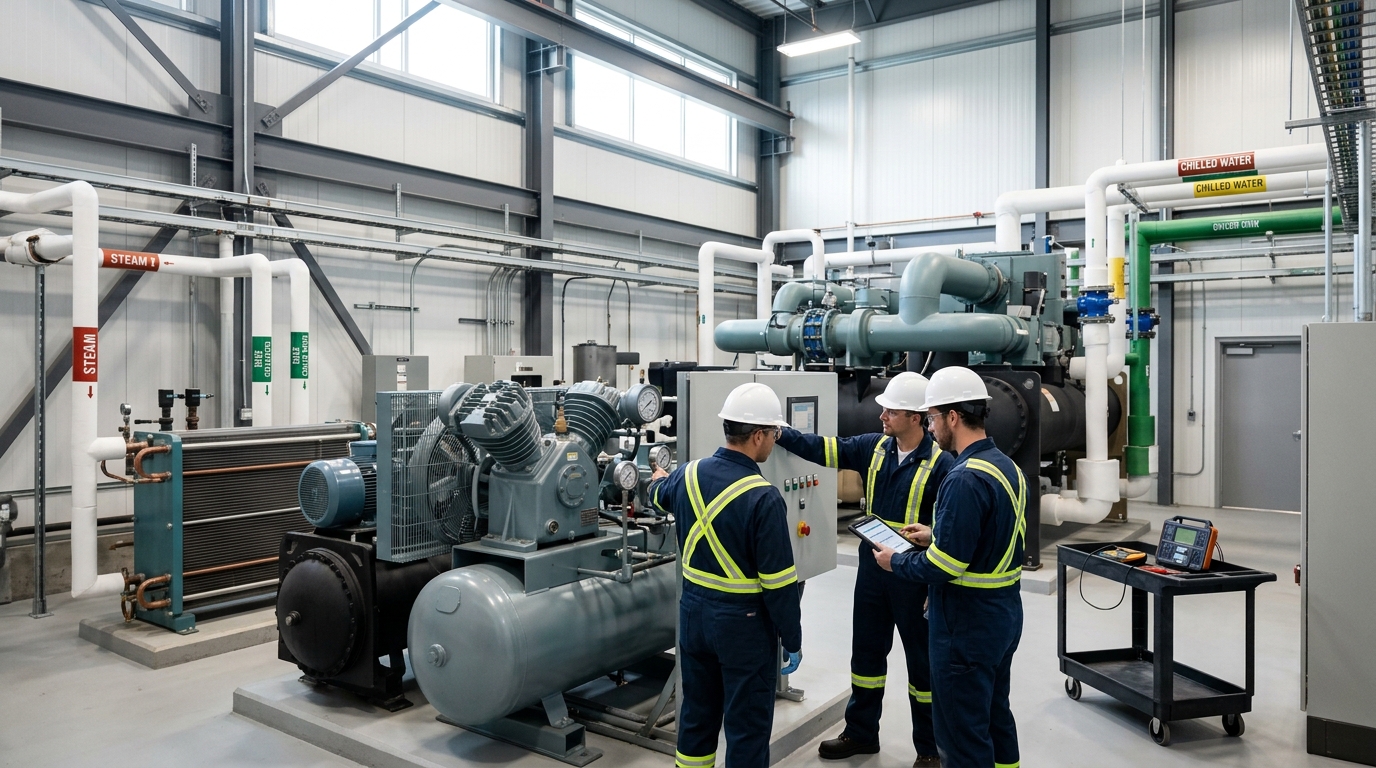
In recent years, the energy-use structure of industrial parks has become increasingly complex. Energy costs typically account for 15% to 30% of operating costs for enterprises in industrial parks. In high-load scenarios such as electronics manufacturing, chemicals, equipment manufacturing, cold-chain logistics, and food processing, electricity costs, steam costs, compressed-air costs, and cooling costs often become key variables affecting profitability.
With the advancement of electricity market-based trading, widening peak-valley price spreads, stricter energy-consumption regulation, and higher corporate carbon-management requirements, energy-efficiency improvement in industrial parks is no longer limited to equipment replacement or lighting retrofitting; it is gradually shifting toward system-level optimization, digital management, and long-term benefit modeling.
Market analysis suggests that over the next three to five years, energy-efficiency demand will shift from single-point savings to coordinated load-side, energy-side, and storage-side optimization.
From a market-supply perspective, services are moving from single-equipment sales to integrated models combining diagnostics, retrofits, Energy Performance Contracting (EPC), and smart O&M. The focus of decision-making has shifted from "whether electricity can be saved" to "payback period, boundary conditions of energy-saving rate, maintenance costs, data verifiability, and long-term stability."
II. Energy-Efficiency Diagnostics Become a Prerequisite
Energy-efficiency diagnostics are foundational activities for retrofits. Their purpose is not simply to list equipment inventories, but to identify waste points, establish baselines, calculate payback periods, and provide verifiable evidence for subsequent projects. Typically, a basic diagnostic cycle takes 2 to 4 weeks, while an in-depth cycle takes 4 to 8 weeks. Complex processes involving multi-circuit metering may extend beyond 10 weeks.
Diagnostic Cost Ranges
- Basic Services: RMB 30,000 - 80,000 (Lighting, HVAC, Compressed Air)
- In-Depth Services: RMB 80,000 - 300,000 (Sub-metering, Load Analysis)
- Complex Modeling: RMB 150,000 - 500,000 (Heat Balance, Carbon Baseline)
Key Requirements
- At least 30 days of continuous operating data
- Metering accuracy Class 0.5S or 1.0 on key circuits
- Complete nameplate parameters and tariff structures
- Defined calculation methodology for EPC disputes
Overall, diagnostic costs generally account for 1% to 3% of subsequent retrofit investment. Deliverables must include an energy-saving potential list, implementable plans, investment estimates, static payback periods, and recommendations for third-party verification.
III. Price Ranges and Investment Characteristics of Mainstream Retrofits
Lighting Systems
Lowest barrier, fastest benefit.
Cost: RMB 50–250 per luminaire; RMB 80–180/m² total.
Returns: 40–70% energy saving; Payback 1.5–3.5 years. Suitable for offices, workshops, and warehouses.
Motors & VFDs
Core investment direction.
Cost: Motors RMB 2k–12k/unit; VFDs RMB 500–2,500/kW.
Returns: 10–30% energy saving; Payback 2–5 years. Best for fans, pumps, and compressors with continuous loads.
Compressed Air
High potential (8–20% of total consumption).
Cost: RMB 500k–2M per system retrofit.
Returns: 15–30% energy saving; Payback 2–4 years. Includes VFD retrofits, leak management, and waste-heat recovery.
Central HVAC
Higher investment intensity.
Cost: RMB 3k–8k per ton refrigeration; Total RMB 1M–8M.
Returns: 10–25% energy saving; Payback 3–6 years. Critical for electronics and pharma where process stability matters more than pure savings.
PV & Storage
Energy-side investments.
Cost: PV RMB 3.2–4.5/W; LFP Storage RMB 1.2–2.0/Wh.
Returns: PV Payback 4–7 years; Storage Payback 3–6 years (with large peak-valley spreads). Smart platforms cost RMB 300k–1.5M initial or annual fees.
IV. Recommendations for Selecting Equipment and Systems
The primary principle is "diagnose first, invest second, verify afterward." Enterprises should not copy benchmark cases blindly but judge based on their own load structure, tariff mechanisms, and operational capabilities.
- Equipment Specifications: Ensure IP55/IP65 protection ratings. Metering devices must be Class 1.0 or better (Class 0.5S for billing). Check COP/IPLV for HVAC and specific power for air systems.
- System Compatibility: Platforms must support Modbus TCP, OPC UA, and MQTT to avoid information silos. Define data tamper-proof mechanisms in contracts.
- Service Capability: Look for 4-hour response for general faults and 8-hour on-site arrival for critical ones. Contracts should specify test methods, baseline correction rules, and warranty periods.
V. Maintenance Costs and Energy-Efficiency Degradation
Long-term returns depend heavily on maintenance. Ignoring degradation rates can erode projected savings.
| System Type | Annual Maint. Cost (% of Invest.) | Key Risks/Degradation Factors |
|---|---|---|
| Lighting | 1% – 3% | Driver failures, illuminance decay, control module issues. |
| Motors/VFDs | 2% – 5% | Bearing lubrication, insulation testing, heat dissipation cleaning. |
| Central HVAC | 3% – 8% | Condenser fouling, pump servicing, cooling tower fill replacement. |
| Compressed Air | 4% – 8% | Leakage rebound (critical), filter clogging, oil separator aging. |
| PV & Storage | 1% – 5% | Module cleaning (PV), battery balancing, thermal management (Storage). |
| Smart Platforms | 10% – 20% | Data security, interface openness, personnel allocation for alarms/reports. |
For EPC projects, owners must reserve budgets for metering calibration and third-party verification, typically RMB 5,000–30,000/year, rising to RMB 50,000–200,000 for large parks.
VI. Applicability Boundaries of Energy Performance Contracting (EPC)
EPC combines investment, accounting, and revenue distribution. Common models include Savings Sharing (15–40% share to owner) and Energy-Cost Management.
When is EPC Suitable?
- Relatively stable load structures
- Complete historical energy data
- Clear metering boundaries
- Controllable process changes
Risks lie in accounting and trust. Savings must be corrected for outdoor wet-bulb temperature (HVAC), air consumption (Compressed Air), and production output (Steam). Without clear methodologies, nominal 20% savings may drop to 8–12% in settlement.
VII. Typical Retrofit Cases: From Diagnostics to Returns
Case 1: Equipment Manufacturing (Yangtze Delta)
Context: 38M kWh/year consumption. High leakage in compressed air (18%).
Investment: RMB 7.2 Million (LED, Air VFD, HVAC Group Control, Platform)
Savings: 16.5% Comprehensive Rate
Payback: ~1.6 Years
Annual Maint: RMB 450,000
Case 2: Electronic Information (South China)
Context: Cleanroom HVAC heavy load. Fixed-speed chillers inefficient at low load.
Investment: RMB 13.5 Million (Chiller Replacement, VFD, Waste Heat)
Savings: 12.4% Comprehensive Rate (3.1M kWh/year)
Payback: ~4.3 Years
EPC Model: 28% sharing ratio, 6-year term
Case 3: Chemical Park (Central China)
Context: Stable steam loads. Poor condensate recovery and direct exhaust heat loss.
Investment: RMB 9.8 Million (Heat Exchangers, Condensate Recovery)
Savings: 9.1% Comprehensive Rate (2,600 tons std coal)
Payback: ~3.8 Years
Verification: Third-party heat balance testing
Case 4: Cold-Chain Logistics
Context: High cooling load, significant peak-valley price spread, ample rooftop.
Investment: RMB 39 Million (2.2MW PV, 5MWh Storage, Refrigeration Ctrl)
Savings: 18% Electricity Expenditure Reduction
Payback: ~5.1 Years
Benefit: Arbitrage + Demand Mgmt + Backup Power
VIII. Outlook: From Single-Point Saving to System Resilience
The future market moves toward integrated generation-grid-load-storage. Enterprises will prioritize energy security, carbon footprint, and demand management alongside simple savings. Diagnostics will become routine tools for annual audits and carbon accounting.
EPC will evolve into integrated energy services, encompassing O&M, carbon asset management, and electricity trading support. Project design must reserve redundancy and digital early-warning capabilities to handle extreme weather and supply chain changes.
Strategic Conclusion
A rational procurement strategy balances initial investment with full life-cycle costs. By combining energy-efficient retrofits, EPC, and smart O&M based on rigorous diagnostics, industrial parks can transform from "passive energy consumers" to "proactive optimizers," achieving a sustainable balance among cost control, carbon management, and production continuity.