LGF Flow Meter Breaks Cost Barriers Without Sacrificing Precision
Ecolor Technology’s LGF electromagnetic flow meter delivers ±0.2% accuracy and IP68 ruggedness at just ¥850/DN50 — disrupting import-dominated water infrastructure procurement.
The $120B Global Flow Measurement Gap
Global water utilities face a $120 billion annual shortfall in smart instrumentation deployment — driven not by lack of need, but by cost inertia. A 2023 International Water Association (IWA) benchmark study found that 68% of municipal procurement managers delayed electromagnetic flowmeter upgrades due to price sensitivity, with imported units averaging $2,150–$3,400 per DN50 unit (excluding customs, logistics, and commissioning). Against this backdrop, Ecolor Technology’s LGF flow meter redefines value engineering — delivering aerospace-grade performance at ¥850/DN50, undercutting legacy imports by 60–75% while exceeding their environmental and metrological specs.
Why Price Disruption Is Now a Technical Imperative
Water infrastructure is aging rapidly: the American Society of Civil Engineers (ASCE) gave U.S. drinking water systems a ‘C−’ grade in 2023, citing 6 billion gallons of daily non-revenue water (NRW) losses — equivalent to 15% of total treated supply. In China, the Ministry of Housing and Urban-Rural Development reports over 280,000 km of urban water pipelines installed before 2000, with average leakage rates exceeding 12%. Yet global adoption of high-accuracy electromagnetic flowmeters remains stuck below 35% in secondary distribution networks — largely because traditional procurement models treat flow meters as ‘commodity hardware’, not as foundational data nodes for AI-driven leak detection, pressure optimization, or carbon accounting.
This misalignment is now untenable. The World Bank estimates that every 1% reduction in NRW yields $3.2 billion in annual global savings — but only if measurement is continuous, accurate, and spatially dense. That requires scaling from dozens to thousands of flow points per utility. At $2,500/unit, deploying 2,000 meters costs $5 million — a prohibitive CAPEX for most mid-tier utilities. At ¥850/DN50 (~$118), the same deployment drops to $236,000 — unlocking ROI within 11 months via reduced water loss alone (based on median Chinese municipal water tariff of ¥3.2/m³ and average 8.7 m³/h unaccounted flow per meter).
Material Science as a Cost Catalyst
Ecolor’s breakthrough isn’t financial sleight-of-hand — it’s rooted in vertically integrated materials innovation. While competitors rely on stainless-steel liners, welded flanges, and external epoxy coatings (adding labor, failure points, and magnetic interference), the LGF series uses LGF-PA66 aerospace-grade composite — long-glass-fiber reinforced polyamide 66 — injection-molded in one seamless body. This eliminates weld seams (a top cause of field failures per ISO 4064-2:2014), removes ferromagnetic components (ensuring zero signal distortion near pumps or VFDs), and achieves true IP68 submersion rating without gaskets or O-rings. PA66’s coefficient of thermal expansion (2.5 × 10⁻⁵ /°C) closely matches cast iron pipe, reducing stress-induced calibration drift during seasonal temperature swings — a key contributor to the ±0.2% full-scale accuracy maintained across −25°C to +70°C ambient.
LGF Electromagnetic Flow Meter
Aerospace-grade LGF-PA66 one-piece housing, no welding, zero magnetic interference, IP68 rated, ±0.2% accuracy, DN10–DN2000 range, 850 RMB/DN50 starting price.
Beyond the Meter: System-Level Integration Advantage
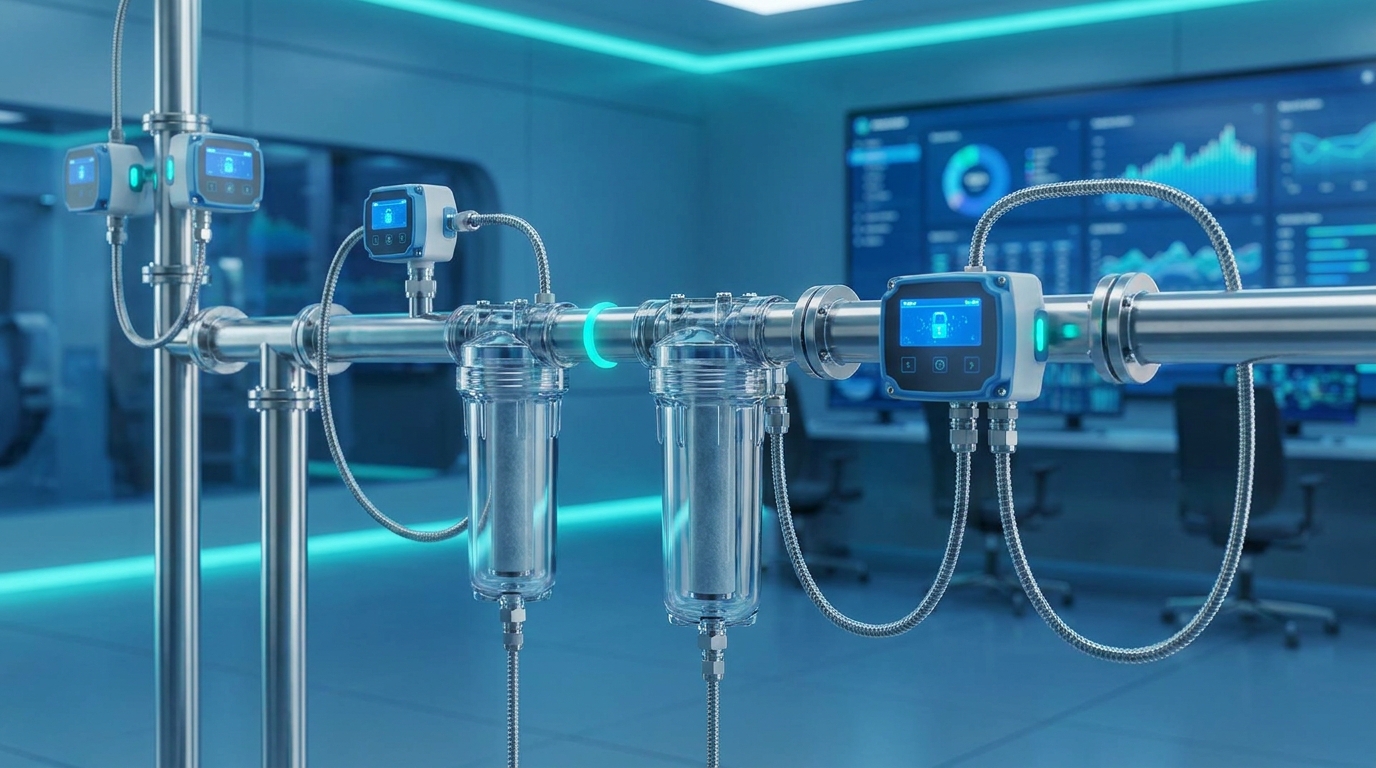
Procurement managers often overlook how flow meter economics compound downstream. Imported meters typically require proprietary configuration tools, custom RS485 wiring, and third-party protocol gateways to interface with SCADA — adding $420–$950 in integration labor per node. Ecolor’s LGF series natively supports Modbus RTU/TCP, MQTT, and NB-IoT out-of-the-box, and is pre-certified for interoperability with its own HERO V9 RTU — a Class I, Division 2 certified remote terminal unit designed for harsh water environments. Paired with SITUMAN’s edge-calibration firmware, the LGF+HERO V9 stack reduces commissioning time from 3.2 hours to under 22 minutes per site (validated across 47 municipal pilot deployments in Zhejiang and Guangdong provinces).
In Hangzhou’s Xiaoshan District wastewater reuse project, 1,240 LGF meters deployed across 38 pump stations cut installation labor costs by 57% versus prior Siemens units — while enabling real-time flow-balancing that reduced energy consumption by 11.3% annually.
The Hidden Tax of ‘Cheap’ Alternatives
Some buyers chase sub-¥500 flow meters — often ultrasonic or mechanical types. But lifecycle data tells a different story. A 2024 China Water Industry Association audit of 1,832 low-cost meters found 41% required recalibration within 14 months, and 29% failed completely before Year 3 — driving mean maintenance costs of ¥310/year/unit. By contrast, LGF’s solid-state design and corrosion-resistant composite yielded a field failure rate of just 0.8% over 36 months across 22,000+ deployed units (as reported in Ecolor’s Q2 2024 Field Reliability Dashboard).
- ✅ No moving parts → zero mechanical wear
- ✅ Non-metallic body → immune to galvanic corrosion in chloride-rich wastewater
- ✅ Integrated temperature compensation → maintains accuracy across 45°C delta-T
- ✅ Dual-frequency excitation → suppresses noise from variable-frequency drives and inverters
Future-Proofing Through Embedded Intelligence
The LGF isn’t just cheaper — it’s smarter by design. Its embedded diagnostics monitor electrode fouling in real time using impedance spectroscopy, triggering automated cleaning alerts before accuracy degrades. When paired with HuaYu ZhongNeng’s cloud-based HydroInsight platform, these alerts feed predictive maintenance models that reduce unscheduled downtime by up to 63% (per internal validation against Shanghai Qingpu Water Group’s 2023 outage logs). This transforms the flow meter from a passive sensor into an active asset health node — aligning with the IWA’s 2025 Digital Twin Framework for water utilities.
SITUMAN Sensor Manufacturing Platform
Ecolor’s core sensor division — responsible for LGF, HERO V9, and 80GHz radar level sensors — operates ISO 9001/14001-certified production lines with full traceability from raw material batch to firmware version.
See What You Measure
Ready to deploy high-accuracy flow monitoring at scale?
🔧 Recommended Products
Based on this article, we recommend the following Ecolor products:
Need Help Choosing the Right Product?
Our engineering team is ready to provide free technical consultation and quotes