Securing the Edge: RTU & Radar Level Sensors Redefine Water IoT Resilience
Hardened remote telemetry units (RTUs) and 80GHz visual fusion radar level sensors are transforming water infrastructure into a secure, self-validating, satellite-resilient IoT ecosystem — where data integrity begins at the sensor, not the server.
From Reactive Monitoring to Resilient Water IoT
The convergence of hardened telemetry, visual verification, and satellite-backed connectivity is shifting global water infrastructure from reactive monitoring to resilient, data-driven operations. This evolution isn’t incremental—it’s architectural.
As utilities manage increasingly distributed assets—from remote reservoirs to underground urban drainage wells—legacy SCADA systems falter under modern cyber and environmental pressures. True resilience now demands security, continuity, and contextual validation built directly into the edge device.
The Cybersecurity Imperative in Distributed Water Networks
Operational technology (OT) in water systems is no longer air-gapped. With cloud integration, real-time optimization, and regulatory automation, IT/OT convergence has expanded the attack surface dramatically—especially for municipal water and wastewater infrastructure.
Ransomware, supply chain compromises, and protocol-level exploits now target local government systems. Perimeter-based firewalls alone are insufficient. The industry is pivoting to zero-trust telemetry models—where every data point is authenticated, encrypted, and validated before entering the network.
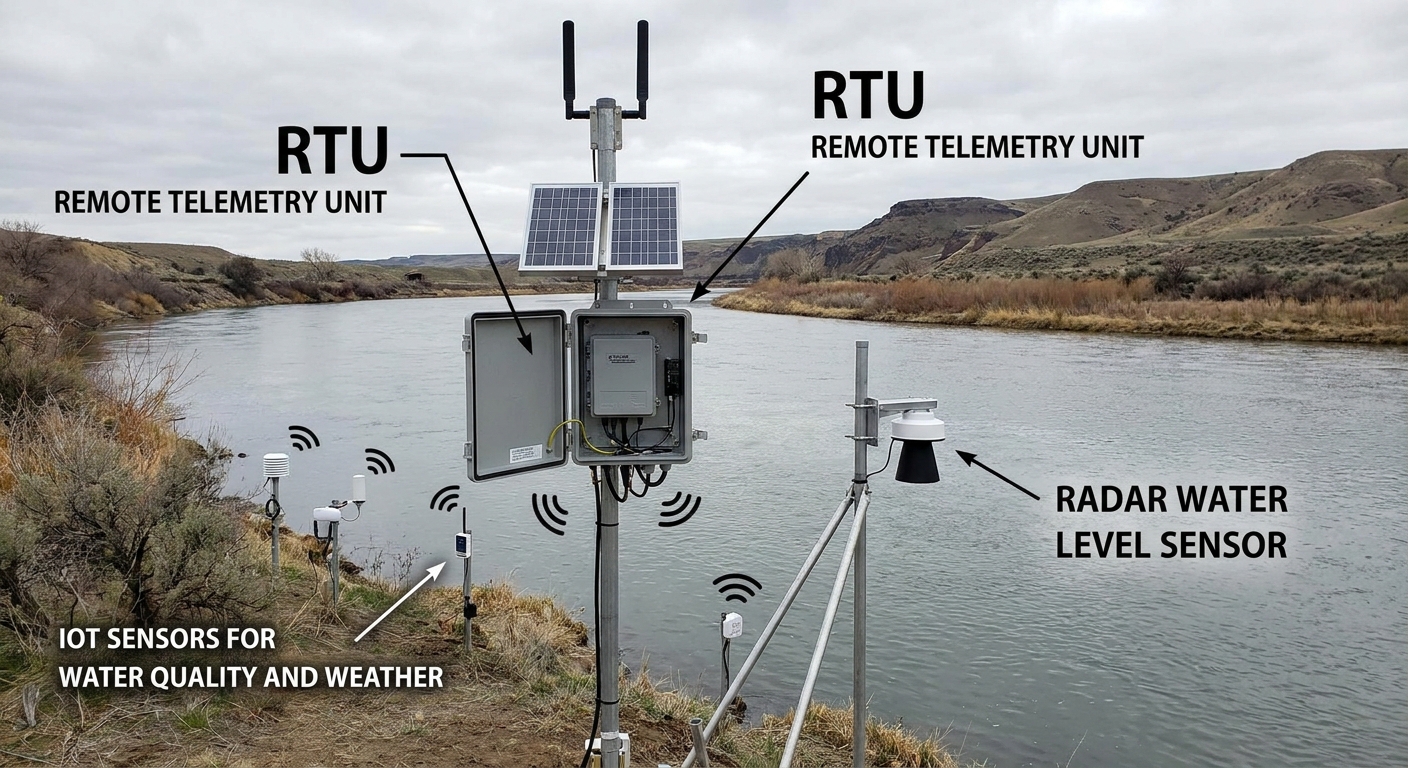
That means embedding security at the source: hardened RTUs that enforce cryptographic handshakes, buffer data during outages, and comply natively with national hydrological standards like SL651—not just as an add-on, but by design.
HERO V9 RTU
- Native SL651 protocol compliance
- Edge-level AES-256 encryption
- Multi-network failover: 4G/5G + LoRaWAN + LEO satellite
- IP68-rated, -40°C to +70°C operating range
- Onboard data caching & offline event logging
Hardening the Edge: Secure, Protocol-Compliant Telemetry
The HERO V9 RTU exemplifies next-generation edge resilience. Engineered for harsh outdoor deployment, it maintains data integrity across cellular-to-satellite handoffs—critical when fiber is cut or towers overload during floods or wildfires.
Unlike legacy gateways that forward raw telemetry, the HERO V9 validates sensor inputs, enforces standardized reporting formats, and buffers data locally during comms blackouts—ensuring no operational blind spots, even under duress.
Bridging Connectivity Gaps with Satellite-Backed Telemetry
Terrestrial networks fail precisely where water infrastructure is most vulnerable: mountainous watersheds, rural aquifer recharge zones, and peri-urban drainage basins. When cellular drops during extreme weather, flood forecasting collapses—and so does regulatory accountability.
Satellite IoT is no longer a luxury backup—it’s foundational. Modern RTUs must support seamless, lossless handover between 4G/5G, LoRaWAN, and low-earth-orbit (LEO) satellite modems—while sustaining multi-year solar-powered operation in off-grid locations.
Signal Resilience
Maintains uptime >99.9% across terrain-challenged sites
Power Efficiency
Ultra-low-power sleep modes enable 5+ year solar battery life
Regulatory Continuity
Guarantees auditable, timestamped datasets for EPA/NWRP compliance
Visual Verification: Ending Blind Trust in Remote Sensing
A number without context is a liability—not intelligence. Traditional ultrasonic or pressure-based level sensors report stage height, but cannot distinguish between true water rise and debris accumulation, biofouling, or hydraulic surges.
The shift to multi-modal sensing fuses high-frequency radar measurement with synchronized optical imaging—creating self-validating nodes that eliminate ambiguity, accelerate incident response, and slash false alarms by up to 70% in stormwater applications.
Visual Fusion Radar Level Meter & Visual Doppler Flow Radar
- 80GHz millimeter-wave radar precision
- Real-time HD optical verification (day/night)
- Non-contact velocity profiling for open channels
- Self-calibrating geometry adaptation
- Timestamped video evidence for regulatory audits
These globally unique instruments combine Doppler radar with synchronized camera feeds—delivering both quantitative flow metrics and qualitative visual proof. In urban drainage wells or ecological release channels, this dual-layer insight detects obstructions, verifies weir conditions, and documents compliance events with forensic-grade traceability.
Because they require zero physical contact, maintenance cycles shrink, calibration drift vanishes, and long-term TCO drops—without sacrificing billing-grade accuracy or audit readiness.
Data-Driven Procurement: Building Resilient Monitoring Stacks
Today’s procurement decisions go beyond unit cost. Engineers evaluate full lifecycle resilience: cybersecurity posture, environmental durability, calibration stability, and native protocol alignment. The goal? A unified stack where electromagnetic flowmeters, radar sensors, and hardened RTUs interoperate seamlessly—enabling predictive analytics, automated reporting, and capital asset optimization.
LGF Electromagnetic Flowmeter
±0.2% accuracy in raw water & industrial effluent; no moving parts; immune to suspended solids & conductivity shifts
Doppler Radar Flow Systems
Non-contact velocity profiling in open channels; adapts dynamically to changing cross-sections and turbulence
Four Pillars of Resilient Water IoT
- ✅ Edge-hardened RTUs with native SL651 compliance—eliminating unverified telemetry injection at the source.
- ✅ Multi-modal visual verification—cross-referencing radar-derived measurements with real-time optical context to reduce false positives and accelerate diagnostics.
- ✅ Satellite-backed communication fallbacks—guaranteeing data continuity during terrestrial outages caused by extreme weather or infrastructure damage.
- ✅ ±0.2% accuracy electromagnetic sensors for closed-pipeline networks—ensuring billing-grade precision and regulatory defensibility.
See What You Measure
Secure your water IoT network with resilient, visually verified telemetry—engineered for regulatory rigor, environmental extremes, and cyber resilience.
Visit Website