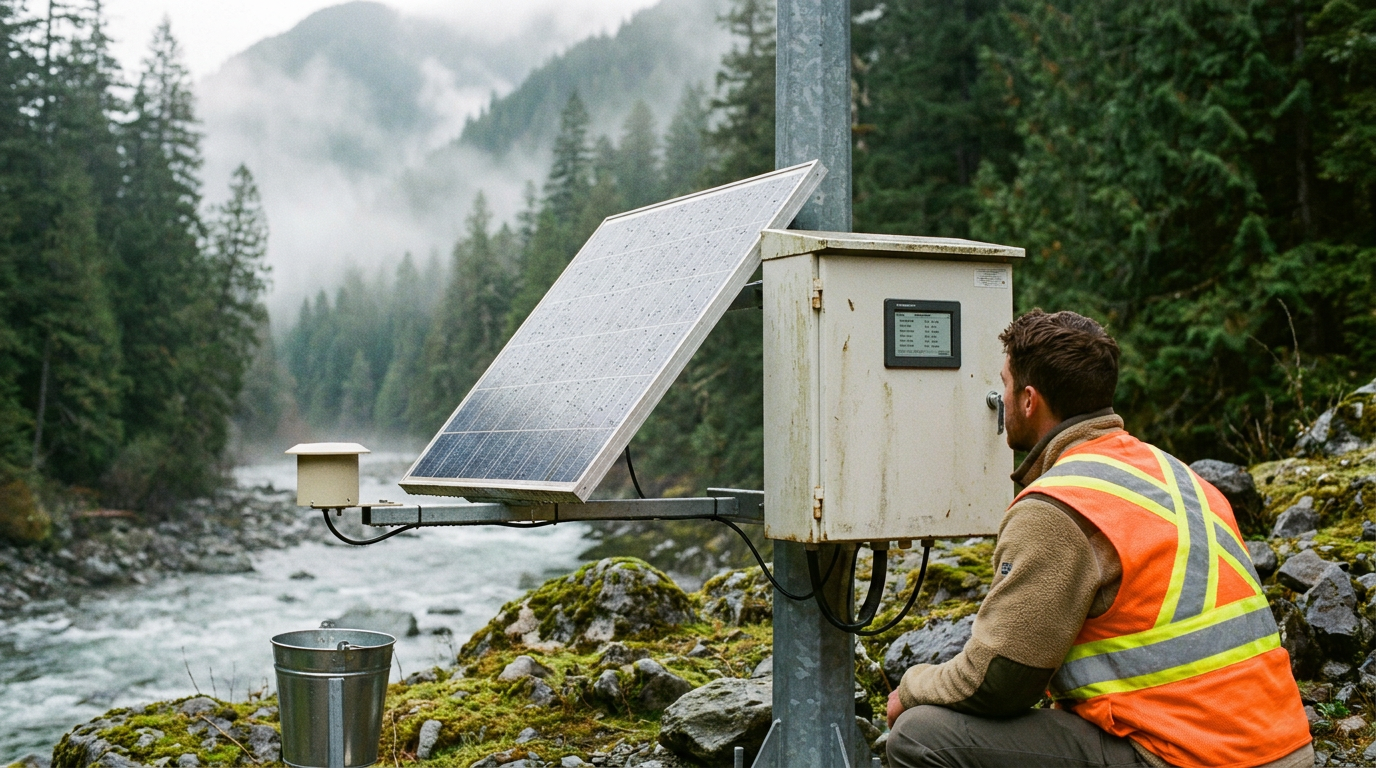
Application Solution of HERO V9 Micro-Power RTU in Solar-Powered Unmanned Hydrological Stations in Remote Mountainous Areas
To address the challenges of inaccessible utility power, unstable power supply, communication blind zones, and equipment survival under extreme conditions at unmanned hydrological stations in remote mountainous areas, a combination of the HERO V9 micro-power telemetry terminal (sleep current <50μA, 4G full-network compatibility, IP68) and a solar–Li-SOCl2 battery hybrid power supply system is adopted. This enables all-weather automatic acquisition and reporting of water level, rainfall, flow, and other parameters, with automatic switching between routine scheduled acquisition and high-frequency acquisition during abnormal events, ensuring long-term stable operation of unmanned hydrological stations during prolonged rainy days and low winter temperatures.
Overview
Summary
To address the challenges of inaccessible utility power, unstable power supply, communication blind zones, and equipment survival under extreme conditions at unmanned hydrological stations in remote mountainous areas, a combination of the HERO V9 micro-power telemetry terminal (sleep current <50μA, 4G full-network compatibility, IP68) and a solar–Li-SOCl2 battery hybrid power supply system is adopted. This enables all-weather automatic acquisition and reporting of water level, rainfall, flow, and other parameters, with automatic switching between routine scheduled acquisition and high-frequency acquisition during abnormal events, ensuring long-term stable operation of unmanned hydrological stations during prolonged rainy days and low winter temperatures.
Key Advantages
Challenges
- Sites are far from the utility grid; pure solar power supply fails during prolonged overcast, rainy, and snowy periods, while pure battery power cannot sustain the long-term energy consumption of high-frequency data collection and 4G reporting.
- Public network signals in mountainous areas are weak and unstable, preventing real-time reporting of collected data and causing delays in flood condition assessment.
- Low winter temperatures drastically reduce the capacity of conventional batteries, while humidity-induced condensation and lightning strikes lead to high equipment failure rates.
- Fixed data collection schedules cannot balance power saving with the need for intensified collection during flood seasons, resulting in missing data during flood events.
- Parameter adjustments and fault diagnosis rely on manual site visits, making single maintenance trips to remote sites costly and slow to respond.
Results
- With dual power supply combining solar energy and lithium thionyl chloride batteries, the site's continuous power supply reliability exceeds 99.9%, ensuring core operations remain uninterrupted for 30 consecutive overcast or rainy days.
- A sleep current of less than 50 μA and tiered load management reduce the average power consumption of the entire station by over 60%, extending the battery replacement cycle to more than 4 years.
- Automatic triggering of abnormal high-frequency collection and sudden-change alarms shortens the delay for flash flood warning data from hours to minutes.
- The automatic data collection and reporting rate reaches ≥99%, with over 50,000 sets of historical data stored locally in frozen format, and automatic retransmission upon reconnection ensures zero data loss.
- Remote parameter setting, time synchronization, and OTA upgrades cover over 90% of maintenance operations, reducing manual site visits from once a month to once or twice a year.
Solution Details
1. Four Major Challenges for Unattended Hydrological Stations in Remote Mountainous Areas
Remote mountainous hydrological monitoring serves as the peripheral nerves of the national hydrological station network and mountain flood early warning systems. A large number of planned stations are located in high mountain valleys, forested areas, and river headwaters where grid power is unavailable, and some stations cannot even guarantee stable sunlight; manual inspection is costly and infrequent, and flash floods during flood season often lack first-hand data. The traditional manned hydrological station model is unsustainable in remote mountainous areas, making unattended retrofitting an inevitable choice—and the first hurdle in unattended conversion is the power supply system: equipment must operate continuously for years without grid power, surviving prolonged overcast and rainy periods, snow cover, and low-temperature capacity degradation.
Power Supply Island: Stations are far from the grid; dedicated line construction costs tens of thousands of yuan per kilometer, and permitting for construction in forested areas is difficult. Pure battery power cannot sustain the energy consumption of high-frequency acquisition and 4G reporting, while pure solar power is constrained by prolonged overcast/rainy periods and winter snow cover—either single energy source carries the risk of supply interruption.
Communication Blind Zones: Mountainous terrain blocks signals, leaving some stations with weak 2G/4G coverage and intermittent public network connectivity; if collected data cannot be reliably retransmitted, flood condition assessment loses real-time capability.
Extreme Environment Survival: At high-altitude stations, winter temperatures below -20°C drastically reduce the capacity of ordinary lead-acid and lithium batteries; humid canyon environments cause severe condensation, and frequent lightning strikes make standard enclosures and connectors inadequate for long-term protection.
Inaccessible Maintenance: Stations are scattered and roads are treacherous, with a single site visit often taking a full day; if parameter adjustments, fault diagnosis, and firmware upgrades must be performed on-site, maintenance costs will consume all the benefits of unattended conversion.
2. Hybrid Power Supply System Architecture Design for Solar-Powered Hydrological RTU
Solar Harvesting Unit: Solar panel wattage is calculated based on station solar resource availability and load power consumption (typical configuration: 30–100W monocrystalline panels), installed at a self-cleaning tilt angle, paired with an MPPT charge controller to improve charging efficiency under low light and low temperature conditions.
Dual-Layer Energy Storage: Primary storage uses lithium iron phosphate or gel battery packs cyclically charged by solar, handling daily power supply; the HERO V9's standard 114Ah@3.6VDC primary Li-SOCl2 battery pack serves as the backup power source, maintaining core acquisition and reporting functions during prolonged overcast/rainy periods, snow cover, or primary storage failure. Under a working schedule of acquisition every 15 minutes and reporting every 2 hours, in pure battery status theoretical endurance: no less than 4 years.
Load Tiered Management: HERO V9 supports automatic switching of operating regimes based on power supply status — when sunlight is sufficient, it increases acquisition and reporting frequency; when battery is low, it automatically reduces frequency to preserve power; when voltage recovers, it automatically restores. It also freezes and stores no fewer than 50,000 historical data records, ensuring no data loss during deferred transmission.
Lightning Protection & Grounding: The solar panel bracket, enclosure, and sensors are all connected to the site grounding grid. Secondary lightning protection modules are configured at both power and signal entry points to address the high incidence of lightning strikes in mountainous areas.
3. HERO V9 Core Measurement & Control Capabilities for Unattended Stations
Dual-Mode Acquisition: Automatic switching between routine timed acquisition (period configurable down to the second) and abnormal high-frequency acquisition. When water level/rainfall exceed thresholds, intensive acquisition and immediate reporting are triggered instantly, securing a minute-level time window for flash flood early warning.
Ultra-Low Power Design: Average sleep current is less than 50 μA. Under the dual-core architecture, the MSP430 handles low-power standby monitoring while the Cortex-M3 manages acquisition and communication burst tasks, with energy allocation refined down to every single wake-up event.
Reliable Communication: The industrial-grade 4G full-network module adapts automatically to the network standards of all three major carriers. When the signal is weak, data is cached locally and automatically retransmitted once the connection recovers. The self-developed lightweight IP communication protocol features minimal memory footprint and fast reconnection, making it well suited to unstable public networks in mountainous areas.
Remote O&M: An independent Bluetooth 5.0 module supports on-site parameter configuration via APP. The remote platform supports parameter delivery, clock calibration (5PPM high-precision clock with automatic zero-point time synchronization), and firmware OTA upgrades — the vast majority of O&M actions require no site visit.
Visual Status: The e-ink screen displays signal strength, battery voltage, and acquisition/reporting cycles in real time for at-a-glance inspection during patrols. Magnetic switch buttons enable operation without opening the enclosure.
4. Typical Application Scenarios for Micro-Power RTU in Hydrological Monitoring
Unmanned Retrofit of National Basic Hydrological Stations: Manual comparative measurement and calibration are retained, while routine water level, rainfall, and flow data are automatically acquired and reported, with data directly connected to national/provincial hydrological data platforms.
Flash Flood Disaster Monitoring & Early Warning: Rainfall + water level combined stations are deployed at flash flood gully outlets and small watershed outlets. Abrupt-change alarms are sent directly to county-level early warning platforms, linked to broadcast and in-home warning systems.
Monitoring of Small & Medium Reservoirs and Key Warping Dams: Long-term automatic monitoring of reservoir water level, inflow, and upstream dam water level provides continuous data series for dam safety assessment and operation scheduling.
Headworks Metering for Plateau Irrigation Districts: Micro-power stations are deployed at headworks water level/flow cross-sections to support irrigation water allocation and metering settlement under agricultural water pricing reform.
5. Engineering Implementation & Long-Term O&M for Solar Hydrological Stations
Site Survey: Analysis of sunshine hours and shading, field testing of public network signal (with multi-carrier comparison), geological and flood risk assessment, with output of power supply and communication configuration documentation.
Installation & Commissioning: Foundation pouring, bracket and solar panel installation, HERO V9 and sensor wiring with lightning protection construction, 48-hour continuous operation testing, and data platform integration.
Acceptance & Handover: Completion of data accuracy comparative testing, power-outage endurance verification, and remote O&M platform authorization, with delivery of as-built documentation and O&M manual.
Long-term assurance: The platform side provides weekly reports and alerts on battery voltage and signal quality, conducts remote inspection before winter, and supports remote firmware and parameter upgrades, achieving the unattended operation goal of "one site visit per year, uninterrupted data throughout the year."
6. Quantitative Method for Power Supply Configuration of Remote Hydrological RTU
The power supply configuration follows a reverse calculation approach of "consumption determines sampling, sampling determines hardware": first define the operating schedule (e.g., water level sampled and stored every 15 minutes, reported every 2 hours, switchable to 5-minute sampling with real-time reporting during flood season), then calculate the station's average daily power consumption (Wh); next, factor in the minimum number of consecutive overcast/rainy days (7–15 days recommended for mountainous areas) and the winter low-temperature derating coefficient (0.6–0.8) to back-calculate the required solar panel peak power and battery storage capacity. The HERO V9 has a sleep current of less than 50 μA, with static daily consumption of approximately 0.01 Ah (3.6V); burst power consumption from sampling and reporting dominates, so reducing reporting frequency and compressing message length is the primary lever for energy savings. Li-SOCl2 batteries offer large one-time capacity and excellent low-temperature performance, making them the ideal choice for backup power. After the configuration document is issued, a verification is conducted before the rainy season based on actual measured sunshine hours, forming a closed loop of "designed configuration – field-verified correction."
7. Data Quality and Standards Compliance for Hydrological Data Communication
The HERO V9 data format is compatible with the common message structures of the hydrological monitoring data communication protocol (SL 651). Encoding of water level, rainfall, and flow elements can be directly interfaced with provincial and national hydrological data platforms without secondary conversion. Collected data is accompanied by timestamps, battery voltage, and signal quality metadata, enabling tiered data quality classification on the platform side. The 5PPM high-precision clock chip performs automatic time synchronization at midnight, keeping station clock error below 1 second, ensuring alignment of multi-station data series and providing a reliable time reference for basin flood routing analysis. Frozen storage capacity is no less than 50,000 sets of historical data; data is fully retained during network outages and retransmitted in sequence upon communication recovery, with automatic deduplication on the platform side.
8. Cost-Effectiveness and Replicability of the HERO V9 Solution
Compared with installing a 10kV dedicated power line, the solar + micropower RTU solution typically costs less than one-tenth as much per station, and construction time is reduced from months to days. Compared with manual patrol measurement, data frequency is increased by dozens of times while annual operating costs drop by over 70%. Station configurations use standardized modules (solar unit, energy storage unit, RTU unit, sensor unit, lightning protection unit); different basins can be rapidly replicated by simply adding or removing modules per the configuration document, providing a scalable engineering template for the "14th Five-Year Plan" hydrological station network densification and unattended retrofitting.
<50μA
Average Sleep Current
114Ah
Li-SOCl2 Battery Pack
≥4 Years
Pure Battery Endurance
50,000+
Historical Data Records
IP68
Whole-Unit Protection
5PPM
High-Precision Clock
? 参考来源
- Hydrological Monitoring Data Communication Protocol (SL 651)
- Ministry of Water Resources, "14th Five-Year Plan" Hydrological Station Network Densification Guidelines
- National Mountain Flood Disaster Monitoring & Early Warning System Technical Specifications
Approach
How we implement intelligence into your infrastructure step by step.
Site Survey and Power Configuration
Measure actual sunshine hours, shading, and multi-carrier public network signals; calculate load power consumption; and output a configuration document specifying solar panel wattage, energy storage capacity, and RTU operating schedules.
Equipment Selection and Installation
Configure HERO V9 RTU, sensors, and lightning protection and grounding systems; complete foundation pouring, solar panel installation, and full-unit wiring; and conduct a 48-hour continuous operation test.
Platform Integration and Commissioning
Connect to hydrological data platforms or flash flood warning platforms; configure collection/reporting cycles, alarm thresholds, and dual-mode switching strategies; and verify logic for offline data retransmission and low-battery frequency reduction.
Acceptance, Handover, and Long-term Maintenance
Complete data comparison testing and endurance verification, deliver as-built documentation, and establish weekly battery voltage/signal warning reports and remote inspection procedures to support year-round unmanned operation.
❓ Related FAQs

Ready to Optimize Your Business?
Contact us, and our professional team will provide customized solutions to help your business achieve digital transformation.
Get In Touch