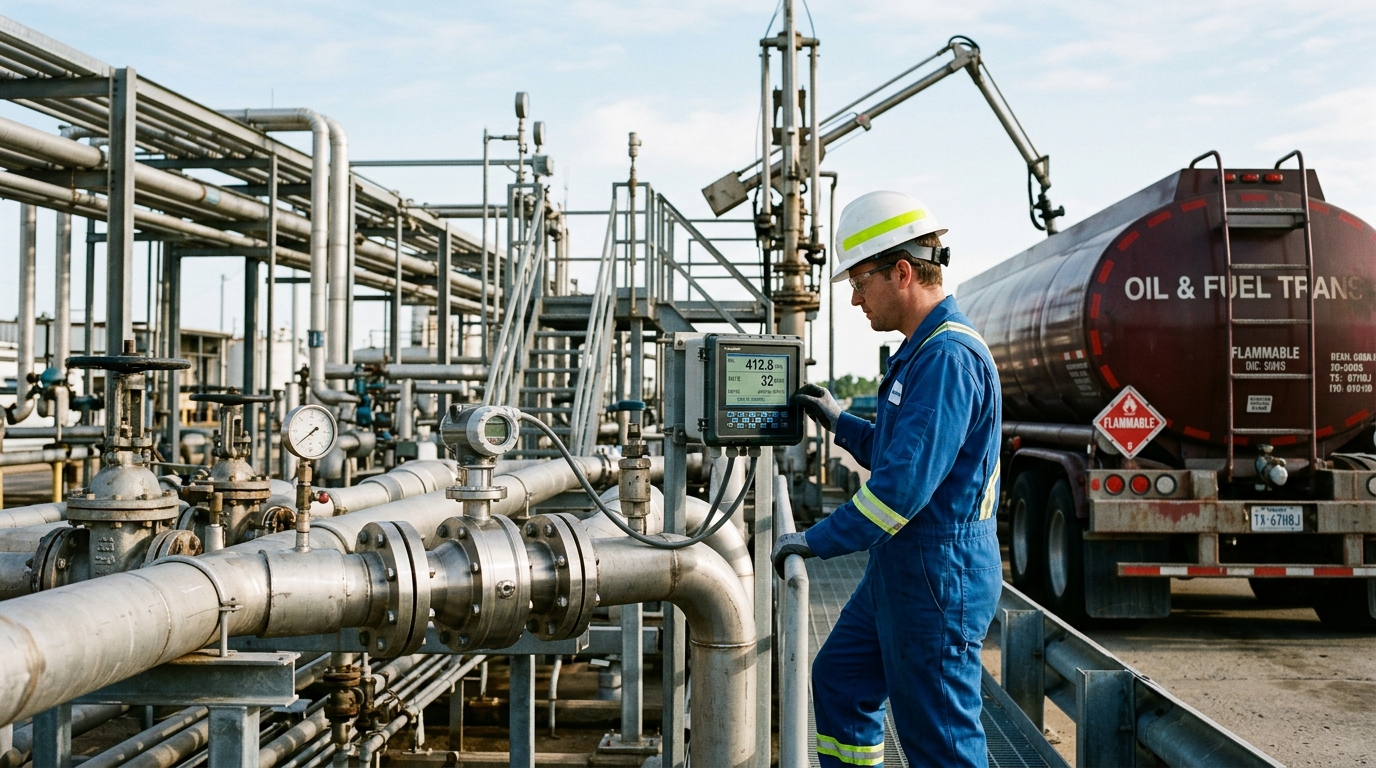
Liquid Turbine Flow Meter Solution for Batch Metering of Low-Viscosity Light Oil Products
Addressing the pain points of rapid wear in positive-displacement meters, prohibitive investment in Coriolis meters, and irreconcilable batch handover data in light-oil loading operations, this solution uses liquid turbine flow meters as the core metering element. With ±0.5%R accuracy, 0.05%–0.2% short-term repeatability and a 1:20 turndown ratio, it delivers high-frequency pulse-based cumulative metering for gasoline, diesel and kerosene, integrated with batch controllers and RTUs for automatic loading, overfill alarm and auditable trade data — balancing metering accuracy with total cost of ownership.
Overview
Summary
Addressing the pain points of rapid wear in positive-displacement meters, prohibitive investment in Coriolis meters, and irreconcilable batch handover data in light-oil loading operations, this solution uses liquid turbine flow meters as the core metering element. With ±0.5%R accuracy, 0.05%–0.2% short-term repeatability and a 1:20 turndown ratio, it delivers high-frequency pulse-based cumulative metering for gasoline, diesel and kerosene, integrated with batch controllers and RTUs for automatic loading, overfill alarm and auditable trade data — balancing metering accuracy with total cost of ownership.
Key Advantages
Challenges
- Rapid wear in positive-displacement meters: oval gear and Roots meters accumulate mechanical wear over dozens of daily batch cycles, drifting from class 0.5 to beyond class 1.0, forcing shorter verification intervals with rising maintenance costs and downtime losses
- Imbalanced investment in high-accuracy options: a Coriolis meter costs 3–5× a same-bore turbine meter, with prices climbing steeply above DN80; equipping every loading arm strains project budgets and offers poor value for internal handover duty
- Uncontrolled manual batch loading: operators watching gauges and closing valves by hand react late, causing both overfill (20–50 L per truck, a substantial loss at 100+ trucks/day) and underfill re-loads, plus spill safety and environmental penalty risks
- No primary data trail for handover: batch totals rely on manual readings with no pulse-level evidence for audit, so buyer and seller reconciliation bases differ, month-end variances cannot be attributed, and trade disputes lack proof
- Mis-selection for low-viscosity media: some projects wrongly apply high-viscosity meters to gasoline or kerosene, or ignore the turbine meter's best linearity below 5×10⁻⁶ m²/s; mismatched turndown, pressure and explosion-proof ratings compromise accuracy
Results
- Batch metering accuracy stabilized at ±0.2%R–±0.5%R with 0.05%–0.2% short-term repeatability; no wear-induced accuracy decay, normal verification intervals restored, and annual metering maintenance cost reduced versus positive-displacement schemes
- Batch controllers cut off loading automatically at preset volume, shrinking overfill/underfill from 20–50 L of manual operation to instrument-accuracy level; overfill risk and re-load disputes are virtually eliminated, and loaded quantity matches the bill of lading
- Batch data (timestamps, pulse totals, flow profiles) is uploaded automatically via RTU to the terminal management system — fully auditable, with month-end variances attributable to individual batches and documented evidence for custody transfer disputes
- Investment reduced by more than 50% versus Coriolis at the same bore; the 1:20 turndown handles large and small batch flows, and DN15–DN300 covers loading arms, pipeline transfer and in-plant blending
- EX db IIC T6Gb certification and IP66 protection ensure long-term stable operation in hazardous areas of oil terminals; drift-free pulse output with strong EMI immunity significantly raises system availability
Solution Details
Liquid Turbine Flow Meter Solution for Batch Metering of Low-Viscosity Light Oil Products
Gasoline, diesel and aviation kerosene are low-viscosity, clean, particle-free liquids — the ideal media for turbine flow meters. Yet oil terminal loading and plant batch handover have long faced a dilemma: positive-displacement meters such as oval gear and Roots meters are rugged, but their mechanical rotors accumulate bearing and gear wear under high-frequency batch start-stop cycles, causing accuracy decay and shortened verification intervals; Coriolis mass flow meters offer the highest accuracy but cost 3–5× more per unit, with sharply rising prices above DN80, making full deployment economically unattractive. Manual gauge reading and hand-operated valve control still cause overfill, underfill and batch records without primary pulse evidence, leading to frequent month-end reconciliation disputes.
This solution adopts the liquid turbine flow meter as the batch metering core: the impeller driven by the fluid generates a raw pulse frequency signal (10 Hz–1.5 kHz) via magnetic pickup — no zero drift, strong anti-interference, short-term repeatability of 0.05%–0.2%. With in-line wet calibration the system uncertainty is held within ±0.2%R–±0.5%R, meeting internal handover and custody transfer requirements for light oil products. DN15–DN300 covers loading arms, pipeline transfer and blending metering; the 1:20 turndown ratio accommodates batch flow swings; EX db IIC T6Gb explosion-proof rating and IP66 protection suit hazardous-area installation at oil terminals. Pulse signals feed batch controllers for preset-volume automatic shut-off, while 4–20 mA/RS485 outputs go through RTUs to the terminal management system, so every batch (start/stop time, pulse total, instantaneous flow profile) is permanently traceable — turning the meter into the data backbone of batch management.
Key Advantages of the Liquid Turbine Flow Meter for Light Oil Batch Metering
- High accuracy and repeatability: ±1%R / ±0.5%R options with a high-precision version at ±0.2%R; short-term repeatability 0.05%–0.2%, reaching custody-transfer-grade accuracy under regular calibration — the preferred choice for light-oil handover
- Raw pulse frequency output: magnetic pickup generates 10 Hz–1.5 kHz pulses with no zero drift and strong anti-interference, natively suited to preset batch control and totalization with single-pulse data granularity
- Wide 1:20 turndown: linear metering across large and small batch flows, minimizing under-registration at low flow and over-range loss at high flow
- Matched to low-viscosity media: designed for clean, particle-free liquids below 5×10⁻⁶ m²/s — gasoline, diesel, kerosene and solvent oils sit in the impeller's best linearity range; media temperature −20–100 °C (custom to 150 °C)
- Industrial explosion-proof build: EX db IIC T6Gb rating, IP66 protection, 304/316 stainless bodies with stainless or duplex-steel impellers, nominal pressure 1.6–25 MPa — suited to hazardous areas and high-pressure transfer lines at oil terminals
- Full bore range and multi-interface networking: DN15–DN300 with flanged, threaded and clamp connections; pulse, 4–20 mA, RS485, HART and GPRS outputs integrate seamlessly with batch controllers, RTUs and terminal SCADA
Liquid Turbine Flow Meter Technical Specifications at a Glance
±0.2%R
High-Precision Accuracy Option
0.05%–0.2%
Short-Term Repeatability
10 Hz–1.5 kHz
Raw Pulse Frequency Output
1:20
Turndown Ratio
DN15–DN300
Full Bore Range
EX db IIC T6Gb
Explosion-Proof Rating
Why the Liquid Turbine Flow Meter Outperforms Alternatives in Batch Handover
Positive-displacement meters such as oval gear and Roots meters are rugged, but their mechanical rotors accumulate bearing and gear wear under high-frequency batch start-stop cycles, causing accuracy decay and shortened verification intervals. Coriolis mass flow meters offer the highest accuracy but cost 3–5× more per unit, with sharply rising prices above DN80, making full deployment economically unattractive. The liquid turbine flow meter strikes the optimal balance: custody-transfer-grade accuracy at a fraction of the Coriolis cost, with no mechanical rotor wear from start-stop cycling.
Applications of the Liquid Turbine Flow Meter in Oil Terminal and Plant Environments
- Oil terminal loading arms — preset-volume automatic shut-off via pulse signals to batch controllers
- Pipeline transfer metering — DN15–DN300 coverage with 1:20 turndown for batch flow swings
- Blending metering — linear response across large and small batch flows
- Hazardous-area installation — EX db IIC T6Gb explosion-proof rating and IP66 protection
- Terminal management system integration — 4–20 mA/RS485 outputs through RTUs for permanent batch traceability
Media Compatibility and Operating Conditions for the Liquid Turbine Flow Meter
The liquid turbine flow meter is designed for clean, particle-free liquids below 5×10⁻⁶ m²/s — gasoline, diesel, kerosene and solvent oils sit in the impeller's best linearity range. Media temperature range is −20–100 °C (custom to 150 °C). Bodies are available in 304/316 stainless steel with stainless or duplex-steel impellers, and nominal pressure ranges from 1.6–25 MPa, suited to hazardous areas and high-pressure transfer lines at oil terminals.
Data Traceability and Batch Management with the Liquid Turbine Flow Meter
Pulse signals feed batch controllers for preset-volume automatic shut-off, while 4–20 mA/RS485 outputs go through RTUs to the terminal management system, so every batch (start/stop time, pulse total, instantaneous flow profile) is permanently traceable — turning the meter into the data backbone of batch management. Manual gauge reading and hand-operated valve control still cause overfill, underfill and batch records without primary pulse evidence, leading to frequent month-end reconciliation disputes. The liquid turbine flow meter eliminates these issues by providing raw pulse data with single-pulse granularity for every batch.
References
- Industrial flow measurement standards for custody transfer of light oil products
- Explosion-proof certification standards EX db IIC T6Gb and IP66 protection ratings
- Turbine flow meter calibration and verification guidelines for low-viscosity media
Approach
How we implement intelligence into your infrastructure step by step.
Media and duty survey
Confirm product (gasoline/diesel/kerosene/solvent oil), viscosity, temperature, maximum/minimum flow and batch-size distribution; verify the media falls within the <5×10⁻⁶ m²/s applicability window, and record hazardous-area classification and pressure requirements into a duty sheet.
Bore size and accuracy selection
Select DN size so normal flow sits at 30%–70% of meter range; choose ±0.5%R or ±0.2%R accuracy per internal-handover or custody-transfer duty; specify upstream strainer and gas eliminator, and fix flange pressure rating and materials.
Installation and wet calibration
Install with 10D upstream / 5D downstream straight runs and a horizontal sensor axis to avoid gas pockets; complete in-line wet calibration against a master meter or weigh tank before commissioning, record the K-factor, and wet-calibrate any media above 5×10⁻⁶ m²/s.
Preset batch loading interlock
Feed pulse signals to a batch controller with preset loading volume and automatic valve shut-off at target; configure overfill alarm and emergency shut-down interlocks, and route 4–20 mA/RS485 via RTU to the terminal loading system for unattended operation.
Data management and periodic verification
Auto-log batch data (time, totals, flow profiles) for monthly reconciliation against weighbridge or prover-tank checks; exploit the meter's repeatability for in-service self-checks (K-factor drift monitoring), schedule statutory verification, and build a lifecycle metering dossier.
❓ Related FAQs
Related Solutions
Application Scheme of Multi-Band Doppler Radar Flowmeter for Surface Velocity Measurement in Natural River Channels at National Hydrological Stations
Ultrasonic Water Meter Solution for DMA District Metering and Leakage Control in Urban Water Supply
Coriolis Flow Meter Solution for High-Precision Micro-Dosing Metering in Chemical Processes

Ready to Optimize Your Business?
Contact us, and our professional team will provide customized solutions to help your business achieve digital transformation.
Get In Touch