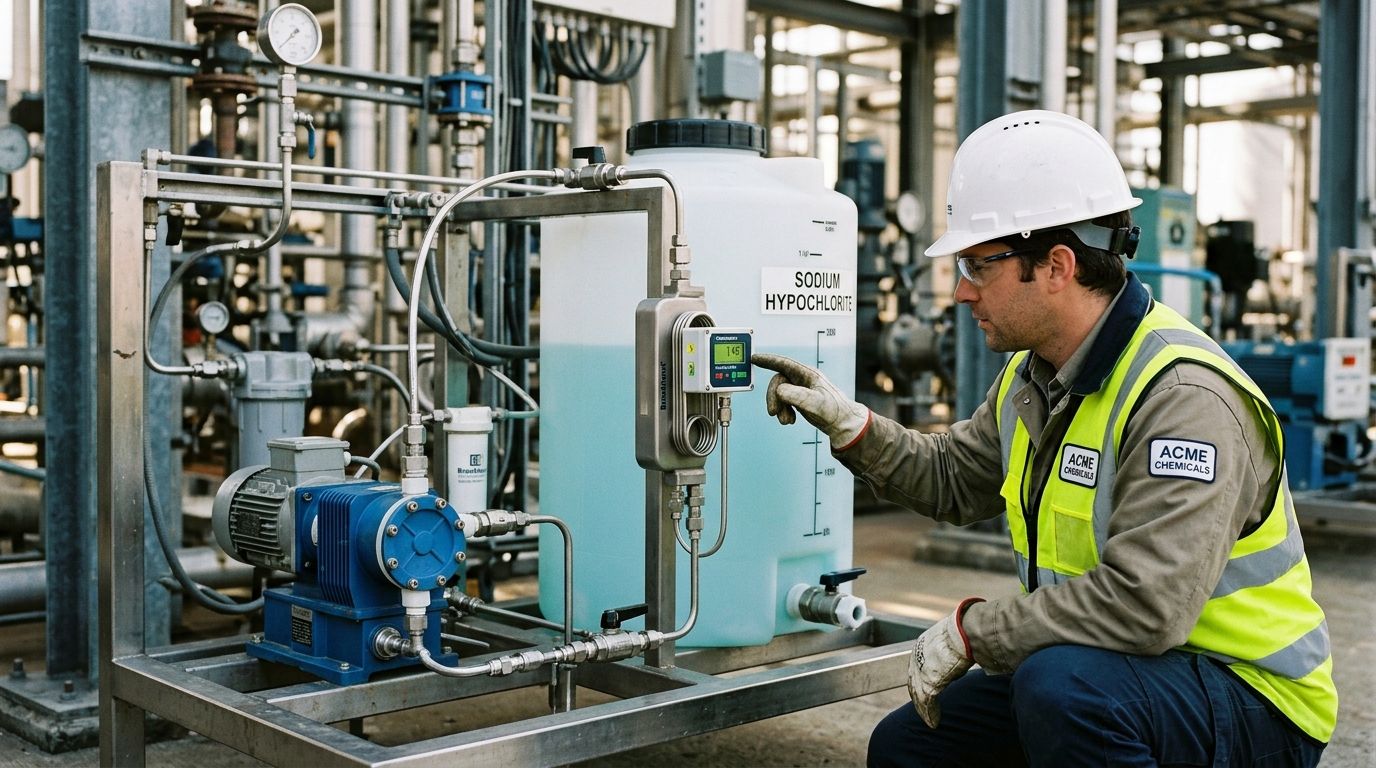
Coriolis Flow Meter Solution for High-Precision Micro-Dosing Metering in Chemical Processes
Chemical micro-dosing with metering pumps typically stagnates at ±3-5% accuracy because volumetric estimates break down when fluid properties change. This solution deploys micro-tube Coriolis mass flowmeters (±0.1% of reading, 100:1 turndown) with pulsation damping, PLC closed-loop dosing control, flow-proportional plus water-quality-feedback strategies and a remote dosing platform - delivering ±0.5% dosing accuracy, 12-15% chemical savings and fully traceable batch records.
Overview
Summary
Chemical micro-dosing with metering pumps typically stagnates at ±3-5% accuracy because volumetric estimates break down when fluid properties change. This solution deploys micro-tube Coriolis mass flowmeters (±0.1% of reading, 100:1 turndown) with pulsation damping, PLC closed-loop dosing control, flow-proportional plus water-quality-feedback strategies and a remote dosing platform - delivering ±0.5% dosing accuracy, 12-15% chemical savings and fully traceable batch records.
Key Advantages
Challenges
- Micro-dosing flows down to ml/min produce weak Coriolis signals that standard sensors cannot resolve
- Metering-pump pulsation excites tube vibration and amplifies zero drift
- Acids, alkalis and oxidisers corrode wetted parts; some chemicals crystallise in dead zones
- Gas release from hypochlorite and suction air ingress create two-phase flow that distorts measurement
- Dosing rooms are often hazardous areas requiring Ex-rated instruments
Results
- Dosing accuracy improved from ±3% to ±0.5% of setpoint, metering trustworthy at ±0.1% class
- PAC consumption down ~15%, PAM down ~12%, significant chemical cost reduction
- Filtrate turbidity standard deviation reduced by 40%+, markedly improved process stability
- Batch cutoff at preset mass with zero conversion error, records archived automatically
- Density anomalies and empty pipe trigger alarms with interlocked switchover, keeping off-spec chemical out
Solution Details
Coriolis Flow Meter Solution for High-Precision Micro-Dosing Metering in Chemical Processes
In water treatment, pharmaceuticals, electroplating and fine-chemical processes, chemical dosing is the process step that directly determines effluent quality and product consistency. Dosing rates for coagulants such as PAC, flocculant aids such as PAM, acids and alkalis, sodium hypochlorite, and antiscalants are typically measured in litres per hour or even millilitres per minute — metering accuracy directly governs treatment performance and chemical cost. Conventional dosing systems usually estimate delivery from metering-pump stroke or frequency in open loop, cross-checked with rotameters or ordinary electromagnetic flowmeters on a volumetric basis. Once fluid density, viscosity or temperature drifts, the volume-to-mass conversion introduces error, and dosing accuracy typically stagnates at ±3% to ±5%, far from what precision dosing and fine cost control require.
Chemical micro-dosing duty is characterised by small line sizes (DN1-DN15), low flow rates and heavy pulsation — plunger and diaphragm metering pumps inherently deliver periodic pulsating flow. This sets demanding requirements on low-flow sensitivity, pulsation immunity and wetted-material compatibility. A Coriolis mass flowmeter, based on the Coriolis effect, measures mass flow directly and is unaffected by density, viscosity, temperature or pressure variations. With measurement accuracy down to ±0.1% of reading and simultaneous density and temperature output, it is a natural fit for micro-dosing: it upgrades dosing metering from "how many litres" to "how many kilograms", eliminating property-driven metering errors by principle.
Core Challenges in Chemical Micro-Dosing Coriolis Measurement
Weak low-flow signals: micro-dosing flows often sit in the range of a few litres to a few tens of litres per hour. The Coriolis force generated inside the flow tubes is extremely small; standard-size sensors cannot respond. Only dedicated micro-tube sensors with high-performance digital signal processing stay stable at milligram-per-second mass flows.
Metering-pump pulsation: the positive-displacement action of plunger/diaphragm pumps produces periodic flow pulsation that can excite mechanical vibration of the measuring tubes and amplify zero drift, causing wild flow readings. Pulsation attenuators, proper installation and transmitter digital filtering must work together.
Corrosive and crystallising media: acids, alkalis, strong oxidisers and concentrated salt solutions attack tube materials aggressively; some chemicals crystallise or plate out in dead zones at low temperature, degrading accuracy and creating hygiene and cleaning problems.
Entrained gas and two-phase flow: chemicals such as sodium hypochlorite and ammonia water release gas readily, and air can be drawn in through suction-side leaks. Gas-liquid two-phase flow severely distorts Coriolis measurement; the process layout must guarantee full single-phase pipe flow.
Explosion-proof requirements: dosing rooms in chemical and pharmaceutical plants often fall inside hazardous areas. Flowmeters and transmitters must meet Ex d / Ex ia ratings, and signal transmission and power supply must comply with explosion-proof regulations.
Coriolis Micro-Dosing Solution Architecture
The solution follows a four-layer architecture: micro-flow sensing — closed-loop dosing control — ratio/feedback optimisation — remote traceability.
Micro-flow sensing layer: a micro-tube Coriolis mass flowmeter is installed on the dosing line downstream of the metering pump, tube size DN1-DN6 selected to the dosing flow with ±0.1% reading accuracy and 100:1 turndown. The transmitter outputs 4-20 mA overlaid with HART (or RS485/Modbus), reporting mass flow, density and temperature in real time.
Closed-loop control layer: the PLC reads the flow signal as feedback and runs PID against the dosing setpoint, adjusting metering-pump VFD frequency or motorised stroke. In high-pulsation duty, a pulsation dampener combined with a back-pressure valve keeps pulsation inside the range where stable full-pipe measurement is maintained.
Ratio/feedback optimisation layer: two optimisation modes are supported — flow-proportional control (dosing follows plant inlet flow or main process flow linearly) and water-quality feedback control (an online indicator such as residual chlorine, pH or turbidity trims the dosing ratio as a secondary feedback), achieving "dose on demand, never overdose".
Remote traceability layer: an RTU/gateway uploads dosing flow, density, cumulative chemical consumption and alarms over 4G or Ethernet to a dosing management platform, generating daily/monthly dosing reports and interfacing with plant-level DCS or SCADA.
Coriolis Flowmeter Selection and Installation for Micro-Dosing
Selection: tube size DN1-DN6 covering normal dosing flow with 2-3x margin; accuracy ±0.1% of reading, repeatability ±0.05%; 316L stainless steel tubes by default, upgraded to Hastelloy C22 or tantalum for hydrochloric acid and other aggressive media; 1/4"-1/2" compression or threaded process connections rated at least 1.6 MPa; transmitter with HART/Modbus, Ex d IIC T6 or intrinsically safe Ex ia, IP67 enclosure.
Installation: mount downstream of the metering pump with tubes always full, preferably vertical with bottom-to-top flow; install a pulsation dampener between pump and meter and a back-pressure valve downstream (≥0.2 MPa) to prevent vaporisation and cavitation; support the sensor independently from process piping to avoid vibration coupling; observe the manufacturer's straight-run guidance away from valves and elbows; route shielded signal cables separately from power cables with proper grounding.
Commissioning: perform on-site zero calibration at full-pipe zero flow; for crystallising media add flushing connections and verify zero with clean water periodically to keep long-term metering trustworthy.
Precision Dosing Control Strategy with Coriolis Mass Flow
PID tuning: micro-dosing loops have small time constants; keep the proportional band moderate to avoid oscillation coupled with pump pulsation, and apply 2-5 s digital filtering to the flow feedback for both responsiveness and smooth readings.
Proportional control: use inlet flow as the primary signal and dosing flow as the secondary; setpoint = inlet flow × dosing ratio, with the ratio auto-trimmed by the water-quality feedback loop to form feedforward-plus-feedback composite control.
Batch metering mode: for intermittent dosing, adopt "preset mass, cut off on target" — the meter's cumulative mass is the batch-completion criterion itself, free of volume-to-mass conversion error, with batch records archived automatically.
Interlocks: when measured density drifts outside the chemical's normal concentration window (indicating dilution, degradation or gas ingress), alarm automatically and switch to the standby dosing branch to keep off-spec chemical out of the process.
Remote Monitoring and O&M for Coriolis Dosing Systems
The dosing platform displays real-time flow curves, density curves, cumulative consumption and pump status for every dosing point; flow limits, empty pipe, sensor faults and density anomalies are escalated by priority to O&M staff; daily/monthly dosing reports are generated automatically, and historical data is retained for at least two years to satisfy GMP and water-utility traceability requirements.
Proven Results of Coriolis Micro-Dosing Retrofits
At an 80,000 m³/day water treatment plant, retrofitting the coagulant dosing system to Coriolis micro-flow closed-loop control delivered: dosing accuracy improved from ±3% to ±0.5% of setpoint; PAC consumption down about 15% and PAM down about 12%; filtrate turbidity standard deviation reduced by over 40% with markedly improved water-quality stability; fully archived dosing data and far fewer manual sampling adjustments, with payback in under 18 months. Similar retrofits in chemical and pharmaceutical plants confirm that ±0.1%-class mass metering underpins batch consistency and material-balance management.
±0.1%
Reading Accuracy
100:1
Turndown Ratio
DN1-DN6
Micro-Tube Sizes
±0.05%
Repeatability
Ex d/ia
Explosion-Proof Rated
IP67
Enclosure Rating
Key Features of the Coriolis Micro-Dosing Flowmeter
- Micro-tube sizes DN1-DN6, 100:1 turndown, ±0.1% reading accuracy, ±0.05% repeatability
- Direct mass flow measurement with simultaneous density and temperature output, immune to property drift
- 316L tubes standard; Hastelloy C22/tantalum for aggressive media
- Transmitter with HART/Modbus, Ex d IIC T6 or Ex ia intrinsically safe, IP67
- Digital filtering and pulsation suppression tailored to metering-pump pulsating flow
- Empty-tube/gas detection and density alarms with automatic switchover interlock
- Batch metering mode: preset-mass cutoff with no volume-to-mass conversion
- Integrates with PLC/RTU and dosing platform for fully traceable dosing data
? Reference Sources
- Coriolis Mass Flow Measurement Principles — Emerson Micro Motion Technical Documentation
- Chemical Dosing Control in Water Treatment — AWWA Standards & Practice Guides
- Micro-Flow Metering for Pharmaceutical Dosing — ISPE Baseline Guides
Approach
How we implement intelligence into your infrastructure step by step.
Dosing system survey and flow assessment
Review process parameters, chemical properties, pump pulsation characteristics and normal/peak dosing rates to size the tubes and control strategy.
Flowmeter selection and installation design
Select tube size, material and Ex rating; design pulsation dampener, back-pressure valve, full-pipe mounting, straight runs and supports.
Installation and calibration in shutdown window
Install dampener and back-pressure valve, mount the meter with independent supports, complete full-pipe zero calibration and Ex wiring checks.
Loop tuning and ratio commissioning
Tune PID and filtering, calibrate dosing ratio, verify batch cutoff accuracy and density-anomaly interlocks.
Integration and consumption review
Connect to the dosing platform, produce monthly dosing and chemical-consumption reports, and continuously refine dosing strategy.
❓ Related FAQs
Related Solutions
Liquid Turbine Flow Meter Solution for Batch Metering of Low-Viscosity Light Oil Products
Application Scheme of Multi-Band Doppler Radar Flowmeter for Surface Velocity Measurement in Natural River Channels at National Hydrological Stations
Ultrasonic Water Meter Solution for DMA District Metering and Leakage Control in Urban Water Supply

Ready to Optimize Your Business?
Contact us, and our professional team will provide customized solutions to help your business achieve digital transformation.
Get In Touch