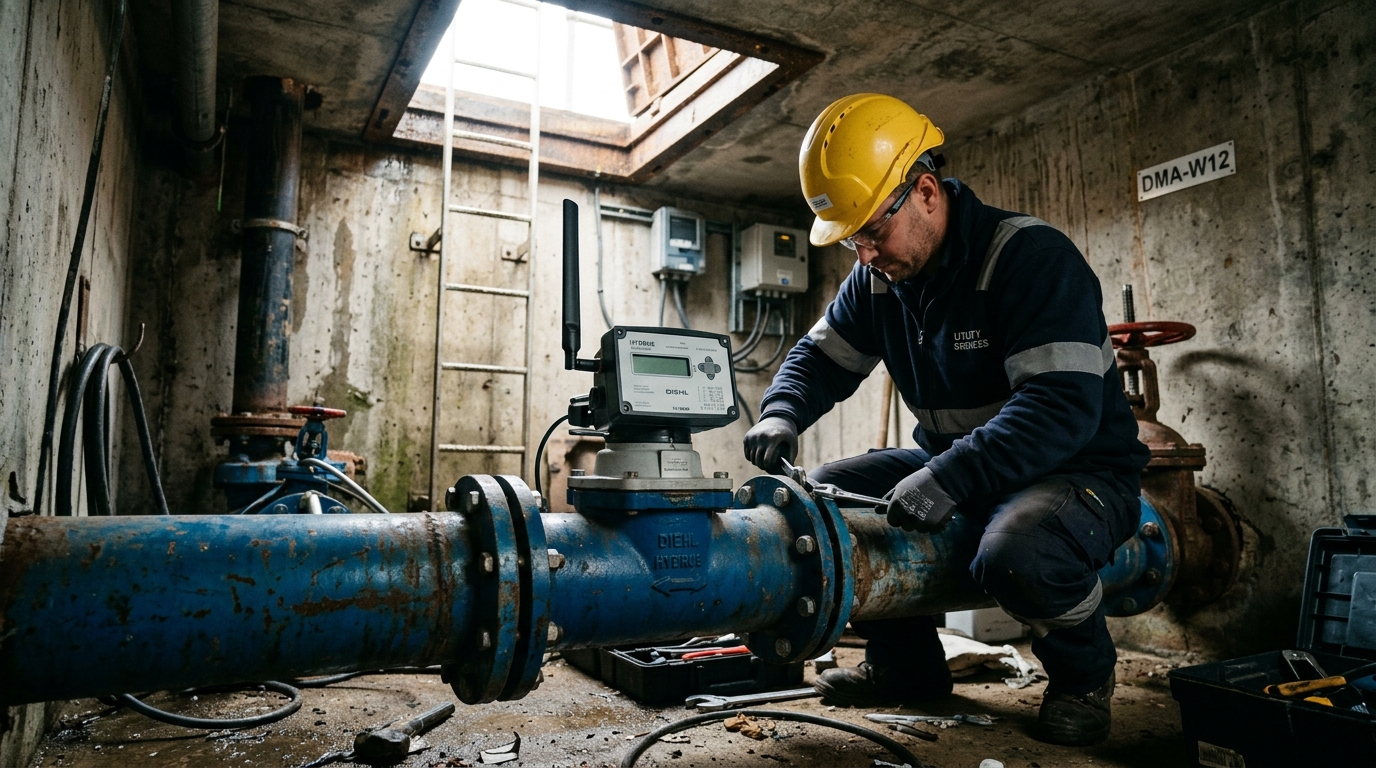
Ultrasonic Water Meter Solution for DMA District Metering and Leakage Control in Urban Water Supply
To address low metering accuracy, narrow turndown, undetectable night-time minimum flows and stubbornly high leakage in urban water supply networks, this solution deploys high-accuracy transit-time ultrasonic water meters (accuracy class R400, DN50-DN300, no mechanical wear, battery life ≥6 years, IP68) to build independent District Metered Areas (DMA). Flow data is transmitted in real time over NB-IoT/LoRa to a leakage analysis platform, enabling online monitoring of DMA inlet flows, automatic identification of night-time minimum flow (MNF) and precise location of leakage zones. Network leakage drops from 18% to below 12%, MNF falls by about 35%, and non-revenue water narrows markedly, supporting leakage governance and water-saving city initiatives.
Overview
Summary
To address low metering accuracy, narrow turndown, undetectable night-time minimum flows and stubbornly high leakage in urban water supply networks, this solution deploys high-accuracy transit-time ultrasonic water meters (accuracy class R400, DN50-DN300, no mechanical wear, battery life ≥6 years, IP68) to build independent District Metered Areas (DMA). Flow data is transmitted in real time over NB-IoT/LoRa to a leakage analysis platform, enabling online monitoring of DMA inlet flows, automatic identification of night-time minimum flow (MNF) and precise location of leakage zones. Network leakage drops from 18% to below 12%, MNF falls by about 35%, and non-revenue water narrows markedly, supporting leakage governance and water-saving city initiatives.
Key Advantages
Challenges
- Mechanical meters have high start flows and wear fast, so night-time low flows go unregistered for years, non-revenue water data is distorted and leakage governance lacks a trustworthy data basis
- Leak detection relies on manual patrols and listening sticks with detection cycles measured in months, while hidden leaks waste water continuously
- Without DMA partitioning, zone leakage levels cannot be quantified and leak-detection resources are deployed by experience, at low efficiency
- No continuous night-time minimum flow (MNF) data means hidden leaks stay unidentified and leakage rates remain stubbornly high
- National regulation caps public supply network leakage at 9% and audits utilities, making rough manual meter reading and experience-based detection unsustainable
Results
- Network leakage drops from 18% to below 12%, meeting national leakage control assessment
- Night-time minimum flow falls about 35% on average; hidden-leak detection shortens from months to 1-2 weeks
- Metered non-revenue water narrows from 4% to under 1%, making leakage statistics truly credible
- Leak-detection resources deploy precisely along platform priority lists, raising survey efficiency by over 50%
- Real-time flow uploads support water-saving city assessment and on-schedule leakage governance reporting
Solution Details
Ultrasonic Water Meter Solution for DMA District Metering and Leakage Control in Urban Water Supply
Urban water supply networks are the lifeline of a city. Leakage control directly affects utility economics and sustainable use of water resources. National authorities require distribution network leakage to be kept within 9%, yet many utilities still run at 12-20%. Inadequate accuracy of mechanical water meters, under-registration of low night-time flows, and slow leakage detection are the core bottlenecks of leakage governance.
The ultrasonic water meter uses the transit-time principle, contains no moving parts, is unaffected by debris or air bubbles, and offers a wide turndown (R400, some models R800) so it meters accurately even at night-time minimum flows. Combined with NB-IoT/LoRa wireless telemetry and a cloud leakage analysis platform, the system upgrades manual meter reading and experience-based leak hunting into online metering, intelligent early warning and precise location.
1. Core Challenges of Urban Leakage Governance
Mechanical meters are inherently inadequate: large start flow, progressive wear, under-registration of night-time low flows - non-revenue water data is distorted and governance has no trustworthy basis.
Leaks are detected too late: crews rely on walking mains and listening sticks; average detection takes months while hidden leaks drain water continuously.
No district quantification: without DMA partitioning, leakage levels of different zones cannot be quantified, and leak-detection resources are deployed by guesswork.
No MNF analysis: night-time minimum flow best reflects leakage level, but without continuous telemetry data, MNF analysis is simply impossible.
Regulatory pressure: leakage rate is part of water-saving city assessment and utility licensing; data must be reported on schedule, and rough management is no longer acceptable.
2. Ultrasonic Meter + DMA Metering System Solution
Architecture: a four-layer "metering - transmission - analysis - governance" architecture covering the full leakage control process.
Metering layer: transit-time ultrasonic water meters are deployed at DMA inlet points, trunk mains and residential master meters - DN50 to DN300, accuracy class R400, start flow as low as 0.015 m³/h (DN100), bidirectional metering, built-in data logging; insert-type ultrasonic flowmeters can serve large transmission mains to cut retrofit cost.
Transmission layer: built-in NB-IoT/LoRa modules report instantaneous flow, cumulative volume and battery voltage every 15 minutes to 1 hour - no cabling, signals penetrate from meter pits; the platform accepts MQTT/HTTP and integrates with SCADA and GIS.
Analysis layer: the leakage platform computes daily supply, night-time minimum flow (MNF) and leakage rate for each DMA, raises alarms on flow spikes and sustained over-consumption, and combines pressure-flow analysis to locate suspected leakage zones and generate prioritized repair lists.
Governance layer: guided by leakage heatmaps and priority lists, leak-detection crews execute district acoustic surveys, pressure management and pipe renewal; results feed back to the platform for verification, closing the "monitor - locate - repair - verify" loop.
3. Key Selection and Installation Points for Ultrasonic Water Meters
Selection: accuracy class R400 or better with turndown covering night-time low flows; battery life ≥6 years (hourly reporting); IP68 for humid pits; remote plus local dual display; conformity to GB/T 778 and JJG162.
Installation: ≥5D straight pipe upstream and ≥2D downstream; away from pumps and valve turbulence; horizontally installed with flooded body and no air pockets; service space and upward-facing antenna in the pit; install pressure sensors alongside for pressure-flow joint analysis.
Data: report every 15 minutes by day, optionally every 5 minutes at night to sharpen MNF analysis; the platform flags and excludes anomalous records so leakage statistics stay credible.
4. Results and Typical Applications of DMA Leakage Control
18% → 12%
Network leakage reduction
35%
Average MNF reduction
1-2 weeks
Leak detection time (from months)
4% → 1%
Metered non-revenue water
50%+
Survey efficiency improvement
Results: network leakage drops from 18% to below 12%, meeting national assessment; MNF falls about 35% on average, cutting hidden-leak detection from months to 1-2 weeks; metered non-revenue water narrows from 4% to under 1%; guided deployment of leak-detection crews raises survey efficiency by over 50%.
Applications: DMA retrofit for city water utilities, leakage governance of ageing residential networks, high-standard metering for new districts, and water-saving city demonstration projects.
Ultrasonic water meters plus DMA district metering push leakage governance from experience-driven to data-driven - real-time online metering, precise leakage location, efficient resource deployment - the core infrastructure for utility cost reduction and water conservation.
The solution suits utilities that must cut non-revenue water fast while building a permanent digital metering foundation.
? Reference Sources
- GB/T 778 - Cold potable water meters standard
- JJG162 - Verification regulation of water meters
- National water-saving city assessment criteria
Approach
How we implement intelligence into your infrastructure step by step.
Network survey and DMA planning
Audit network topology, existing metering points and leakage data; partition independent DMAs; fix ultrasonic meter locations and sizes.
Meter selection and telemetry design
Select R400 ultrasonic meters by pipe diameter and flow range; design NB-IoT/LoRa networking, reporting intervals and platform integration.
Installation and data onboarding
Install meters, verify straight-run and flooded conditions, test wireless signals, connect and validate flow data on the leakage platform.
Leakage analysis go-live and handover
Configure MNF analysis, alarm rules and priority lists; train leak-detection crews for list-driven surveys; hand over O&M and calibration plans.
❓ Related FAQs
Related Solutions
Liquid Turbine Flow Meter Solution for Batch Metering of Low-Viscosity Light Oil Products
Application Scheme of Multi-Band Doppler Radar Flowmeter for Surface Velocity Measurement in Natural River Channels at National Hydrological Stations
Coriolis Flow Meter Solution for High-Precision Micro-Dosing Metering in Chemical Processes

Ready to Optimize Your Business?
Contact us, and our professional team will provide customized solutions to help your business achieve digital transformation.
Get In Touch