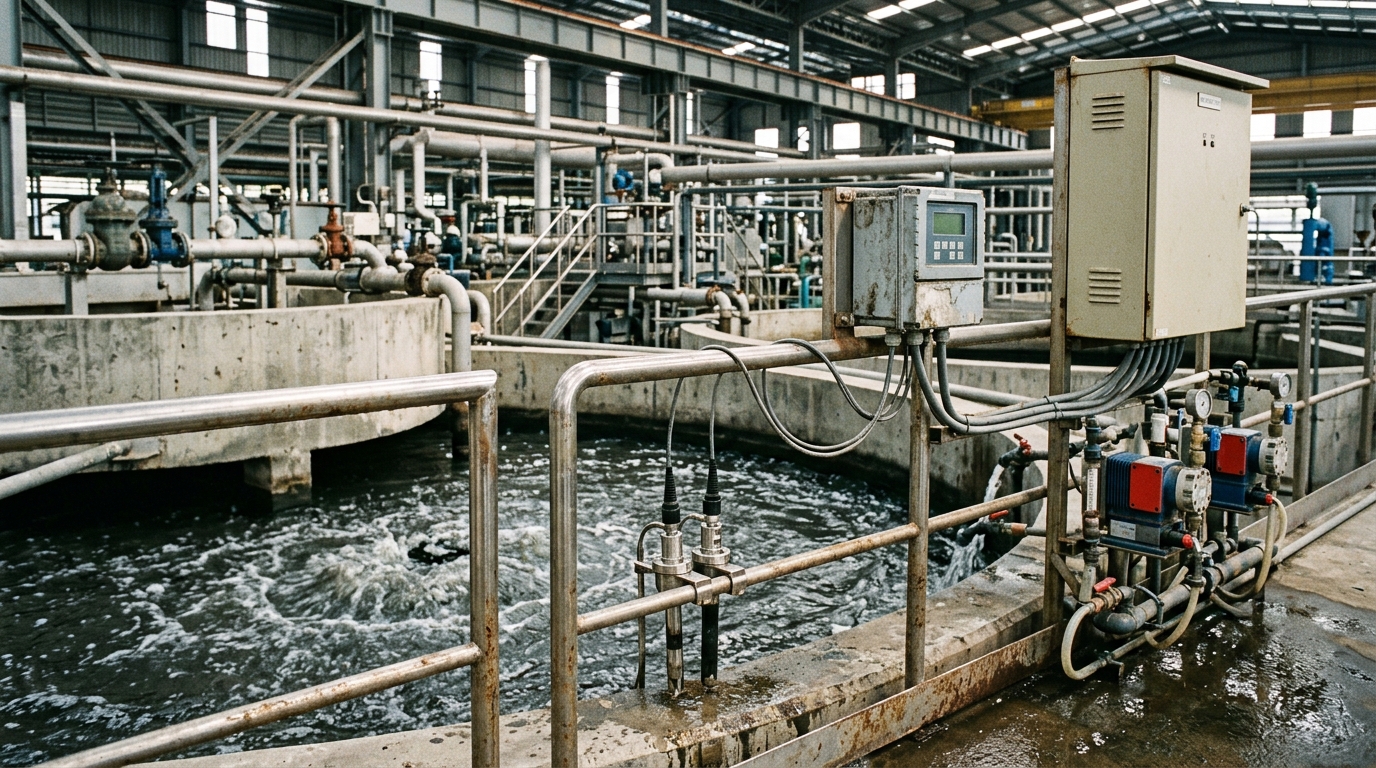
pH/ORP Analyzer Solution for Industrial Wastewater Neutralization Process Control
Industrial wastewater suffers violent pH swings, lagging manual testing and crude chemical dosing. This solution deploys online pH/ORP analyzers (glass combination electrodes, 0-14 pH range, ±0.01 pH accuracy, ORP -2000 to +2000 mV) to continuously monitor neutralization basin acidity and oxidation-reduction potential, feeding 4-20 mA/RS485 into the PLC for closed-loop acid/base dosing control, achieving stable discharge pH (6-9), roughly 25% lower reagent consumption and 80% fewer manual lab tests while meeting GB 8978 discharge standards.
Overview
Summary
Industrial wastewater suffers violent pH swings, lagging manual testing and crude chemical dosing. This solution deploys online pH/ORP analyzers (glass combination electrodes, 0-14 pH range, ±0.01 pH accuracy, ORP -2000 to +2000 mV) to continuously monitor neutralization basin acidity and oxidation-reduction potential, feeding 4-20 mA/RS485 into the PLC for closed-loop acid/base dosing control, achieving stable discharge pH (6-9), roughly 25% lower reagent consumption and 80% fewer manual lab tests while meeting GB 8978 discharge standards.
Key Advantages
Challenges
- Batch discharges and process swings push influent pH across the 2-13 range; infrequent, lagging manual tests leave discharge pH transiently over-limit
- Dosing is estimated by experience without real-time pH feedback; acid and alkali are routinely overdosed, raising cost and causing secondary pollution
- Cyanide destruction, hexavalent chromium reduction and sulfide oxidation need precise ORP endpoints that manual adjustment cannot hold stable
- Uneven mixing and electrode fouling distort readings and mislead the control loop, destabilizing effluent quality
- GB 8978 and industry standards require discharge pH in the 6-9 band with online monitoring and continuous data upload, beyond manual record-keeping
Results
- Discharge pH compliance improved from 82% to over 99.5%, eliminating transient exceedances
- Acid/alkali reagent consumption fell about 25%, cutting neutralization cost and secondary pollution
- ORP control compliance for cyanide destruction and chromium reduction rose from 70% to 98%
- Manual lab test frequency dropped 80% with staffing cut from 3 to 1, sharply lowering O&M cost
- pH/ORP data streams to the environmental platform in real time, passing inspection and permit audits for two consecutive years
Solution Details
Online pH/ORP Analyzer Solution for Industrial Wastewater Neutralization Process Control
Compliant industrial wastewater discharge is a hard requirement of national environmental inspection and pollutant discharge permit management. Wastewater from electroplating, chemical, pharmaceutical, printing and dyeing, and metallurgical industries swings violently in acidity, with pH jumping in batches (2-13) alongside heavy metals and cyanides. Neutralization is the critical stage of most industrial wastewater treatment trains. Traditional manual grab sampling tests pH infrequently and belatedly, dosing is estimated by experience, discharge exceedance risk stays high, chemicals are wasted, and the continuous online data upload required by discharge permits cannot be satisfied.
The online pH/ORP analyzer uses a glass combination electrode to continuously measure acidity and oxidation-reduction potential in the neutralization basin: measuring range 0-14 pH (±0.01 pH accuracy) and ORP -2000 to +2000 mV, with automatic cleaning and temperature compensation. The transmitter outputs 4-20 mA plus RS485 Modbus to the neutralization control PLC, interlocking with acid/base dosing metering pumps to realize closed-loop "continuous monitoring, automatic neutralization, precise dosing" - upgrading experience-based manual operation into data-driven automated operation.
Core Challenges of Industrial Wastewater Neutralization
Violent, frequent pH swings: Batch discharges and process fluctuations push influent pH across the 2-13 range; manual tests every 2-4 hours lag far behind, and discharge pH frequently exceeds limits transiently.
Crude dosing and chemical waste: Dosing is estimated by experience without considering real-time pH; acid and alkali are commonly overdosed, raising cost and creating secondary pollution from excess salts.
Inadequate ORP control: Cyanide destruction, hexavalent chromium reduction and sulfide oxidation require precise ORP control of reaction endpoints; manual adjustment cannot hold stable compliance.
Distorted measurement misleads control: Uneven mixing and electrode fouling distort readings, the control loop reacts wrongly, and effluent quality becomes unstable.
Regulatory compliance pressure: GB 8978 Integrated Wastewater Discharge Standard and electroplating/pharmaceutical industry standards require discharge pH in the 6-9 band plus installed online monitoring with continuous data upload to environmental platforms - manual records cannot satisfy this.
Online pH/ORP Monitoring and Automatic Neutralization Control System
System architecture: A four-layer "measurement - control - dosing - upload" architecture covers the whole neutralization process.
Measurement layer: pH and ORP electrodes are installed immersively in the fully mixed zones of primary/secondary neutralization basins with ultrasonic or water-spray automatic cleaners; the transmitter provides temperature compensation and high-impedance signal conditioning, outputting live pH and ORP values; the ORP electrode determines oxidation-reduction endpoints - for example hexavalent chromium reduction requires holding ORP in the 250-350 mV band.
Control layer: The neutralization PLC acquires pH/ORP signals in real time and runs PID arithmetic against the setpoint (e.g. pH 7.0 ± 0.3), split-ranging variable-frequency acid and alkali dosing pumps; two-stage basins in series ensure full reaction and buffering; pH excursions trigger alarms and an emergency dosing circuit, while ORP excursions adjust reducing/oxidizing agent feed.
Data upload layer: pH, ORP, flow and dosing data are uploaded via 4G/Ethernet to the environmental data acquisition unit (CEMS) and the plant wastewater platform, generating trend curves, reagent consumption ledgers and daily/monthly reports; exceedance data is automatically flagged and retained to satisfy permit and inspection requirements.
Key Selection and Installation Points for pH/ORP Analyzer
Selection: Glass combination pH electrodes (antimony or differential electrodes for high-suspended-solids wastewater), 0-14 pH range, ±0.01 pH accuracy, T90 response ≤ 30 s; platinum-ring or gold-ring ORP electrodes, -2000 to +2000 mV; IP65 transmitters with 4-20 mA + RS485 Modbus dual output and built-in electrode impedance self-diagnostics and break alarms; ultrasonic or water-spray automatic cleaning chosen by water quality to cut fouling maintenance.
Installation: Immerse electrodes in fully mixed, uniformly flowing zones of the neutralization basin, away from dosing ports and dead corners; for flow-through mounting keep velocity at 0.3-3 m/s; tilt electrodes 15-30 degrees from vertical to reduce bubble adhesion; run shielded twisted-pair signal cable away from VFDs and power cables; recalibrate every two weeks with standard buffer solutions (pH 4.00/6.86/9.18) and ORP standard solution for long-term trustworthy readings.
Monitoring and Maintenance Management for Neutralization Process
The wastewater platform displays pH/ORP curves and equipment health for every basin in real time; discharge pH below 6 or above 9 triggers tiered operator alerts and interlocked dosing pump adjustment; reagent consumption and compliance-rate reports are generated automatically to support cost accounting and environmental ledgers; electrode lifetime and cleaning cycles are reminded in advance to reduce sudden failures; historical data is retained for no less than 3 years for online regulatory review and enforcement inspection.
Application Results of pH/ORP Analyzer in Industrial Wastewater Treatment
After an industrial park wastewater treatment plant deployed online pH/ORP monitoring with closed-loop automatic dosing on 6 neutralization systems: discharge pH compliance improved from 82% to over 99.5%; acid/alkali reagent consumption fell about 25%; ORP control compliance for cyanide destruction and chromium reduction pre-treatment rose from 70% to 98%; manual lab test frequency dropped 80% and the lab staffing was cut from 3 to 1; pH/ORP data streams to the environmental platform in real time, passing environmental inspection and discharge permit verification for two consecutive years - reliable technical assurance for stable, compliant discharge by park enterprises.
0-14 pH
Measuring Range
±0.01 pH
Accuracy
-2000 to +2000 mV
ORP Range
T90 ≤ 30 s
Response Time
4-20 mA + RS485
Dual Output
IP65
Protection Rating
? 参考来源
- GB 8978 Integrated Wastewater Discharge Standard
- Electroplating and Pharmaceutical Industry Discharge Standards
- Environmental Data Acquisition Unit (CEMS) Technical Specifications
Approach
How we implement intelligence into your infrastructure step by step.
Process survey and neutralization assessment
Review wastewater sources, quality fluctuation patterns, basin volume and mixing conditions to fix electrode locations, ranges and dosing interlock strategy.
Instrument selection and control design
Select pH/ORP electrode types and ranges; design immersive/flow-through mounting, automatic cleaning and PLC split-range dosing control.
Installation, commissioning and calibration
Complete electrode mounting and 4-20 mA/RS485 wiring; calibrate with standard buffers and ORP standard solution; tune PID parameters and alarm thresholds.
Platform integration and handover
Connect CEMS and plant wastewater platform, configure trend curves, reagent ledgers and tiered alarms; train operators and hand over calibration plans.
❓ Related FAQs
Related Solutions
Application Solution for Turbidity/Suspended Solids Analyzers in Coagulation and Sedimentation Process Control at Water Treatment Plants
Dissolved Oxygen Electrode Solution for Precise Aeration Control in Wastewater Treatment Plant Aeration Tanks
Online Residual Chlorine Analyzer Solution for Secondary Water Supply Pump Room Water Quality Monitoring

Ready to Optimize Your Business?
Contact us, and our professional team will provide customized solutions to help your business achieve digital transformation.
Get In Touch