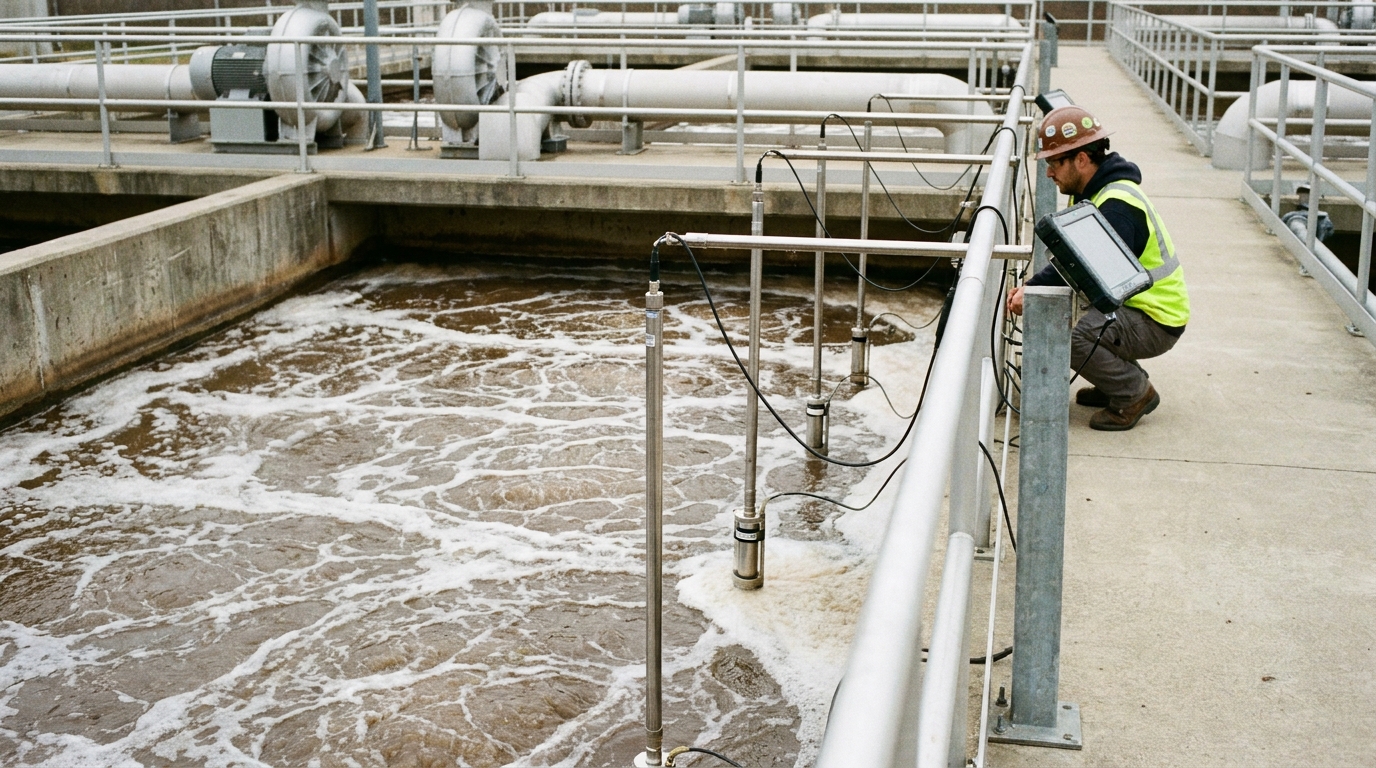
Dissolved Oxygen Electrode Solution for Precise Aeration Control in Wastewater Treatment Plant Aeration Tanks
To address high aeration energy consumption, coarse manual adjustment, coexisting over-aeration and under-aeration, and fluctuating effluent ammonia nitrogen in wastewater treatment plants, this solution deploys optical (luminescence) dissolved oxygen electrodes (0-20 mg/L range, 0.01 mg/L resolution, IP68, built-in auto-cleaning and air calibration) for zone-based online DO monitoring of aeration tanks. DO signals are fed to the PLC aeration control system via 4-20mA/RS485, dynamically adjusting DO setpoints according to influent load and closed-loop modulating blower frequency and zone air valves to deliver air on demand — cutting aeration energy by 20%-30% while keeping effluent ammonia nitrogen stably compliant.
Overview
Summary
To address high aeration energy consumption, coarse manual adjustment, coexisting over-aeration and under-aeration, and fluctuating effluent ammonia nitrogen in wastewater treatment plants, this solution deploys optical (luminescence) dissolved oxygen electrodes (0-20 mg/L range, 0.01 mg/L resolution, IP68, built-in auto-cleaning and air calibration) for zone-based online DO monitoring of aeration tanks. DO signals are fed to the PLC aeration control system via 4-20mA/RS485, dynamically adjusting DO setpoints according to influent load and closed-loop modulating blower frequency and zone air valves to deliver air on demand — cutting aeration energy by 20%-30% while keeping effluent ammonia nitrogen stably compliant.
Key Advantages
Challenges
- Blowers run at constant airflow regardless of load; over-aeration and under-aeration coexist while aeration consumes 40%-60% of plant electricity
- Manual tuning by experience and portable spot checks is coarse and slow to react to influent surges and rainy-season shocks
- Insufficient aeration causes incomplete nitrification, ammonia fluctuation and compliance risk under Class-1A discharge standards
- Over-aeration shears sludge flocs, worsens settling and raises both energy and sludge handling costs
- Energy and carbon metrics enter operation assessments while the absence of DO data leaves energy-saving retrofits with no starting point
Results
- Aeration energy reduced by 20%-30% with significantly lower electricity per ton of water
- Effluent ammonia nitrogen stably meets Class-1A limits with fluctuation narrowed by over 50%
- DO compliance rate (within ±0.3 mg/L of setpoint) raised from under 70% to above 95%
- Reduced blower running hours and start-stop frequency extend equipment life
- DO database and energy-saving reports support plant carbon accounting and refined operation assessment
Solution Details
Dissolved Oxygen Electrode Solution for Precise Aeration Control in Wastewater Treatment Plant Aeration Tanks
The aeration system is the core energy-consuming unit of a wastewater treatment plant, typically accounting for 40%-60% of the plant's total electricity consumption. Conventional aeration control relies on operator experience with manually adjusted blower air volume, resulting in the dilemma of energy-wasting over-aeration or standard-violating under-aeration. As discharge standards tighten and energy/carbon constraints rise, the conflict between constant-airflow aeration and precise compliance becomes increasingly acute.
Optical (luminescence-quenching) dissolved oxygen electrodes consume no oxygen, require no electrolyte or membrane, have no flow requirement, and respond quickly with long-term stability. Combined with 4-20mA/RS485 signal transmission and PLC/blower control systems, they form a closed loop of 'DO online monitoring - control strategy calculation - precise air volume modulation', upgrading traditional constant-airflow operation into demand-driven precise aeration — a mature and reliable energy-saving technical route for both retrofit and greenfield projects.
1. Core Challenges in Aeration Tank Operation
- High energy waste from fixed airflow: Blowers run at constant airflow regardless of influent load; excess DO in the front zones and deficit in the tail zones coexist, wasting electricity during low-load periods.
- Coarse and delayed manual adjustment: Operators tune air valves by experience and portable spot checks, too infrequent and slow to react to influent load surges or rainy-season flows.
- Unstable effluent ammonia nitrogen: Insufficient or uneven aeration causes incomplete nitrification, ammonia fluctuations, and compliance risk under stringent Class-1A discharge limits.
- Sludge property degradation: Over-aeration shears flocs, raises SVI, and worsens settling in secondary clarifiers while driving up energy cost.
- Growing assessment pressure: Energy-per-ton-water and carbon emission metrics enter plant operation assessments, yet coarse aeration offers no data foundation for optimization.
2. DO Electrode + Precise Aeration Control System
Architecture: A four-layer closed loop of 'sensing - control - actuation - optimization' covering the full aeration process.
Sensing layer: Optical DO electrodes installed at representative positions of each pass (head, middle, tail, 0.3-0.5 m below surface): 0-20 mg/L range, 0.01 mg/L resolution, T90<90 s, IP68, with built-in auto-cleaning brush and air calibration, dual 4-20mA/RS485 output.
Control layer: DO data feeds the PLC aeration cabinet running cascaded per-pass DO setpoint control; setpoints are dynamically corrected by influent flow and online ammonia data (e.g., 2.0 mg/L at peak load, 1.0-1.5 mg/L at low load). Zone air flow meters and motorized regulating valves allocate air independently per pass.
Actuation layer: PLC outputs modulate blower frequency, inlet guide vanes or zone valve openings for stepless air volume adjustment; multiple blowers are load-balanced and rotated to avoid frequent start-stop.
Optimization layer: The supervisory platform tallies air-per-ton-water, DO compliance rate and blower power, generating energy-saving reports that support long-term setpoint tuning and performance assessment.
3. Key Points of Selection and Installation
Selection: Prefer optical electrodes - membrane-free, electrolyte-free, oxygen-independent, flow-independent; IP68 probe with auto-cleaning; Modbus RTU/HART transmitter for PLC integration; replaceable sensor cap every 1-2 years at controlled cost.
Installation: Mount away from direct bubble streams at hydraulically representative points, 0.3-0.5 m below surface, on retractable mounting stands for easy maintenance; use shielded waterproof cables; distribute points evenly at head/middle/tail of each pass to avoid single-point bias.
Commissioning: Perform zero and air calibration before startup with Winkler iodometric cross-check; set a ±0.2 mg/L control dead-band to prevent blower oscillation; run airflow step tests to identify DO response lag before PID tuning and closed-loop activation.
40-60%
of plant electricity consumed by aeration
0-20 mg/L
measurement range
0.01 mg/L
resolution
T90<90s
fast response time
IP68
long-term submerged rating
±0.2 mg/L
control dead-band for stability
Key Product Features of the Dissolved Oxygen Electrode
- Luminescence-quenching principle: no oxygen consumption, no electrolyte, no membrane, T90<90 s response
- 0-20 mg/L range with 0.01 mg/L resolution, IP68 rated for long-term submerged service
- Built-in auto-cleaning brush and air calibration keep maintenance minimal
- Dual 4-20mA and RS485 Modbus outputs integrate seamlessly with PLC and blower control systems
- Cascaded per-pass DO setpoint control with influent-load-based dynamic scheduling delivers air on demand
- Supervisory platform provides DO trends, air-per-ton-water and energy reports for continuous optimization
? 参考来源
- Wastewater Treatment Plant Aeration Energy Consumption Data — Industry Reports
- Optical DO Sensor Technical Specifications — Manufacturer Documentation
- Precise Aeration Control System Design Guidelines — Process Engineering References
Approach
How we implement intelligence into your infrastructure step by step.
Site Survey & Control Strategy Design
Measure existing DO distribution, blower airflow and power consumption, evaluate current air regulation means, and define electrode layout and per-pass precise aeration strategy.
Electrode Selection & Installation
Select optical DO electrodes and transmitters per pass geometry and depth, complete retractable installation, shielded waterproof wiring and signal loop tests.
System Integration & Closed-Loop Commissioning
Connect DO signals to the PLC aeration cabinet, configure PID parameters, control dead-band and dynamic setpoints, then jointly tune blower VFDs and zone valves into closed-loop control.
Performance Verification & Handover
Verify DO accuracy against Winkler titration, run 72-hour energy-saving and effluent stability evaluation, deliver energy report and calibration maintenance plan before handover.
❓ Related FAQs
Related Solutions
Application Solution for Turbidity/Suspended Solids Analyzers in Coagulation and Sedimentation Process Control at Water Treatment Plants
pH/ORP Analyzer Solution for Industrial Wastewater Neutralization Process Control
Online Residual Chlorine Analyzer Solution for Secondary Water Supply Pump Room Water Quality Monitoring

Ready to Optimize Your Business?
Contact us, and our professional team will provide customized solutions to help your business achieve digital transformation.
Get In Touch