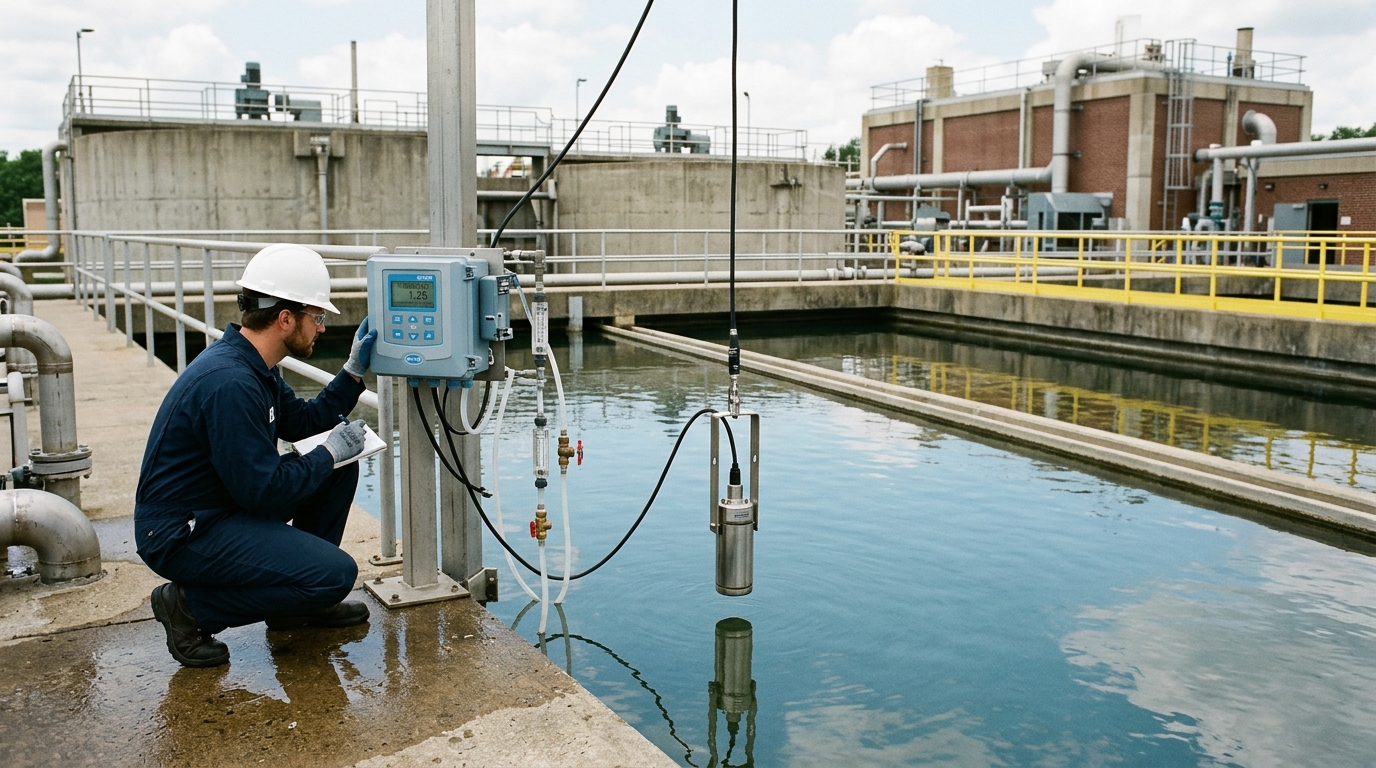
Application Solution for Turbidity/Suspended Solids Analyzers in Coagulation and Sedimentation Process Control at Water Treatment Plants
To address issues such as dosing in the coagulation and sedimentation process of water plants relying on experience, lagging response to sudden changes in raw water turbidity, large errors in manual colorimetric measurement of sedimentation tank effluent, extensive judgment of filter backwash timing, and difficulty in reporting and tracing water quality data, a flow-through turbidity analyzer and submersible turbidity/suspended solids electrodes are used to build a full-process online turbidity monitoring and process interlock control system covering "raw water-coagulation-sedimentation-filtration." The raw water turbidity collection frequency is increased from manual once every 2 hours to continuous automatic collection, the sedimentation tank effluent turbidity is stably controlled below 1 NTU, the unit consumption of coagulant is reduced by 10%~20%, and filter backwashing is changed from timed operation to turbidity breakthrough-triggered operation, resulting in significant annual water and chemical savings and providing a highly timely and traceable continuous water quality data foundation for water plants to meet water supply standards, save energy and reduce consumption, and support smart water platforms.
Overview
Summary
To address issues such as dosing in the coagulation and sedimentation process of water plants relying on experience, lagging response to sudden changes in raw water turbidity, large errors in manual colorimetric measurement of sedimentation tank effluent, extensive judgment of filter backwash timing, and difficulty in reporting and tracing water quality data, a flow-through turbidity analyzer and submersible turbidity/suspended solids electrodes are used to build a full-process online turbidity monitoring and process interlock control system covering "raw water-coagulation-sedimentation-filtration." The raw water turbidity collection frequency is increased from manual once every 2 hours to continuous automatic collection, the sedimentation tank effluent turbidity is stably controlled below 1 NTU, the unit consumption of coagulant is reduced by 10%~20%, and filter backwashing is changed from timed operation to turbidity breakthrough-triggered operation, resulting in significant annual water and chemical savings and providing a highly timely and traceable continuous water quality data foundation for water plants to meet water supply standards, save energy and reduce consumption, and support smart water platforms.
Key Advantages
Challenges
- Coagulant dosage must be dynamically adjusted according to raw water turbidity. Manual experience-based dosing leads to waste from overdosing or exceedance from underdosing, and the lack of continuous turbidity feedback prevents closed-loop optimization.
- During rainstorm flood seasons or upstream accidental discharges, raw water turbidity can surge several times within a short period. Manual sampling once every 2 hours lags in detecting sudden changes, making process adjustments passive.
- Manual colorimetric comparison and offline turbidimeters for sedimentation tank effluent are affected by sampling location, technique, and timing, resulting in high data dispersion that cannot truly reflect operating conditions.
- Filters are backwashed at fixed intervals. When turbidity is low, premature backwashing wastes water and capacity; when turbidity breaks through, delayed backwashing causes effluent exceedance.
- Manual water quality logs have inconsistent standards and delayed records. Effluent turbidity compliance data cannot be reported in real time to regulators and smart water platforms, making assessment and traceability difficult.
Results
- Turbidity collection frequency increased from manual once every 2 hours to continuous automatic collection, enabling minute-level early warning and feedforward coagulant dosing linkage for sudden raw water turbidity changes.
- Sedimentation tank effluent turbidity is stably controlled below 1 NTU, and filtered water turbidity is stably below 0.3 NTU, ensuring continuous stable effluent compliance.
- Coagulant unit consumption decreased by approximately 15% compared with manual experience-based dosing. Filter backwashing is triggered by turbidity breakthrough, reducing backwash water consumption by over 20%.
- Over 12 consecutive months, equipment availability exceeded 99% and data online rate exceeded 98%, passing water quality compliance assessment audits.
- All-element data from raw water, sedimentation, and filtered water turbidity is archived in one place. Compliance data is reported in real time to the regulatory platform, auditable and traceable.
Solution Details
Application Solution for Turbidity/Suspended Solids Analyzers in Coagulation and Sedimentation Process Control at Water Treatment Plants
Coagulation and sedimentation are the most critical physicochemical treatment steps at the front end of water treatment plants and wastewater treatment. Turbidity is not only a direct indicator for evaluating coagulation effectiveness, sedimentation efficiency, and filtration quality, but also a key process parameter for guiding chemical dosing, determining backwash timing, and providing early warning of sudden water quality changes. Traditional water plants mostly rely on manual timed sampling for colorimetric comparison or visual inspection of water samples, with data collected only a few times per day and timeliness measured in hours. When raw water turbidity fluctuates dramatically with rainfall, flood seasons, and upstream discharge, the problem of "can't see it, can't adjust it accurately, can't report it quickly" has long persisted. Chemical dosing can only be roughly adjusted based on experience, which both wastes chemicals and makes it difficult to ensure stable compliance of treated water.
The online deployment of turbidity/suspended solids analyzers provides a closed-loop solution: flow-through turbidimeters (laser 90° scattering method, compliant with ISO7027 standard) are installed at key measurement points including raw water intake, coagulation reaction, sedimentation tank effluent, and filtered water, continuously measuring 0.01~100NTU low-turbidity water samples with resolution as low as 0.001NTU; submersible turbidity/suspended solids electrodes (IP68 rated, RS485 digital output) are placed in sedimentation tanks, clarifiers, and sludge return lines, measuring 0.01~3000NTU wide-range turbidity and suspended solids concentration; HERO series RTU or PLC collects turbidity data from each point locally, links them according to the process chain of "raw water turbidity - chemical dosage - sedimentation effluent turbidity - filtered water turbidity," and transmits data via 4G/Ethernet to the water plant's smart water platform, achieving minute-level online turbidity monitoring across the entire process and automatic optimization control of dosing and backwashing.
1. Five Major Pain Points in Water Plant Coagulation and Sedimentation Processes
Chemical dosing difficult to precisely determine based on experience: Coagulant dosage needs dynamic adjustment according to raw water turbidity, temperature, and pH. Manual experience-based dosing either wastes chemicals through over-dosing or fails to meet standards due to under-dosing, and lacks continuous turbidity feedback for closed-loop optimization.
Delayed response to sudden raw water turbidity changes: Rainstorms, flood seasons, or upstream accidental discharge cause raw water turbidity to spike several times or even dozens of times within a short period. Manual sampling every 2 hours means sudden changes are discovered with delay, process adjustments are passive, and effluent turbidity temporarily exceeds standards.
Large errors in manual colorimetric comparison of sedimentation tank effluent: Visual colorimetric comparison and offline turbidimeters are affected by sampling location, operator technique, and time delays, resulting in high data dispersion that cannot truly reflect sedimentation tank operating conditions and floc settling effectiveness.
Coarse judgment of filter backwash timing: Traditional fixed-cycle timed backwashing wastes water and capacity when turbidity is low, while failure to backwash promptly when turbidity spikes leads to effluent exceeding standards, lacking continuous filtered water turbidity monitoring to support demand-triggered backwashing.
Difficult water quality data reporting and traceability: Manual records have inconsistent formats and delayed entries. Effluent turbidity compliance data cannot be reported in real time to regulatory platforms and smart water systems, making assessment and traceability difficult.
2. "Full-Process Turbidity Sensing + RTU Linkage + Platform Optimization" System Architecture
Turbidity sensing layer: Flow-through turbidimeters (0~100NTU range, 0.001NTU resolution, laser 90° scattering method) are deployed at raw water intake for continuous raw water turbidity monitoring; flow-through turbidimeters or submersible electrodes are deployed at coagulation reaction tanks and sedimentation tank effluent to evaluate coagulation and sedimentation effectiveness; high-precision flow-through turbidimeters (0~1NTU/0~20NTU low range) are deployed at filter effluent to monitor filtered water turbidity; submersible turbidity/suspended solids electrodes (0.01~3000NTU, IP68 rated, with automatic cleaning brush) are deployed at sedimentation tank sludge level, sludge return lines, and sludge discharge lines to measure suspended solids concentration and guide sludge discharge.
Acquisition & Control Layer: The HERO series RTU or water plant PLC collects turbidity data from each measurement point locally, connected via RS485/Modbus-RTU digital communication. It supports a compound dosing control strategy of "raw water turbidity feedforward + settled water turbidity feedback" and backwash triggering logic based on filtered water turbidity breakthrough, with local breakpoint data storage to ensure continuity.
Communication & Transmission Layer: Multi-channel backhaul via 4G full-network/ Ethernet/ fiber optics, supporting Modbus, OPC-UA, and smart water platform protocols, with automatic storage and retransmission upon signal anomalies.
Platform Optimization Layer: The water plant smart water platform automatically generates raw water-sedimentation-filtered water turbidity trend curves and dosing rate correlation analysis, links turbidity surges and exceedances to alarms, adjusts dosing pump frequency via settled water turbidity feedback, triggers backwash based on filtered water turbidity, archives electronic water quality records in a one-stop repository, and interfaces with regulatory reporting systems.
3. Key Technologies and Selection Points
Range and Accuracy Matching Process Stages: For raw water and settled water, select flow-through turbidimeters with a range of 0~100 NTU or 0~20 NTU and a resolution of 0.001~0.01 NTU; for filtered water, select low-range high-precision models with a range of 0~1 NTU to ensure compliance criteria; for sludge return and sludge discharge, select submersible electrodes with a wide range of 0~3000 NTU.
Measurement Principle and Standard Compliance: Prioritize laser 90° scattering method (compliant with ISO7027 international standard) turbidimeters, resistant to color and ambient light interference, with sapphire optical windows and filters ensuring low-turbidity measurement stability.
Anti-Fouling and Self-Cleaning Design: Select submersible electrodes with automatic cleaning brush models, set cleaning frequency to eliminate bubbles, fouling, and biofouling; equip flow-through turbidimeters with a stable inlet flow path (50~300 ml/min) and drain port to reduce scaling on optical windows.
Installation Method and Protection Rating: Wall-mount flow-through turbidimeters on process bypass lines with IP54 protection; install submersible electrodes directly into tanks via NPT3/4 threads with IP68 protection for long-term immersion, with cable length customized to tank depth.
Digital Communication and Data Quality Control: Select RS485 digital smart sensors supporting Modbus protocol, with strong anti-interference capability and direct integration with RTU/PLC; the platform uses a unified time base, with regular comparison between standard solution calibration and water sample calibration, ensuring turbidity data is auditable and traceable.
4. Typical Application Scenarios
Raw Water Turbidity Feedforward Dosing Control: Continuous monitoring of raw water inlet turbidity; upon sudden changes, feedforward links with dosing pumps to increase dosage, while settled water turbidity feedback fine-tunes it, achieving "feedforward + feedback" compound precision dosing with chemical unit consumption reduced by 10%~20%.
Settled Water Turbidity Online Assessment: Continuous measurement of settled water turbidity replaces manual colorimetric testing, making floc settling performance and effluent quality visible in real time, with immediate alarms upon exceedance, and sedimentation tank operating conditions accessible on a single screen.
Filter Turbidity Breakthrough Backwash Triggering: Continuous monitoring of filtered water turbidity changes fixed-cycle timed backwashing to on-demand backwashing triggered by turbidity breakthrough thresholds, saving water and energy while maintaining stable effluent turbidity compliance.
Sludge Return and Discharge Concentration Control: Submersible turbidity/suspended solids electrodes measure suspended solids concentration in sludge return and discharge pipes, guiding return ratio and discharge cycles, ensuring stable sludge concentration in the biological system.
5. Engineering Implementation and Long-Term O&M
Site Survey and Measurement Point Design: Verify water plant process stages and water quality conditions, complete turbidity instrument selection, range configuration, installation locations, and sampling flow path design for each measurement point, and deliver construction drawings and dosing/backwash control strategy documents.
Installation, Commissioning, and Calibration: Complete the installation of the flow-through turbidimeter and submersible electrode, flow path connection, and RS485 wiring; perform Formazin standard solution calibration and water sample comparison calibration; after a 48-hour continuous operation assessment, connect to the platform.
Platform Integration and Acceptance Handover: Configure the data acquisition schedule, turbidity alarm thresholds, pre-feedforward/feedback dosing parameters, and backwash trigger logic; complete acceptance by comparing online turbidity measurements with laboratory results; deliver as-built documentation and O&M manuals.
Long-term O&M and Periodic Inspection: Remotely monitor equipment status and data integrity via the platform; periodically clean the optical window, check the cleaning brush function, perform periodic calibration with standard solutions, and inspect battery and cable protection; ensure turbidity measurement quality throughout the full lifecycle.
Application Results
After a water treatment plant with a daily supply capacity of 50,000 tons deployed a flow-through turbidimeter and submersible turbidity/suspended solids electrode online monitoring system across the entire process of raw water, coagulation, sedimentation, and filtration: turbidity collection frequency increased from manual sampling once every 2 hours to continuous automatic collection; sudden raw water turbidity surges (short-term spikes of more than 8 times during rainstorms) achieved minute-level early warning and pre-feedforward dosing linkage; sedimentation tank effluent turbidity was stably controlled below 1 NTU, and filtered water turbidity remained stably below 0.3 NTU; coagulant unit consumption decreased by approximately 15% compared to manual experience-based dosing; filter backwashing was changed from timed to turbidity breakthrough-triggered, reducing backwash water consumption by more than 20%; over 12 consecutive months, equipment availability exceeded 99% and data online rate exceeded 98%; compliant effluent turbidity data was reported to the regulatory platform in real time and passed water quality assessment audits, providing a reliable continuous water quality data foundation for the plant's energy savings, compliant water supply, and smart water management construction.
Key Product Features
- The flow-through turbidimeter uses laser 90° scattering method (compliant with ISO7027 international standard), with selectable ranges of 0~1/0~20/0~100 NTU, resolution as low as 0.001 NTU, and indication error ±2% or ±0.015 NTU, whichever is greater.
- The submersible turbidity/suspended solids electrode has IP68 protection, a wide measuring range of 0.01~3000 NTU, SUS316L body + PPS fiberglass upper and lower covers, and a sapphire optical window resistant to color and ambient light interference, suitable for long-term immersion.
- The submersible electrode provides RS485 digital smart output supporting Modbus protocol, with strong anti-interference capability for direct integration with RTU/PLC. It features an automatic cleaning brush to eliminate bubble contamination and biological adhesion, extending maintenance intervals.
- The HERO series RTU collects turbidity from multiple measurement points on site, supports composite dosing control with raw water turbidity feedforward + sedimentation effluent turbidity feedback, and filtered water turbidity breakthrough-triggered backwash logic, with 16M Flash local storage and resume-from-breakpoint capability.
- The flow-through turbidimeter is wall-mounted with IP54 protection, with a stable inlet flow path of 50~300 ml/min and a drain port to reduce scaling; the submersible electrode with NPT3/4 thread is directly immersed, and cable length can be customized up to 100 meters according to tank depth.
- The platform automatically generates raw water-sedimentation-filtered water turbidity trend curves and correlation analysis with coagulant dosage. Turbidity sudden changes and exceedances trigger linked alarms, and electronic water quality logs are archived in one place and connected to the regulatory reporting system.
? Reference Sources
- ISO7027 — Water quality: Determination of turbidity (international standard for laser 90° scattering method)
- Application Solution for Turbidity/Suspended Solids Analyzers in Coagulation and Sedimentation Process Control at Water Treatment Plants
Approach
How we implement intelligence into your infrastructure step by step.
Site Survey and Measurement Point Design
Verify the water plant process sections and water quality conditions, complete turbidity meter selection, range configuration, installation location, and sampling flow path design for each measurement point, and deliver construction drawings and dosing/backwash control strategy documents.
Installation, Commissioning, and Calibration
Complete the installation of flow-through turbidimeters and submersible electrodes, flow path connection, and RS485 wiring. Perform Formazin standard solution calibration and water sample comparison calibration. After 48 hours of continuous operation assessment, connect to the platform.
Platform Integration and Acceptance Handover
Configure collection schedules, turbidity alarm thresholds, dosing feedforward/feedback parameters, and backwash trigger logic. Complete online turbidity and laboratory comparison acceptance, and deliver as-built documentation and O&M manuals.
Long-term O&M and Periodic Inspection
Platform remote monitoring of equipment status and data integrity, periodic cleaning of optical windows, functional checks of cleaning brushes, periodic calibration with standard solutions, and inspection of battery and cable protection to ensure turbidity measurement quality.
❓ Related FAQs
Related Solutions
Dissolved Oxygen Electrode Solution for Precise Aeration Control in Wastewater Treatment Plant Aeration Tanks
pH/ORP Analyzer Solution for Industrial Wastewater Neutralization Process Control
Online Residual Chlorine Analyzer Solution for Secondary Water Supply Pump Room Water Quality Monitoring

Ready to Optimize Your Business?
Contact us, and our professional team will provide customized solutions to help your business achieve digital transformation.
Get In Touch