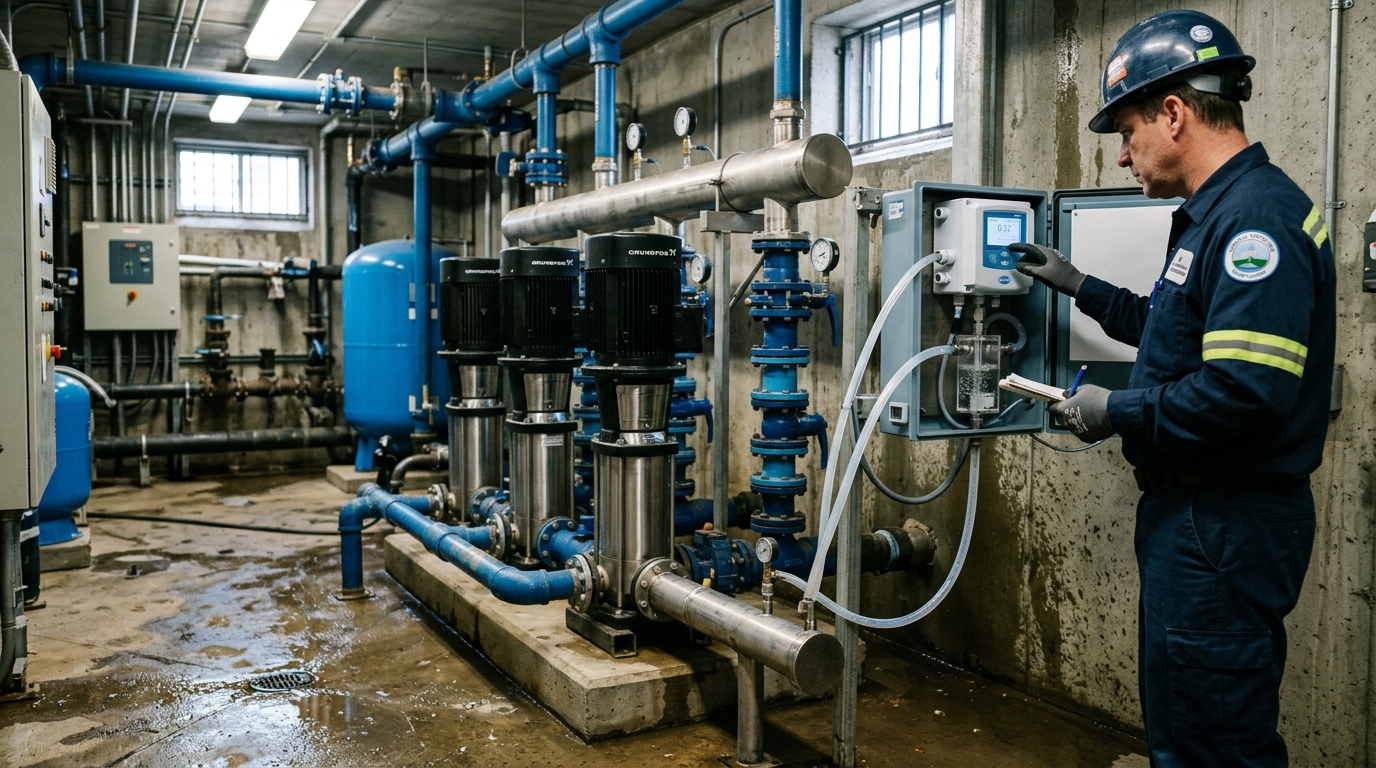
Online Residual Chlorine Analyzer Solution for Secondary Water Supply Pump Room Water Quality Monitoring
Secondary supply pump rooms suffer fast chlorine decay, lagging manual testing and crude disinfectant dosing. This solution deploys amperometric online residual chlorine analyzers (0-5 mg/L, 0.01 mg/L resolution, automatic temperature and pH compensation) to monitor pump-room discharge chlorine continuously, feeding 4-20 mA/RS485 into the PLC/RTU for closed-loop dosing control with real-time alarms and platform upload - lifting terminal chlorine compliance to 99.6%, cutting disinfectant use by about 18% and securing the urban last-mile water quality.
Overview
Summary
Secondary supply pump rooms suffer fast chlorine decay, lagging manual testing and crude disinfectant dosing. This solution deploys amperometric online residual chlorine analyzers (0-5 mg/L, 0.01 mg/L resolution, automatic temperature and pH compensation) to monitor pump-room discharge chlorine continuously, feeding 4-20 mA/RS485 into the PLC/RTU for closed-loop dosing control with real-time alarms and platform upload - lifting terminal chlorine compliance to 99.6%, cutting disinfectant use by about 18% and securing the urban last-mile water quality.
Key Advantages
Challenges
- Residual chlorine decays continuously through networks and tanks and swings hard at demand peaks, while infrequent manual sampling reacts too late
- Fixed-schedule dosing ignores inlet chlorine and flow changes, so over-dosing and under-dosing coexist
- Tank contamination and network backflow are only caught via complaints or monthly tests, with no real-time early warning
- Large numbers of scattered pump rooms make manual patrol sampling costly and the discontinuous data cannot support KPI assessment or regulation
- GB 5749 and local secondary-supply regulations set explicit terminal chlorine (≥0.05 mg/L) and online monitoring compliance requirements
Results
- Terminal chlorine compliance rose from 91% to 99.6%, major water-safety improvement
- Disinfectant consumption down about 18%, precise dosing also reducing by-product risk
- Average anomaly detection time cut from 48 hours to under 15 minutes
- Manual sampling frequency reduced 70%, significant O&M labour and cost savings
- Fully traceable online chlorine data satisfying health-authority inspections and utility KPI audits
Solution Details
Online Residual Chlorine Analyzer Solution for Secondary Water Supply Pump Room Water Quality Monitoring
Secondary water supply is the "last mile" of urban water distribution, and the water quality inside pump rooms directly affects the drinking-water safety of thousands of households. Residual chlorine left from the water plant decays continuously through pipe networks and storage tanks; without effective disinfection and water-quality monitoring in secondary supply pump rooms, microbiological risks rise significantly. Manual grab-sample chlorine testing is infrequent and lagging, unable to capture quality fluctuations or support precise disinfectant dosing.
The online residual chlorine analyzer uses an amperometric (constant-potential electrolysis) sensor to measure free residual chlorine continuously in real time, with a range of 0-5 mg/L and 0.01 mg/L resolution, backed by automatic temperature and pH compensation for stable, reliable readings. The transmitter outputs 4-20 mA plus RS485 Modbus, connecting directly to the pump room PLC or RTU and interlocking with sodium hypochlorite / chlorine dioxide dosing equipment - achieving closed-loop, demand-based disinfection and upgrading operations from periodic sampling and experience-based dosing to continuous monitoring and quality-driven dosing.
Core Challenges of Water Quality Monitoring in Secondary Supply Pump Rooms
Fast chlorine decay and large fluctuations: Tank retention time and peak-demand swings drive residual chlorine between 0.05 and 0.5 mg/L; manual testing is infrequent and lagging, unable to intervene when quality deteriorates.
Crude disinfection dosing: Most pump rooms dose on fixed schedules regardless of inlet chlorine and flow variations, causing over-dosing (taste issues, disinfection by-product risk) and under-dosing (microbiological exceedances) to coexist.
Delayed detection of anomalies: Tank contamination or network backflow is only discovered through user complaints or monthly tests, with no real-time early warning.
Stretched O&M manpower: Utilities operate large numbers of widely scattered pump rooms; manual patrol sampling is costly and the discontinuous data cannot support performance assessment or regulatory oversight.
Growing compliance pressure: GB 5749 (Sanitary Standard for Drinking Water) and local secondary-supply regulations set explicit requirements for terminal residual chlorine (no less than 0.05 mg/L) and online water-quality monitoring capability.
Online Residual Chlorine Analysis Solution Architecture
Architecture: a four-layer design - sampling, measurement, control and upload - covering the full chain of pump-room water quality monitoring.
Sampling and measurement layer: Sample water is drawn from the pump-room discharge header (or tank outlet), passes a pressure-reducing stabilizing valve and pre-filter into the analyzer flow cell; the amperometric chlorine sensor measures free residual chlorine continuously while temperature is measured simultaneously, with built-in pH compensation (optional external pH electrode) ensuring consistent readings across varying water qualities.
Closed-loop control layer: The pump-room PLC/RTU samples the chlorine signal in real time, runs PID against the setpoint (e.g. 0.30 mg/L) and modulates the hypochlorite metering pump to achieve demand-based disinfection; over-limit or low chlorine triggers automatic alarms and can interlock inlet valve closure, standby-tank switching or flushing sequences.
Data upload layer: Via 4G/Ethernet, chlorine, temperature, flow, pH (optional) and device status are uploaded to the secondary-supply management platform, which generates quality trends and daily/monthly reports, supports mobile viewing and tiered alarm push, and connects to the utility dispatch center.
Selection and Installation Key Points for Online Residual Chlorine Analyzer
Selection: range 0-5 mg/L free chlorine (0-10 mg/L optional for high-dose scenarios), resolution 0.01 mg/L, repeatability ±2% or ±0.02 mg/L; T90 response ≤ 60 s; reagent-free membrane or electrolyte-type sensors chosen per O&M conditions; IP65 transmitter with 4-20 mA + RS485 Modbus dual output; flow cell with automatic cleaning and bubble elimination to cut maintenance.
Installation: take the sample at a steady-flow, bubble-free section of the discharge header, keep sample tubing short (under 5 m) and continuously flowing with no dead legs; drain the flow cell to a nearby floor drain; mount the analyzer in a dry, ventilated, shaded location at 5-40 °C; keep sensors away from direct sunlight and strong EMI; perform DPD colorimetric cross-check calibration every two weeks for long-term accuracy.
Monitoring and O&M Management for Secondary Water Supply Pump Rooms
The platform displays live chlorine curves and device health for every pump room; chlorine below 0.05 mg/L (the national terminal limit) or above the upper setpoint triggers tiered alarms to O&M staff with a full response audit trail; daily and monthly reports are generated automatically to support utility KPI assessment and health-authority inspections; sensor lifetime and electrolyte level are predicted in advance to prevent sudden failures; historical data is retained for at least 3 years.
Proven Results of Online Residual Chlorine Monitoring Deployment
After a provincial capital utility deployed online chlorine monitoring with closed-loop dosing in 126 secondary supply pump rooms: terminal chlorine compliance rose from 91% to 99.6%; disinfectant consumption dropped by about 18%, with precise dosing also reducing by-product risk; average time to detect water-quality anomalies shrank from 48 hours to under 15 minutes; manual sampling frequency fell 70%, significantly lowering annual O&M cost; and fully traceable online chlorine data helped the utility pass the health authority's secondary-supply audit, securing the water quality of the urban "last mile".
0-5 mg/L
Free Chlorine Range
0.01 mg/L
Resolution
±2%
Repeatability
≤ 60 s
T90 Response
IP65
Transmitter Rating
4-20 mA
+ RS485 Modbus
Key Features of the Online Residual Chlorine Analyzer
- Amperometric sensor, 0-5 mg/L free chlorine range, 0.01 mg/L resolution, ±2% repeatability
- Automatic temperature and pH compensation, T90 ≤ 60 s, stable reliable measurement
- 4-20 mA plus RS485 Modbus output, direct PLC/RTU integration for closed-loop dosing control
- Reagent-free flow cell with automatic cleaning and bubble elimination, low maintenance
- IP65 transmitter, secondary-supply platform integration, mobile viewing and tiered alarm push
- Optional turbidity/pH/temperature expansion for multi-parameter monitoring on one transmitter
? Reference Sources
- GB 5749 - Sanitary Standard for Drinking Water
- Local secondary water supply regulations and monitoring requirements
- Utility deployment case study - 126 secondary supply pump rooms
Approach
How we implement intelligence into your infrastructure step by step.
Pump room survey and sampling-point assessment
Review pump-room layout, discharge header location, tank volume and demand patterns to fix the sampling point, analyzer position and closed-loop control strategy.
Equipment selection and installation design
Select chlorine range, sensor type and communications; design sample pressure reduction and filtration, flow-cell drainage and dosing interlock.
Installation, commissioning and cross-check calibration
Install the analyzer with 4-20 mA/RS485 wiring, perform DPD colorimetric cross-check, tune PID dosing parameters and alarm thresholds.
Platform integration and O&M handover
Connect to the secondary-supply platform, configure trends, reports and tiered alarms, train O&M staff and hand over spares and the calibration plan.
❓ Related FAQs
Related Solutions
Application Solution for Turbidity/Suspended Solids Analyzers in Coagulation and Sedimentation Process Control at Water Treatment Plants
Dissolved Oxygen Electrode Solution for Precise Aeration Control in Wastewater Treatment Plant Aeration Tanks
pH/ORP Analyzer Solution for Industrial Wastewater Neutralization Process Control

Ready to Optimize Your Business?
Contact us, and our professional team will provide customized solutions to help your business achieve digital transformation.
Get In Touch