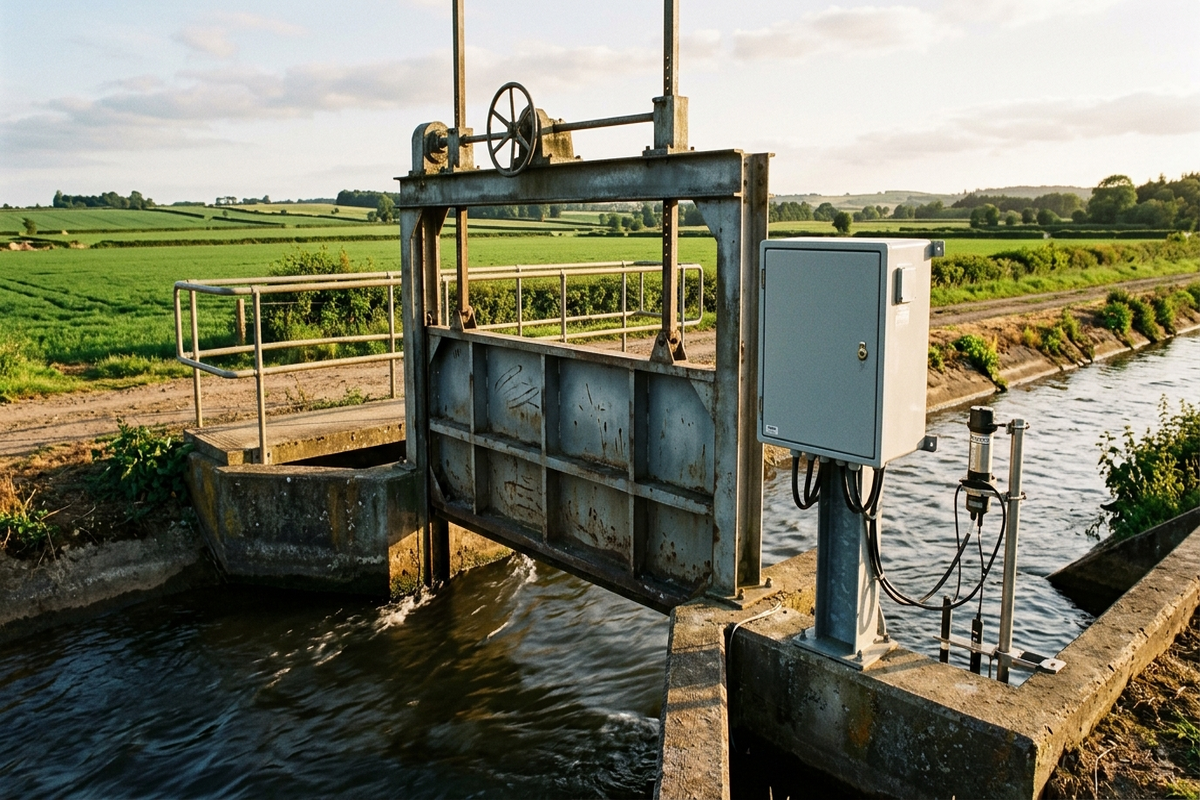
RTU-Based Remote Control Solution for Irrigation District Gates
Addressing the challenges of scattered gate management, low manual operation efficiency, and delayed water allocation in large and medium-sized irrigation districts, this solution uses RTU remote telemetry terminals to achieve remote gate operation, real-time water level and flow monitoring, and intelligent coordinated control.
Overview
Summary
Addressing the challenges of scattered gate management, low manual operation efficiency, and delayed water allocation in large and medium-sized irrigation districts, this solution uses RTU remote telemetry terminals to achieve remote gate operation, real-time water level and flow monitoring, and intelligent coordinated control.
Key Advantages
Challenges
- Widely distributed gates
- Delayed water allocation
- Lack of real-time monitoring
- Slow extreme weather response
- Aging equipment, low automation
Results
- Centralized remote gate management
- Second-level control response
- Real-time water level and flow monitoring
- Intelligent coordinated scheduling
- Automatic water consumption statistics
Solution Details
RTU-Based Remote Control Solution for Irrigation District Gates: An Overview
Large and medium-sized irrigation districts are the core infrastructure for agricultural irrigation. With numerous gates distributed across extensive canal networks, traditional manual inspection and on-site operation can no longer meet modern irrigation management requirements. Gate operation relies on personnel traveling to each site, resulting in slow response, low scheduling efficiency, and inability to achieve precise water resource allocation. An RTU-based remote control solution for irrigation district gates addresses these critical challenges by enabling centralized, real-time, and automated gate management.
Core Challenges in Irrigation District Gate Management
- Widely Distributed Gates: Canal networks in large irrigation districts can span hundreds of kilometers with dozens to hundreds of gates. Manual inspection and on-site operation are time-consuming, labor-intensive, and costly.
- Delayed Water Allocation: In traditional mode, information about upstream water changes and downstream demand adjustments relies on manual communication. Gate response lags by hours or even days, causing water waste or insufficient irrigation.
- Lack of Real-Time Monitoring: Most irrigation district gates lack online water level and flow monitoring. Scheduling decisions rely on experience rather than data-driven precision.
- Slow Extreme Weather Response: During floods or droughts, rapid gate adjustments are needed. Manual operation cannot respond in time, creating safety risks.
- Aging Equipment, Low Automation: Many irrigation district gates remain manually or simply electrically operated, lacking remote communication and automatic control capabilities.
Solution: System Architecture of the RTU-Based Remote Control Solution
The solution employs a four-layer architecture: Perception — Transmission — Platform — Application.
- Perception Layer: Deploy RTU remote telemetry terminals at each gate, connecting gate opening sensors, upstream/downstream water level gauges, and canal flow meters for real-time data collection.
- Transmission Layer: RTUs upload data to the irrigation management center via 4G/5G, LoRa mesh, or BeiDou satellite communication. Supports store-and-forward with ≥30 days local caching.
- Platform Layer: The irrigation informatization platform aggregates all gate data, providing GIS mapping, real-time dashboards, historical trend analysis, and alarm management.
- Application Layer: Supports web, mobile APP, and large-screen display access. Managers can view gate status and issue control commands anytime, anywhere.
RTU Selection and Deployment for Precise Gate Control
- Multi-Channel Acquisition: Supports 4-20mA, RS485/Modbus interfaces for water level gauges, flow meters, gate opening sensors, and rain gauges.
- Gate Control Output: Relay/analog outputs drive electric hoists for remote gate operation with precise opening control (±1% accuracy).
- Low Power Design: Sleep current <1mA, solar + lithium battery powered, ≥20 days continuous operation in overcast conditions.
- Protection Rating: IP67, operating temperature -40°C to +85°C, lightning protection for harsh field environments.
- Local Logic Control: Built-in PLC logic supports local coordinated control (e.g., auto-open gate when water level exceeds threshold), autonomous operation even during communication outages.
Intelligent Control Strategies for Water Allocation
- Water Level Coordinated Control: RTUs automatically adjust gate openings based on upstream/downstream water level setpoints to maintain canal levels within target ranges.
- Flow-Based Allocation: Combined with downstream branch canal demand plans, automatically calculates target gate openings for on-demand water distribution.
- Flood Emergency Mode: When water level exceeds warning thresholds, RTUs automatically trigger emergency gate opening and send alarms to the management center.
- Scheduled Dispatch: Supports time-based gate opening schedules for automated irrigation rotation.
- Remote Manual Control: Managers can remotely adjust any gate opening via platform or APP, with full operation audit trails.
Data Management and Analytics with GIS Mapping
- Real-Time Monitoring: Water level, flow, gate opening, and rainfall data displayed in real-time with ≤1 minute refresh.
- Historical Query: Query historical data by time, gate, and parameter type with trend charts and statistical reports.
- Alarm Management: Multi-level alarms (warning, alarm, emergency) via SMS, APP push, and audible/visual alerts.
- Water Consumption Statistics: Automatic statistics of water usage by canal and time period, supporting water fee billing and resource planning.
Technical Advantages of the RTU-Based Remote Control Solution
- Centralized Remote Management: One management center controls hundreds of gates, drastically reducing manual inspection and on-site operations.
- Second-Level Response: Control command to gate action response <3 seconds, far faster than hour-level manual response.
- Intelligent Coordination: RTU local logic + platform global optimization, from single-gate auto-control to district-wide intelligent scheduling.
- High Reliability: Industrial-grade design, MTBF ≥100,000 hours, dual communication link redundancy for critical control continuity.
- Open Integration: Supports Modbus/MQTT/OPC-UA standard protocols, compatible with existing SCADA and water informatization platforms.
Typical Applications for Irrigation District Gates
- Remote control of main/branch canal gates in large and medium irrigation districts
- Automation retrofit of reservoir irrigation discharge gates
- Joint gate scheduling for cross-basin water transfer projects
- Intelligent management of urban landscape water system gates
- Coordinated flood drainage pump station gate control
Implementation Recommendations for the RTU-Based Remote Control Solution
- Survey: Comprehensive assessment of gate quantity, type, operation mode, communication conditions, and power supply.
- Design: Design RTU deployment and communication network (public/LoRa/BeiDou hybrid) based on gate distribution.
- Equipment Retrofit: Install electric hoists and sensors on existing manual gates; new gates equipped with RTU systems directly.
- Platform Deployment: Deploy irrigation informatization platform, configure control logic, alarm rules, and scheduling plans.
- Commissioning: Per-station debugging of communication links, control loops, and coordination logic with 72-hour continuous operation testing.
- Training: Train irrigation management staff on platform and APP usage, establish remote inspection and maintenance protocols.
RTU Remote Telemetry
Precise Gate Opening Control
Low-Power Solar Supply
Local PLC Coordination Logic
Multi-Communication Networking
GIS Mapping Display
? Reference Sources
- Irrigation District Automation Technical Specifications (SL/T 802-2020)
- RTU Product Datasheet and Application Guide
- Case Studies from Large Irrigation District Modernization Projects
Approach
How we implement intelligence into your infrastructure step by step.
Perception Layer
Deploy RTU remote telemetry terminals at each gate, connecting gate opening sensors, water level gauges, and flow meters for real-time data collection.
Transmission Layer
Upload RTU data to the irrigation management center via 4G/LoRa/BeiDou hybrid communication with store-and-forward and dual-link redundancy.
Platform Layer
Deploy irrigation informatization platform providing GIS mapping, real-time dashboards, historical analysis, alarm management, and remote control.
Intelligent Control
Configure water level coordination, flow allocation, flood emergency, and scheduled rotation strategies for district-wide intelligent scheduling.
❓ Related FAQs
Related Solutions
Distributed RTU Solution for Long-Distance Water Pipeline Pressure Monitoring
Compact Water Quality Monitoring Station Solution for Township River Cross-Section Assessment
Micro-Power Self-Powered Portable Telemetry Terminal for Emergency Water Source Quality Monitoring

Ready to Optimize Your Business?
Contact us, and our professional team will provide customized solutions to help your business achieve digital transformation.
Get In Touch