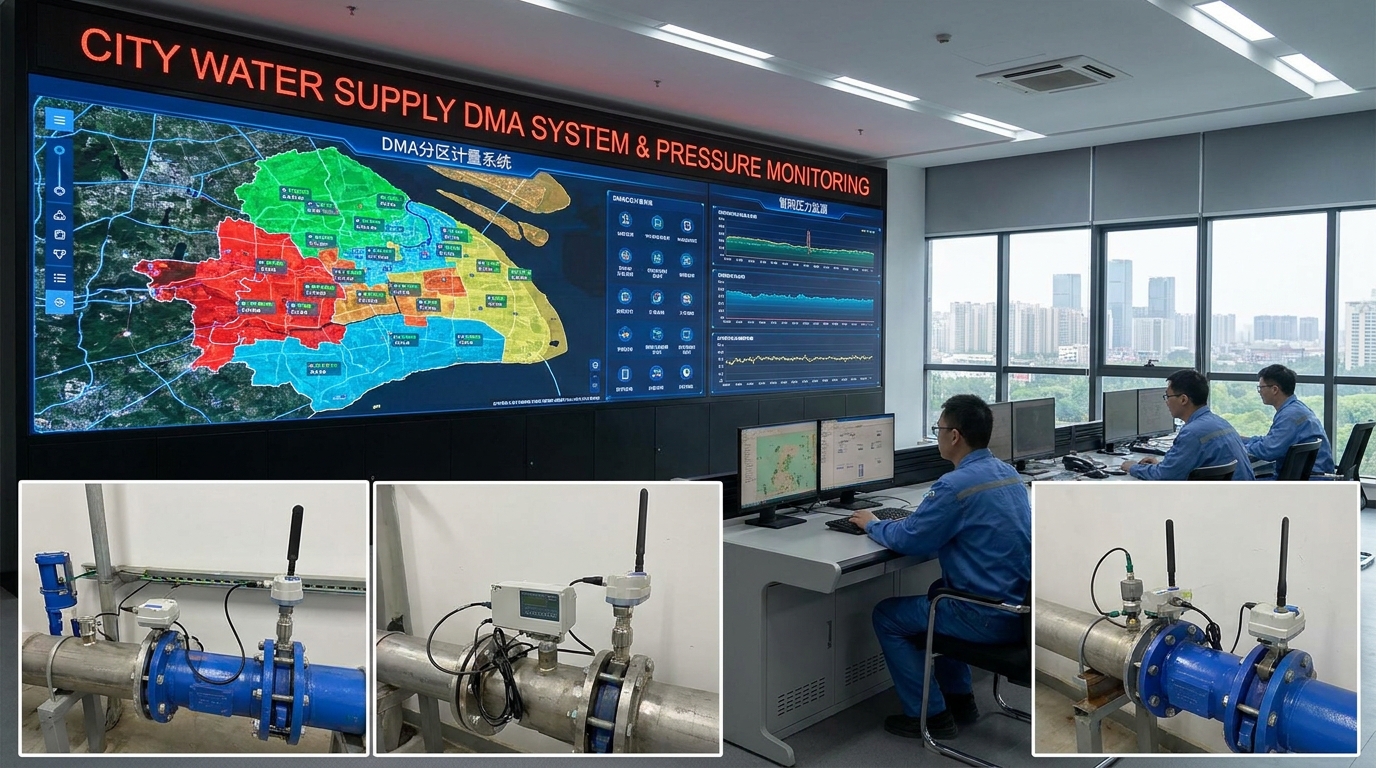
From Technical Challenges to Successful Implementation: A Chronicle of Urban Pipe Network Project Execution
As urbanization accelerates and municipal water supply systems expand in scale, challenges—including aging infrastructure, significant water loss, and rising operational costs—are becoming increasingly acute. Reducing non-revenue water (NRW) and advancing resource-efficient water management have thus emerged as strategic priorities for the global water industry.
This article presents a real-world case study from M City—a prefecture-level city in East China—where Yicai Tech collaborated with the local water group to implement a District Metered Area (DMA)–based leakage control project across the urban core. Drawing on comprehensive field data and operational insights, this report details the technical approach, implementation methodology, and quantifiable outcomes of the initiative.
I. Project Background and Baseline Water System Conditions
The urban core of M City covers approximately 120 km² and serves nearly one million residents. Prior to the project, its distribution network spanned roughly 1,350 km, comprising ductile iron pipes, polyethylene (PE) pipes, and legacy materials—including grey cast iron and concrete pipes installed decades ago. Due to heterogeneous construction timelines, complex subsurface utility interferences, and fragmented asset records, granular network monitoring and proactive management were virtually impossible.
Key Baseline Metrics
- ● Average Daily Production: 280,000 m³
- ● Overall Leakage Rate: 23.8% (Far exceeding the national benchmark of ≤15%)
- ● National Standard Reference: CJJ 92–2016 (Standard for Leakage Control and Evaluation)
Such high NRW not only represented massive water wastage but also imposed substantial burdens on treatment plant energy consumption, chemical dosing, and pump station operations. In response, M City Water Group partnered with Yicai Tech to launch a comprehensive, DMA-driven leakage reduction program grounded in data intelligence and hydraulic engineering rigor.
II. Key Technical Challenges Encountered
During feasibility assessment and design phases, the project team identified three critical technical hurdles:
Topological Complexity
The historic urban core features a highly interconnected looped network. Arbitrary segmentation risks abrupt pressure drops or stagnant flow zones.
Data Gaps
Nearly 30% of pipelines from the 1990s lacked accurate GIS coordinates or as-built drawings, impeding precise boundary delineation.
Pressure Transients
Terrain-induced elevation differentials caused elevated residual pressures at night, exacerbating leakage and distorting Minimum Night Flow (MNF) patterns.
III. Integrated Solution and Implementation Strategy
To address these interrelated challenges, the team adopted a phased, adaptive framework: “Comprehensive Planning → Tiered Metering → Phased Rollout → Dynamic Optimization.”
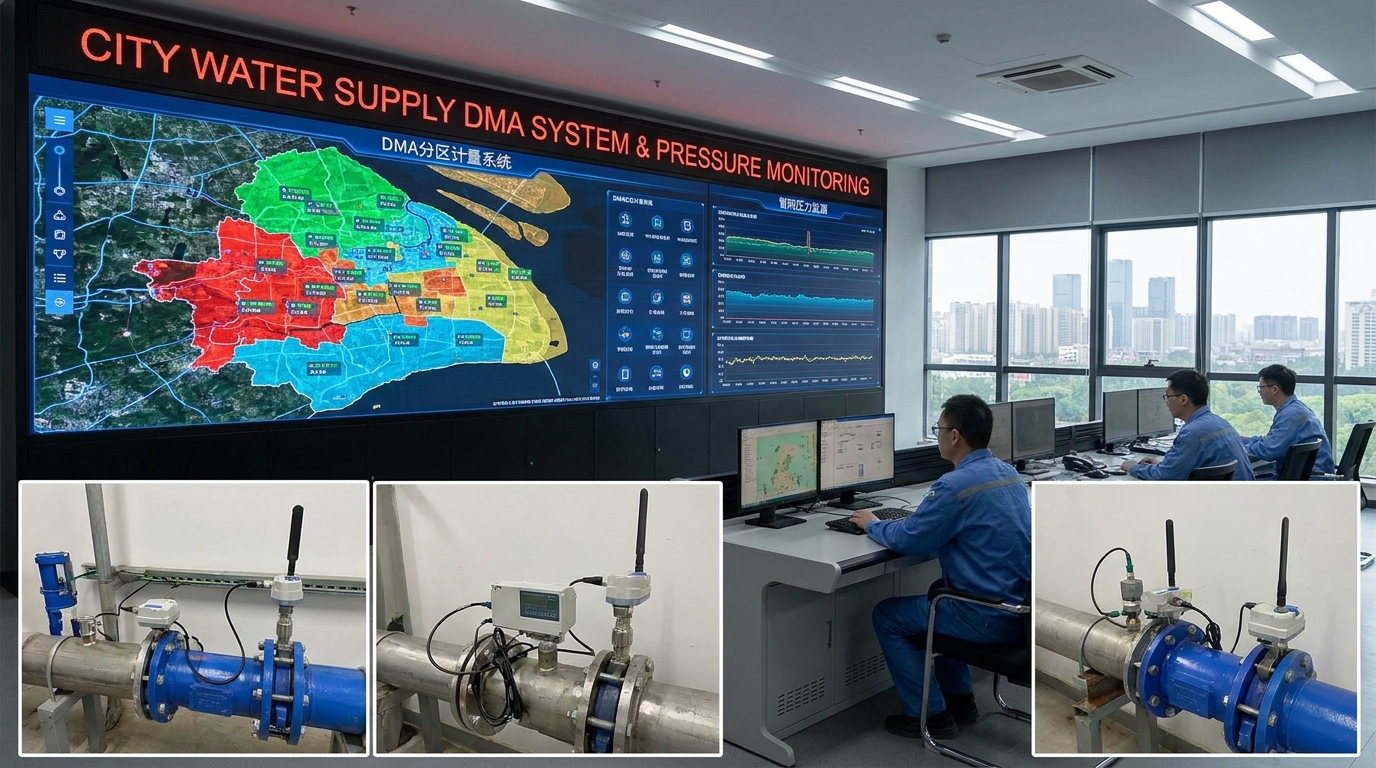
1. Hydraulic-Aware Topology Reconstruction
Leveraging GIS-integrated hydraulic micro-simulation software, the entire 1,350-km network was virtually segmented and hydraulically validated. A hierarchical DMA architecture was established:
- Level-1 DMAs: 5 major zones aligned with water plant service boundaries.
- Level-2 DMAs: 28 zones bounded by arterial roads and natural hydrological divides.
- Level-3 DMAs: 115 fine-grained zones serving 2,000–5,000 residential connections each.
2. High-Fidelity IoT Metering Infrastructure
At each inlet and outlet node of the 115 Level-3 DMAs, the team installed 142 high-accuracy electromagnetic flowmeters—certified to Class 0.5 accuracy—with integrated smart data acquisition terminals. These devices transmit synchronized flow and pressure readings every 15 minutes to a centralized SCADA platform. In high-pressure zones, intelligent pressure-reducing valves (PRVs) were deployed to dynamically modulate nocturnal pressure profiles.
"When a DMA’s MNF deviates by >15% from its statistically derived norm for three consecutive nights, the system triggers a geotagged work order—guiding field technicians to conduct targeted acoustic leak detection with sub-10-meter precision."
IV. Measurable Outcomes and Performance Validation
Following an 18-month construction phase and one year of stabilized operation, the project delivered robust, verifiable results across economic, operational, and resilience dimensions.
Down from 23.8%, achieving full compliance with national regulatory targets.
Equivalent to over RMB 10 million ($1.4 million USD) in avoided production costs.
Operational Efficiency Gains
- Leak Detection Efficiency: Improved by 300%. Field teams precisely located and repaired 314 concealed underground leaks and 62 valve internal leaks.
- Main-Break Incidents: Reduced by 45% through intelligent nighttime pressure management.
- Asset Life Extension: Strengthened system-wide supply security and reduced stress on aging pipes.
V. Industry Implications and Forward Outlook
The M City experience underscores that effective leakage control is not merely about pipe repair—it is a multidisciplinary systems engineering endeavor integrating hydraulic modeling, spatial informatics, edge sensing, and predictive analytics. Scientific DMA zoning forms the structural foundation; reliable, high-resolution metering provides actionable intelligence; and continuously refined data analytics constitute the operational nervous system sustaining long-term performance gains.
Looking ahead, as digital twin technologies mature and AI-driven decision support becomes mainstream, DMA-based, data-centric network management will evolve from best practice to industry standard—powering the global water sector’s transition toward sustainability, resilience, and net-zero operations.

