Smart Irrigation vs. Water Saving: A Selection Guide for Smart Water Scenarios
As the global water supply-demand gap widens, irrigation district informatization has become the cornerstone of agricultural modernization. This guide provides a comparative analysis of mainstream technical routes—ranging from traditional wired PLC systems to cutting-edge AIoT solutions—to help management departments select the most suitable architecture for efficient water resource management and smart irrigation implementation.

Traditional Distributed Control Based on Wired Communication and PLC
This route centers on Programmable Logic Controllers (PLC), utilizing fiber optics or dedicated cables to build robust SCADA systems. It represents the most mature technical form for early-stage irrigation district development, prioritizing absolute stability.
The system boasts exceptional anti-interference capabilities, guaranteeing millisecond-level data latency and high precision for gate operations. However, construction costs are prohibitively high, and laying cables in complex outdoor terrain can be difficult and time-consuming.
Best For:
Trunk engineering of large-scale irrigation districts, such as canal headworks, major locks, and core pumping stations where safety and real-time performance are critical.
IoT Route Using Low-Power Wide-Area Networks (LPWAN)
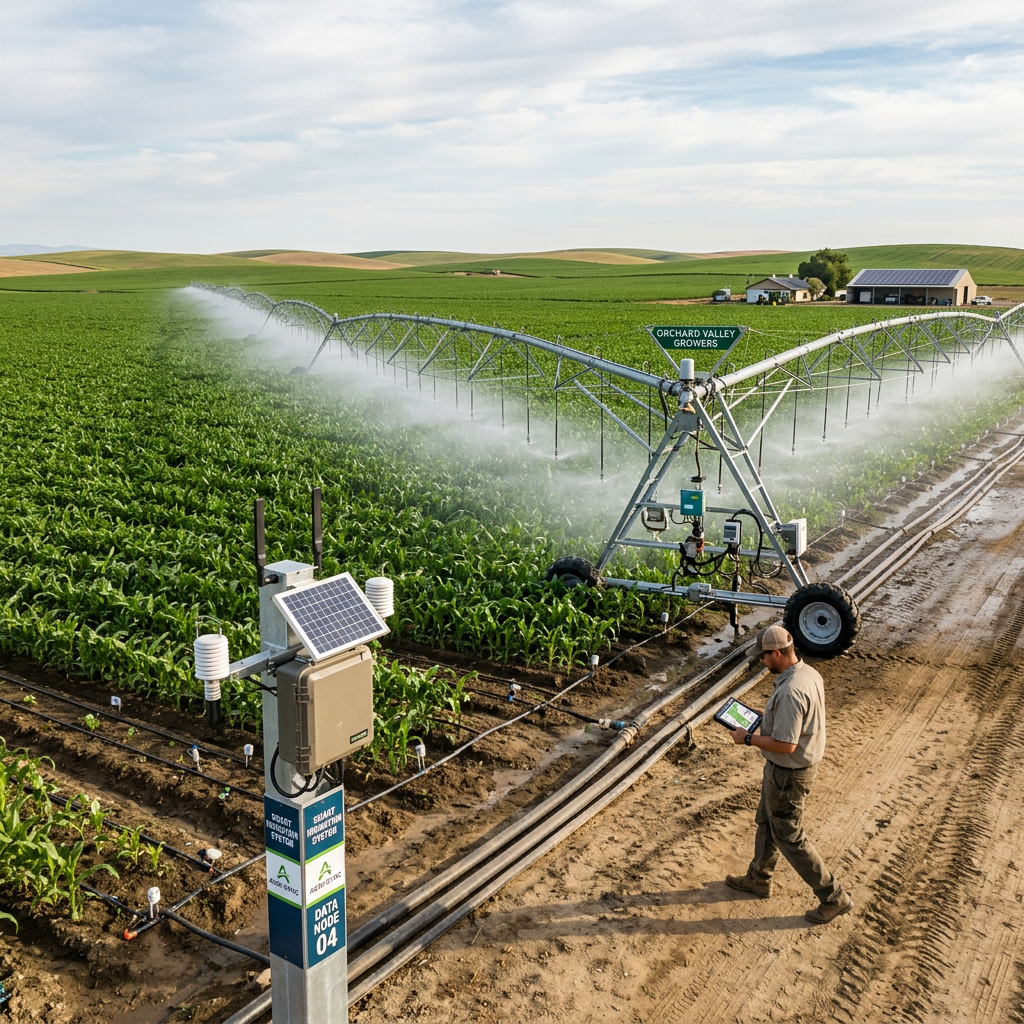
Leveraging technologies like NB-IoT, LoRa, and 4G/5G, this route combines solar power with low-power wireless terminals for flexible deployment. It breaks spatial limitations, allowing information perception to extend into every capillary vessel of the irrigation district.
While it significantly reduces costs and enables large-area soil moisture monitoring, signal blind spots may exist in remote mountainous areas. Additionally, limited by low-power design, data collection is typically minute-level or hour-level, making it unsuitable for high-frequency hydraulic control.
Key Advantage
Flexible deployment and low cost for field-level smart irrigation.
Limitation
Signal gaps in remote areas; lower data frequency for dynamic control.
AIoT Intelligent Fusion via Cloud-Edge-End Collaboration
This cutting-edge route integrates Edge Computing and Artificial Intelligence (AI) to move beyond simple data transport. On-site terminals possess logic computing capabilities, while the cloud handles big data analysis and hydrological modeling.
Edge gateways can autonomously execute water-saving scheduling even during network outages, while the cloud generates optimal distribution plans based on weather and crop demand. Although the initial threshold and integration complexity are high, this route truly realizes "precise supply according to demand."
Ideal Scenario:
Medium-to-large projects aiming for "Digital Twin Irrigation Districts" or national-level modern demonstration sites with high water-saving efficiency requirements.
Comprehensive Selection Recommendations and Outlook
No single technical route dominates all scenarios. Management bodies should adhere to principles of "adapting measures to local conditions," "hierarchical deployment," and "compatible evolution."
-
1
Core Hubs & Main Canals Prioritize the PLC measurement and control route ("wired as mainstay, wireless as auxiliary") to ensure engineering safety and backbone precision.
-
2
Secondary Canals & Field Ends Vigorously promote wireless IoT technology to achieve full coverage with high cost-performance ratios for smart irrigation goals.
-
3
Top-Level Design Reserve API interfaces and data protocol standards to facilitate future upgrades to the integrated "Cloud-Edge-End" AIoT architecture.
The essence of irrigation district informatization lies not in piling up new technologies, but in optimizing resource allocation through reasonable technical combinations. Objectively evaluating assets and clarifying management pain points are essential to finding the best balance point for modern agriculture.

