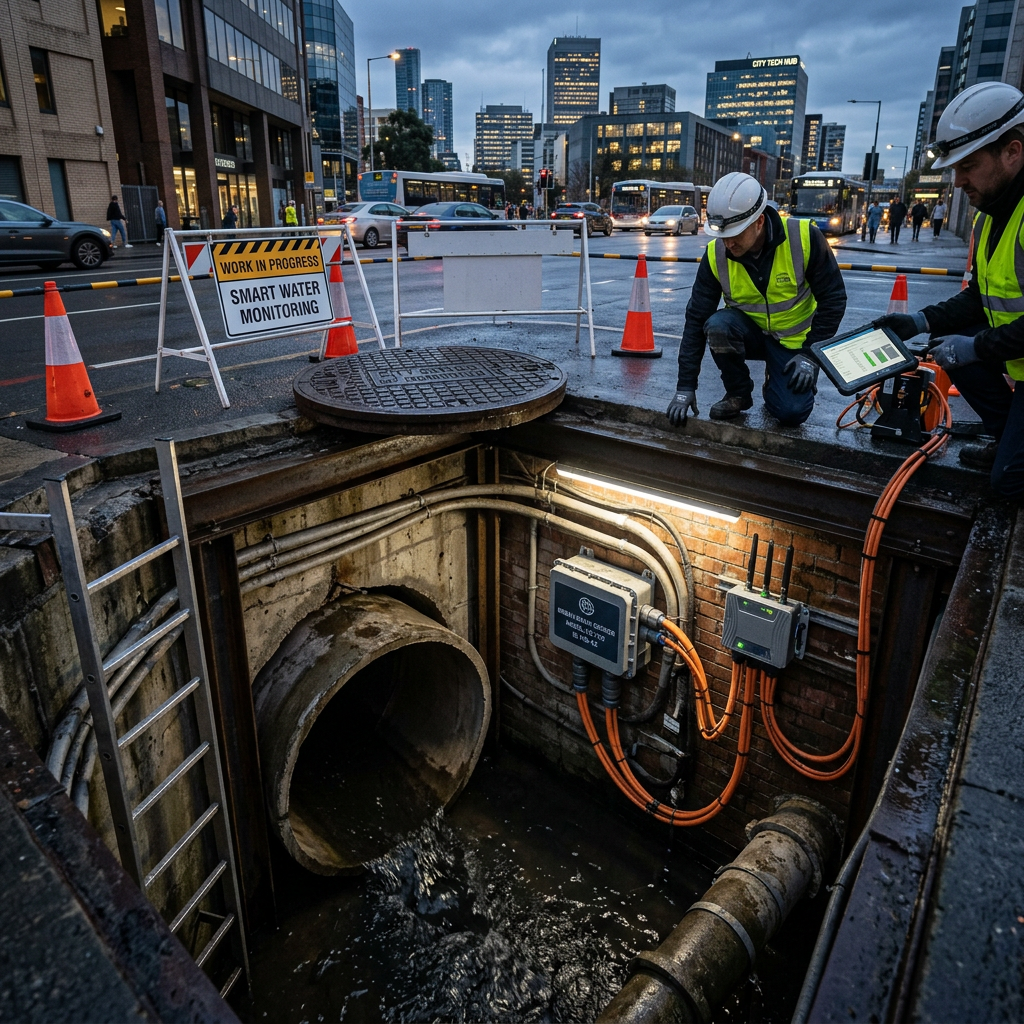
Intelligent Drainage Network Monitoring: A Case Study in Coastal City Flood Prevention
As extreme weather events intensify, the intelligent renovation of urban drainage networks has become a critical strategy for flood mitigation. Ecolor Technology recently completed a major IoT sensing project for a coastal city in Southeast China, transforming 150 kilometers of aging pipelines into a proactive defense system that reduces emergency response times by over 90% and ensures resilient urban infrastructure.

Project Background: Addressing the Overload Crisis in Old Urban Networks
The target city faces a subtropical monsoon climate with annual precipitation exceeding 1,600 millimeters. Its main urban drainage networks, largely constructed in the 1990s, suffer from complex topological structures, rain-sewage mixing, and severe pipeline aging.
Statistics reveal 12 incidents of waterlogging exceeding safety thresholds in the past three years, severely disrupting traffic and daily life. To combat this, the Water Affairs Bureau initiated an intelligent renovation covering 150 kilometers of trunk pipelines and 35 identified low-lying accumulation areas.
Technical Challenges: Engineering Hurdles in Confined Underground Spaces
Unlike surface projects, underground network monitoring faces stringent environmental constraints. The primary challenge is high-precision measurement under complex flow conditions, where traditional contact sensors are prone to clogging by floating debris and sediment.
Equipment must also survive perpetual high humidity (near 100%) and corrosive hydrogen sulfide gases. Furthermore, strong signal shielding by cast iron covers and the lack of grid power in extensive underground chambers require robust wireless penetration and long-term battery solutions.
Solution: Building a Multi-dimensional IoT Sensing System
Ecolor Technology deployed a comprehensive solution using non-contact millimeter-wave radar level gauges and Doppler ultrasonic flow meters. The radar gauge mounts at the manhole top to avoid corrosion, while the flow meter calculates velocity via frequency shifts of suspended particles.
Devices feature an IP68 rating with anti-corrosion treatment and utilize NB-IoT technology for superior signal penetration. Edge computing algorithms enable intelligent sleep/wake switching, allowing micro-porous lithium batteries to sustain operations for 3 to 5 years.
Communication
NB-IoT with deep penetration capabilities.
Protection Rating
IP68 Dust & Water Resistant.
Battery Life
3 to 5 Years on single charge.
Measurement Accuracy
Error controlled within 2mm.
Implementation Process: From Node Selection to Platform Integration
The four-month project strictly adhered to municipal standards, beginning with hydraulic model analysis to select 120 critical nodes across the 150-kilometer network. These nodes include trunk pipe junctions, pump station inlets/outlets, and low-lying underpass areas.
Engineers utilized a modular bracket system for installation, controlling the time per unit to under 45 minutes without damaging chamber structures. Data was transmitted via a dedicated network to the "Smart Water One Map" platform, achieving a packet loss rate of less than 0.5%.
Final Results: Significant Impact of a Data-Driven Flood Prevention System
The system successfully operated through one full flood season, reducing emergency response time from an average of 2 hours to just 15 minutes. During a recent typhoon, the system issued warnings 40 minutes in advance, preventing severe waterlogging on three main arterial roads.
Quantitative assessment improved significantly, identifying four silted sections and two rain-sewage cross-connections through data analysis. This precise data support enabled targeted non-excavation repairs, eliminating financial waste from blind construction.
Conclusion: Building Resilient Cities Through Digital Transformation
This project validates the reliability of high-precision IoT sensing technologies in complex underground environments. As digital transformation continues, objective network data will remain indispensable for building resilient cities, with Ecolor Technology committed to providing professional sensing equipment for the smart water sector.

