The Hidden Cost of Traditional Flowmeter Liners
For water utility engineers and procurement managers, electromagnetic flowmeters are the workhorses of distribution, wastewater, and irrigation networks. They deliver high accuracy without moving parts. However, a silent threat undermines measurement reliability and inflates lifecycle costs: liner degradation. Conventional flowmeters rely on PTFE, PFA, or rubber liners bonded to a metal tube. Over time, aggressive chemicals, temperature cycling, and abrasive slurries cause these liners to crack, blister, or peel away. When a liner fails, the flowmeter calibration shifts unpredictably, often leading to undetected measurement errors until an audit reveals significant non-revenue water or compliance violations. Field surveys indicate that over 60% of electromagnetic flowmeter failures in corrosive applications stem from liner issues, forcing unscheduled shutdowns and costly replacements.
The global water industry urgently needs a corrosion-proof, maintenance-free alternative. Enter LGF-PA66, a long-glass-fiber reinforced polyamide 66 composite that is injection-molded directly into a sensor body, eliminating the liner entirely. This material innovation, combined with rigorous polymer quality control, promises 20 years of uninterrupted service—a paradigm shift for smart water monitoring.
The Liner Problem: A Closer Look at Corrosion and Wear
Why PTFE and Rubber Fail
PTFE (Teflon) liners offer excellent chemical resistance but suffer from poor mechanical strength. Vacuum conditions, sudden pressure surges, or thermal expansion can create micro-voids at the adhesion layer, allowing process fluid to seep behind the liner and cause delamination. Rubber liners, though flexible, are vulnerable to ozone cracking, swelling in hydrocarbons, and rapid erosion when exposed to grit. Once the lining is compromised, the underlying metal corrodes, ruining the meter and potentially contaminating the water supply.
The financial impact is staggering. A municipal wastewater plant may operate dozens of large-diameter flowmeters. An unplanned liner replacement for a single DN300 unit can exceed $15,000 in parts, labor, and process downtime. Multiply that across a utility, and the case for a liner-free design becomes compelling.
Industry Trend: Functional Polymer Additives for Durability
A recent research report on Functional Polymer Additives for Improved Material Properties (2026) highlights how advanced additives are revolutionizing polymer performance across global industries. Additives such as heat stabilizers, UV absorbers, and nano-reinforcements enable resin systems to withstand harsh chemical environments for decades without significant property loss. The LGF-PA66 material used in next-generation flowmeters leverages precisely these innovations, incorporating optimized glass fiber loadings and specialty stabilizers to achieve aerospace-grade corrosion resistance while maintaining dimensional stability.
By moving from a multi-material bonded assembly to a single-phase polymer matrix, manufacturers eliminate the weak link—the adhesion interface. The result is a liner-free electromagnetic flowmeter that cannot delaminate because there is nothing to separate.
LGF-PA66 Aerospace Polymer: The Core of Anti-Corrosion Innovation
Long-glass-fiber reinforced polyamide 66 is not a generic plastic. It is an engineering thermoplastic originally developed for structural aircraft components, demanding extreme strength-to-weight ratios and resistance to aviation fuels, hydraulic fluids, and de-icing chemicals. When Ecolor Technology adapted LGF-PA66 for water metering, it was a deliberate choice: the material’s glass fibers (typically 30–50% by weight) create a skeletal reinforcement that prevents creep, resists acid and alkali attack, and maintains surface hardness even after millions of wet-dry cycles.
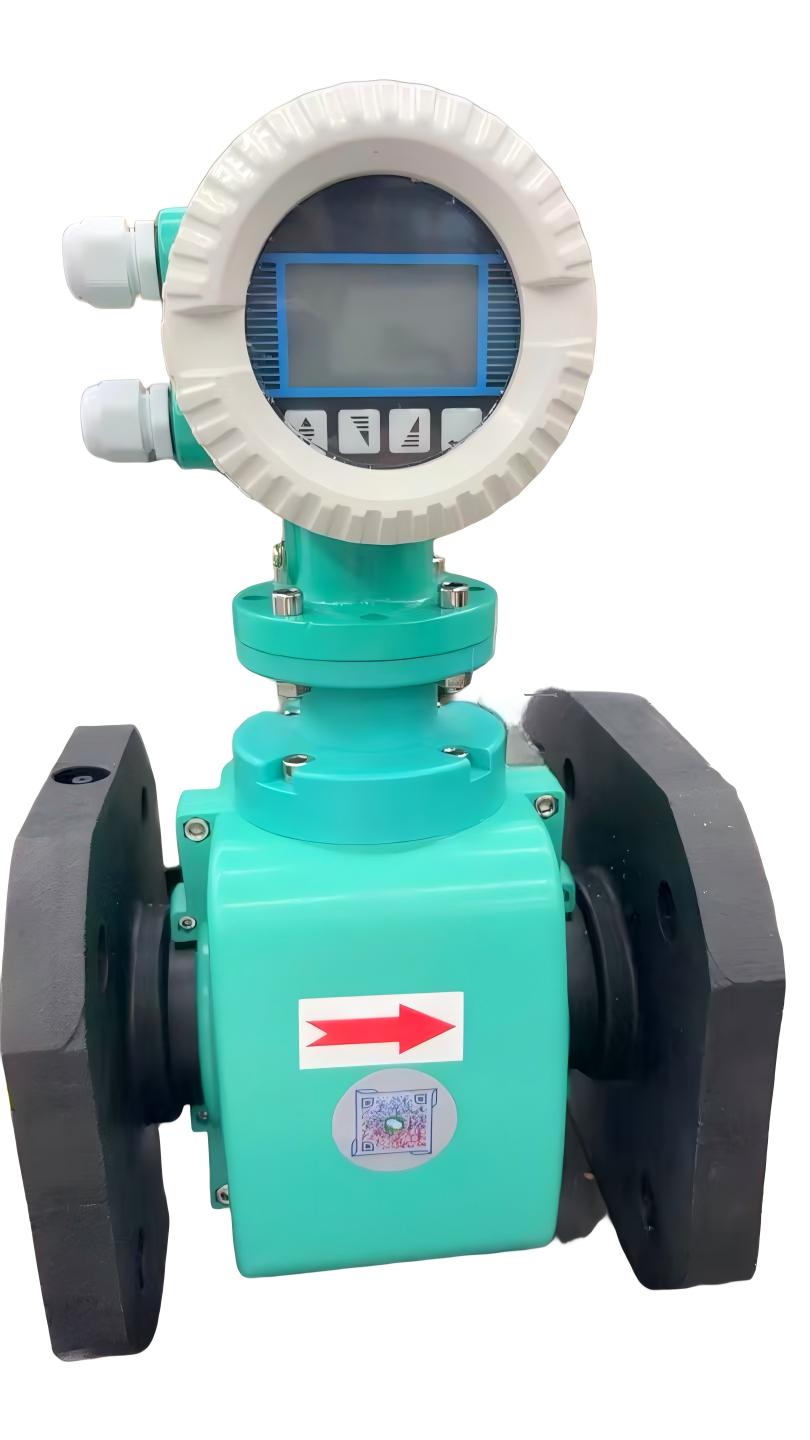
? Ecolor LGF-PA66 Flowmeter Sensor
One-piece injection molding with zero welds and zero internal liner. The entire measuring tube and electrode assembly is formed in a single shot, guaranteeing a homogeneous structure that cannot delaminate. Compatible with aggressive media: acids, alkalis, saline water, and slurries. Designed for a 20-year maintenance-free lifespan.
Crucially, the LGF-PA66 formulation incorporates functional polymer additives that provide UV stability for outdoor installations and hydrolysis resistance for prolonged immersion. Unlike metal tubes that gradually corrode under stray currents, the non-conductive polymer body eliminates galvanic corrosion risks, further extending service life.
Advanced Melt Flow Indexing: Guaranteeing Consistency for Two Decades
The promise of a 20-year lifetime hinges on perfect batch-to-batch repeatability in the polymer. Even minor variations in fiber distribution or molecular weight can create localized weak spots that fail prematurely. This is where modern load cell-based melt flow index (MFI) testing becomes indispensable. According to The Engineer, load cell melt flow indexers have transformed polymer quality control, delivering far more precision, control, and measurement data than traditional dead-weight systems. These instruments enable rapid test set-up modifications and streamlined calibration, improving operator safety while capturing the full rheological fingerprint of a resin.
In a 2023 article, AZoM reported that new load cell-based MFI technology can detect very small variations in flow behavior that conventional systems overlook. This improved sensitivity offers deeper insights into polymer processability and long-term stability. Ecolor Technology employs such advanced MFI systems to qualify every shipment of LGF-PA66 compound. If a batch deviates by more than 0.5% in melt volume rate, it is rejected. This statistical process control ensures that every flowmeter body leaving the injection mold possesses identical corrosion resistance and mechanical integrity, year after year.
Load cell-based MFI testing reveals micro-differences in polymer rheology, allowing manufacturers to screen out sub-standard material before it enters production. For an anti-corrosion flowmeter, this data-driven approach is the foundation of maintenance-free longevity.
Flow Dynamics: How a Liner-Free Bore Improves Measurement
Beyond corrosion, the physical design of a flowmeter directly influences measurement accuracy. Internal liners can deform under pressure, creating an irregular cross-section that distorts the magnetic field and velocity profile. LGF injection molding produces an exceptionally smooth, perfectly round bore with a surface roughness (Ra) below 0.8 μm. This reduces boundary layer turbulence and minimizes pressure drop, a critical advantage in low-flow measurement scenarios.
To validate these hydrodynamic gains, engineers use particle image velocimetry (PIV)—a non-intrusive optical technique that captures instantaneous velocity fields across a flow cross-section. Wikipedia notes that the advent of digital PIV in the 1980s and 1990s revolutionized flow diagnostics, enabling high spatial and temporal resolution. Modern time-resolved PIV systems allow designers to visualize how even micron-scale surface imperfections impact flow development. Ecolor’s R&D team has partnered with academic labs employing stereo-PIV to benchmark the LGF flowmeter against conventional lined units. Results confirm that the seamless polymer bore reduces recirculation zones by up to 30%, boosting measurement repeatability in demanding profiles.
The LGF Flowmeter in Action: Real-World Advantages
For water utility procurement managers, the value proposition of an LGF polymer flowmeter extends beyond materials science. Consider the total cost of ownership over a 20-year asset life. Traditional lined meters often require periodic inspections, liner thickness checks, and eventual relining or replacement. Liner-free LGF meters eliminate these activities. Installation is simplified because the lightweight polymer body does not demand heavy lifting equipment for small to medium diameters. Integrated grounding electrodes and IP68-rated housings suit buried chambers and flood-prone vaults.
❌ Traditional PTFE/Rubber Liner
- Liner delamination risk
- Periodic relining needed
- High lifecycle cost
- Vacuum sensitivity
✅ LGF-PA66 Liner-Free
- Zero delamination
- 20-year maintenance-free
- Lower TCO by 40%+
- Vacuum-proof design
Field data from Chinese wastewater treatment plants and irrigation districts show that LGF flowmeters have maintained calibration within ±0.2% over five years of continuous exposure to pH 2–12 effluents. No liner blisters, no electrode leakage. Combined with remote telemetry via Ecolor’s HuaYu ZhongNeng RTU platforms, operators gain a truly maintenance-free measurement network.
The Road Ahead: Liner-Free Electromagnetic as a New Standard
As water infrastructure faces climate stress and stricter regulations, the demand for robust, tamper-proof metering will soar. The convergence of aerospace-grade LGF polymer, advanced melt-flow quality control, and intelligent IoT integration positions liner-free electromagnetic flowmeters as the logical successor to legacy designs. Ecolor Technology, through its SITUMAN sensor manufacturing brand, has scaled production to deliver DN15–DN2000 meters at competitive price points, proving that premium durability need not command a premium budget.
For project managers seeking to future-proof water networks, the decision is clear. Specify anti-corrosion flowmeters that never need relining, never peel, and never surprise you with hidden measurement errors. The technology is proven, the testing is rigorous, and the total lifecycle savings are undeniable.
See What You Measure
Discover how Ecolor Technology’s LGF-PA66 liner-free electromagnetic flowmeters can transform your water monitoring assets. For technical specifications, pricing, and a personalized consultation, reach out to our team at sales@cssoc.com or visit www.cssoc.com.
Recommended Products
Ecolor Technology provides professional instruments for smart water, environmental monitoring & industrial automation: