Multi-Band Doppler Radar Flowmeter Selection Guide: The Ultimate Comparison of Non-Contact Flow Measurement Technologies
Introduction: The "Last Mile" of Flow Measurement
In the water resources and water management industry, a category of scenarios has long lacked an ideal flow measurement solution — open channels, culverts, partially filled drainage pipes, and natural waterways. Conventional pipeline flowmeters cannot be used here because the flow is open, partially filled, and features irregular cross-sections.
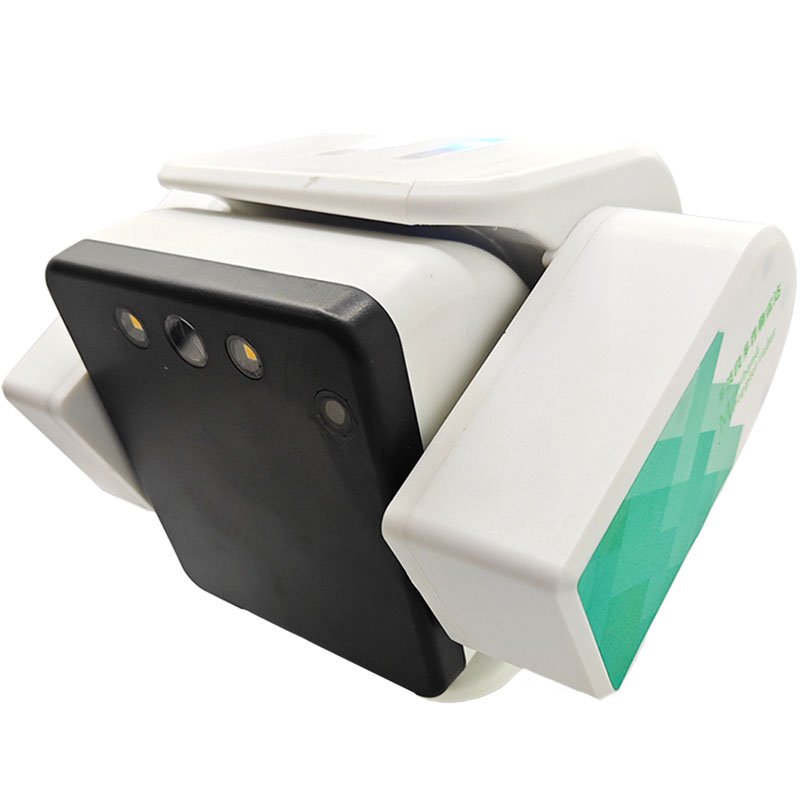
Traditional methods like weirs/flumes or area-velocity sensors require costly construction or submersible installation. The Doppler radar flowmeter offers a new approach: non-contact measurement of surface velocity via radar, combined with level and cross-section data to calculate flow. The latest visual flow radar integrates level sensing, multi-band Doppler velocity radar, and an HD camera into one "4-in-1" device.
1. In-Depth Analysis of Operating Principles
Doppler Effect for Velocity Measurement
The Doppler radar flowmeter transmits microwave signals toward the water surface. Tiny surface ripples act as moving reflectors, causing a frequency shift in the reflected signal. This Doppler shift is directly proportional to the surface water velocity.
The velocity is calculated using the formula: V = (Δf × c) / (2 × f₀ × cos θ), where V is surface velocity, Δf is the Doppler frequency shift, c is the speed of light, f₀ is the transmitted frequency, and θ is the radar's angle of incidence.
The Significance of Multi-Band Operation
Single-frequency Doppler radar can struggle with low velocity (<0.1 m/s), high velocity (>5 m/s), or wastewater surfaces with oil films or foam. Multi-band radar simultaneously operates across multiple frequency bands, like K-band (~24 GHz) and W-band (~77 GHz).
Through signal fusion algorithms, it achieves more reliable velocity measurements. Lower frequency bands offer greater penetration for covered surfaces, while higher frequency bands provide higher resolution for calm, low-velocity water surfaces.
From Level + Velocity to Flow Rate
With measured surface velocity and water level, combined with pre-configured channel or pipe cross-section parameters, the flow rate Q is calculated as Q = V × A(h), where V is the mean velocity and A(h) is the wetted cross-sectional area at level h.
The system includes built-in models for standard cross-sections like circular pipes, rectangular, trapezoidal, and U-shaped channels. Custom cross-section parameters can also be entered for accurate non-contact flow calculation.
2. The "4-in-1" Capability of Visual Flow Radar
Traditional setups require three separate devices: a radar level gauge, a Doppler radar, and a camera. The visual flow radar integrates all functions into one compact device, simplifying installation and reducing costs.
Level Measurement
80 GHz FMCW radar, range 0.3–30 m, accuracy ±1 mm
Velocity Measurement
Multi-band Doppler radar, 0.05–15 m/s, accuracy ±1%
Flow Calculation
Built-in multiple cross-section models, real-time computation
Video Surveillance
2 MP HD camera with infrared night vision
Technical Advantages of Integrated Design
Time Synchronization: Level and velocity data are collected simultaneously by the same device, eliminating flow calculation errors from time offsets. Spatial Alignment: Measurements are taken from the same height, removing interpolation errors.
Simplified Installation: Only one mounting point, power supply, and communication link are needed, reducing installation time to 1–2 hours. IP68 Full-Unit Protection: The entire unit is sealed in a single enclosure for robust environmental protection.
Built-in Motorized Angle Adjustment
The visual flow radar features a built-in motorized angle adjustment mechanism that can be controlled remotely. This solves a major installation pain point for devices mounted on bridges or above pipelines.
Installers mount the device approximately, then precisely adjust the angle (±15°) from the ground via a mobile app, significantly improving efficiency and safety for open channel flow monitoring.
3. Comparison with Other Flow Measurement Methods
Visual Flow Radar vs. Weir/Flume Method
The weir/flume method requires costly hydraulic structures that alter flow conditions. The visual flow radar offers non-contact installation with no infrastructure investment or head loss, making it suitable for a wider range of channels and pipes.
| Comparison Item | Weir/Flume Method | Visual Flow Radar |
|---|---|---|
| Infrastructure Investment | High | None |
| Measurement Accuracy | ±3%–5% | ±2%–3% |
| Installation Duration | Long (civil construction) | Short (1–2 hours) |
Visual Flow Radar vs. Submersible Doppler Flowmeters
Submersible Doppler flowmeters are installed in the water, facing clogging risks and high maintenance. The non-contact visual flow radar, mounted above the water, eliminates these issues and offers a longer service life for sewage network monitoring.
Visual Flow Radar vs. ADCP Acoustic Doppler
ADCP is essential for large river velocity profiling but is costly. For urban pipe networks, small/medium channels, and discharge outfalls, the visual flow radar provides a more economical and practical non-contact flow measurement solution.
4. Typical Application Scenarios
Non-Full Pipe Flow Monitoring in Sewage Networks
Most urban sewage pipelines operate under gravity flow and are not full. The visual flow radar's non-contact principle is ideal for this, mounted above the pipe inside a manhole to measure level and velocity for drainage system assessment.
River Outfall Discharge Monitoring
River discharge outfalls are key regulation targets. The device can be mounted above the outfall, using its Doppler radar to identify flow direction—crucial for detecting reverse flow caused by river backwater—and separately accumulate discharge volumes.
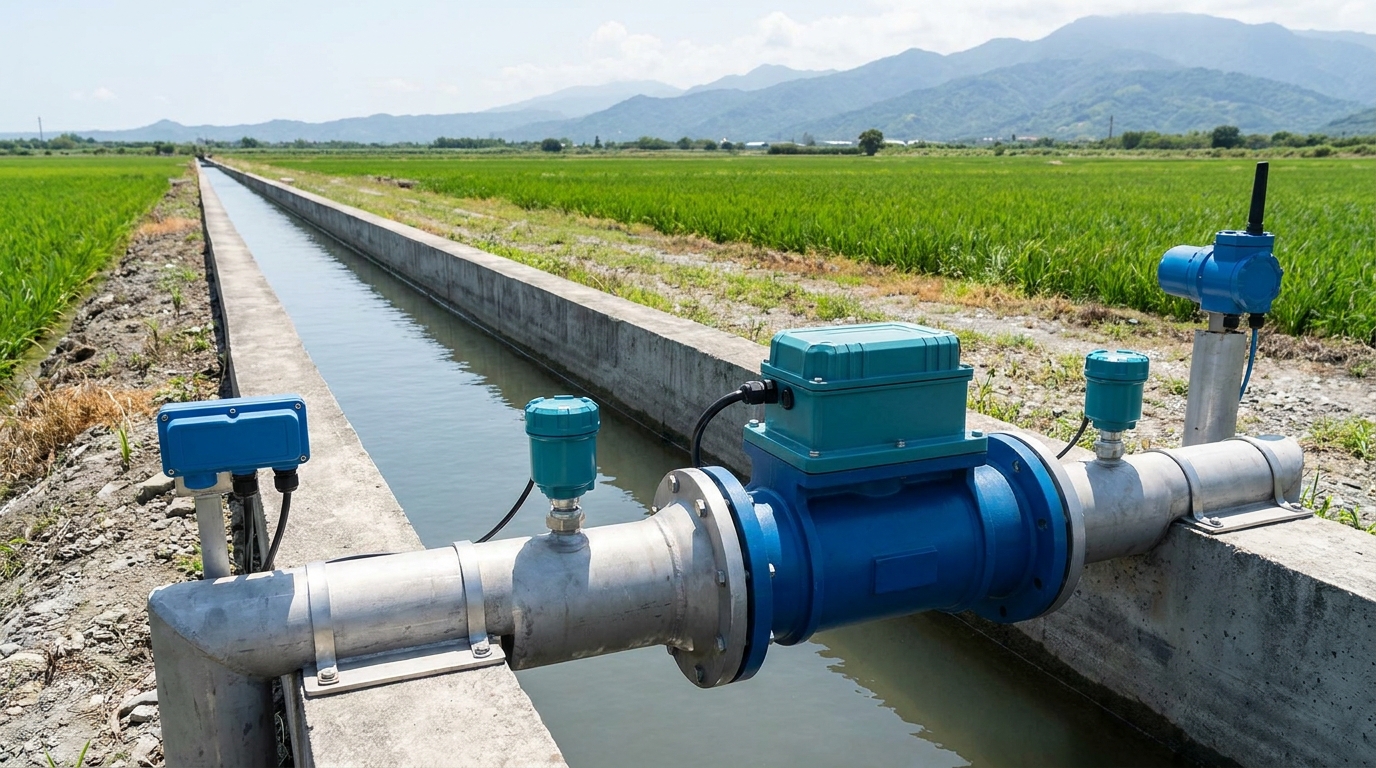
Irrigation Canal Flow Metering
For trapezoidal or rectangular irrigation canals with variable flow, the radar can be mounted on bridges. It requires no weir construction, avoids altering hydraulic conditions, and enables rapid installation for open channel flow monitoring.
Urban Culvert/Box Culvert Flow Monitoring
In confined urban culverts, the device can be installed at inspection openings. The built-in motorized angle adjustment is particularly valuable here, allowing remote fine-tuning of the radar angle when the mounting point is not directly above the channel centerline.
5. Selection Guide: Key Parameters
Essential Parameters to Confirm
When selecting a Doppler radar flowmeter, confirm the site's velocity range (0.05–15 m/s), mounting height, and accurate channel or pipe cross-section geometry. Also decide on communication method (4G/NB-IoT/RS485) and power supply (battery/solar/mains).
Setting Realistic Accuracy Expectations
Non-contact flow measurement accuracy depends on site conditions. Expect ±3% in ideal conditions, ~±5% in typical conditions, and ±8%–10% in complex scenarios with irregular cross-sections or rapidly varied flow.
For custody-transfer level accuracy (±1%–2%), a full-pipe electromagnetic flowmeter is recommended. The strength of the non-contact radar flowmeter lies in measuring challenging scenarios like partially filled pipes.
6. Installation and Commissioning Notes
Incidence Angle Setting: Ensure the Doppler radar is mounted at an angle (typically 30°–60°), not vertically downward. Avoid Turbulence Zones: Do not install near waterfalls or hydraulic jumps where surface velocity is unstable.
Accurate Cross-Section Survey: Precisely measure the installation cross-section geometry, as area errors directly affect flow results. Surface Velocity Coefficient Calibration: Post-installation comparison with a portable flowmeter is recommended to refine the default coefficient (0.80–0.90) for mean velocity conversion.
Conclusion
Doppler radar flowmeters have opened a new path for flow measurement in partially filled pipes, open channels, and natural waterways. The latest visual flow radar, with its "4-in-1" integrated design, IP68 protection, and motorized angle adjustment, is becoming the preferred solution for urban pipe network and hydrological flow monitoring.
For technical specifications, application solutions, or field selection support for visual flow radar, please visit www.cssoc.com or call our service hotline at 400-808-9114. The Ecolor Technology engineering team provides professional non-contact flow measurement solutions.
Ecolor Technology (Hangzhou) | Situman Sensor Manufacturing | HuaYu ZhongNeng System Integration
Recommended Products
Ecolor Technology provides professional instruments for smart water, environmental monitoring & industrial automation: