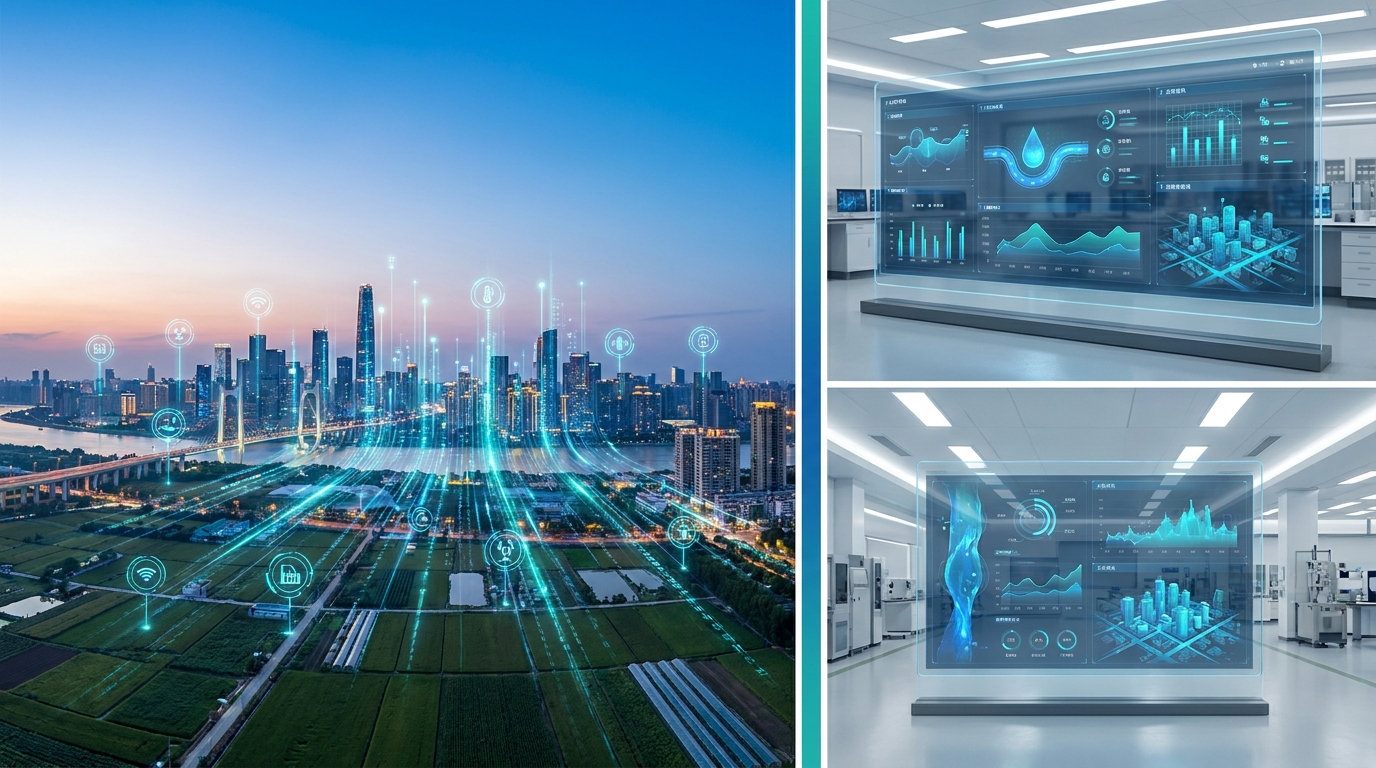
From Blue Economy to Smart Monitoring: The Global Water Shift
This article explores how the convergence of the blue economy framework, workforce health imperatives, and smart water monitoring technologies is transforming global water management—from reactive maintenance to predictive, data-driven stewardship.
At its core lies a new paradigm: water infrastructure is no longer just about pipes and plants—it’s about resilience, equity, real-time intelligence, and regenerative economic value.
A Confluence of Blue Economy and Human Capital
The World Economic Forum affirms that workforce health underpins global supply chain stability—and that a sustainable blue economy is essential to navigating today’s environmental turbulence. This dual priority signals a fundamental rethinking of water management: it must evolve from isolated engineering tasks into an integrated pillar of regenerative development.
China’s “forward-looking businesses and vibrant innovation ecosystem,” as noted by the WEF, are emerging as key contributors to achieving the UN’s Sustainable Development Goals—particularly where water security, climate adaptation, and public health intersect.
SDG 6 & SDG 14: The Infrastructure Imperative Behind Smart Water Monitoring
SDG 6 (clean water and sanitation) and SDG 14 (life below water) define the operational heart of the blue economy. Yet progress demands more than policy—it requires intelligent infrastructure capable of precise measurement, adaptive distribution, and transparent valuation of water resources.
Global Water Resources’ recent launch of a monthly dividend reflects a broader financial shift: smart water programs—including advanced metering infrastructure (AMI) and dynamic conservation rate structures—are now delivering consistent, measurable returns. This fusion of sustainability and fiscal discipline is unlocking new investment—but only where robust, scalable technology enables trust in data.
Sensing the Unseen: The Smart Monitoring Revolution
Data has become the true compass for water utilities—replacing reactive leak repairs with proactive, sensor-driven oversight. Terms like non-revenue water (NRW), PFAS detection, and condition assessment have moved from technical journals into executive strategy sessions.
From acoustic leak detectors to satellite-based hydrological analytics, innovation is accelerating. But the most consequential advances are happening at the edge—where Chinese manufacturers like Ecolor Technology are solving long-standing field-level blind spots with purpose-built instrumentation.
Chinese Innovation Fills Critical Gaps in Water Monitoring Technology
Traditional electromagnetic flowmeters struggle with accuracy in large-diameter pipes under low-flow or unstable conditions. Ecolor’s LGF electromagnetic flowmeter overcomes this with a proprietary excitation structure—delivering high precision for bulk transfer and industrial discharge applications.
80GHz Visual Radar Level Sensor
Non-contact, millimeter-accurate level measurement for open channels and reservoirs—with integrated real-time video verification.
Multi-Band Doppler Flow Radar
World’s only underground pipe monitoring system with built-in camera—enables live inspection without excavation.
HERO V9 RTU Gateway
Rugged edge computing device for local data preprocessing, alarm triggering, and 4G/NB-IoT telemetry to central platforms.
Together, these instruments form a cohesive smart water monitoring stack—not merely digitizing infrastructure, but endowing it with situational awareness, diagnostic capability, and autonomous responsiveness.
Workforce Health, Water Scarcity, and Tech Convergence
The WEF’s focus on workforce health resonates directly with water security realities. In water-stressed regions, scarcity drives not only physical hardship but also lost labor productivity and soaring healthcare costs from waterborne disease outbreaks.
Reducing non-revenue water isn’t just about utility finances—it’s a frontline public health intervention. And equitable conservation incentives—like those enabled by advanced rate designs—depend entirely on granular, trustworthy data from meters and sensors. Reliable, cost-effective sensing tools are thus critical enablers of both fiscal solvency and social equity—democratizing precision beyond high-income OECD cities.
Navigating the Blue Future
The global water industry stands at an inflection point—where environmental stewardship, community well-being, and digital infrastructure converge into a single operational reality.
The blue economy is no longer abstract. It lives in every remote sensor reading, every pipeline inspection report, every dividend paid by a water utility committed to resilience. For water managers, the imperative is clear: invest in real-time, AI-ready monitoring—not as a tech upgrade, but as foundational infrastructure for human and systemic health.
Companies like Ecolor Technology exemplify how cost-optimized, field-proven sensing and telemetry solutions can accelerate this transition—turning the vision of a sustainable blue economy into quantifiable, actionable, and scalable reality.
Key Sources Cited
- The World Economic Forum – Environment and Natural Resource Security Initiative
- Water Finance & Management: “Water Innovation of the Month”
- Global Water Resources – Monthly Dividend Announcement
- United Nations: The 17 Sustainable Development Goals (SDGs)
- World Economic Forum – Wikipedia (contextual background)
Recommended Products
Ecolor Technology provides professional instruments for smart water, environmental monitoring & industrial automation: