Proper Application Methods for Energy Conservation in Industrial Parks Under Complex Operating Conditions
Energy Management | Industrial Retrofitting | EMC Solutions
Introduction: The Era of "Refined Retrofitting"
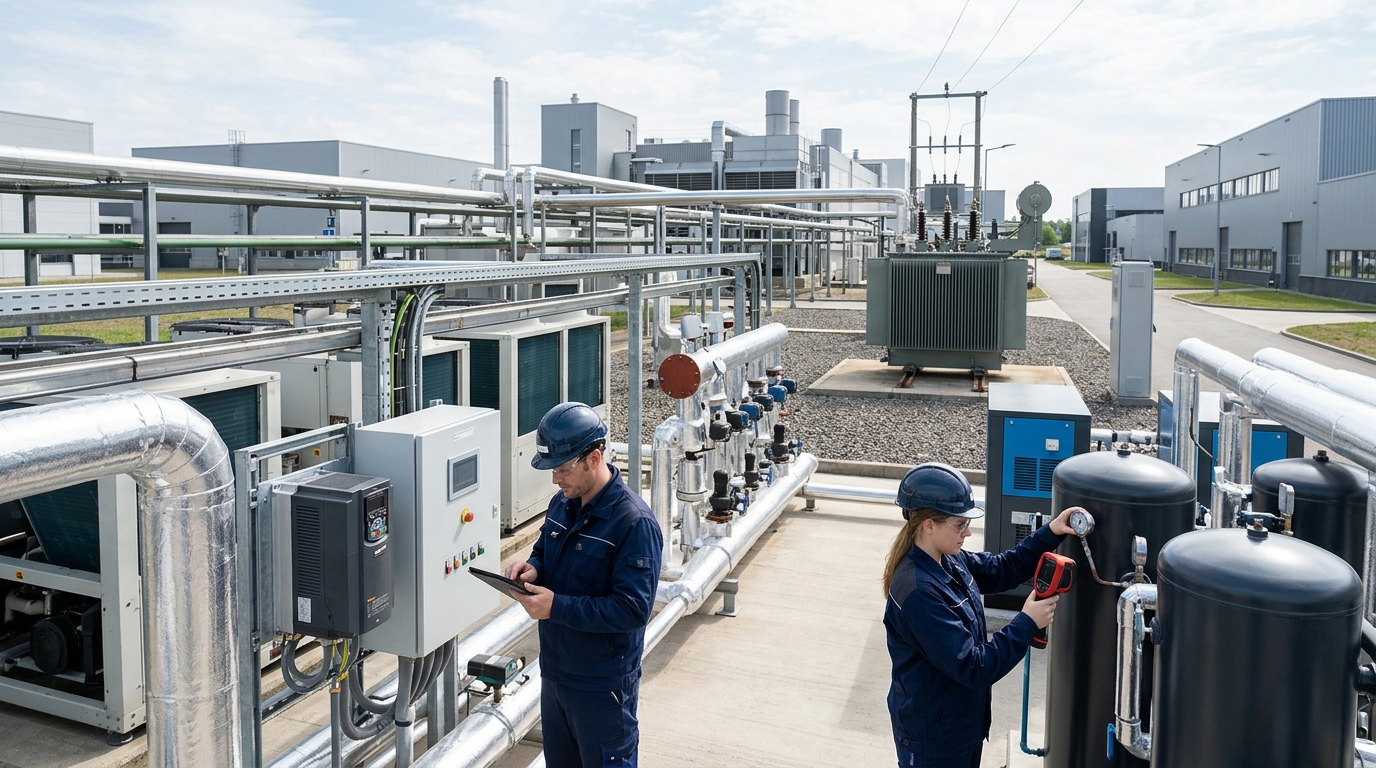
Against the backdrop of overlapping adjustments in electricity pricing mechanisms, tightening constraints on energy consumption rights, and increasing pressure for carbon reduction across the supply chain, energy conservation in industrial parks has shifted from merely replacing a few high-efficiency motors and lighting fixtures to a systematic engineering approach. This encompasses power supply and distribution, compressed air, HVAC, circulating water, lighting, energy storage, and digital management.
For park management and tenant enterprises, energy-saving retrofits must be not only implementable but also measurable, verifiable, and billable. After reviewing multiple park projects, industry research indicates that project success often depends not on single equipment parameters, but on the accuracy of energy efficiency diagnosis, the clarity of installation boundaries, the alignment of commissioning strategies with production conditions, and whether daily maintenance forms a closed loop.
Guided by practical implementation, this guide focuses on three key concepts: energy-saving retrofitting, Energy Management Contracts (EMC), and energy efficiency diagnosis. It outlines key operational points for installation steps, commissioning methods, routine maintenance, and common troubleshooting.
I. Pre-Retrofitting: Defining Boundaries & Mechanisms
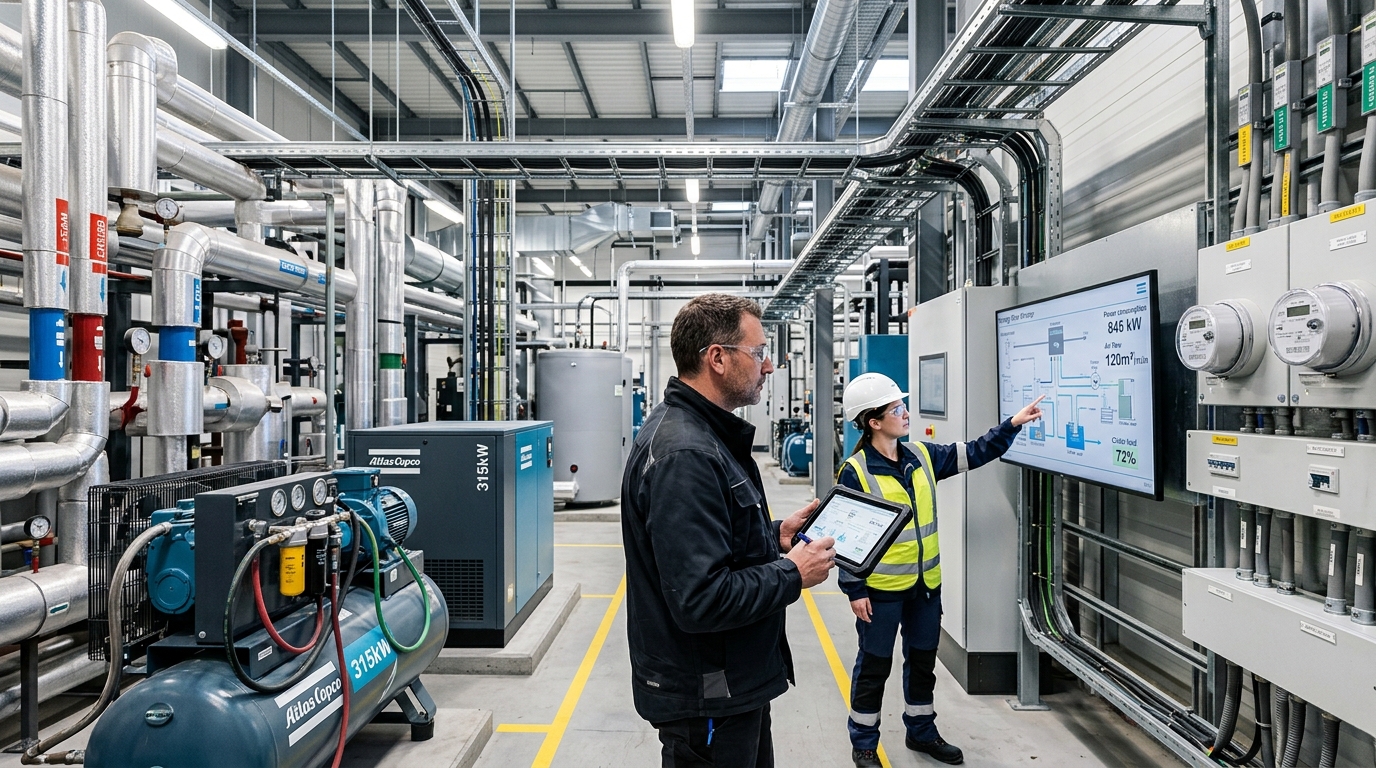
Energy efficiency diagnosis should first define boundaries and then establish baselines. Boundaries typically include electricity, natural gas, steam, compressed air, circulating water, and purchased cooling. The diagnosis team needs to collect at least 12 months of energy bills to generate load curves and establish ledgers for key equipment such as transformers, air compressors, water pumps, fans, chillers, and lighting systems.
Key Judgment Indicators
- Transformers: Economic load rate should be between 40% and 70%; power factor above 0.92.
- Motors: Long-term load rates below 40% should be evaluated for Variable Frequency Drive (VFD) installation or replacement.
- Air Compressors: Specific power analysis against the range of 5.5 to 6.5 kW/(m³/min).
- Water Pumps: If operating efficiency falls below 70%, inspect selection and condition matching.
Diagnostic outputs should form a list of actionable retrofit projects. For example, in a mechanical processing park diagnosis, a 12% compressed air leakage rate and 28% invalid energy consumption due to valve throttling were identified. Priority measures included centralized control for leaks, VFD differential pressure control for pumps, and LED zoned lighting, estimating a comprehensive energy-saving potential of 10% to 14%.
II. Installation Steps: Data Traceability First
Before installation, the "three drawings and one table" must be completed: primary power supply diagram, control schematic, point layout table, and power outage operation plan. Safety procedures such as power outage, voltage testing, tagging, and grounding must be executed for critical lines.
Metering Standards
Use 0.5S-class multi-function meters. Current transformer ratio must match actual load. Secondary circuit conductors ≥ 4 mm². Communication via RS485/Ethernet/4G-5G.
Data Collection
Cycle recommended: 5–15 minutes. Critical process points: increase to 1 minute. Use shielded twisted pair cables with single-point grounding.
Equipment retrofits should proceed systematically. On the power supply side, prioritize reactive power compensation targeting a power factor of 0.95–0.98. For compressed air systems, equip pressure transmitters and flow meters, controlling the main pipeline network pressure band between 0.60 MPa and 0.70 MPa. Water pump and fan retrofits must synchronously install VFDs and differential/static pressure sensors, avoiding mere hardware swaps without logic changes.
III. Commissioning Methods: From Protection to Optimization
Commissioning follows the sequence: "offline first, then energized; manual first, then automatic; individual first, then interlocked."
Critical Commissioning Points
- VFD Setup: Enter motor nameplate data for auto-tuning. Set acceleration/deceleration times and current limits. For long-distance cables, evaluate output reactors.
- Water Pump VFDs: Do not blindly reduce frequency. Set differential pressure based on the most unfavorable point. Minimum operating frequency: 25–30 Hz to prevent cavitation.
- Chiller Plants: Focus on matching chillers, pumps, and cooling towers. Adopt variable water temperature control to avoid "low temperature and high flow rate" inefficiencies.
- Verification: Conduct continuous trial runs for ≥72 hours. Establish baseline models before retrofitting for accurate comparison.
Case Study: After interlocked commissioning at an electronic industrial park, power factor increased from 0.93 to 0.98, maximum demand decreased by 18%, and comprehensive energy savings reached 11.6% (approx. 960,000 kWh/year).
IV. Routine Maintenance: Sustaining Effects
Without maintenance, energy-saving effects typically degrade within 6–18 months. Parks should establish equipment and energy ledgers recording nameplates, parameters, calibration dates, and fault history.
Maintenance Tiers
Check energy platform data gaps, alarms, and critical pressures/temperatures.
Inspect air compressor running time, unloading ratio, and pipeline pressure fluctuations.
Verify power deviation between main/sub-meters. Check VFD fans, filters, and cabinet temperatures.
Infrared thermography of cable joints, busbars, and capacitor cabinets. Clean heat sinks.
Calibrate key meters, flow meters, and temperature sensors.
V. Common Troubleshooting
Troubleshooting should focus on root causes rather than simple resets.
- Data Issues: If single points fail, check gateway communication and shielding. If entire areas fail, check switches and power supplies. Verify CT ratios for sudden value changes.
- VFD Alarms: Overcurrent/overheating may stem from short acceleration times or blocked vents. Low-frequency noise requires checking for resonance points and setting skip frequencies.
- Inefficient Performance: Insufficient lighting savings? Check if branch circuits are controlled. Poor pump performance? Check for bypass valve leakage or sensor drift. High specific power in compressors? Check for clogged filters or leaks.
- Safety Events: Capacitor tripping often relates to harmonics. Energy storage alarms require distinguishing between BMS, PCS, and fire protection systems. Record all faults in work orders.
VI. Energy Management Contracts (EMC)
The core of EMC is transforming energy savings into auditable contract assets. Contracts must specify baseline periods, metering boundaries, correction methods (for production/weather), and dispute resolution.
Shared Savings
ESCO invests. Savings shared over 5-8 years. Ideal for parks avoiding upfront capital.
Guaranteed Savings
Owner invests. Service provider guarantees minimum savings. Owner retains asset ownership.
Cost Trusteeship
O&M bundled with targets. Suitable for unified management of multi-entity parks.
In a central China mechanical park case using shared savings, annual cost savings reached ~1.8 million RMB with a 3.2-year payback period. Key success factors included sufficient preliminary diagnosis, clear metering points, and transparent operational data.
VII. Conclusion: From Point-Saving to Comprehensive Services
The next stage of industrial park energy conservation will shift from point-specific equipment retrofits to comprehensive energy services. With the rise of distributed PV, storage, and flexible loads, energy efficiency diagnosis must expand from "reading meters" to "analyzing loads, processes, and carbon emissions."
Future projects will emphasize three directions:
- Source-Grid-Load-Storage Coordination: Integrating PV, storage, HVAC, and production loads into unified dispatch.
- Virtual Power Plants (VPP): Participating in demand response and power system regulation.
- Carbon Management Integration: Transforming energy savings into quantifiable carbon emission reduction data.
Parks that solidify their energy efficiency diagnosis, installation specifications, commissioning standards, and O&M systems will be best positioned to gain a stable advantage amid energy cost constraints and green manufacturing competition.