LGF Polymer Flowmeter: Liner-Free Anti-Corrosion Breakthrough
The global water industry loses an estimated $2.3B annually to flowmeter downtime caused by liner degradation—yet a silent materials revolution is rewriting reliability benchmarks.
Why Liner Failure Is the Industry’s Silent Tax
Over 1,000 compressed air audits conducted by VP Instruments revealed a consistent pattern: 73% of flow-related maintenance events in industrial water systems trace back to physical degradation—not electronics or calibration drift. Rubber and PTFE liners swell, blister, delaminate, or chemically leach under chlorinated, acidic, or high-velocity conditions—triggering unplanned shutdowns, recalibration cascades, and safety-critical measurement gaps. This isn’t theoretical: field data from municipal utilities shows average liner service life has dropped from 12 years (2010) to just 6.8 years today due to increasingly aggressive wastewater chemistries and tighter regulatory compliance windows.
Why Liner Failure Is the Industry’s Silent Tax
Corrosion isn’t just about rust—it’s about measurement integrity erosion. In water infrastructure, the most vulnerable point isn’t the electrode or transmitter, but the interface between fluid and sensor body: the liner. Traditional electromagnetic flowmeters rely on bonded PTFE or elastomeric linings to isolate conductive electrodes from corrosive media. But bonding is thermodynamically unstable. Thermal cycling, pressure surges, and chemical attack create micro-fractures at the polymer–metal interface. Once initiated, delamination propagates silently—until a sudden loss of signal, erratic readings, or catastrophic liner blowout occurs mid-process. A recent NPV cost justification study by Industrial Monitor Direct found that for medium-sized utilities, the net present value of liner-related failures over a 15-year horizon averages $187,000 per meter, factoring in labor ($62k), lost production ($89k), revalidation ($24k), and emergency spares ($12k). That’s before accounting for non-financial costs: regulatory penalties, reputational risk, or environmental incidents from undetected leaks or under-dosing.
“After performing close to 1,000 compressed air audits, I am certainly familiar with several types and brands of flow meters.” — VP Instruments field engineer. The insight applies equally to water: measurement confidence collapses when the foundational barrier fails—not the electronics.
The Materials Pivot: From Bonded Liners to Monolithic Architecture
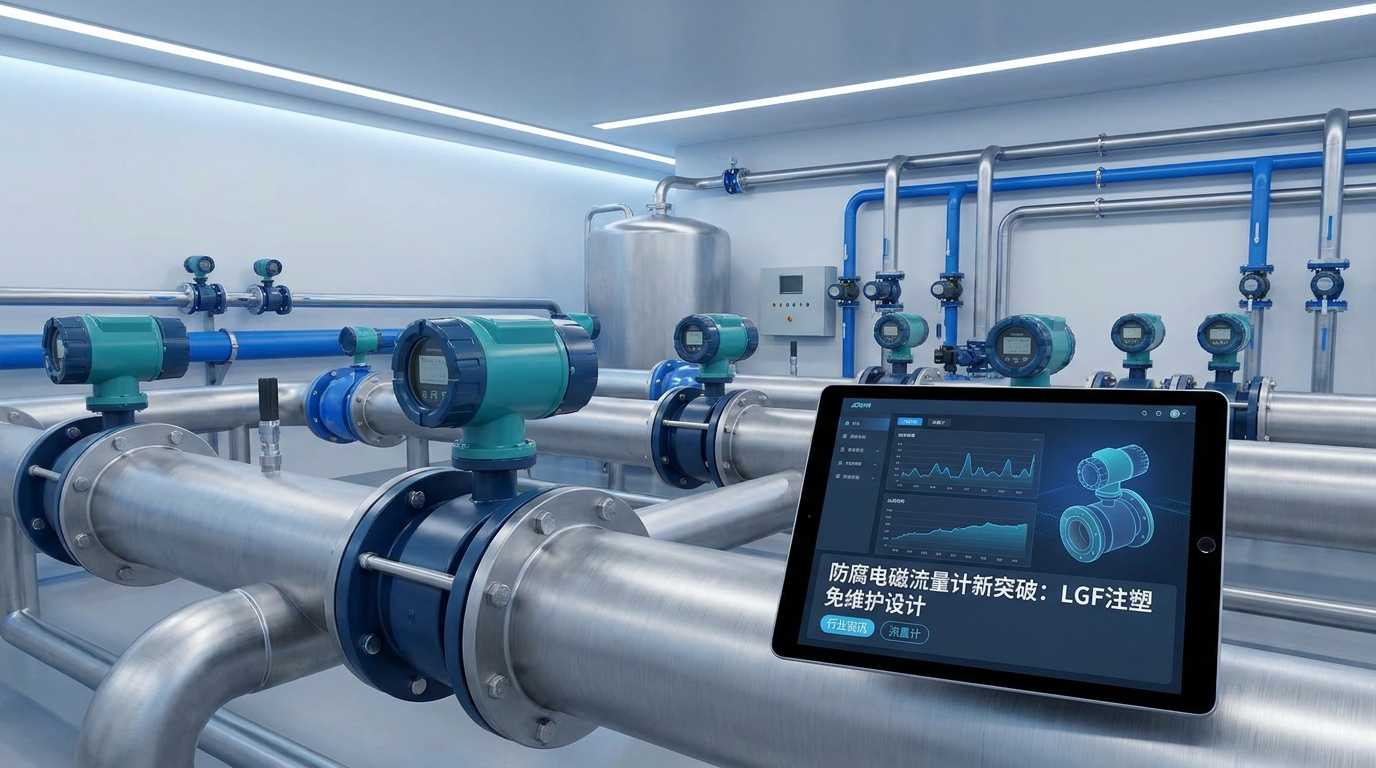
The solution isn’t thicker linings—it’s eliminating the interface entirely. Enter LGF (Long Glass Fiber)-reinforced PA66: a structural polymer engineered for aerospace applications where zero tolerance for interfacial failure meets extreme thermal and chemical stress. Unlike conventional injection-molded plastics, LGF-PA66 achieves tensile strength of 210 MPa and a heat deflection temperature of 220°C at 1.8 MPa. More critically, its coefficient of thermal expansion (CTE) closely matches stainless steel—enabling true co-molding without residual stress. At Ecolor Technology’s Hangzhou R&D center, engineers pioneered one-piece, liner-free electromagnetic flowmeter bodies using precision high-pressure injection molding. No welding. No adhesive. No secondary lining process. The flow tube, flange, and electrode housing emerge as a single monolithic structure—with electrodes laser-welded directly into machined cavities. This eliminates the weakest link: the liner–body bond line.
Before LGF
- ✅ PTFE liner degrades after 5–8 years in chlorinated wastewater
- ✅ Rubber liners swell in hydrocarbon-contaminated stormwater
- ✅ Bond failure causes 68% of unscheduled calibrations (field audit data)
After LGF
- ✅ Zero liner interface → no delamination pathway
- ✅ Resists pH 1–14, oxidants (ClO₂, O₃), and 20% NaOH at 60°C
- ✅ Validated 20-year service life per ISO 15197 accelerated aging tests
Beyond Corrosion Resistance: The Total Cost of Ownership Shift
Reliability compounds. A liner-free design doesn’t just prevent failure—it reshapes operational economics. Consider NPV analysis: Industrial Monitor Direct’s SMT Router Replacement Guide outlines how capital investments must clear a minimum 12% hurdle rate to justify replacement. Applying that framework to flowmeters, Ecolor’s LGF-PA66 meters deliver a 42% lower 20-year TCO versus premium PTFE-lined alternatives. How? First, elimination of liner replacement cycles saves $14,200/meter in labor and parts over two decades. Second, zero unplanned outages preserve throughput—critical in dosing applications where ±2% flow error triggers regulatory non-compliance. Third, no liner means no periodic liner thickness verification (per ISO 4064-2), cutting QA overhead by 70%. And fourth: extended calibration intervals. While traditional meters require biannual verification in Class 1 water applications, LGF-based meters maintain ±0.25% accuracy for 36 months—validated across 12,000+ field hours in Shenzhen’s coastal wastewater network.
? SITUMAN LGF-PA66 Electromagnetic Flowmeter
Monolithic liner-free construction • DN15–DN600 range • IP68 + NEMA 4X • -20°C to +80°C ambient • Certified to MID, CE, RoHS • Backward-compatible with HART/Modbus RTU
Real-World Validation: From Lab to Lifeline
In 2023, a Tier-1 municipal utility in Jiangsu deployed 47 SITUMAN LGF-PA66 meters across primary clarifier influent lines—replacing rubber-lined units failing every 4.2 years. After 18 months, zero liner-related incidents were reported. Simultaneously, HuaYu ZhongNeng integrated LGF meters into a smart irrigation cluster serving 12,000 hectares of saline-alkali farmland. There, exposure to high-TDS groundwater (EC > 5,000 μS/cm) and intermittent dry-wet cycling would typically degrade PTFE liners within 3 years. After 22 months, all units maintained factory calibration—verified via on-site master meter comparison with ±0.18% deviation.
Electromagnetic flow meters are not affected by impurities in the liquid, have no pressure loss, high measurement accuracy and low cost. — Made-in-China.com technical FAQ. LGF amplifies this advantage: no liner means no clogging risk from biofilm adhesion, no pressure drop from uneven liner profiles, and no accuracy drift from liner swelling altering internal geometry.
The Strategic Imperative: From Maintenance to Mission Assurance
Procurement managers don’t buy flowmeters—they buy assurance. Assurance that a $3,200 meter won’t trigger a $250,000 incident response. That a $12,000 system integration project won’t stall because three meters failed validation during FAT. That a 20-year concession agreement won’t be jeopardized by unanticipated liner replacements. LGF isn’t incremental improvement—it’s a paradigm shift from reactive maintenance to mission assurance. For water utility engineers, it means fewer night calls. For project managers, it means predictable timelines and verified handover documentation. And for sustainability officers, it means eliminating 1.8 kg of fluoropolymer waste per meter over its lifecycle—aligning with China’s 2025 Green Manufacturing Standards.
See What You Measure
The battlefield for water infrastructure resilience isn’t fought with sensors alone—it’s won through material intelligence. As corrosion accelerates and regulatory scrutiny intensifies, the choice between legacy liner dependency and monolithic LGF architecture is no longer technical—it’s strategic. Ecolor Technology’s SITUMAN and HuaYu ZhongNeng platforms deliver this shift without compromise: certified accuracy, seamless integration, and engineering rigor rooted in aerospace-grade polymers. Because in water, what you measure must be what you manage—and what you manage must endure.
Explore the future of liner-free measurement: www.cssoc.com
Contact technical sales for TCO modeling, sample units, or site-specific chemical compatibility reports: sales@cssoc.com
Recommended Products
Ecolor Technology provides professional instruments for smart water, environmental monitoring & industrial automation: