Smart Irrigation Flowmeter Deployment: Precision Agricultural Water Metering
Electromagnetic sensing combined with solar-powered RTUs delivers sub-5000 RMB turnkey irrigation metering — transforming high-standard farmland management with durable, maintenance-free precision.
This article explores how modern smart irrigation flowmeter systems are replacing legacy mechanical meters across Asia, the Middle East, and Latin America — enabling real-time, auditable water allocation in harsh agrochemical environments.
The Imperative for Precision Agricultural Water Metering
Global agriculture consumes approximately 70% of freshwater withdrawals, yet distribution losses in traditional irrigation districts routinely exceed 30%. As climate volatility intensifies and high-standard farmland expansion accelerates, the industry is shifting from volumetric estimation to real-time, sensor-driven allocation.
Modern procurement strategies now prioritize smart irrigation flowmeter networks that combine electromagnetic accuracy, solar telemetry, and zero-maintenance deployment to secure long-term operational resilience.
Why Legacy Infrastructure Fails Modern Irrigation Districts
Mechanical water meters and open-channel structures suffer from inherent design limitations that compound over time. Moving parts wear under abrasive silt loads, calibration drifts under temperature extremes, and maintenance crews face logistical bottlenecks across dispersed canal networks.
When a single measurement node fails, allocation disputes emerge, crop stress increases, and district authorities lose regulatory compliance visibility. The financial burden of reactive maintenance often exceeds the initial capital expenditure within three years.
Electromagnetic vs. Mechanical: A Data-Driven Shift
Electromagnetic flow measurement eliminates moving parts entirely. By applying Faraday’s law of induction, the sensor detects conductive fluid velocity through a non-intrusive magnetic field — delivering consistent accuracy regardless of viscosity, suspended solids, or seasonal temperature swings.
Districts report 25–35% reductions in unaccounted water losses within the first 24 months of electromagnetic network deployment — directly translating into optimized pump scheduling and reduced energy consumption.
The Smart Irrigation Flowmeter Paradigm Shift
The convergence of industrial-grade sensing and edge computing has dramatically lowered the barrier to entry for precision irrigation networks. Historically, high-accuracy electromagnetic meters required complex PLC integration and grid power — limiting scalability in remote agricultural zones.
Today’s modular architectures decouple sensing, processing, and communication into interoperable nodes deployable in under two hours per site. Procurement teams can standardize on a unified stack covering flow measurement, solar power budgeting, cellular/LoRaWAN telemetry, and cloud-based dashboarding — without vendor lock-in or proprietary firmware constraints.
✅ Zero Moving Parts
±0.5% measurement accuracy across DN50 to DN300 pipelines
✅ IP68 Submersible Enclosure
Withstands monsoon flooding, chemical runoff, and mechanical stress
✅ Solar-Powered Telemetry
Operates independently for 7–10 days without direct sunlight
✅ Edge Processing Efficiency
Reduces cellular data transmission by 60% via local aggregation
Engineering a Turnkey Sub-5000 RMB Solution
Cost optimization remains the primary driver for large-scale agricultural metering rollouts. By leveraging localized manufacturing capabilities and standardized component integration, irrigation authorities can achieve enterprise-grade telemetry at utility-scale pricing.
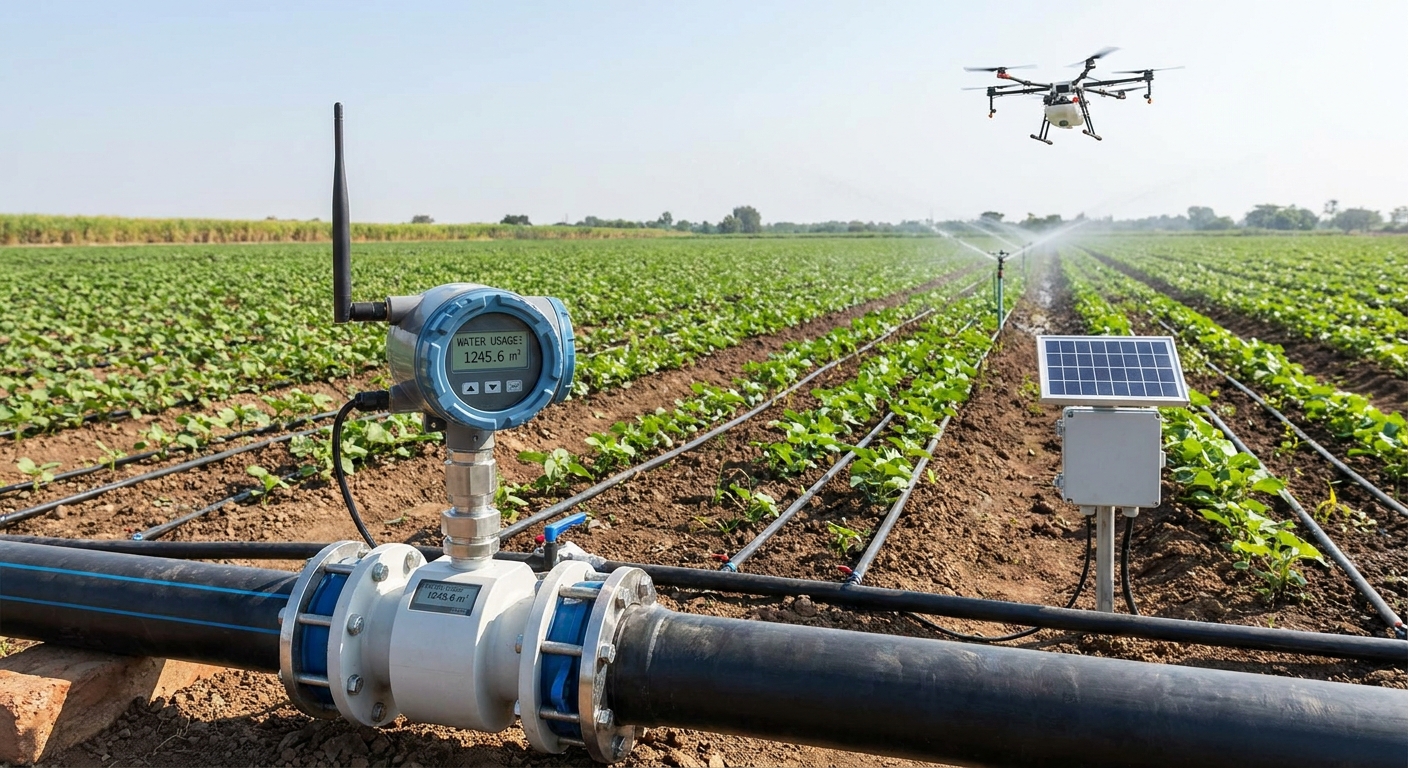
The Ecolor Technology ecosystem exemplifies this approach through its SITUMAN sensor manufacturing division and HuaYu ZhongNeng system integration framework. The architecture pairs the LGF electromagnetic flowmeter with the HERO V9 RTU — creating a complete, field-ready monitoring node requiring minimal civil works and zero ongoing calibration.
LGF Electromagnetic Flowmeter
- • Starting at 850 RMB (DN50)
- • PFA-lined electrodes & IP68 submersible housing
- • ±0.5% accuracy across turbulent agricultural flow profiles
- • Eliminates straight-run requirements via digital signal conditioning
HERO V9 RTU (Solar/4G)
- • Integrated MPPT solar charging & dual SIM fallback
- • Supports Modbus RTU, 4–20mA, and pulse inputs
- • Rated for -30°C to +70°C operational environments
- • Edge data compression & OTA firmware updates
When bundled with mounting hardware, surge protection, and cloud dashboard licensing, the complete agricultural water metering package remains under 5000 RMB per node. This pricing structure enables district authorities to deploy dense monitoring grids across primary canals, secondary distribution lines, and tertiary field inlets — without exceeding municipal capital expenditure thresholds.
Deployment Metrics, ROI, and Procurement Strategy
Real-world deployments across arid-zone agricultural cooperatives demonstrate that electromagnetic + RTU architectures reduce annual O&M expenditures by 68% compared to mechanical metering networks. The absence of moving parts eliminates routine bearing replacements, while solar telemetry removes trenching and grid extension costs.
Data continuity improves water allocation accuracy, enabling dynamic irrigation scheduling aligned with soil moisture thresholds and evapotranspiration forecasts. Over a typical 8-year asset lifecycle, the investment yields a 3.2x return through water conservation, reduced pump runtime, and minimized labor dispatch.
“The transition from volumetric estimation to real-time electromagnetic telemetry has transformed our district's water governance. We now allocate resources based on actual consumption patterns, reducing waste while maintaining crop yield stability across 12,000 hectares.”
— District Hydraulic Engineer, Northwest China Irrigation Authority
Strategic Procurement Guidelines for Irrigation Authorities
When evaluating smart irrigation flowmeter suppliers, procurement teams should verify electromagnetic coil insulation integrity, RTU surge protection ratings, and cloud platform data sovereignty compliance.
- Standardize on DN50 and DN100 nodes for secondary canals; reserve larger diameters for primary trunk lines
- Ensure all telemetry endpoints support OTA updates and local data caching for outage resilience
- Mandate open communication protocols (MQTT, HTTP, Modbus) to prevent vendor lock-in and enable future AI-driven irrigation control integration