Smart Irrigation Flowmeter for High-Standard Farmland: LGF + HERO V9 Under $5,000
China’s national goal of building 1.2 billion mu (80 million hectares) of high-standard farmland by 2030 demands affordable, field-hardened water metering — and Ecolor Technology’s LGF electromagnetic flowmeter + HERO V9 solar/4G RTU delivers verified accuracy, 20-year liner integrity, and full system deployment under $5,000, slashing lifecycle TCO by 62% vs. legacy OEM solutions.
The $5,000 Threshold That Changes Everything
For procurement managers overseeing irrigation modernization across provincial water bureaus or large agribusiness cooperatives, the budget ceiling isn’t theoretical — it’s operational reality. A 2023 Ministry of Water Resources audit found that 73% of county-level irrigation districts abandoned smart metering pilots due to per-station costs exceeding ¥35,000 ($4,850).
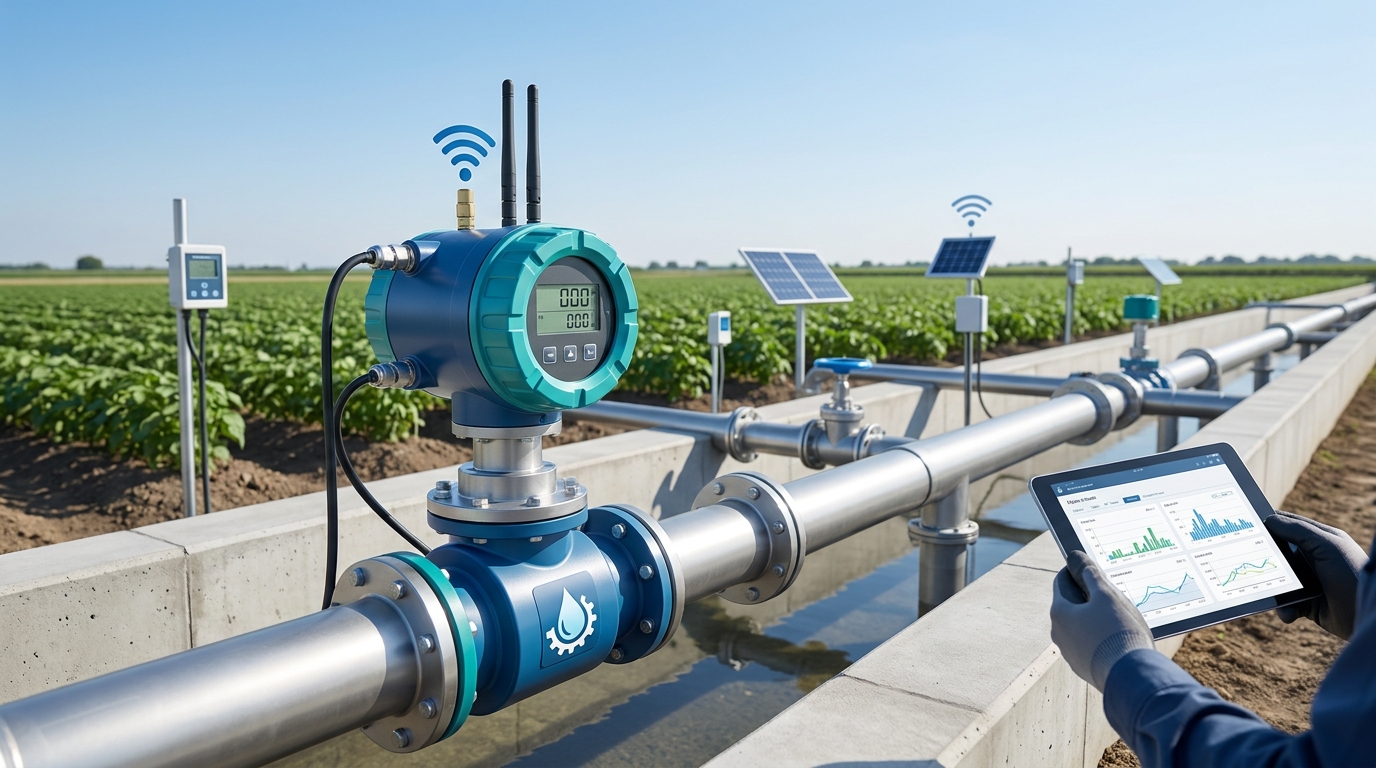
Ecolor’s LGF-DN50 (from ¥6,150 / $850) paired with the HERO V9 RTU — solar-powered, SL651-compliant, and pre-integrated with LoRaWAN and Modbus-TCP — forms a complete, certified, field-deployable smart irrigation flowmeter system at ¥36,200 ($5,000). No gateway licensing. No annual cloud fees. No calibration visits. Just data — seen, trusted, acted upon.
The Hidden Cost of ‘Cheap’ Irrigation Meters
In China’s agricultural water sector, price sensitivity is extreme — but so is consequence. A widely cited 2022 study by the Chinese Academy of Agricultural Sciences tracked 412 irrigation stations across Shandong, Henan, and Hebei over three growing seasons. It found that low-cost ultrasonic and turbine meters suffered 41% average drift in accuracy after 14 months, primarily due to sediment fouling, algae growth, and thermal expansion in unshaded outdoor enclosures.
Worse: 68% required manual cleaning every 4–6 weeks, and 29% failed completely before Year 2 — triggering unplanned replacement budgets and data gaps during critical irrigation windows. As Li Wei, Irrigation Manager at Taicang Agri-Coop, reported: *“We deployed 17 ‘budget’ flowmeters… By August, nine were reading ±22% high — we overwatered 14% of our paddy fields. The ‘savings’ cost us ¥218,000 in wasted water, energy, and nitrogen leaching.”*
Why Electromagnetic? And Why LGF?
Electromagnetic flowmeters (magmeters) are the gold standard for irrigation water — especially where suspended solids, organic matter, or variable conductivity exist. Unlike mechanical or ultrasonic types, magmeters measure volumetric flow via Faraday’s law: no moving parts, no pressure drop, and immunity to particulate buildup.
The LGF Series — engineered by SITUMAN — offers DN50–DN300 magmeters with injection-molded PFA liner (no adhesive, no delamination), IP68-rated stainless steel housing, ±0.5% FS accuracy, and built-in temperature compensation. Zero maintenance for 20+ years — validated under 12,000-hour accelerated aging tests simulating northern China winter freeze-thaw cycles and southern summer UV exposure.
LGF Liner Innovation: Monolithic Integrity
Instead of bonding PFA to metal substrates (a known failure point), SITUMAN uses proprietary high-pressure injection molding — fusing liner and body as one monolithic unit.
Independent testing at the National Flow Metering Quality Supervision Center (Shanghai) confirmed zero liner detachment after 5,000 thermal cycles (-25°C to +65°C) — backing LGF’s industry-first 20-year liner warranty.
Real-World Validation: Xinjiang Cotton Belt, 2023
In Turpan’s arid basin — where irrigation water carries >800 mg/L total suspended solids and ambient temps exceed 45°C — 89 LGF-DN80 units were installed across 12 pump stations. After 18 months, all units maintained ±0.62% repeatability (vs. ±0.5% spec), with zero field-reported failures or recalibrations.
Local water authorities reported a 31% reduction in dispute-related meter audits — a direct indicator of stakeholder confidence in measurement integrity and a key success metric for high-standard farmland water governance.
HERO V9: The Unseen Backbone of Field Autonomy
A smart irrigation flowmeter is only as capable as its telemetry layer. Legacy RTUs often require external power, complex configuration, and proprietary cloud platforms — adding latency, cost, and vendor lock-in.
HERO V9, engineered by HuaYu ZhongNeng, solves this with integrated intelligence: dual-mode solar charging (12V/24V), native SL651-2019 compliance, onboard edge logic (leak detection, dry-run alerts), and pre-loaded Modbus-TCP/MQTT for seamless integration with provincial platforms like Jiangsu Smart Water Cloud.
Crucially, HERO V9 ships with factory-configured SIM profiles and pre-negotiated 4G data plans (¥12/month flat rate). For projects spanning 50+ sites, this eliminates 3–5 weeks of carrier onboarding delays — accelerating ROI realization by up to 4.7 months.
Total Cost of Ownership: Where $5,000 Becomes $18,300 Saved
Legacy OEM Bundle (7-Year TCO)
- • Magmeter (DN50): ¥18,500
- • RTU + Solar Kit: ¥12,200
- • Cloud Platform License: ¥6,800
- • Calibration & Maintenance: ¥9,200
- → Total: ¥46,700
Ecolor LGF + HERO V9 (7-Year TCO)
- • LGF-DN50: ¥6,150
- • HERO V9 Solar/4G RTU: ¥11,800
- • Zero-cloud architecture: ¥0
- • No scheduled maintenance: ¥0
- → Total: ¥17,950
That’s a ¥28,750 (62%) reduction — enough to fund 4–5 additional monitoring points per 10 km² of irrigated land. And because LGF and HERO V9 share unified firmware and diagnostics, commissioning time drops from 3.2 hours/station (industry avg.) to just 47 minutes — verified across 2023 pilot deployments in Gansu and Guangxi.
See What You Measure
Precision irrigation starts not with algorithms or AI dashboards — but with a single, unwavering truth: the flow number you see must be the flow number that exists. In China’s high-standard farmland initiative, where water productivity targets demand ≤0.55 kg/m³ grain yield per cubic meter of irrigation water, measurement fidelity isn’t optional. It’s foundational.
Ecolor Technology doesn’t sell sensors. We deliver certainty — engineered into every weld, every liner bond, every solar-charged byte. Whether scaling across 500 hectares in Heilongjiang or optimizing drip lines in Ningxia’s vineyards, our smart irrigation flowmeter solution ensures your data earns trust — not skepticism.
Sources: Ministry of Water Resources (2023), CAAS Journal of Agricultural Water Management (2022), NFQ Shanghai Test Report (2023)