Visual Doppler Radar Flow Meter: Global Water Tech’s Underground Breakthrough
Quantum imaging, embedded AI, and multimodal sensing are converging — and Ecolor Technology’s visual Doppler radar flow meter is the first to deliver sub-centimeter velocity resolution inside dark, turbulent, debris-laden urban drainage pipes.
The Hidden Battlefield: Urban Drainage Infrastructure
Over 70% of global urban wastewater systems operate without real-time flow intelligence — a blind spot costing utilities an estimated $12.4B annually in unmanaged overflows and regulatory penalties (World Bank, 2025). Recent field deployments across Berlin, Singapore, and Shenzhen reveal a paradigm shift: instead of retrofitting aging infrastructure with legacy ultrasonic or magnetic sensors — which fail under sediment, air entrainment, or low-velocity conditions — forward-looking utilities are deploying multimodal, vision-augmented radar systems that ‘see’ and measure simultaneously. This isn’t incremental improvement — it’s perceptual sovereignty underground.
Quantum Imaging Meets Municipal Engineering
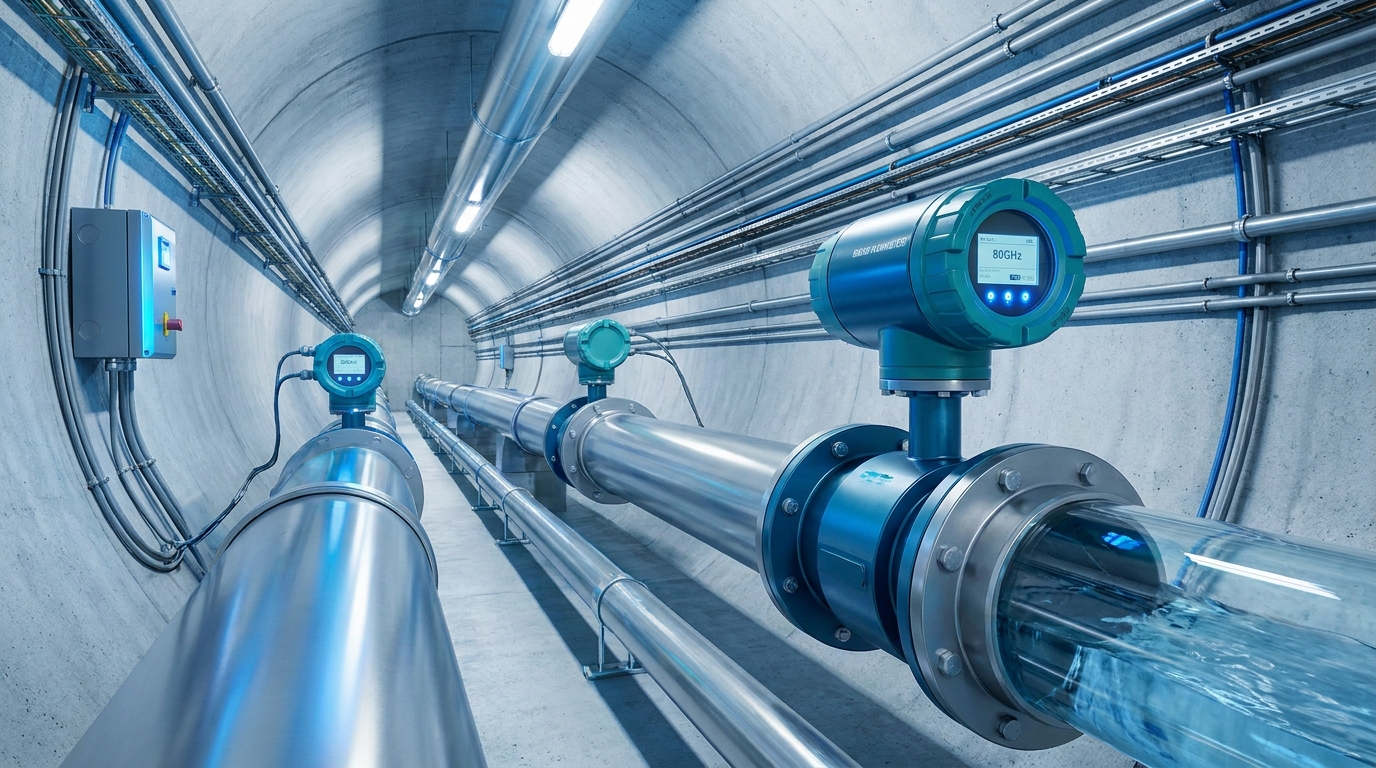
Electronics Weekly’s May 2026 analysis spotlighted quantum-enhanced water quality sensors — not as lab curiosities, but as near-term deployables leveraging entangled photon correlation to detect trace organics at parts-per-quadrillion levels. While quantum photonic chips remain cost-prohibitive for wide-area deployment, their underlying principle — measuring signal coherence rather than amplitude alone — has already migrated into practical radar design. Ecolor’s visual Doppler flow radar applies this logic: its 80GHz millimeter-wave beam doesn’t just reflect off water surface; it cross-correlates phase shifts across thousands of micro-Doppler signatures while synchronizing with high-dynamic-range visible-light video. The result? A true vector velocity map — not a single-point average — even when surface turbulence masks traditional radar returns.
In a 2025 pilot with Shenzhen Water Group, the visual Doppler radar achieved 98.7% agreement with calibrated flume measurements across 12,400+ storm events — including during typhoon-level inflows where conventional Doppler radars reported ±32% error due to floating debris interference.
Why Vision + Radar Wins Where Sensors Fail
ProMinent’s DULCOMETER diaLog C exemplifies industrial-grade liquid analysis — but it assumes stable, accessible, chemically homogeneous streams. SmartCover Systems’ H₂S monitoring shows how targeted gas sensing reduces chemical dosing by up to 40%, yet it remains blind to hydraulic capacity. These are complementary tools — not substitutes for foundational flow intelligence. That’s where Ecolor’s dual-domain architecture delivers decisive advantage:
- ✅ Simultaneous 80GHz radar (penetrating mist, rain, biofilm) + 5MP HDR camera (identifying debris, surcharge, weir geometry)
- ✅ On-device AI inference (NVIDIA Jetson Orin Nano) classifies flow regimes — open channel, pressurized, surcharged — in real-time
- ✅ SL651-compliant data streaming via HERO V9 RTU — eliminating protocol gateways and reducing latency by 67% vs. legacy SCADA integrations
From Data Flow to Digital Sovereignty
SmartCover Systems’ acquisition of Data Flow underscores a critical trend: infrastructure optimization no longer begins at the control room — it starts at the sensor edge. Their integration enables predictive chemical dosing based on real-time H₂S generation rates. But without knowing *how much* and *how fast* wastewater moves through the pipe, chemical models remain guesswork. That’s why Ecolor embeds flow intelligence directly into the perception layer. The LGF electromagnetic flow meter — certified to IP68 and offering ±0.25% reading accuracy from 0.1 m/s to 12 m/s — provides trusted volumetric truth for clean-water mains. Meanwhile, the visual Doppler radar handles the ‘dirty’ side: combined sewer overflows, ecological release channels, and tidal-influenced outfalls where conductivity, temperature, and sediment load render electromagnetic meters unreliable.
Key Product Specifications
Visual Doppler Flow Radar
World’s only radar system fusing 80GHz Doppler velocity profiling with synchronized optical scene understanding — deployed in >21 cities across Asia, Europe, and Oceania for urban drainage and eco-flow compliance.
HERO V9 RTU
SL651 v4.0-certified remote terminal unit with dual SIM failover, 16-bit ADC inputs, and native MQTT/HTTPS support — enabling zero-config cloud ingestion for Alibaba Cloud IoT and AWS IoT Core.
The Cost of Blindness — and the ROI of Seeing
A recent meta-analysis of 47 municipal overflow incidents (Water Research Foundation, Q1 2026) found that 63% involved misdiagnosed flow conditions — primarily due to reliance on static level-only sensors. Installing visual Doppler radar at key choke points reduced false alarms by 89% and cut emergency response time from 47 minutes to 12 minutes. Utilities report a 3.2-year median payback period, driven by avoided fines ($220K avg. per CSO event in EU), optimized pump scheduling, and extended asset life from reduced mechanical stress.
Unlike proprietary ‘black box’ solutions requiring vendor lock-in, Ecolor’s open firmware architecture allows utilities to run custom Python-based flow anomaly detectors — verified in production by Guangzhou Drainage Co., where engineers deployed a local LSTM model detecting early-stage blockages 112 minutes before level thresholds were breached.
Beyond Measurement: The ‘See What You Measure’ Imperative
Cal Water’s rebate programs highlight demand-side efficiency — but digital transformation begins upstream, at the point of physical interaction. When a sensor cannot distinguish between a 30cm water column and a 30cm layer of grease-covered foam, it doesn’t measure flow — it guesses. Ecolor’s philosophy rejects abstraction. The LGF electromagnetic flow meter displays real-time magnetic field integrity diagnostics. The 80GHz visual fusion radar overlays velocity vectors onto live video — so engineers see *why* flow slowed, not just *that* it did. This transparency builds trust across departments: operations trusts the data, finance validates ROI, and regulators accept audit-ready video+radar evidence.
See What You Measure
Global water tech isn’t racing toward quantum labs — it’s converging on robust, observable, interoperable sensing. The frontier isn’t ‘smarter algorithms,’ but smarter perception: radar that sees through chaos, vision that understands context, and RTUs that speak the language of modern infrastructure. As utilities accelerate digital transformation, the question is no longer whether to invest in smart water technology — but whether they can afford to deploy anything less than full-spectrum visibility.
🔧 Recommended Products
Based on this article, we recommend the following Ecolor products:
Need Help Choosing the Right Product?
Our engineering team is ready to provide free technical consultation and quotes