The Concrete Jungle's Achilles' Heel: Why Urban Flood Monitoring Demands More Than Just Data
The modern metropolis is a marvel of engineering, a dense network of steel, glass, and concrete. Yet, this very strength is also its critical vulnerability. As climate change accelerates, bringing more frequent and intense rainfall, our cities are increasingly susceptible to flash floods. The vast expanses of impermeable surfaces—roads, parking lots, and rooftops—transform gentle rain into torrential runoff, overwhelming drainage systems designed for a bygone era. The result is urban waterlogging, a fast-onset disaster that turns critical infrastructure into dangerous traps. Low-lying roads, underpasses, and subway entrances, the very arteries of urban mobility, can become inundated in minutes, posing severe risks to public safety, causing massive economic disruption, and paralyzing entire city sections.
Historically, managing this threat has been a reactive exercise. Warnings were often issued too late, based on generalized weather forecasts or delayed reports from manual patrols. The economic toll of this approach is staggering. Globally, urban flooding causes billions of dollars in damage annually, from submerged vehicles and damaged property to business closures and costly infrastructure repairs. A study by the World Bank highlights that the urban poor are disproportionately affected, and the overall cost is a significant drag on municipal budgets and national economies. According to the U.S. National Institute of Building Sciences, every dollar invested in hazard mitigation can save up to six dollars in post-disaster recovery costs. This statistic underscores a powerful truth: in the battle against urban floods, proactive defense is not just a strategic advantage; it is an economic imperative. The question is no longer whether we should invest in early warning systems, but what kind of system can provide the timely, accurate, and—most importantly—trustworthy intelligence needed to make life-or-death decisions.
From Ambiguity to Action: The Critical Need for Visual Verification
Traditional automated monitoring has relied on various sensor technologies, such as ultrasonic or pressure-based level transmitters. While an improvement over manual methods, these systems provide a single, abstract data point: the water level. For an emergency manager in a command center, a reading of '1.5 meters' at an underpass raises more questions than it answers. Is the sensor functioning correctly? Is the reading skewed by floating debris? Is a single stalled vehicle causing a localized backup, or is the entire area rapidly flooding? Acting decisively—such as closing a major thoroughfare or shutting down a subway line—based on a single, unverified number carries immense responsibility and risk.
This is the critical gap in conventional urban flood monitoring: the lack of context. Without visual confirmation, data is just a number, open to interpretation and doubt. In a crisis where every second counts, this ambiguity can lead to fatal hesitation. This is where Ecolor Technology's guiding principle, "See What You Measure," transforms the paradigm of water monitoring. We believe that actionable intelligence is born from the fusion of precise measurement and clear, contextual validation. An effective waterlogging warning system must not only tell you what is happening but also show you, empowering decision-makers with the confidence to act swiftly and decisively.
The Power of Fusion: 80GHz Radar Precision Meets High-Definition Visuals
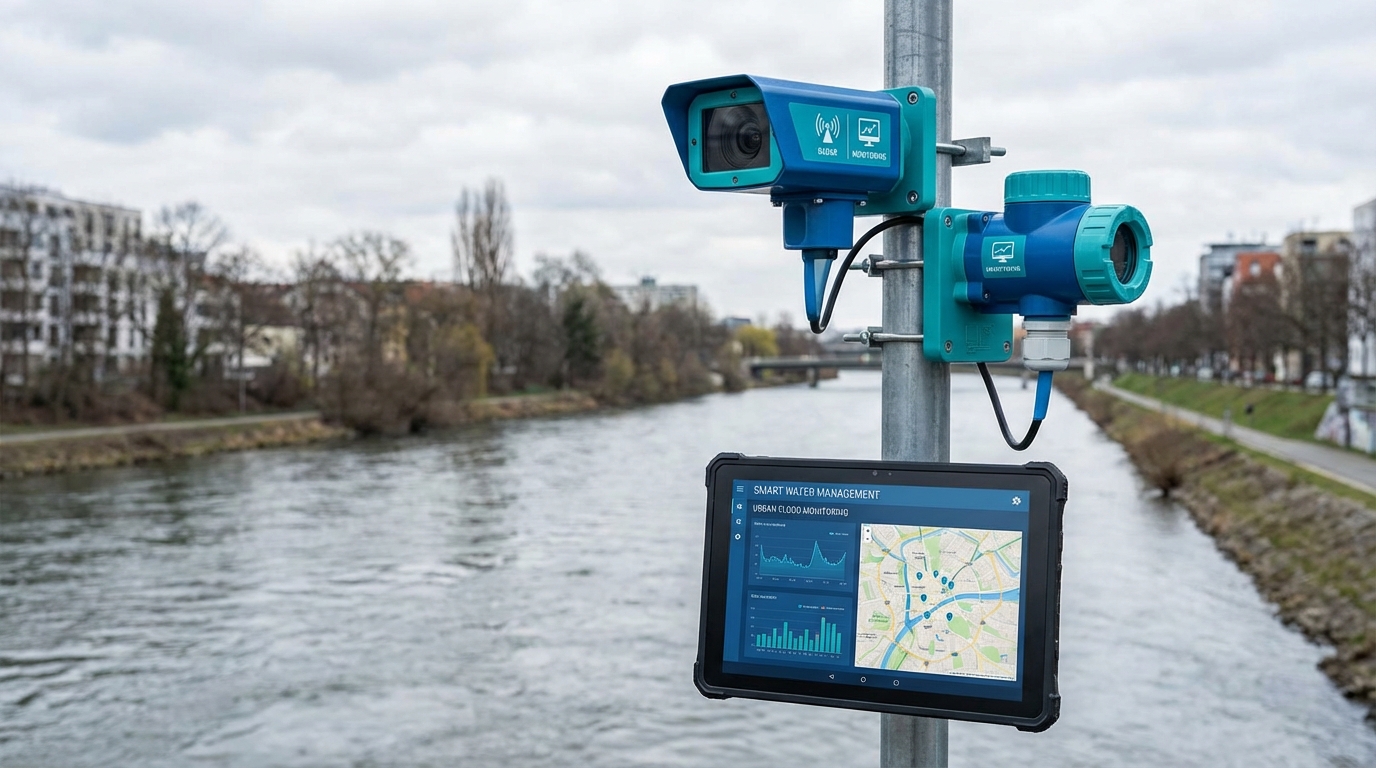
To address this challenge, Ecolor Technology, through its advanced sensor manufacturing division SITUMAN, has engineered an integrated solution specifically for the urban environment: a radar water level sensor combined with a high-definition camera. This is not simply two devices bolted together; it is a synergistic system where each component enhances the other's value, creating a powerful tool for proactive flood defense.
At its core is the 80GHz Frequency-Modulated Continuous Wave (FMCW) radar. This technology offers several distinct advantages for the tight confines of urban infrastructure:
- Pinpoint Accuracy: The high 80GHz frequency produces an extremely narrow beam angle. This allows the sensor to measure the water level with millimeter-level precision, even in narrow channels, culverts, or down the side of a bridge abutment, without picking up false echoes from surrounding walls or structures.
- Unwavering Reliability: Unlike ultrasonic sensors, radar is unaffected by environmental factors like wind, fog, rain, or temperature fluctuations. Its non-contact nature means it is safe from corrosive water, floating debris, and vandalism, ensuring a long operational life with minimal maintenance—a key factor in reducing the total cost of ownership (TCO) for municipal clients.
- Robust Performance: The FMCW technology provides stable and reliable readings, filtering out noise and interference common in busy urban settings.
Paired with this precision instrument is an integrated HD camera, which serves as the system's eyes on the ground. When the radar detects that water has reached a pre-defined warning or alarm threshold, the system automatically captures high-resolution images or a short video clip. This visual data is transmitted alongside the level reading to the central command platform. Suddenly, the abstract number '1.5 meters' is replaced with a clear, undeniable picture: rising water rapidly approaching the roadway, a car already stranded, or debris blocking a critical drain. This visual verification provides:
- Situational Awareness: Emergency responders can instantly assess the severity and nature of the threat.
- Decision Confidence: There is no ambiguity. The visual proof justifies immediate action, such as dispatching crews, activating digital road signs to close the underpass, or ordering the closure of nearby subway station floodgates.
- Post-Event Analysis: The archived visual data is invaluable for understanding flood dynamics, identifying recurring problem spots, and planning future infrastructure improvements.
Designed for the Urban Battlefield: Resilient Monitoring Where It Matters Most
The true test of a waterlogging warning system is its performance at the most vulnerable points of a city. Ecolor Technology's integrated visual radar stations are purpose-built for these critical locations, with features designed for resilience and autonomous operation.
Low-Lying Roads and Underpasses
These locations are notorious flash flood hotspots. An integrated station mounted above the roadway provides constant, 24/7 vigilance. When water begins to pool, the system sends an immediate alert, allowing traffic authorities to close the road well before it becomes a death trap. The visual feed helps them confirm the road is clear of vehicles before activating barriers, ensuring public safety.
Subway and Metro Entrances
A flooded subway system can take weeks to restore and cost a city millions in lost revenue and repair costs. By placing monitoring stations near vulnerable entrances, transit authorities receive advance warning of surface water accumulation. This crucial lead time allows them to deploy flood barriers, activate pumps, and safely suspend service if necessary, protecting a city's most vital transportation network.
Autonomous and Resilient by Design
Recognizing that severe weather often coincides with power outages, these stations are designed for complete autonomy. An integrated solar panel and battery system ensure uninterrupted operation, even when the city's power grid fails. Data is transmitted wirelessly via 4G or 5G cellular networks, making the system independent of local cable infrastructure that could be damaged in a flood. This robust, self-sufficient design is a hallmark of the solutions delivered by Ecolor's system integration arm, HuaYu ZhongNeng, which specializes in deploying reliable, turnkey monitoring networks for critical applications.
Building a Smarter, Safer Future
As cities continue to grow and climate patterns become more unpredictable, the need for intelligent, resilient infrastructure has never been greater. Moving beyond reactive measures and embracing proactive, data-driven defense is essential for safeguarding lives and economies. The integration of high-precision 80GHz radar with real-time visual verification represents a significant leap forward in urban flood monitoring. It closes the critical gap between raw data and actionable intelligence, empowering city managers, water utility engineers, and emergency responders with the tools they need to protect their communities.
By providing a clear, unambiguous view of escalating threats, these advanced systems allow for the creation of a truly effective waterlogging warning system. This is the future of urban resilience—a future where technology empowers us not just to measure the world, but to see it, understand it, and protect it with confidence. To learn more about how integrated visual radar systems can fortify your city's defenses against urban flooding, explore the innovative solutions from Ecolor Technology at www.cssoc.com.
Sources
Recommended Products
Ecolor Technology provides professional instruments for smart water, environmental monitoring & industrial automation: