The Rising Tide: A Paradigm Shift in Urban Flood Defense
As cities expand and climate patterns become increasingly erratic, the threat of urban flooding has escalated from a seasonal nuisance to a critical infrastructure challenge. The scenes are becoming all too familiar: submerged underpasses, inundated subway stations, and low-lying roads transformed into impassable canals. Traditionally, municipal response has been reactive—acting after the damage is done. However, a technological revolution is underway, shifting the focus from post-disaster cleanup to pre-emptive, data-driven defense. As highlighted in recent analyses of global flood preparedness, the future lies in leveraging real-time data monitoring and predictive analytics to build resilient cities. The question is no longer just *if* we can monitor floodwaters, but *how* we can do so with the precision, reliability, and contextual awareness needed to act before disaster strikes.
The core challenge has evolved. It's not enough to simply detect water. Modern flood management demands a comprehensive understanding of the situation in real-time. This requires moving beyond simplistic sensors to intelligent systems that can both quantify the threat and provide visual verification, enabling rapid, confident decision-making.
The Frailty of Contact: Why Traditional Sensors Fall Short
For years, the backbone of many flood alert systems has been contact-based sensors. These devices, which often rely on probes or floats, are designed to trigger an alarm when they physically touch water. While simple in principle, their fundamental design presents a critical vulnerability. As industry resources like Alarm Grid point out, many flood sensors are paradoxically not designed for prolonged or turbulent submersion. During an actual urban flood event—characterized by fast-moving water, debris, sediment, and corrosive runoff—these sensors are prone to failure precisely when they are needed most.
The issues are manifold: probes can be damaged by floating debris, electrical contacts can be fouled by sediment, and the entire unit can be washed away or destroyed. This unreliability creates a dangerous gap in a city's defense network, leading to missed alerts and delayed responses. The need is clear for a more robust, resilient, and maintenance-free approach. The solution lies in taking the sensor out of the water altogether.
The Non-Contact Revolution: 80GHz Radar Technology
Enter non-contact radar technology. By mounting a sensor safely above the expected flood level—on the ceiling of an underpass, the side of a bridge, or a pole near a subway entrance—it can measure water level with incredible precision without ever touching the water. Ecolor Technology's SITUMAN series leverages advanced 80GHz FMCW (Frequency-Modulated Continuous-Wave) radar. This high-frequency technology offers significant advantages:
- ✅ Millimeter-Level Accuracy: It provides highly precise water level data, allowing for the detection of even subtle changes that can be precursors to a major event.
- ✅ All-Weather Performance: Unlike some optical or ultrasonic sensors, 80GHz radar is virtually unaffected by rain, fog, dust, or darkness, ensuring reliable 24/7 operation.
- ✅ Enhanced Durability: With no moving parts and no contact with corrosive floodwater or debris, the sensor's lifespan is dramatically increased and maintenance requirements are minimized.
Beyond Measurement: The Power of Sensor Fusion
Accurate data is the foundation, but data alone is not intelligence. A water level reading of 1.5 meters at a critical underpass is an urgent alarm, but it doesn't answer crucial questions. Is the rise due to a blocked drain? Are vehicles trapped? Is debris accumulating and posing a greater risk? This is where the concept of sensor fusion, as explored in academic research like the HESS paper on fusing imagery and sensor data, becomes a game-changer for urban flood monitoring.
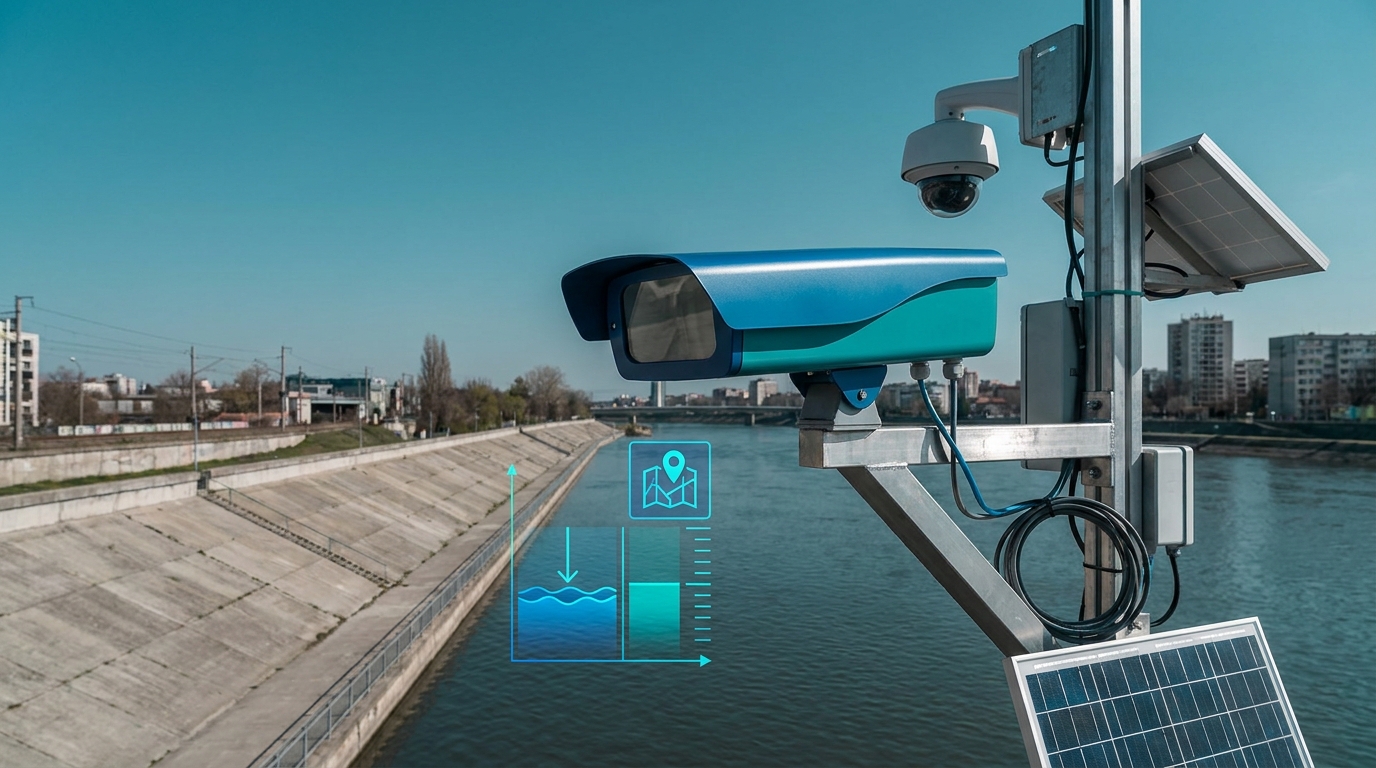
By integrating a high-definition camera with the radar level sensor, we move from simply measuring a problem to truly understanding it. This fusion of quantitative data (the radar's precise level measurement) and qualitative context (the camera's visual feed) is the embodiment of Ecolor Technology's core philosophy.
See What You Measure
This isn't just a slogan; it's an operational imperative. When an alarm is triggered, control center personnel can immediately access a live video stream from the exact location. This visual verification eliminates false alarms, provides immediate situational awareness, and enables a more targeted and effective emergency response. They can see if a pump station has failed, if a trash receptacle has overturned and blocked a culvert, or confirm that a roadway is clear before reopening it to traffic.
? Ecolor's Radar-Camera Water Level Station
Our integrated station combines an 80GHz non-contact radar for precise water level measurement with a high-definition camera for real-time visual verification. Designed for urban environments, this solar-powered unit offers a complete, standalone solution for monitoring critical points like low-lying roads, bridge underpasses, and subway entrances. Data and video are transmitted wirelessly to a central platform, providing a comprehensive, actionable view of the urban hydrological network.
Fueling Predictive Analytics for Proactive Response
The ultimate goal of a modern urban flood monitoring system is to move from reaction to prediction. As pioneering technology firms like Portugal's Greenmetrics.ai are demonstrating, it is now possible to predict urban flood risks more than an hour in advance. This capability is entirely dependent on a steady stream of high-quality, real-time data from a dense network of reliable sensors.
A city-wide deployment of Ecolor's radar-camera stations at strategic choke points creates this essential data backbone. The continuous flow of water level data, correlated with rainfall forecasts and historical flood data, fuels the machine learning models that power a true waterlogging warning system. This allows authorities to:
- ✅ Issue Targeted Alerts: Warn residents and businesses in specific, at-risk neighborhoods before flooding begins.
- ✅ Pre-deploy Resources: Position emergency crews, pumps, and barriers in anticipated flood zones for a faster response.
- ✅ Automate Infrastructure: Automatically trigger the closure of flood gates at underpasses or subway entrances based on predictive thresholds.
- ✅ Optimize Traffic Flow: Reroute traffic away from areas predicted to flood, preventing stranded vehicles and ensuring emergency access.
This proactive stance, built on the foundation of fused sensor data, transforms flood management from a costly, chaotic emergency response into a planned, controlled, and data-informed operation. It minimizes economic disruption, protects property, and, most importantly, saves lives.
Building a Resilient Future, One Sensor at a Time
The fight against urban flooding is a complex challenge that demands an intelligent, multi-layered solution. The era of relying on single-point, failure-prone sensors is over. The future is integrated, non-contact, and visually verified. By fusing the quantitative accuracy of 80GHz radar with the invaluable contextual insight of high-definition video, cities can build a nervous system that not only detects but also understands and anticipates flood events.
Solutions like Ecolor Technology's solar-powered radar-camera stations are more than just hardware; they are the eyes and ears of a smart city's flood defense infrastructure. They provide the ground truth needed to calibrate predictive models, the real-time awareness to manage ongoing events, and the post-event data to build more resilient infrastructure for the future. For procurement managers, water utility engineers, and project managers tasked with safeguarding our urban centers, investing in this fused sensor technology is a critical step towards a safer, more resilient tomorrow.
To learn more about how Ecolor Technology is helping cities build resilient flood defense systems with our advanced urban flood monitoring solutions, please visit our website at www.cssoc.com.
Sources:
1. Dale, J. E., et al. (2026). Community-scale urban flood monitoring through fusion of time-lapse imagery, terrestrial lidar, and remote sensing data. Hydrology and Earth System Sciences. Retrieved from https://hess.copernicus.org/articles/30/2183/2026/
2. The Weather (n.d.). The Sensors That Anticipate Flooding in Portuguese Cities Are Reaching Europe and the United States. Retrieved from https://www.theweather.com/news/trending/the-sensors-that-anticipate-flooding-in-portuguese-cities-are-reaching-europe-and-the-united-states.html
3. Alarm Grid (n.d.). Flood Sensors. Retrieved from https://www.alarmgrid.com/browse/flood-sensors
4. MakeUseOf (n.d.). 4 places to put a contact sensor that have nothing to do with security or doors. Retrieved from https://www.makeuseof.com/places-to-put-a-contact-sensor-that-have-nothing-to-do-with-security-or-doors/
5. Blueprint Newspapers Limited (2026). 2026 flood threat: Between warnings and preparedness. Retrieved from https://blueprint.ng/2026-flood-threat-between-warnings-and-preparedness/
Recommended Products
Ecolor Technology provides professional instruments for smart water, environmental monitoring & industrial automation: