
AI Edge Computing Gateway for Pressure Anomaly Prediction and Leakage Early Warning in Water Supply Networks
Addressing the pain points of water supply network leakage management - delayed leak detection, manual-dependent minimum night flow analysis, pressure anomalies that are hard to attribute, siloed monitoring points without cross-validation, and slow burst response - this solution is built around the AI edge computing gateway: a dedicated energy-metering chip samples three-phase electrical parameters every second, and power fingerprinting identifies early electromechanical anomalies such as impeller wear and cavitation; the pump station dynamic model solves real-time flow and pump efficiency from electrical inputs with head as the boundary condition under physical constraints rather than black-box fitting; soft-sensor shadow metering keeps flow data continuous even when physical meters fail or are absent; power x pressure x flow three-factor cross-validation automatically flags instrument anomalies within 24 hours; per-device models learn from startup with edge training and cloud calibration, running autonomously through network outages with store-and-forward. Connected via RS485/4G to inline and insertion ultrasonic flow meters and pressure transmitters, the gateway performs pressure surge detection, minimum night flow analysis and leakage early warning at the edge, cutting leak and burst detection from days to minutes and supporting utility NRW targets and refined DMA operations.
Overview
Summary
Addressing the pain points of water supply network leakage management - delayed leak detection, manual-dependent minimum night flow analysis, pressure anomalies that are hard to attribute, siloed monitoring points without cross-validation, and slow burst response - this solution is built around the AI edge computing gateway: a dedicated energy-metering chip samples three-phase electrical parameters every second, and power fingerprinting identifies early electromechanical anomalies such as impeller wear and cavitation; the pump station dynamic model solves real-time flow and pump efficiency from electrical inputs with head as the boundary condition under physical constraints rather than black-box fitting; soft-sensor shadow metering keeps flow data continuous even when physical meters fail or are absent; power x pressure x flow three-factor cross-validation automatically flags instrument anomalies within 24 hours; per-device models learn from startup with edge training and cloud calibration, running autonomously through network outages with store-and-forward. Connected via RS485/4G to inline and insertion ultrasonic flow meters and pressure transmitters, the gateway performs pressure surge detection, minimum night flow analysis and leakage early warning at the edge, cutting leak and burst detection from days to minutes and supporting utility NRW targets and refined DMA operations.
Key Advantages
Challenges
- Long hidden-leak detection cycles: hidden leaks often take weeks or even months to surface through manual acoustic surveys or monthly NRW reports, wasting huge volumes of water and potentially escalating into bursts and road collapses
- High-latency cloud-dependent MNF analysis: traditional minimum night flow analysis requires cloud batch processing of returned data with poor timeliness, and centralized analysis struggles to cover point-by-point real-time assessment across hundreds or thousands of monitoring points
- Single-factor data cannot attribute anomalies: when one pressure or flow point reads abnormal, genuine leakage, instrument drift, pump condition changes and user consumption fluctuations cannot be told apart - high false alarm rates keep field crews busy with fruitless checks
- Data gaps during instrument failures: monitoring data breaks while flow meters or pressure transmitters are failed or under calibration, severing the leakage analysis chain and invalidating historical baselines
- Siloed monitoring points: pressure, flow, power and pump status data live in different systems from different vendors, lacking cross-validation and fusion capability - contradictory anomaly signals are hard to arbitrate
Results
- Leak detection cut from days to minutes: edge-side real-time pressure surge detection and MNF analysis trigger instant alarm push, dramatically speeding up burst and hidden-leak response
- Three-factor cross-validation reduces false alarms: power x pressure x flow verify each other and instrument anomalies are auto-identified within 24 hours, so alarms are self-authenticating and fruitless field inspections drop significantly
- Soft-sensor shadow metering eliminates data gaps: while physical flow meters fail or are absent, the pump dynamic model keeps estimating flow as a mutual backup, so the monitoring chain never breaks
- Power fingerprinting gives early electromechanical warning: impeller wear, cavitation and rotor eccentricity are identified from current waveforms within seconds - warning ahead of network pressure anomalies and avoiding unplanned supply interruptions
- Per-device models get smarter with use: learn-from-startup, edge training with cloud calibration and confidence gating adapt to changing site conditions, with prediction accuracy improving continuously over long-term operation
Solution Details
AI Edge Computing Gateway for Pressure Anomaly Prediction and Leakage Early Warning in Water Supply Networks
Water network leakage is a universal operating challenge for utilities worldwide: aging pipes, failed joints and third-party construction damage cause hidden leaks and bursts that not only waste water and keep non-revenue water rates high, but may also trigger road collapses and other public safety incidents. Traditional leakage control relies on manual acoustic leak surveys and monthly NRW reports, so hidden leaks often go undetected for weeks or even months. Minimum Night Flow (MNF) analysis is an internationally recognized effective approach, yet sending data to the cloud for batch analysis introduces latency, and a single pressure or flow measurement point cannot distinguish genuine leakage from instrument drift or consumption pattern changes - producing high false alarm rates that exhaust field crews with fruitless inspections.
This solution deploys the AI edge computing gateway to build an edge-intelligent system for pressure anomaly prediction and leakage early warning in water supply networks. Gateways are installed at pump stations, booster stations and DMA metering points. A dedicated energy-metering chip samples three-phase voltage, current, power and energy every second, and power fingerprinting detects early electromechanical anomalies - impeller wear, cavitation, rotor eccentricity - from current waveforms. Pump performance degradation typically precedes network pressure anomalies, so power fingerprints provide a brand-new leading signal for both leakage and equipment fault warning. The pump station dynamic model takes electrical parameters as inputs and head as the boundary condition, solving real-time flow and pump efficiency through physics-constrained modeling rather than black-box fitting. Soft-sensor shadow metering keeps the system estimating flow continuously while a flow meter is absent or failed, backing up physical instruments so the data chain never breaks. Power x pressure x flow three-factor cross-validation verifies each other and automatically identifies instrument anomalies within 24 hours, making every alarm self-authenticating. The per-device self-learning model starts learning at power-up, adapts to new and old operating conditions, and combines edge training with cloud calibration - the longer it runs, the better it understands the site. A confidence gate outputs data normally when inference is reliable and explicitly marks 'learning' when samples are insufficient: it would rather draw no line than draw a wrong one.
The gateway connects via multiple RS485 (Modbus) channels to inline ultrasonic flow meters, insertion ultrasonic flow meters and pressure transmitters, with 4G uplink to the cloud. Non-intrusive installation only clamps current transformers onto the power distribution circuit - no pipe cutting, no shutdown, no fluid contact, wired and ready. Pressure surge detection, pressure gradient trend analysis and minimum night flow computation all run locally at the edge; the device operates autonomously through network outages, never loses data on power failure, and forwards stored records after recovery. Relay and analog outputs link directly to existing SCADA and control loops, while the industrial LCD color screen and four-key panel allow on-site comparison of soft-sensor and hard-instrument trends. The accompanying Ecolor IoT platform provides device management, time-series storage, alarm push and OpenAPI subscription for a complete data pipeline - cutting leak detection from days to minutes and giving utilities a trustworthy data foundation for NRW targets, DMA zoning and pipe renewal decisions.
Key Capabilities of the AI Edge Computing Gateway
- Power fingerprinting: a dedicated energy-metering chip samples all three-phase electrical parameters every second, identifying early electromechanical anomalies such as impeller wear, cavitation and rotor eccentricity from current waveforms
- Pump station dynamic model: solves real-time flow and pump efficiency with electrical parameters as inputs and head as the boundary condition - physics-constrained modeling, not black-box fitting
- Soft-sensor shadow metering: flow is known even without a flow meter, mutually backing up physical instruments so data stays continuous while meters are 'blind'
- Three-factor cross-validation: power x pressure x flow verify each other and instrument anomalies are automatically identified within 24 hours - data authenticates itself
- Per-device self-learning models: learn from power-up, adapt to new and old conditions, edge training with cloud calibration - the longer it runs the better it knows your pumps; a confidence gate would rather draw no line than a wrong one
- Non-intrusive install & outage autonomy: current transformers clamp onto the distribution circuit only - no pipe work, no shutdown; autonomous during network outages, no data loss on power failure with store-and-forward, and relay/analog outputs connect directly to existing SCADA
Leakage Early Warning Performance at a Glance
1 s
Three-phase electrical sampling interval
24 h
Automatic instrument anomaly identification
3-factor
Power x pressure x flow cross-validation
Days → Minutes
Leak detection time reduction
Zero shutdown
Non-intrusive clamp-on installation
No data loss
Store-and-forward on power failure
Technical Details: Edge Intelligence for Water Supply Networks
The gateway connects via multiple RS485 (Modbus) channels to inline ultrasonic flow meters, insertion ultrasonic flow meters and pressure transmitters, with 4G uplink to the cloud. Pressure surge detection, pressure gradient trend analysis and minimum night flow computation all run locally at the edge, so latency-prone cloud batch analysis is no longer required for early warning.
- Multiple RS485 (Modbus) channels for inline ultrasonic flow meters, insertion ultrasonic flow meters and pressure transmitters
- 4G uplink to the cloud for device management, time-series storage, alarm push and OpenAPI subscription via the Ecolor IoT platform
- Local edge execution of pressure surge detection, pressure gradient trend analysis and minimum night flow computation
- Autonomous operation through network outages with store-and-forward of stored records after recovery
- Relay and analog outputs linking directly to existing SCADA and control loops
- Industrial LCD color screen and four-key panel for on-site comparison of soft-sensor and hard-instrument trends
Applications: Pressure Anomaly Prediction and Leakage Early Warning
Gateways are installed at pump stations, booster stations and DMA metering points, giving utilities a trustworthy data foundation for NRW targets, DMA zoning and pipe renewal decisions. Because pump performance degradation typically precedes network pressure anomalies, power fingerprints provide a leading signal for both leakage and equipment fault warning, while the confidence gate explicitly marks 'learning' when samples are insufficient - it would rather draw no line than draw a wrong one.
? 参考来源
- Product description and feature list provided by the manufacturer
- Minimum Night Flow (MNF) analysis as an internationally recognized leakage control approach
Approach
How we implement intelligence into your infrastructure step by step.
Site survey and monitoring point planning
Map the supply network topology and DMA boundaries; determine deployment locations at pump stations, booster stations and district metering points; survey distribution circuits and existing flow meter / pressure transmitter access conditions, and plan power-fingerprint acquisition points and three-factor cross-validation combinations into a one-point-one-file ledger.
Gateway installation and non-intrusive integration
Clamp three-phase current transformers onto the distribution circuit and mount the gateway on DIN rail or wall; connect inline/insertion ultrasonic flow meters and pressure transmitters via RS485 (Modbus); configure the 4G uplink and relay/analog outputs to existing SCADA - all without touching pipes or stopping supply.
Edge model initialization and self-learning
The gateway starts self-learning at power-up, collecting power, pressure and flow baselines to build its per-device model; the confidence gate marks the 'learning' phase until samples suffice, after which pressure surge detection, gradient trend analysis and MNF computation activate automatically.
Leakage warning strategy and platform configuration
Configure district leakage thresholds, MNF baseline drift alarms and three-factor arbitration rules on the Ecolor IoT platform; push alarms to O&M devices and subscribe via OpenAPI into utility billing and dispatch systems to close the detect-locate-handle loop.
O&M management and continuous model calibration
Use the industrial LCD panel to compare soft-sensor vs hard-instrument trends on site; periodically check CT wiring and grounding; the edge-training/cloud-calibration mechanism absorbs condition changes automatically, with quarterly reviews of model confidence and leak-location accuracy feeding pipe renewal decisions.
Recommended Hardware
Essential components for this solution.
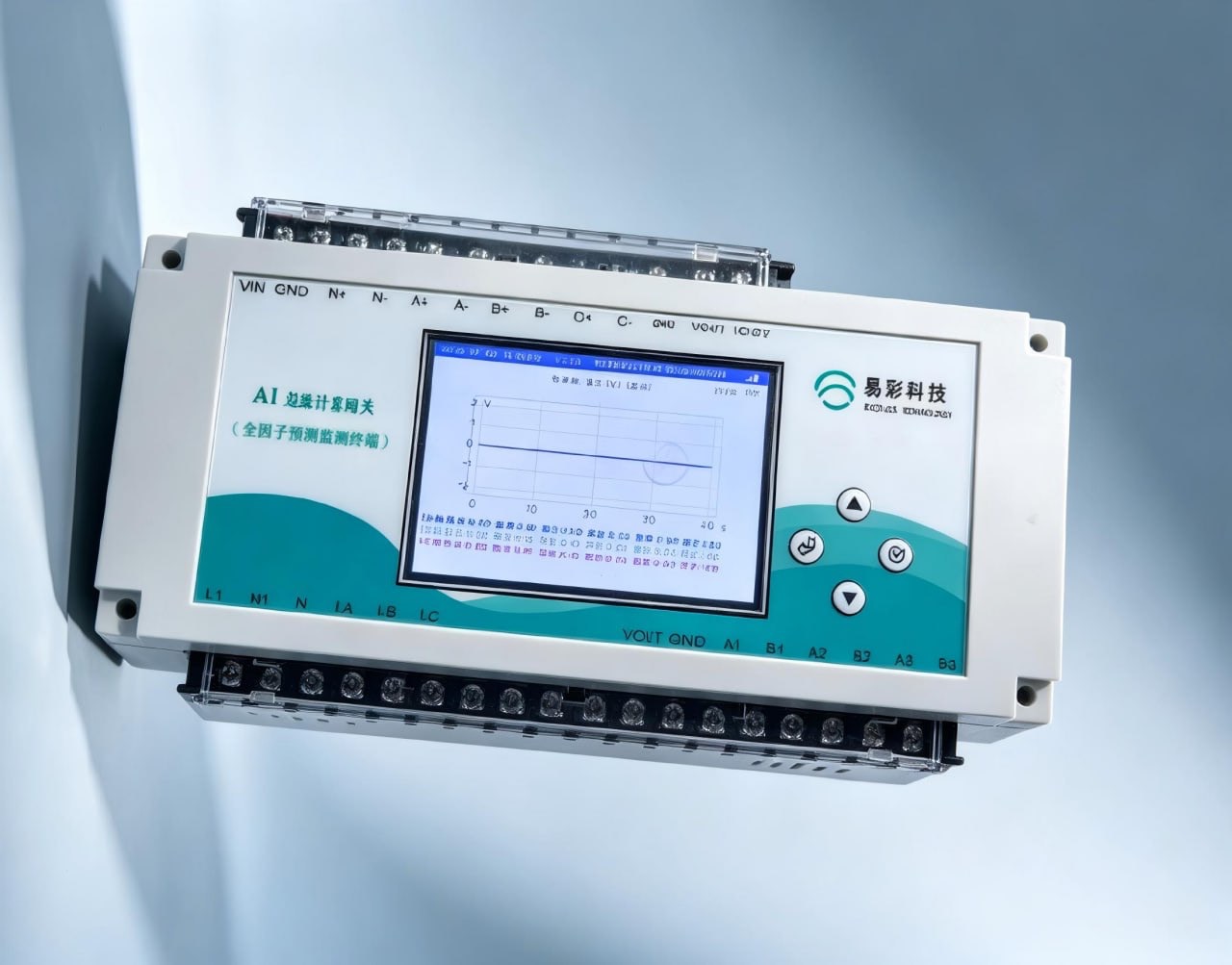
❓ Related FAQs
Related Solutions
pH/ORP Meter Application for Precision ORP Control of Chlorine Disinfection in Drinking Water Treatment Plants
Conductivity Meter Application for Online Product Water Quality Monitoring in RO Seawater Desalination
Compact Water Quality Monitoring Station Solution for Township River Cross-Section Assessment

Ready to Optimize Your Business?
Contact us, and our professional team will provide customized solutions to help your business achieve digital transformation.
Get In Touch