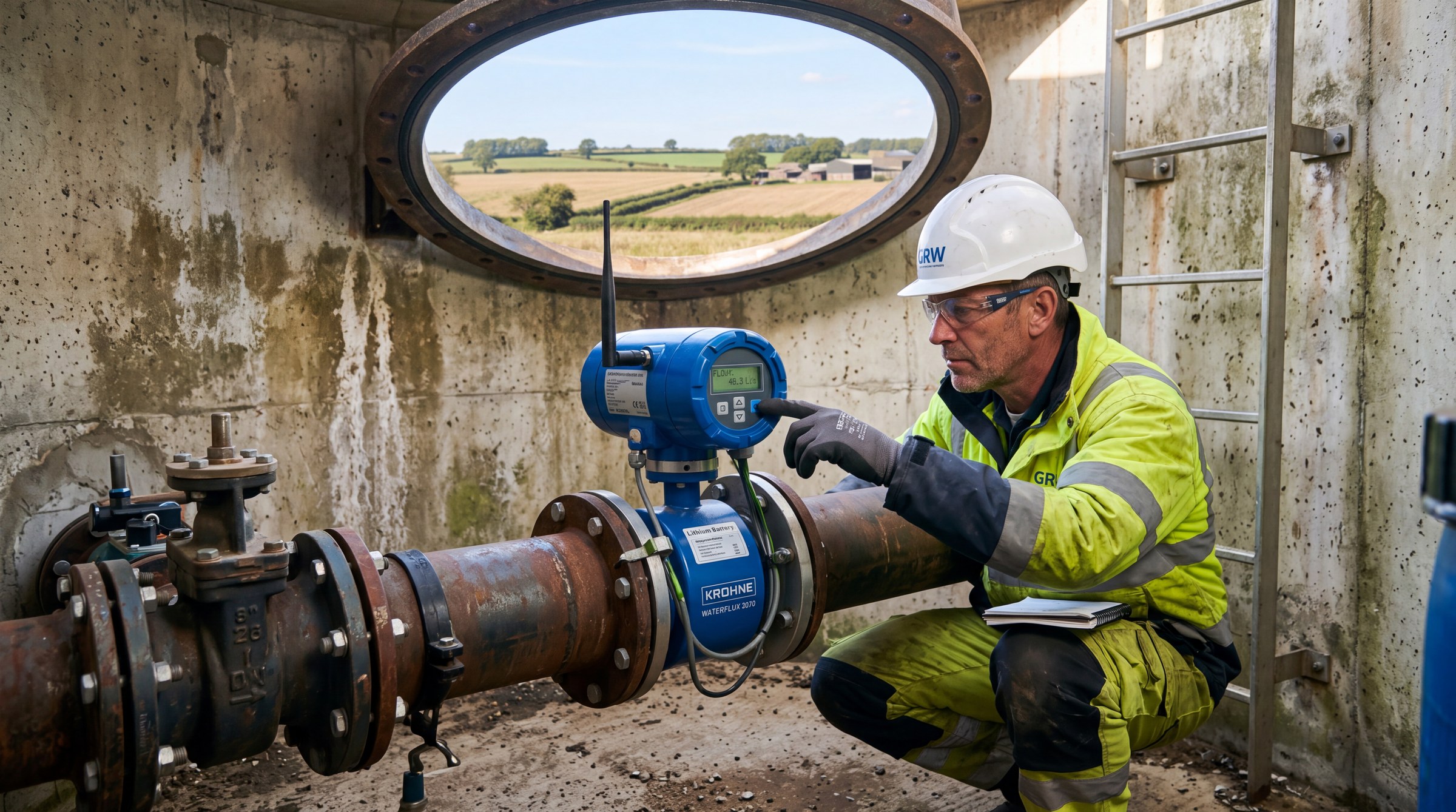
Battery-Powered Electromagnetic Flow Meter Solution for Off-Grid Remote Metering
For metering points far from the power grid — river intakes, canal offtakes, rural water networks and remote industrial pipelines — this solution deploys battery-powered electromagnetic flow meters with ultra-low-power excitation and NB-IoT/4G telemetry, delivering trade-grade flow measurement for 6+ years without mains power or wiring.
Overview
Summary
For metering points far from the power grid — river intakes, canal offtakes, rural water networks and remote industrial pipelines — this solution deploys battery-powered electromagnetic flow meters with ultra-low-power excitation and NB-IoT/4G telemetry, delivering trade-grade flow measurement for 6+ years without mains power or wiring.
Key Advantages
Challenges
- Metering points are far from the grid; mains connection costs exceed the metering investment and take months
- Water-tax and abstraction-permit metering demands trade-grade accuracy that mechanical meters cannot deliver
- Unattended sites must auto-report tamper-proof data with instant anomaly alarms
- Average power must be milliwatt-level; battery capacity dictates runtime and OPEX
- Wet chambers, freezing winters and flooding test protection and stability
Results
- Per-site deployment cut from months to 2–3 days, investment down 80%+
- Velocity 0.05–10 m/s, accuracy ±0.5%–±1.0%, turndown ≥100:1
- 6+ years battery life at typical duty; lifetime cost below solar solutions
- Local storage plus back-fill keeps data completeness ≥99.9%
- Data feeds water-tax and abstraction regulatory platforms with full traceability
Solution Details
Battery-Powered Electromagnetic Flow Meter Solution for Off-Grid Remote Metering
In water resources taxation, abstraction permitting and irrigation metering, a large share of metering points sit far from the municipal power grid: river abstraction intakes, canal distribution points, rural supply network extremities and remote industrial pipelines. Bringing mains power to these locations requires trenching, cabling and utility applications, typically costing tens of thousands of RMB per point and taking months — the single largest barrier to metering coverage. Mechanical water meters need no power, but their high starting flow rate, high pressure loss, lack of remote communication and vulnerability to tampering make them unsuitable for trade-custody and regulatory metering. Battery-powered electromagnetic flow meters combine the Faraday induction principle with micro-power pulsed excitation and duty-cycled measurement, achieving milliwatt-level average consumption and multi-year battery life, and add low-power wireless telemetry to deliver online metering quality at off-grid locations identical to mains-powered sites.
Core Challenges in Off-Grid Flow Metering
Points far from the grid: Abstraction wells, sluice offtakes and wells are typically hundreds of meters to kilometers from the low-voltage grid; grid connection costs exceed the metering hardware investment and involve road excavation and lengthy approvals.
Trade-grade accuracy required: Water tax collection and abstraction permitting demand wide turndown, low starting flow, bidirectional metering and traceable data — beyond the capability of mechanical meters and weirs.
Remote reporting and tamper resistance: Regulators require automatic data reporting that eliminates manual reading errors and interference; unattended sites need anomaly alarms and local data storage.
Harsh power budget: Battery capacity is finite and replacement cost scales with site count; average consumption must be in the milliwatt range and batteries must perform in cold climates.
Harsh environments: Wet meter chambers, outdoor exposure, winter cold and seasonal flooding test ingress protection and long-term stability.
Solution Architecture for Battery-Powered Electromagnetic Flow Meter
1. System Architecture
A four-layer architecture — low-power sensing, battery supply, wireless telemetry, cloud metering:
Low-power sensing layer: The battery-powered electromagnetic flow meter measures volumetric flow of conductive liquids by Faraday's law. Low-frequency duty-cycled excitation energizes the coils only during measurement windows; a micro-power ASIC handles signal conditioning, excitation control and flow integration while the rest of the time the unit sleeps at microampere level.
Power layer: A high-capacity primary lithium battery pack (Li-SOCl2 or Li-Mn) is sized against daily measurement cycles and reporting frequency; typical configurations run 6+ years maintenance-free. The battery compartment is sealed to IP68, allowing submerged chamber installation; an optional small solar float-charger extends life or supports higher reporting rates.
Telemetry layer: NB-IoT or 4G Cat.1 modules work in sleep-wake scheduled reporting with configurable intervals (e.g. 1h/4h/1d); data is stored locally during outages and back-filled on reconnection, with instant alarms for low battery, empty pipe, over-range and magnetic interference.
Cloud metering layer: The metering platform provides instantaneous and cumulative flow, daily/monthly reports, water balance analysis, alarms and exportable settlement reports per water-tax or permitting requirements, with interfaces to water-resources regulatory platforms.
2. Measurement and Power Design of Battery-Powered Electromagnetic Flow Meter
Duty-cycled excitation: Excitation runs only within scheduled windows (e.g. 60 s measurement every 10 min), cutting average excitation power by more than an order of magnitude; multi-sample averaging within each window preserves accuracy.
Range and accuracy: Velocity range 0.05–10 m/s, accuracy ±0.5%–±1.0%, turndown ≥100:1 — covering dry-season low flows and wet-season peaks, with far lower starting flow than mechanical meters.
Power budgeting: Runtime is computed from daily measurement time, transmit duration and power, and derated battery capacity at low temperature; reporting frequency trades off directly against battery life and is set to the minimum the regulation requires.
Cold-climate and protection: Wide-temperature cells with insulated installation for northern regions; IP68 overall rating permits long-term submerged installation; electrode/liner selection (316L/Hastelloy, rubber/PTFE) per medium.
3. Deployment Essentials for Remote Metering Sites
Location: Straight runs meeting 5D upstream / 3D downstream, full-bore flow, away from pump turbulence and two-phase flow; chamber depth and diameter allow maintenance; anti-theft covers.
Grounding and interference: Keep away from cathodic protection and welding stray currents; pipe and flange bonding per standard practice.
Configuration: Magnet or Bluetooth configuration of size, range, reporting interval and alarm thresholds; factory calibration certificates archived to the cloud for traceability.
Acceptance: Field comparison against a master meter or volumetric method; sites pass acceptance before entering the metering ledger, with periodic remote audits and field spot-checks.
4. Typical Applications of Battery-Powered Electromagnetic Flow Meter
Water-tax abstraction metering: Private wells and river intakes metered continuously, with data flowing directly to tax and water-authority platforms.
Irrigation metering and charging: Canal offtakes and branch inlets support volumetric charging and water-saving assessments.
Rural supply network metering: Extremity and district totalizers feeding DMA leakage assessment.
Industrial abstraction and discharge: Remote industrial intake and discharge lines for EIA and discharge-permit compliance.
Technical Advantages of Battery-Powered Electromagnetic Flow Meter
No mains, no wiring
Battery power plus wireless telemetry — no trenching, no cabling, no utility applications; per-site deployment shrinks from months to days.
Trade-grade accuracy
Full-bore electromagnetic measurement with wide turndown and low starting flow meets quasi-trade-custody requirements.
Ultra-long runtime
Micro-power excitation and duty-cycled measurement give 6+ years battery life at typical duty — lower lifetime cost than solar-plus-battery builds.
Trustworthy, traceable data
Local storage, scheduled reporting and back-fill keep records ≥99.9% complete; calibration and acceptance records archived in the cloud.
Chamber-grade protection
IP68 allows long-term submerged installation in intake wells and valve chambers.
Open integration
HJ212, SL651 and custom APIs connect to water-resource, tax and irrigation platforms.
Key Features of Battery-Powered Electromagnetic Flow Meter
- Electromagnetic full-bore metering, low starting flow, trade-grade accuracy
- Micro-power duty-cycled excitation, milliwatt-level average consumption
- High-capacity lithium battery, 6+ years typical runtime
- NB-IoT/4G telemetry with scheduled reporting and back-fill
- IP68 rating for long-term submerged chamber installation
- Alarms: low battery, empty pipe, over-range, magnetic interference
- HJ212/SL651 protocols and custom APIs
? Reference Sources
- Faraday's Law of Induction — Electromagnetic Flow Measurement Principles
- Water Resources Taxation and Abstraction Permitting Guidelines
- NB-IoT and 4G Cat.1 Low-Power Wide-Area Network Standards
- IP68 Ingress Protection Rating Specifications
- HJ212 and SL651 Environmental Monitoring Data Transmission Protocols
Approach
How we implement intelligence into your infrastructure step by step.
Site survey and sizing
Check pipe conditions, full-bore status and network coverage; select size, electrode/liner materials and communication mode.
Power budget and configuration
Size battery life against required reporting frequency; configure measurement duty, intervals and alarms.
Installation
Straight-run or chamber installation with bonding and grounding, avoiding stray-current interference.
Commissioning and acceptance
Field comparison for metering error; calibration certificate archived to cloud; platform integration trial.
Long-term operation
Enter into metering ledger; periodic remote battery and data-integrity audits with field spot-checks.
❓ Related FAQs
Related Solutions
Liquid Turbine Flow Meter Solution for Batch Metering of Low-Viscosity Light Oil Products
Application Scheme of Multi-Band Doppler Radar Flowmeter for Surface Velocity Measurement in Natural River Channels at National Hydrological Stations
Ultrasonic Water Meter Solution for DMA District Metering and Leakage Control in Urban Water Supply

Ready to Optimize Your Business?
Contact us, and our professional team will provide customized solutions to help your business achieve digital transformation.
Get In Touch