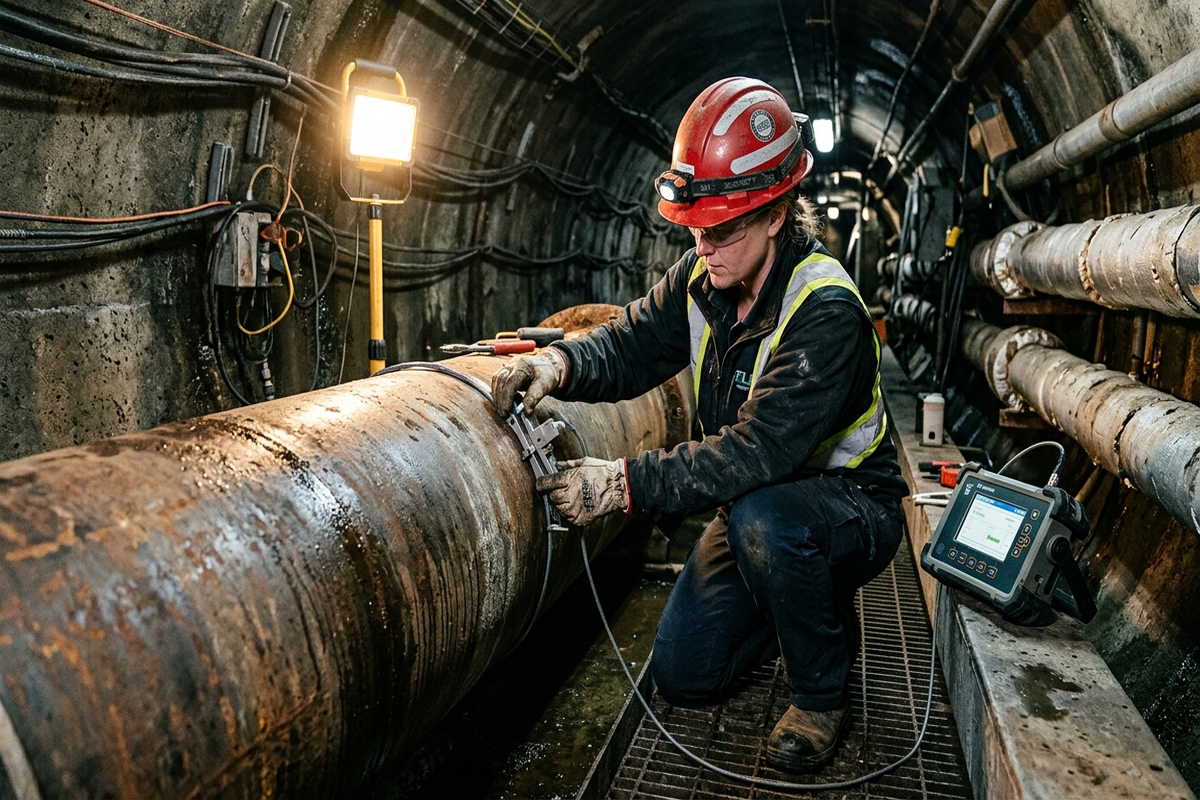
Clamp-On Ultrasonic Flowmeter for Non-Intrusive Metering in Aging Pipeline Retrofit
Aging water and heating networks cannot afford shutdowns or pipe-cutting for meter installation. The clamp-on ultrasonic flowmeter installs on the pipe exterior with zero intrusion — no cutting, no welding, no service interruption — delivering fast, low-cost flow metering and DMA zoning for aging pipeline retrofit projects.
Overview
Summary
Aging water and heating networks cannot afford shutdowns or pipe-cutting for meter installation. The clamp-on ultrasonic flowmeter installs on the pipe exterior with zero intrusion — no cutting, no welding, no service interruption — delivering fast, low-cost flow metering and DMA zoning for aging pipeline retrofit projects.
Key Advantages
Challenges
- Shutdown unacceptable — conventional meter retrofit requires long outage windows
- Aged brittle pipe walls risk new leaks from cutting and drilling
- Missing records — material, wall thickness and lining unknown
- Wide-area retrofit with limited budget demands low-cost rapid deployment
- Underground chambers demand high protection and maintenance-free operation
Results
- Zero-intrusion installation without shutdown, 2-4 hours per point
- 50%-70% lower overall cost versus pipe-cutting retrofit
- Full DN15-DN6000 coverage, strongest advantage on large diameters
- NB-IoT/4G wireless transmission, independent battery operation in chambers
- DMA zoning established within one week, greatly faster leak localization
Solution Details
Clamp-On Ultrasonic Flowmeter for Non-Intrusive Metering in Aging Pipeline Retrofit
Retrofitting aging water supply, district heating and industrial pipeline networks is a core part of urban renewal and water-loss control. Many pipelines that have served for 20-30 years must keep operating continuously, while conventional electromagnetic flowmeters and mechanical meters require pipe cutting, drainage and welding — long outages, high cost and the risk of damaging already weakened pipe walls. Based on the transit-time ultrasonic principle, the clamp-on ultrasonic flowmeter mounts its transducers directly on the pipe exterior, requiring no pipe penetration and no shutdown. It provides a truly "zero-intrusion" metering solution for aging pipeline retrofit.
Core Challenges in Aging Pipeline Retrofit Metering
Shutdown is unacceptable: Main transmission lines and industrial circulation mains serve wide areas; conventional meter retrofit needs hours to days of outage windows that are difficult to coordinate.
Aged pipe walls cannot tolerate secondary work: Cast iron and concrete pipes thinned by decades of corrosion are brittle; flange cutting, drilling and welding easily create new leakage points.
Missing pipe records: As-built drawings of old networks are often incomplete — material, wall thickness and lining conditions are unknown, complicating flow measurement and instrument selection.
Limited retrofit budget: Large-scale network retrofit involves hundreds of metering points; per-point cost must stay low while deployment must be fast.
Metering plus long-term reliability: Retrofit projects need meters that not only install quickly but also run stably for years in underground chambers, pipe galleries and other harsh environments.
System Architecture of the Clamp-On Ultrasonic Flowmeter Solution
A four-layer design of "clamp-on sensing — local processing — wireless transmission — platform management":
Clamp-on sensing layer: Transit-time ultrasonic transducers are mounted in pairs on the pipe exterior, transmitting and receiving ultrasonic signals and measuring the time difference between downstream and upstream propagation to derive flow velocity and volumetric flow. Sensors are fully isolated from the medium — zero intrusion, zero leakage risk.
Local processing layer: The transmitter handles signal processing and flow totalization, displaying instantaneous flow, accumulated volume, velocity and signal quality, with on-board storage of 3+ years of history.
Wireless transmission layer: NB-IoT/4G/LoRa modules upload flow data to the cloud platform; battery-powered operation is supported for chambers and remote sections without mains power.
Platform management layer: The flow platform provides network-wide flow visualization, DMA zoning analysis, minimum night flow leakage assessment, abnormal flow alarms and reporting.
Key Points for Clamp-On Installation on Aged Pipes
Pipe section selection: Prefer sections with sufficient straight pipe (10D upstream, 5D downstream), full-bore flow and no two-phase flow; avoid elbows, valves, reducers and pump outlets.
Surface preparation: On corroded old pipes, grind the mounting point down to bare metal, removing rust and aged coatings; use high-temperature long-life couplant for reliable acoustic coupling.
Pipe parameter setup: Accurately enter material (steel/cast iron/PE/concrete), outer diameter, wall thickness and lining type; where records are missing, measure wall thickness on site with an ultrasonic thickness gauge and verify settings through signal strength and waveform quality.
Multi-path configuration: For large diameters (DN600+) or higher accuracy requirements, select dual-path or multi-path models to reduce errors caused by velocity profile distortion.
Protection and fixing: For underground chambers choose IP68 transducers and waterproof enclosures; fix with brackets against displacement; add sun shields for above-ground pipes.
Typical Retrofit Application Modes for Clamp-On Ultrasonic Flowmeters
Rapid DMA zoning deployment: Leveraging the "install-and-go" nature of clamp-on meters, complete boundary metering of zoning areas within one week, quickly establishing a district water-balance system to locate high-leakage zones.
Before-and-after retrofit metering: Install clamp-on meters before and after retrofit works to measure actual flow changes and quantify retrofit effectiveness (leakage reduction, conveyance capacity improvement).
Transmission capacity assessment: Conduct flow surveys on undocumented old mains to understand actual loads, providing data support for diameter verification and retrofit design.
Temporary and emergency metering: For repair, flushing and emergency dispatch scenarios, clamp-on meters can be installed, removed and reused at will, spreading costs across multiple uses.
Technical Advantages of the Clamp-On Ultrasonic Flowmeter
Zero-Intrusion Installation
No pipe cutting, no shutdown, no hot work
Rapid Deployment
2-4 hours per point, 90%+ faster
Low Cost
50%-70% reduction in per-point cost
Large-Diameter Friendly
Full coverage DN15 to DN6000
No Pressure Loss
No contact with medium, no moving parts
Reversible & Relocatable
Sensors can be moved intact
Zero-intrusion installation: No pipe cutting, no shutdown, no hot work; installation never interrupts conveyance and causes zero damage to aged pipe walls.
Rapid deployment: A single point is installed in 2-4 hours, cutting construction time by over 90% versus pipe-cutting retrofit and greatly reducing coordination costs.
Low cost: No pipe fittings, flanges, drainage or restoration work — overall per-point retrofit cost drops 50%-70%.
Large-diameter friendly: Full coverage from DN15 to DN6000; cost advantages grow with diameter, ideal for aging large-diameter mains.
No pressure loss, no wear: Measurement never contacts the medium, adds no pressure loss and involves no moving parts — essentially maintenance-free.
Reversible and relocatable: Sensors can be relocated intact when metering points change, matching the phased nature of network retrofit.
Typical Applications for Aging Pipeline Retrofit
- DMA zoning metering for aging urban water network retrofit
- Flow monitoring in primary/secondary district heating network balancing
- Online metering retrofit of industrial circulation water mains without shutdown
- Flow survey and discharge accounting for municipal drainage/reclaimed water networks
- Retrofit effectiveness evaluation for old residential area water supply networks
- Intermediate metering and leak localization on long-distance transmission pipelines
Implementation Recommendations for Clamp-On Ultrasonic Flowmeter Retrofit
- Network survey and point selection: Identify metering points based on the current network status; verify diameter, material, wall thickness and straight-run conditions; build a point archive, prioritizing full-bore sections with sufficient straight pipe.
- Site inspection and solution design: Inspect surface-preparation space, power/battery options and wireless signal quality at each point; determine path configuration and protection class; produce per-point installation plans.
- Installation and commissioning: Grind pipe surfaces to bare metal, apply long-life couplant, clamp transducers, and confirm qualified installation via signal quality, waveform and zero-point calibration.
- Platform integration and zoning: Configure wireless upload, connect points to the flow platform, define DMA zones and establish flow baselines.
- Operational verification: Run continuously for 2-4 weeks, cross-validating against upstream/downstream meters; optimize installation position or parameters if necessary.
- O&M regime: Establish quarterly inspections of signal quality and couplant condition plus abnormal-data checks to ensure long-term metering reliability.
? Reference Sources
- Transit-Time Ultrasonic Flow Measurement Principles — International Standards Documentation
- Aging Pipeline Retrofit Best Practices — Urban Water Infrastructure Guidelines
- DMA Zoning and Leakage Control Methodologies — Water Network Management References
Approach
How we implement intelligence into your infrastructure step by step.
Network survey & point selection
Identify metering points from current network status; verify diameter, material, wall thickness and straight-run conditions; build a point archive prioritizing full-bore sections with sufficient straight pipe.
Site inspection & solution design
Inspect surface-preparation space, power and wireless signal conditions at each point; determine path configuration and protection class; issue per-point installation plans.
Clamp-on installation & commissioning
Grind mounting points to bare metal, apply long-life couplant, clamp transducers, and confirm qualified installation via signal quality, waveform and zero-point calibration.
Platform integration & zoning
Configure wireless data upload, connect all points to the flow platform, define DMA zones and establish flow baselines with minimum night flow models.
Verification & O&M
Cross-validate metering data over 2-4 weeks of continuous operation; establish quarterly inspections of signal quality, couplant condition and abnormal data.
❓ Related FAQs
Related Solutions
Split-Type Electromagnetic Flow Meter Solution for Pump Stations with High Humidity and Heavy Vibration
Inline Ultrasonic Flow Meter Solution for Pump Station Discharge Metering and Pump Efficiency Testing
Doppler Ultrasonic Flow Meter Solution for Flow Monitoring in Partially Filled Municipal Drainage Conduits

Ready to Optimize Your Business?
Contact us, and our professional team will provide customized solutions to help your business achieve digital transformation.
Get In Touch