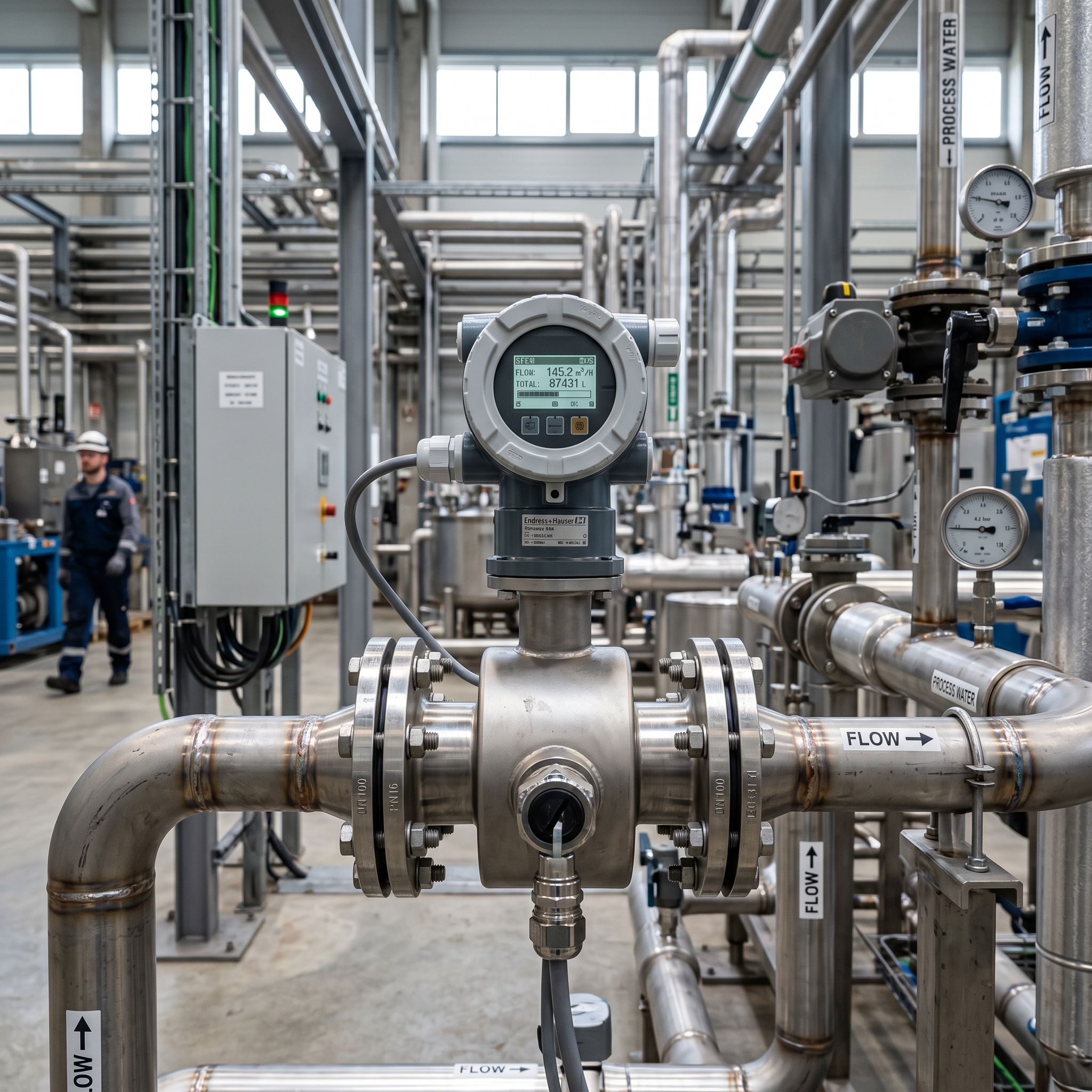
Selection and Application of Electromagnetic Flowmeters in Industrial Process Control
This article systematically covers the key selection criteria for electromagnetic flowmeters in industrial process control, including electrode materials, liner selection, sizing calculation, installation requirements, and signal processing strategies.
Overview
Summary
This article systematically covers the key selection criteria for electromagnetic flowmeters in industrial process control, including electrode materials, liner selection, sizing calculation, installation requirements, and signal processing strategies.
Key Advantages
Challenges
- Insufficient conductivity rendering measurement impossible
- Erosion of electrodes and liners by highly corrosive media
- Measurement errors due to distorted flow profiles at installation sites
- Signal distortion under strong electromagnetic interference
- Insufficient sensor reliability in high-temperature/high-pressure conditions
Results
- Measurement accuracy of ±0.2% meeting process control metering needs
- Electrode/liner combinations covering 98% of industrial liquid media
- IP68 protection rating suitable for harsh field environments
- DSP digital signal processing effectively suppressing power-line and RF interference
- Multiple industrial communication protocols seamlessly integrating with DCS/PLC systems
Solution Details
Fundamental Role of Electromagnetic Flowmeters in Industrial Process Control
In industrial process control, flow measurement is fundamental for ensuring stable process parameters, consistent product quality, and precise energy management. Electromagnetic flowmeters (EMFs) have become the preferred choice for liquid flow measurement in the process industry, thanks to their advantages of zero pressure loss, high accuracy, wide turndown ratio, and immunity to fluid density, temperature, and viscosity variations. However, proper selection of EMFs involves multiple dimensions — conductivity matching, electrode and liner material selection, sizing determination, straight-run requirements, grounding methods, signal processing, and anti-interference strategies. Any oversight in any of these links can lead to measurement inaccuracy, equipment damage, or even safety incidents.
Advanced Technology and Material Options for Electromagnetic Flowmeters
CSSOC electromagnetic flowmeter series employs advanced low-frequency rectangular wave excitation technology with a built-in DSP digital signal processor, effectively suppressing power-line interference, electrochemical noise, and signal drift caused by fluid fluctuations. The sensor features a fully welded structure with IP68 protection rating, and is available with multiple liner materials including PTFE, PFA, polyurethane, and neoprene, as well as electrode materials such as 316L, Hastelloy, titanium, tantalum, and platinum-iridium alloy — covering the full spectrum from ordinary municipal water supply to highly corrosive chemical media.
Core Selection Workflow for Electromagnetic Flowmeters in Process Control
The core selection workflow includes: First, conductivity verification — the measured liquid must have conductivity ≥5 μS/cm (pure/deionized water is not suitable). Second, sizing calculation — typically selecting within the economic velocity range of 0.5-10 m/s, with large diameters going as low as 0.3 m/s. Third, liner-electrode matching — PTFE liner + Hastelloy electrodes for strong acid environments, PFA liner + tantalum electrodes for high-temperature strong corrosion, polyurethane liner + 316L electrodes for slurry and wastewater. Fourth, installation requirements — typically 10D upstream and 5D downstream straight pipe sections (D = pipe diameter), avoiding installation at pump outlets, downstream of valves, or elbows where flow profiles are distorted. Fifth, grounding — grounding rings or grounding electrodes must be used to ensure a complete measurement circuit.
Signal Integration and Certification for Electromagnetic Flowmeters
For process control applications, EMFs must also consider signal integration with DCS/PLC systems. CSSOC flowmeters provide multiple output options including 4-20mA analog, pulse/frequency output, RS485 (Modbus RTU), and HART protocol, enabling seamless integration into mainstream industrial control systems. For hazardous locations, Exd IIC T6 flameproof or Exia IIC T4 intrinsically safe certified versions are available.
Typical Application Scenarios for Electromagnetic Flowmeters
Typical application scenarios include: precise metering of chemical reactor feed (±0.2%), pharmaceutical purified water system flow monitoring, food & beverage CIP cleaning fluid metering, simultaneous pulp consistency and flow measurement in papermaking, steel continuous casting cooling water control, municipal water plant output metering, and various acid/alkali/salt solution transfer pipelines.
Key Product Features of CSSOC Electromagnetic Flowmeters
- Low-frequency rectangular wave excitation for strong anti-interference
- Fully welded sealed structure, IP68 protection
- Multiple liner and electrode material options
- 4-20mA/Pulse/RS485/HART multi-output modes
- Flameproof and intrinsically safe explosion-proof certification available
- Bidirectional flow measurement with automatic forward/reverse detection
Approach
How we implement intelligence into your infrastructure step by step.
❓ Related FAQs
Related Solutions
Split-Type Electromagnetic Flow Meter Solution for Pump Stations with High Humidity and Heavy Vibration
Inline Ultrasonic Flow Meter Solution for Pump Station Discharge Metering and Pump Efficiency Testing
Doppler Ultrasonic Flow Meter Solution for Flow Monitoring in Partially Filled Municipal Drainage Conduits

Ready to Optimize Your Business?
Contact us, and our professional team will provide customized solutions to help your business achieve digital transformation.
Get In Touch