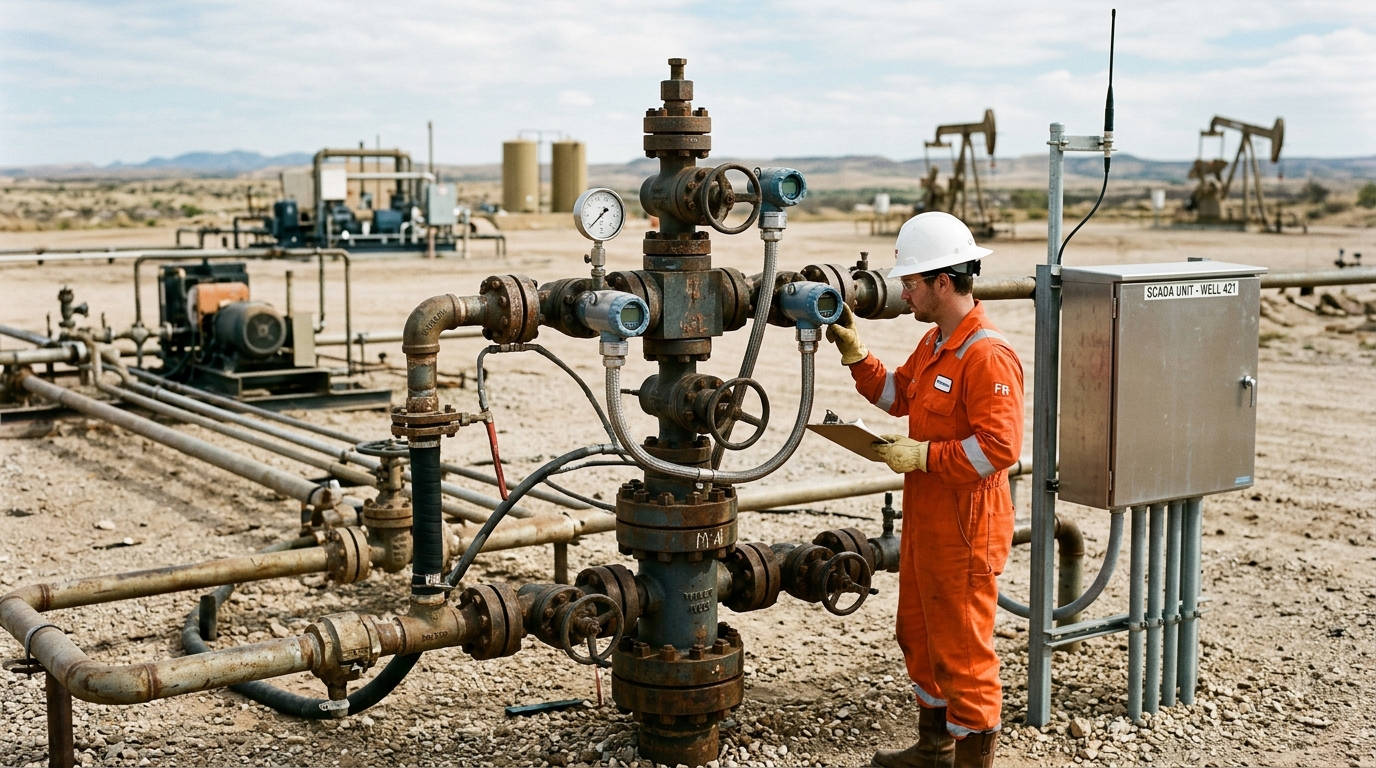
Explosion-Proof Pressure Transmitter and RTU Application Solution for Produced Water Measurement and Monitoring in Oil and Gas Fields
To address the challenges in oil and gas field produced water (sewage reinjection) systems—including difficulties in achieving explosion-proof compliance for wellsite instrumentation, poor timeliness of manual injection pressure readings, corrosion and scaling caused by high-salinity water quality, scattered well sites lacking utility power and communication infrastructure, and delayed reinjection volume assessment data—an integrated "well-station-network" online metering and monitoring system has been established using explosion-proof pressure transmitters and T6-rated explosion-proof HERO V9 series RTUs. The pressure data acquisition frequency has been upgraded from once-daily manual readings to continuous automatic collection at 5-minute intervals, reinjection volume assessment latency has been reduced from 48 hours to under 10 minutes, and inspection manpower has been reduced by over 60%. This provides a highly timely, traceable, and continuous data foundation for dynamic analysis of waterflood development, pipeline network leak early warning, and green and safe production in oilfields.
Overview
Summary
To address the challenges in oil and gas field produced water (sewage reinjection) systems—including difficulties in achieving explosion-proof compliance for wellsite instrumentation, poor timeliness of manual injection pressure readings, corrosion and scaling caused by high-salinity water quality, scattered well sites lacking utility power and communication infrastructure, and delayed reinjection volume assessment data—an integrated "well-station-network" online metering and monitoring system has been established using explosion-proof pressure transmitters and T6-rated explosion-proof HERO V9 series RTUs. The pressure data acquisition frequency has been upgraded from once-daily manual readings to continuous automatic collection at 5-minute intervals, reinjection volume assessment latency has been reduced from 48 hours to under 10 minutes, and inspection manpower has been reduced by over 60%. This provides a highly timely, traceable, and continuous data foundation for dynamic analysis of waterflood development, pipeline network leak early warning, and green and safe production in oilfields.
Key Advantages
Challenges
- Oil and gas production areas are explosive hazardous environments; ordinary pressure instruments lack explosion-proof certification and cannot be installed on-site, so wellsite pressure measurement has long relied on manual meter reading.
- Water injection pressure is manually read once a day, leading to delayed detection of pump discharge overpressure, wellhead underpressure, and sudden trunk line pressure drops, resulting in passive handling of leaks and blocked wells.
- Produced water has high salinity and contains H2S/CO2, causing severe corrosion and scaling on sensor diaphragms and pressure guide lines; ordinary instruments have short service life and large drift.
- Individual wells and water distribution stations are numerous, widely scattered, and remotely located, with no utility power and weak public network signals, limiting both power supply and data transmission.
- Manual measurement of injection volume has large errors and inconsistent record standards; assessment data reporting delays are measured in days, and injection-production imbalances are detected late.
Results
- Water injection pressure acquisition frequency has been upgraded from manual once-daily to continuous automatic collection at 5-minute intervals, reducing injection volume assessment delay from 48 hours to less than 10 minutes.
- In the first year of operation, automatic alarms identified and located 7 trunk line leaks and 12 single-well blockage anomalies, reducing response time from an average of 3 days to same-day action.
- Manual wellsite inspection and meter reading labor has been reduced by over 60%, with manual meter reading and glass tube water measurement largely phased out of daily operations.
- For 12 consecutive months, equipment availability exceeded 99% and data online rate exceeded 98%, passing explosion-proof special safety inspections and injection volume assessment audits.
- All pressure-flow-injection volume data is archived in one platform, with auditable and traceable assessment results, supporting dynamic analysis of water injection development.
Solution Details
Explosion-Proof Pressure Transmitter and RTU Application Solution for Produced Water Measurement and Monitoring in Oil and Gas Fields
Oil and gas field development entering the mid-to-high water cut stage makes produced water treatment and reinjection both a hard regulatory constraint for environmental compliance and a core process link for maintaining reservoir pressure and enhancing oil recovery. A produced water reinjection system typically consists of source water wells, water supply stations, injection stations (injection pump stations), injection trunk lines with distribution rooms, and injection wells. Pressure is the core operating parameter running through the entire system: injection pump discharge pressure determines reinjection capacity, distribution room and wellhead pressures reflect individual well injection conditions, and trunk line pressure gradient changes serve as early signals of leaks and blockages. However, a large number of oilfield well sites still rely on manual inspection and meter reading, with data collected once per day and timeliness measured in days—the long-standing problems of injection systems being "unseen, miscalculated, and slow to report" persist.
The combination of explosion-proof pressure transmitters and micro-power RTUs provides an online solution to this challenge: explosion-proof pressure transmitters (intrinsically safe Ex ia IIC T6 or flameproof Ex d certified, compliant with the GB3836 series standards) are installed at wellheads, distribution rooms, and injection pump station pressure points, converting medium pressure into 4-20mA/HART or RS485 signals with 0.25/0.5 class accuracy; the HERO V9 series RTU (integral explosion-proof T6 certification, IP68 protection, ARM Cortex-M3 + MSP430 dual-core) acquires pressure, flow, and water quality data on-site, operating under a "routine timed acquisition + abnormal high-frequency acquisition" strategy, and transmits via 4G/NB-IoT/BeiDou multi-channel telemetry to the produced water reinjection monitoring platform, achieving minute-level online metering and automated assessment of pressure, flow, and reinjection volume across all elements.
Five Major Pain Points in Oil and Gas Field Produced Water Metering and Monitoring
Difficult explosion-proof compliance for wellsite instrumentation: Oil and gas production areas are explosive atmospheres. Ordinary pressure instruments and acquisition terminals cannot be installed in hazardous zones. The lack of explosion-proof certification leaves numerous measurement points dependent on manual meter reading, with automation upgrades stalled at the compliance threshold.
Poor timeliness of injection pressure data: Manual meter reading occurs once daily and is constrained by weather and inspection routes. Abnormal injection pressures (pump discharge overpressure, wellhead underpressure, sudden trunk line pressure drop changes) often go undetected for days, leaving leak and well blockage responses reactive.
Corrosion and scaling from high-salinity produced water: Produced water has high salinity and contains H2S/CO2 and suspended solids, causing severe corrosion and scaling on pressure sensing diaphragms and impulse lines. Ordinary instruments suffer short service life and large drift, resulting in low data credibility.
Difficult power supply and communication for dispersed well sites: Individual wells and distribution rooms are numerous, widely scattered, and remotely located. Most lack utility power and have weak public network signals. Traditional wired solutions incur high construction costs, with both instrument power supply and data backhaul constrained.
Delayed and distorted reinjection volume assessment data: Dynamic reservoir development analysis requires per-well, per-day reinjection volume accounting. Manual metering has large errors and inconsistent ledger standards. Reporting delays for assessment data are measured in days, and injection-production imbalance detection lags.
"Explosion-proof Sensing + Micro-power RTU + Platform Assessment" System Architecture
Explosion-proof sensing layer: Explosion-proof pressure transmitters are deployed at wellhead, distribution room, and pump station pressure points, featuring diffused silicon or ceramic capacitive sensing elements, with ranges selected per injection pressure class (0~10/25/40/60MPa), accuracy of 0.25 or 0.5 class, 316L stainless steel or Hastelloy diaphragms resistant to H2S/CO2 corrosion, and anti-plugging, anti-scaling impulse line structures; reinjection trunk lines and individual well metering points can be integrated with electromagnetic flowmeters or vortex flowmeters for reinjection volume metering, with intrinsically safe loops connected through isolating barriers and safety barriers.
Acquisition & Control Layer: The HERO V9 series RTU features full-unit explosion-proof certification (T6 rating) and IP68 protection. Its dual-core architecture supports scenario-based strategies including "routine timed acquisition + abnormal high-frequency acquisition" and "standard limit violation alarms + instantaneous transient alarms." Standby current is below 50μA, with a standard high-capacity lithium thionyl chloride battery pack that supports external expansion. Combined with solar panels, it ensures long-term operation at well sites without utility power. 16M Flash provides local storage for interrupted data, and the 5PPM high-precision clock with automatic time synchronization ensures consistent timestamps across the entire network.
Communication & Transmission Layer: Multi-channel adaptive connectivity via 4G full-network/NB-IoT/BeiDou satellite, supporting Modbus-RTU and oilfield SCADA configuration protocols. In weak-signal areas, the system automatically reduces frequency for storage and resumes transmission upon recovery, ensuring no data segment loss.
Platform & Assessment Layer: The produced water reinjection monitoring platform automatically generates single-well/single-station pressure-flow curves and daily/monthly reinjection volume reports. Pressure transients and flow deviations trigger linked leak/blockage alarms. Electronic well history logs and assessment ledgers are archived in one place, interfacing with the oilfield production command system.
Key Technologies and Selection Considerations for Explosion-Proof Pressure Transmitters
Explosion-proof Type Selection: For hazardous areas such as wellheads and water distribution rooms, intrinsically safe (Ex ia IIC T6) pressure transmitters and intrinsically safe circuits are preferred. Flameproof types may be selected for injection pump rooms. The RTU and acquisition terminals must hold complete national explosion-proof certification, with explosion-proof ratings matched to hazardous area classifications, eliminating systemic vulnerabilities where "instruments are explosion-proof but terminals are not."
Corrosion Resistance and Anti-scaling Design: Diaphragm materials are selected based on the produced water quality report (316L as baseline, upgraded to Hastelloy or tantalum diaphragm for high-chloride/high-sulfur conditions). Pressure impulse lines are equipped with purging and anti-plugging structures. Well sites with severe scaling issues require shortened calibration cycles and installation of online cleaning devices.
Range and Overpressure Protection: Injection pump start/stop and valve operations generate pressure surges. Transmitter range should be selected at 1.5–2 times operating pressure, with overpressure tolerance of at least 2× full scale. Buffer coils should be installed at pump discharge measurement points.
Micro-power Consumption and Power Supply Solutions: With a 15-minute acquisition and 2-hour reporting cycle, the RTU's lithium battery provides a theoretical service life of over 4 years. Acquisition frequency and reporting strategies are configured as "zero-power standby during normal operation, high-frequency encryption during anomalies," balancing data density with battery life.
Data Quality Control and Assessment Criteria: The platform unifies time reference and measurement standards. Breakpoint-resume transmission ensures data completeness. Reinjection volumes are automatically calculated per well per day and periodically compared against manual verification values. Assessment results are auditable and traceable.
Typical Application Scenarios for Explosion-Proof Pressure Transmitter Systems
Online Monitoring of Injection Stations and Water Distribution Rooms: Continuous acquisition of pressure and flow at pump discharge, main lines, and each distribution outlet in water distribution rooms. Injection system operating conditions are visualized on a single screen, with instant alarms for overpressure and underpressure.
Automatic Measurement of Single-well Wellhead Pressure and Reinjection Volume: Each injection well is equipped with an independent metering unit. Reinjection volumes are automatically accumulated and reported, replacing manual meter reading and glass-tube water measurement, meeting per-well assessment requirements.
Reinjection Mainline Leak Monitoring: Based on multi-point pressure gradient and flow balance analysis along the pipeline, leak-induced pressure drop characteristics are rapidly identified and section-located, shortening response time and reducing environmental risks.
Linked Operation of Source Water Wells and Water Supply Stations: Dynamic water levels in source wells, water supply station pressure, and the injection system are coordinated for dispatch, achieving water balance management of "injection determined by production, production determined by injection."
Engineering Implementation and Long-term Operation & Maintenance
Site Survey and Explosion-proof Selection Design: Verify hazardous area classifications and well site conditions, complete measurement point layout, explosion-proof selection, power supply and communication scheme design, and metering accuracy design. Deliver construction drawings and assessment criteria documentation.
Installation, Commissioning, and Metering Calibration: Complete transmitter and RTU installation, intrinsic safety loop wiring and grounding, pressure indication calibration and flowmeter verification, followed by a 48-hour continuous operation test before platform integration.
Platform Integration, Acceptance, and Handover: Configure acquisition schedules, alarm thresholds, and assessment report templates; complete data-to-manual metering comparison for acceptance; deliver as-built documentation and operation & maintenance manuals.
Long-term Operation, Maintenance, and Periodic Inspection: Remotely monitor equipment status and data integrity via the platform, perform periodic verification of diaphragm fouling and zero drift, issue battery low-level alerts and replacements, conduct winterization/thermal insulation and flood-season inspections, ensuring full life-cycle metering quality assurance.
Application Results of Explosion-Proof Pressure Transmitter and RTU Deployment
Following the deployment of explosion-proof pressure transmitters and RTU-based online metering and monitoring systems across 3 water injection stations and 87 injection wells in an oilfield produced-water reinjection system: injection pressure acquisition frequency increased from manual readings once daily to continuous automatic collection at 5-minute intervals, and reinjection volume assessment latency was reduced from 48 hours to under 10 minutes. In the first year of operation, the system automatically alerted and located 7 trunk-line leaks and 12 single-well plugging anomalies, reducing response time from an average of 3 days to same-day resolution. Well-site inspection and meter-reading manpower decreased by over 60%. Equipment availability remained above 99% and data online rate above 98% for 12 consecutive months, successfully passing the oilfield company's explosion-proof special safety inspection and reinjection volume assessment audit, providing a reliable data foundation for waterflood development dynamic analysis and green, safe production.
5-min
Data acquisition interval
<10 min
Assessment latency
60%
Manpower reduction
99%
Equipment availability
98%
Data online rate
19
Anomalies detected in year 1
? 参考来源
- GB3836 Series Standards for Explosive Atmospheres
- Oilfield Produced Water Reinjection System Design Specifications
- HERO V9 Series RTU Technical Documentation
Approach
How we implement intelligence into your infrastructure step by step.
Site Survey and Explosion-Proof Selection Design
Verify hazardous area classification and wellsite conditions, complete measurement point layout, explosion-proof type selection, power supply and communication scheme, and metering accuracy design, and output construction drawings and assessment standard documents.
Installation, Commissioning, and Metering Calibration
Complete installation of explosion-proof pressure transmitters and RTUs, intrinsic safety loop wiring and grounding, pressure indication calibration and flowmeter verification, and after 48-hour continuous operation assessment, connect to the platform.
Platform Integration, Acceptance, and Handover
Configure acquisition schedules, alarm thresholds, and assessment report templates, complete online data comparison with manual metering for acceptance, and deliver as-built documentation and operation and maintenance manuals.
Long-Term Maintenance and Periodic Inspection
Remotely monitor equipment status and data integrity via the platform, regularly calibrate for diaphragm scaling and zero drift, manage battery level alarms and replacements, and conduct winterization and flood season inspections to ensure metering quality.
❓ Related FAQs
Related Solutions
Compact Water Quality Monitoring Station Solution for Township River Cross-Section Assessment
Micro-Power Self-Powered Portable Telemetry Terminal for Emergency Water Source Quality Monitoring
Visual Fusion Radar Water Level Gauge for Non-Contact Level Measurement in Hydropower Forebays and Tailraces

Ready to Optimize Your Business?
Contact us, and our professional team will provide customized solutions to help your business achieve digital transformation.
Get In Touch