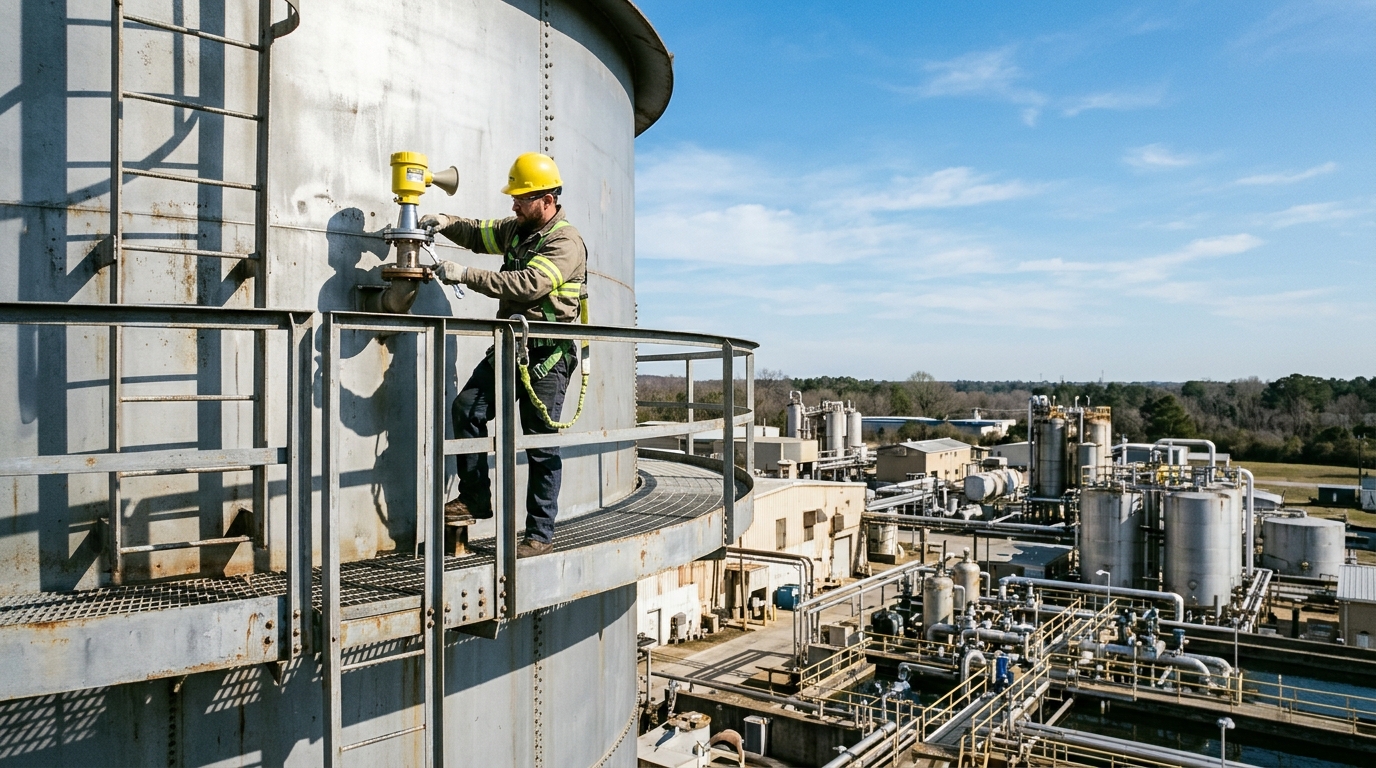
Radar Level Meter Solution for Level Safety Monitoring of Elevated Water Tanks and Pressure Vessels
Addressing the pain points of risky manual climbing inspections of elevated water tanks, contact-type level instruments failing under high temperature and pressure inside pressure vessels, frequent overflow and dry-run incidents, and measurement drift caused by vapor and foam, this solution is built around 26 GHz K-band radar level meters: non-contact microwave pulse measurement with ±3 mm accuracy and 0-30-70 m range covering tanks of all heights, process pressure -0.1 to 4.0 MPa and process temperature -40 to +200 degC for pressure vessels, IP67 protection with aluminum alloy / stainless steel 304 housings for outdoor tank tops, and 4-20 mA / HART / RS485 outputs feeding RTUs and monitoring platforms for continuous level monitoring, real-time overflow and dry-run alarms, and pump/valve interlock control in unattended water supply systems.
Overview
Summary
Addressing the pain points of risky manual climbing inspections of elevated water tanks, contact-type level instruments failing under high temperature and pressure inside pressure vessels, frequent overflow and dry-run incidents, and measurement drift caused by vapor and foam, this solution is built around 26 GHz K-band radar level meters: non-contact microwave pulse measurement with ±3 mm accuracy and 0-30-70 m range covering tanks of all heights, process pressure -0.1 to 4.0 MPa and process temperature -40 to +200 degC for pressure vessels, IP67 protection with aluminum alloy / stainless steel 304 housings for outdoor tank tops, and 4-20 mA / HART / RS485 outputs feeding RTUs and monitoring platforms for continuous level monitoring, real-time overflow and dry-run alarms, and pump/valve interlock control in unattended water supply systems.
Key Advantages
Challenges
- Risky manual inspection of elevated tanks: tanks typically stand 15-40 m high; climbing readings are infrequent and lagging, impossible in rain, snow or wind, and carry serious fall risks - tank levels remain monitoring blind spots
- Contact instruments fail inside pressure vessels: hydropneumatic tanks and deaerators run hot, pressurized and turbulent; floats jam, submersible probes lose seals, magnetic flaps corrode and leak - short instrument life and costly maintenance shutdowns
- Level excursions cause safety incidents: tank overflow wastes water and erodes foundations; low level leads to pump cavitation, dry running and network pressure loss; vessel overfill may trip safety valves or create overpressure accidents, with losses discovered only after the fact
- Vapor, foam and temperature swings distort measurement: condensation inside tanks, summer heat and winter cold cause abrupt temperature changes; surface foam and turbulence make ultrasonic and acoustic readings drift with frequent false alarms
- No remote data, no unattended operation: most local instruments lack telemetry; operators can only patrol on schedule, night and holiday anomalies go unnoticed, and centralized remote dispatch of pump stations is impossible
Results
- Non-contact radar measurement with ±3 mm accuracy and 0-70 m range delivers continuous online level monitoring across the full height of elevated tanks, replacing manual climbing readings with real-time platform data
- Process pressure -0.1 to 4.0 MPa and temperature -40 to +200 degC ensure long-term stable operation in pressurized high-temperature vessels, virtually eliminating jamming and seal-failure faults of contact instruments
- Multi-level high-overflow and low-dry-run alarms push notifications in real time, and relay outputs interlock pump start/stop and inlet valves - turning overflow and suction-empty incidents from post-hoc discovery into proactive interception
- 26 GHz microwaves are virtually immune to vapor, temperature/pressure changes and surface foam, giving zero-drift measurement under winter cold and summer heat with markedly improved alarm accuracy
- 4-20 mA / HART / RS485 telemetry plus RTU networking unify all tank and vessel levels on one monitoring platform, enabling fully unattended operation and sharply reduced inspection costs
Solution Details
Radar Level Meter Solution for Elevated Water Tanks and Pressure Vessels
Elevated water tanks and pressure vessels are key storage and buffering assets in municipal water supply and industrial process systems: elevated tanks use head difference to stabilize network pressure, while pressure vessels (hydropneumatic tanks, deaerators, surge drums) balance system volume and pressure under pressurized conditions. The level safety of both directly determines supply continuity - tank overflow wastes water and erodes foundations, while low level causes pump cavitation, dry running and network pressure loss; overfilling pressure vessels may trip safety valves or even create overpressure hazards. Yet level monitoring has long lagged behind: manual climbing readings are infrequent and dangerous; contact instruments such as floats and submersible probes suffer short life and seal failures under high temperature, pressure and corrosion inside vessels; ultrasonic meters drift badly under vapor condensation, temperature swings and surface foam.
26 GHz K-Band Radar Level Meter for Non-Contact Level Monitoring
This solution deploys 26 GHz K-band radar level meters for non-contact level monitoring of elevated tanks and pressure vessels. The narrow, energy-concentrated microwave beam is emitted downward from a flanged or threaded mounting on the tank top, virtually unaffected by atmospheric vapor or temperature and pressure changes, reading true level echoes accurately even amid dense vapor and foam-covered surfaces. Accuracy is ±3 mm with customizable ranges of 0-30-70 m, fully covering tanks of all heights and vertical or horizontal vessels. Process pressure -0.1 to 4.0 MPa and process temperature -40 to +200 degC, with aluminum alloy / stainless steel 304 housings and IP67 protection, ensure long-term stable operation in pressurized high-temperature vessels and harsh outdoor tank-top climates. Outputs of 4-20 mA / HART / RS485 with two-wire 24 VDC supply simplify wiring; data streams to the monitoring platform via RTUs or telemetry terminals, where multi-level alarms for high-level overflow, low-level dry run and abnormal rate-of-change are configured, and relay outputs interlock pump start/stop and inlet valves - closing the measurement-alarm-control loop for unattended safe operation.
Key Specifications at a Glance
Product Features of the Radar Level Meter
- 26 GHz K-band non-contact measurement: narrow-beam, energy-concentrated microwave pulses emitted from the tank top without touching the medium - no wear, no contamination, compact antenna for easy retrofit on existing tanks and vessels
- High accuracy and wide range: ±3 mm accuracy with customizable 0-30-70 m ranges and a small blind zone - good performance on both small vessels and tall elevated tanks
- Pressure-vessel ready: process pressure -0.1 to 4.0 MPa and process temperature -40 to +200 degC suit hydropneumatic tanks, deaerators and other pressurized high-temperature vessels
- Industrial protection and materials: IP67 rating with aluminum alloy / stainless steel 304 housings withstand long-term outdoor exposure and humid corrosive plant environments
- Strong interference immunity: virtually unaffected by atmospheric vapor or temperature and pressure changes, accurately reading true level echoes even in dense vapor and foam with high signal-to-noise ratio
- Flexible networking outputs: two-wire 24 VDC / four-wire 220 VAC supply with 4-20 mA / HART / RS485 outputs connect directly to RTUs, telemetry terminals and SCADA platforms; thread or flange process connections optional
Technical Specifications
- Measurement Principle: 26 GHz K-band non-contact radar
- Accuracy: ±3 mm
- Measuring Range: 0-30-70 m (customizable)
- Process Pressure: -0.1 to 4.0 MPa
- Process Temperature: -40 to +200 °C
- Housing Material: Aluminum alloy / Stainless steel 304
- Protection Rating: IP67
- Output Signals: 4-20 mA / HART / RS485
- Power Supply: Two-wire 24 VDC / Four-wire 220 VAC
- Process Connection: Thread or flange (optional)
Application Scenarios for Level Safety Monitoring
The radar level meter solution is designed for level safety monitoring across municipal water supply and industrial process systems. In elevated water tanks, the non-contact radar continuously tracks water level to prevent overflow, foundation erosion and low-level pump cavitation or dry running. In pressure vessels such as hydropneumatic tanks, deaerators and surge drums, the meter operates reliably under pressurized high-temperature conditions, where multi-level alarms for high-level overflow, low-level dry run and abnormal rate-of-change are configured, and relay outputs interlock pump start/stop and inlet valves - closing the measurement-alarm-control loop for unattended safe operation.
? 参考来源
- Original product description and feature list provided by the manufacturer
Approach
How we implement intelligence into your infrastructure step by step.
Site survey and measuring point planning
Survey tank height, volume curves, vessel design pressure and temperature, medium properties, opening conditions and signal coverage; determine measuring points, antenna types and range configurations for every tank and vessel in a one-tank-one-file ledger.
Selection and installation design
Choose 30 m or 70 m ranges by vessel height; verify flange rating and sealing against vessel design pressure and temperature; mount away from inlet turbulence and ladder obstruction so the beam is clear of interference, and add lightning protection and sealed junction boxes at outdoor points.
RTU access and platform networking
Connect radar meters to RTUs or telemetry terminals via 4-20 mA or RS485 Modbus, configure sampling rates and transmission channels; upload levels to the monitoring platform, convert to stored volume via tank volume curves, and integrate into the centralized pump-station dispatch view.
Alarm thresholds and interlock configuration
Set tiered alarms for high-level overflow, low-level dry run and abnormal rate-of-change with notification recipients; wire relay outputs to interlock pump start/stop, inlet valves and safety logic, then simulate and test the automatic interception of overflow and suction-empty incidents.
Commissioning verification and O&M
During commissioning, verify zero and full scale against manual dip readings and correct mounting deviations; establish quarterly inspections of antenna cleanliness, flange sealing and signal quality, and archive historical level data as operational and dispatch records.
Recommended Hardware
Essential components for this solution.
❓ Related FAQs
Related Solutions
Visual Fusion Radar Water Level Gauge for Non-Contact Level Measurement in Hydropower Forebays and Tailraces
Ultrasonic Level Meter Solution for Non-Contact Level Monitoring of Clean-Water and Balancing Basins in Water Treatment Plants
Submersible Level Transmitter Solution for Deep-Well Groundwater Dynamic Monitoring

Ready to Optimize Your Business?
Contact us, and our professional team will provide customized solutions to help your business achieve digital transformation.
Get In Touch