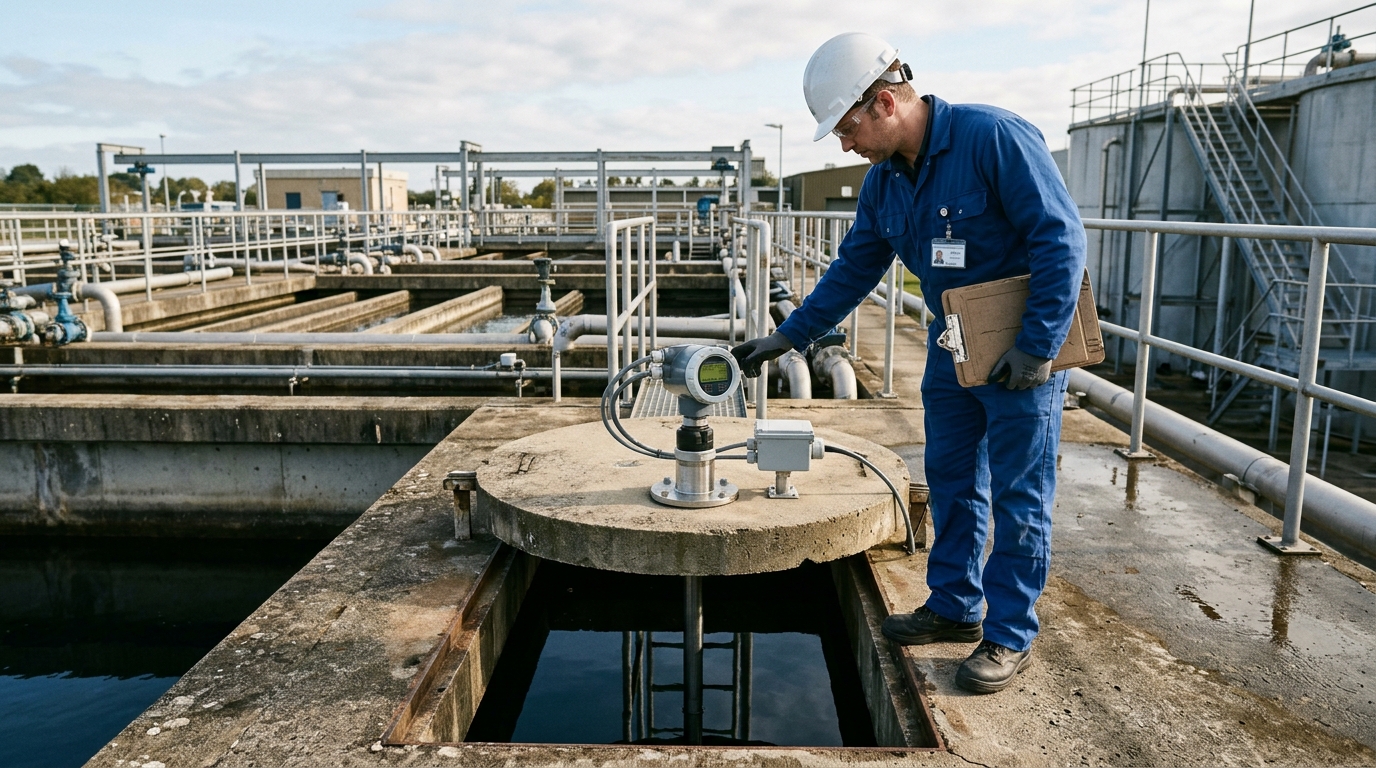
Ultrasonic Level Meter Solution for Non-Contact Level Monitoring of Clean-Water and Balancing Basins in Water Treatment Plants
Addressing the pain points of lagging manual dipping at clean-water and balancing basins, corrosion and scaling of contact-type level instruments, and false alarms caused by level surges during pump start/stop, this solution is built around non-contact ultrasonic level meters with a 0-15 m range, ±0.5% ranging accuracy, IP65 protection and optional Exd IICT6Gb explosion-proof rating. Built-in automatic power adjustment, gain control, temperature compensation and interfering-echo suppression eliminate false echoes from wall reflections and foam, while dual 4-20 mA and RS485 Modbus outputs connect directly to PLC/RTU for continuous multi-basin level monitoring, pump interlocking and water-balance analysis.
Overview
Summary
Addressing the pain points of lagging manual dipping at clean-water and balancing basins, corrosion and scaling of contact-type level instruments, and false alarms caused by level surges during pump start/stop, this solution is built around non-contact ultrasonic level meters with a 0-15 m range, ±0.5% ranging accuracy, IP65 protection and optional Exd IICT6Gb explosion-proof rating. Built-in automatic power adjustment, gain control, temperature compensation and interfering-echo suppression eliminate false echoes from wall reflections and foam, while dual 4-20 mA and RS485 Modbus outputs connect directly to PLC/RTU for continuous multi-basin level monitoring, pump interlocking and water-balance analysis.
Key Advantages
Challenges
- Infrequent manual dipping with night blind spots: basin levels rely on once-per-shift manual dipping, data lag by hours, and anomalies during unmanned night shifts go completely undetected - dry-running and overflow risks persist
- Corrosion and scaling drift of contact instruments: submersible transmitters immersed in chlorinated, algae- and sediment-laden water drift severely after probe corrosion and scaling, and frequent calibration consumes heavy maintenance labor
- False alarms from pump-induced level surges: pump start/stop causes violent surface waves with foam and turbulence; ordinary level instruments jitter and trigger false high/low alarms, and interlock misoperations threaten supply safety
- False echoes from basin structures: guide walls in clean-water basins and columns and walls in balancing basins create multiple ultrasonic reflections; instruments without echo suppression lock onto false echoes and produce jumping, distorted readings
- Isolated multi-basin data blocks water-balance analysis: level instruments of mixed brands and protocols are not unified into SCADA, so dispatchers cannot see plant-wide storage distribution in real time and water-balance-based energy-saving dispatch lacks a data foundation
Results
- Clean-water and balancing basin levels are monitored continuously around the clock with second-level updates, replacing per-shift manual dipping, eliminating night blind spots and sharply reducing dry-run and overflow incident risk
- Non-contact measurement removes probe corrosion and scaling entirely; instruments run long-term without recalibration, maintenance drops from monthly cleaning/calibration to quarterly inspection, and data continuity and credibility improve markedly
- Interfering-echo suppression and waveform computation reject false echoes from pump-start foam and turbulence, readings stay smooth, and the accuracy of high/low level alarms and pump interlocks improves greatly with false alarms essentially eliminated
- All basin levels feed PLC/RTU and plant SCADA over one RS485 Modbus network, making plant-wide storage distribution visible in real time; water-balance analysis and delivery-pump optimization gain a continuous, accurate data base, and unit energy consumption falls accordingly
- IP65 protection with optional Exd IICT6Gb explosion-proof configuration covers humid plant areas and hazardous zones, and one instrument family serves clean-water basins, balancing basins and recovery tanks - standardizing spares and O&M
Solution Details
Non-Contact Ultrasonic Level Meter for Clean-Water and Balancing Basins
Clean-water reservoirs and balancing basins are the core storage structures of a drinking water plant: the clean-water basin level directly governs the suction safety of the delivery pump group and the dispatch of finished water, while the balancing basin level reflects raw-water storage and process load balance. This ultrasonic level meter solution delivers continuous, non-contact level monitoring for both basin types. Lagging or distorted level data causes, at best, frequent pump cycling and rising energy consumption, and at worst pump damage from running dry or water loss through overflow. Traditional manual dipping is infrequent and leaves a complete blind spot during unmanned night shifts; submersible level transmitters immersed in chlorinated, algae-laden water suffer severe drift after probe corrosion and scaling, and are often damaged by sludge entanglement during basin cleaning.
How the Non-Contact Ultrasonic Level Meter Works
This solution installs non-contact ultrasonic level meters on basin covers. The sensor emits ultrasonic pulses toward the water surface; the echo is received by the same transducer, and the time difference between emission and reception yields the distance to the surface and hence the level - with no contact with the water at all, fundamentally eliminating corrosion, scaling and entanglement. The 0-15 m range covers all basin depths with ±0.5% ranging accuracy, and the 0.3-0.6 m blind zone suits cover-mounted installation heights. Built-in automatic power adjustment, gain control and temperature compensation keep measurement stable across ambient temperature swings; advanced waveform computation and interfering-echo suppression identify and reject false echoes from wall reflections, foam and inlet turbulence. The IP65 housing suits the humid plant environment, and Exd IICT6Gb explosion-proof models serve basins with hazardous-area requirements. Dual 4-20 mA analog and RS485 Modbus digital outputs connect straight to the plant PLC and RTU, so pump start/stop interlocking, high/low level alarms and multi-basin water-balance analysis all run on one continuous, accurate level dataset.
Key Specifications at a Glance
Product Features of the Ultrasonic Level Meter
- Non-contact measuring principle: MCU-controlled ultrasonic pulse emission, echo reception and time-of-flight ranging keep the sensor out of the water, eliminating corrosion, scaling, entanglement and contamination for chlorinated and algae-laden media
- High accuracy and wide range: 0-15 m range covers all basin depths with ±0.5% ranging accuracy and a 0.3-0.6 m blind zone, suiting various cover mounting heights and resolving both low levels in clean-water basins and large swings in balancing basins
- Intelligent signal processing: built-in automatic power adjustment, gain control and temperature compensation keep measurement stable across ambient changes; advanced waveform computation raises accuracy and interfering-echo suppression rejects wall reflections and foam echoes
- Dual outputs for flexible networking: 4-20 mA analog output is compatible with existing PLC/DCS, RS485 Modbus digital output connects directly to RTU and SCADA, and multiple meters share one bus for low wiring cost and noise-free data
- Industrial protection and explosion-proof option: IP65 housing for humid plant environments, Exd IICT6Gb models for basins under hazardous-area codes, and 24 VDC supply for unified power distribution
- Easy cover-top installation: flange or bracket mounting on basin manholes or reserved openings, installed without draining or shutting down the basin - rapid deployment for both new plants and retrofits, with mounting height reserved per blind-zone requirements
Technical Parameters
- Measuring range: 0-15 m
- Ranging accuracy: ±0.5%
- Blind zone: 0.3-0.6 m
- Outputs: 4-20 mA analog + RS485 Modbus digital
- Housing protection: IP65
- Explosion-proof option: Exd IICT6Gb
- Power supply: 24 VDC
- Mounting: Flange or bracket on basin manholes or reserved openings
Application Scenarios in Water Treatment Plants
The ultrasonic level meter is designed for clean-water reservoirs and balancing basins where reliable, continuous level data is critical. In clean-water basins, accurate level readings support pump suction safety and finished-water dispatch. In balancing basins, the meter tracks raw-water storage and process load balance across large level swings. Pump start/stop interlocking, high/low level alarms and multi-basin water-balance analysis all run on one continuous, accurate level dataset, making the solution suitable for both new plant construction and retrofit projects.
? Reference Sources
- Original product description and feature list provided by the manufacturer
- Technical specifications: range, accuracy, blind zone, outputs, protection rating and power supply as stated in the source material
Approach
How we implement intelligence into your infrastructure step by step.
Basin survey and point planning
Map basin structures, depths, cover-top installation conditions and existing instruments at clean-water, balancing and recovery basins; determine monitoring points, mounting heights (reserving the 0.3-0.6 m blind zone), power and communication routing into a point schedule.
Instrument selection and range configuration
Match range to basin depth and verify blind zone against mounting height; select IP65 standard models for humid areas and Exd IICT6Gb models for hazardous zones; unify output configuration (4-20 mA + RS485 Modbus) and plan communication addresses.
Cover-top installation and echo environment check
Mount sensors on basin manholes or reserved openings via flange or bracket, keeping the acoustic beam vertical and clear of guide walls, columns and inlet turbulence; after installation review the echo profile to confirm the true surface echo is locked, setting echo-suppression windows where needed.
Data integration and pump interlocking
Feed all basin levels over an RS485 bus into PLC/RTU and plant SCADA; configure high/low level alarm thresholds, delivery-pump start/stop interlock logic and a multi-basin water-balance dashboard to close the level-dispatch loop.
O&M management and periodic verification
Keep level data logs and alarm records; inspect sensor face cleanliness and cable seals quarterly, and verify measurement deviation against dipping or a calibrator annually; use the data for water-balance analysis, energy-saving pump dispatch and a plant-wide level archive.
Recommended Hardware
Essential components for this solution.
❓ Related FAQs
Related Solutions
Visual Fusion Radar Water Level Gauge for Non-Contact Level Measurement in Hydropower Forebays and Tailraces
Radar Level Meter Solution for Level Safety Monitoring of Elevated Water Tanks and Pressure Vessels
Submersible Level Transmitter Solution for Deep-Well Groundwater Dynamic Monitoring

Ready to Optimize Your Business?
Contact us, and our professional team will provide customized solutions to help your business achieve digital transformation.
Get In Touch