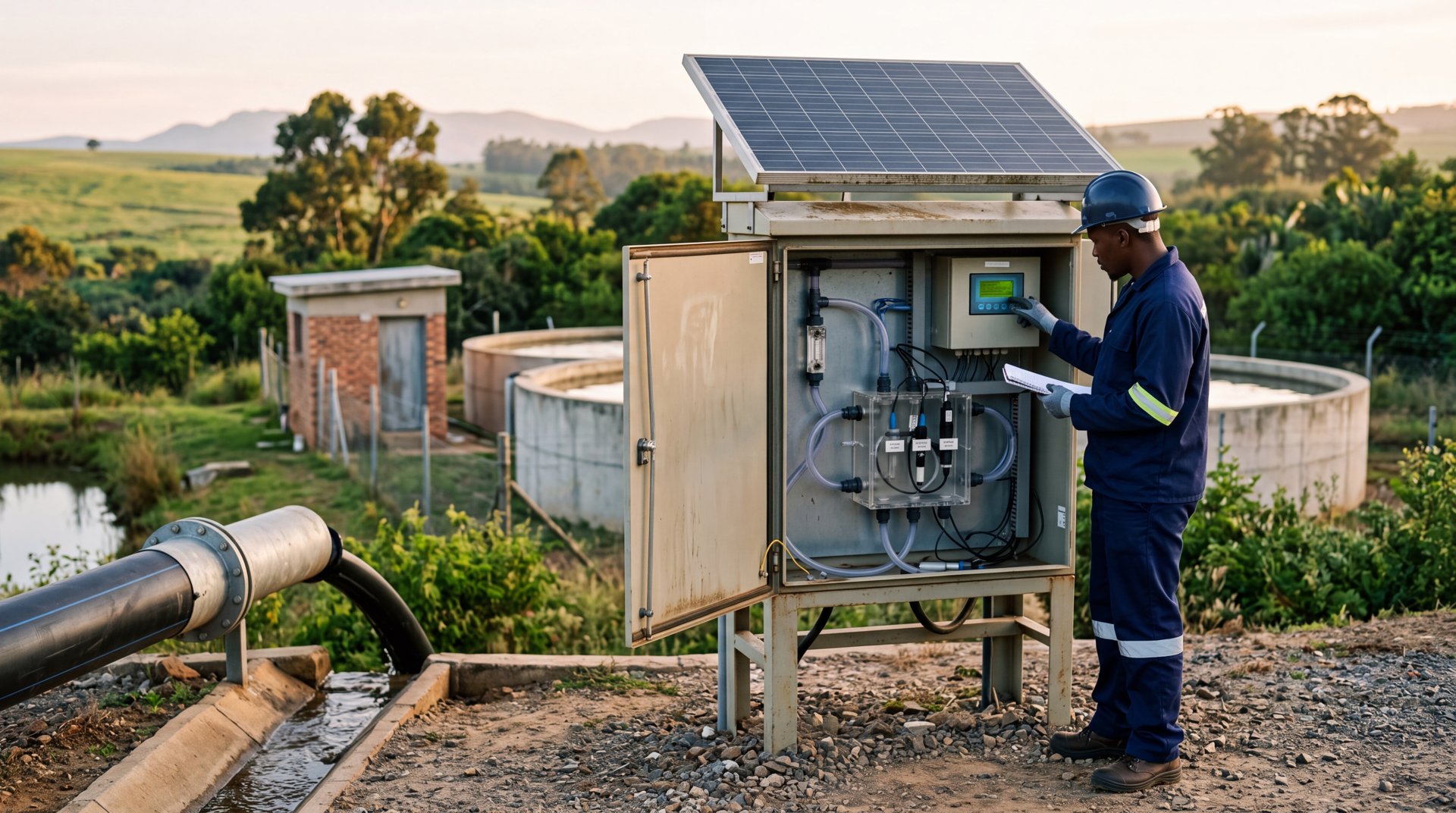
Small-Scale Water Quality Monitoring Station Deployment for Rural Drinking Water Safety Projects
Rural drinking water projects are scattered, under-staffed and lack laboratory capacity. The compact water quality monitoring station integrates turbidity, residual chlorine, pH, conductivity and temperature online monitoring with solar power and 4G/NB-IoT telemetry, delivering low-cost continuous monitoring and early warning for outlet and tap water, supporting standardized O&M and compliance assessment of rural water supply.
Overview
Summary
Rural drinking water projects are scattered, under-staffed and lack laboratory capacity. The compact water quality monitoring station integrates turbidity, residual chlorine, pH, conductivity and temperature online monitoring with solar power and 4G/NB-IoT telemetry, delivering low-cost continuous monitoring and early warning for outlet and tap water, supporting standardized O&M and compliance assessment of rural water supply.
Key Advantages
Challenges
- Many scattered sites with low per-site budget
- No monitoring room, poor power and network at rural sites
- No dedicated O&M staff — reagent-free, low-maintenance devices required
- Source turbidity shocks and endpoint chlorine decay need continuous control
- Data must integrate with county/provincial regulatory platforms
Results
- Continuous 4-parameter monitoring, turbidity resolution 0.01 NTU
- Off-grid solar sites sustain ≥15 days of bad weather
- Reagent-free design cuts annual O&M cost far below traditional analyzers
- Exceedance alarm within 5 minutes — response upgraded from days to minutes
- Data integrity ≥98%, supporting compliance assessment
Solution Details
Small-Scale Water Quality Monitoring Station for Rural Drinking Water Safety
Rural drinking water safety is a baseline project for livelihood and rural revitalization. As scaled rural water supply and urban-rural integrated water supply expand, full-process water quality supervision "from source to tap" is increasingly required. Yet rural supply works are numerous, small and dispersed; most lack online monitoring and still rely on manual sampling with low frequency and poor timeliness. The small-scale water quality monitoring station, with its integrated design, low power consumption, reagent-free measurement and simple installation, offers an affordable and sustainable online monitoring path.
Core Challenges in Rural Water Quality Monitoring
Massive number of sites, low budget per site: A county may host dozens to hundreds of supply works; equipment must be low-cost and deployable in phases.
Primitive site conditions: Small plants have cramped spaces, no standard monitoring room, unstable or no grid power, and uneven network coverage — demanding compact, low-power, solar-powered, wireless units.
Weak O&M capability: Rural works rarely have dedicated lab or instrument staff; equipment must be reagent-free or long-maintenance-interval, with self-diagnosis and remote support.
Complex water quality risks: Sources are small reservoirs, ponds, rivers or groundwater with high turbidity shocks in flood season; residual chlorine decays at pipe ends with microbiological risk — continuous control of turbidity, chlorine, pH and temperature is essential.
Regulatory data integration: Compliance assessment and emergency supervision require unified upload to county/city rural water supply platforms in standard formats.
System Architecture for Rural Online Monitoring
A three-layer architecture: "integrated station — wireless transmission — cloud platform".
Integrated station: The compact station combines a multi-parameter analyzer (turbidity, residual chlorine, pH, conductivity, temperature), sampling/pre-treatment unit, data logger, power and communication modules in an outdoor protective cabinet. Outlet-water sites use a flow-through cell fed by booster pump or gravity; endpoint sites can use direct in-pipe probes.
Wireless transmission: 4G/NB-IoT as primary channel per local signal conditions; data packaged per hydrological/environmental protocols, with automatic re-send on network failure.
Cloud platform: Real-time display, quality trend curves, exceedance alarms (SMS/app push), daily/monthly reports, station compliance statistics, with interfaces reserved for provincial rural supply supervision platforms.
Recommended Parameter Configuration for Rural Stations
Outlet water (mandatory): turbidity (0-20 NTU, extendable to 100 NTU), residual chlorine (0-5 mg/L), pH, temperature — directly corresponding to treatment and disinfection control under GB5749.
Optional extension: conductivity (TDS/source change indication), ammonia or CODMn modules for source pollution warning.
Endpoint checkpoints: chlorine + turbidity two-parameter simplified station to control per-site cost.
Deployment Key Points for Rural Monitoring Stations
Siting & sampling: Outlet monitors at clear-water tank discharge or after the delivery pump; endpoint monitors at hydraulically unfavorable points or sensitive users (schools, village offices).
Power design: Grid + UPS where available; solar + lithium battery otherwise, sized for ≥15 days of autonomy, whole-station consumption under 10 W.
Installation & protection: Ground or wall mounting, IP55+ cabinet, lightning protection and grounding; shading cover on the measuring cell against algae.
Calibration & maintenance: Turbidity calibrated with formazin standards quarterly, pH two-point calibration, chlorine electrode replacement every 6-12 months; the platform detects drift and schedules maintenance.
Data link: Unified station coding, reporting interval 15 min (plus event-triggered), one-pass integration with upper-level platforms.
Typical Deployment Models for Rural Water Supply
County-wide package: Plan outlet stations and endpoints as one network per county, single tender with phased installation.
Standard for 1000t/10k-person works: Scaled works (≥1000 m³/d or ≥10,000 persons served) are equipped with outlet online monitoring as acceptance and assessment requirement.
Emergency + assessment: Denser turbidity monitoring in flood season, denser chlorine checks during holidays; data directly feeds compliance assessment.
Technical Advantages of the Small-Scale Monitoring Station
Compact Integration
Four standard parameters in one cabinet under 0.3 m² footprint, no monitoring room needed
Low Power, Solar-Ready
Typical consumption <8 W; solar+battery operates off-grid at remote sites
Reagent-Free
Optical/electrochemical methods for turbidity, chlorine, pH, conductivity — no chemical consumables, no waste handling
Remote O&M
Remote calibration, diagnostics and maintenance reminders let 1-2 technicians cover hundreds of stations per county
Open Integration
HJ212, SL651 and custom APIs for regulatory platforms at all levels
Typical Application Scenarios
- County-level outlet water online monitoring for rural centralized supply
- Compliance build-out for "1000t/10k-person" rural supply works
- Replacement of manual inspection rounds at township and inter-village stations
- Network endpoint chlorine/turbidity checkpoints
- Drinking water safety consolidation projects in formerly poor areas
- Transitional monitoring in urban-rural integrated pipelines
- Temporary emergency supply (drought/relief) monitoring
Deployment Recommendations for Rural Water Quality Stations
- Baseline survey: Inventory supply works, scales, sources and existing testing capacity; prioritize coverage.
- Siting plan: One station per plant outlet plus hydraulically unfavorable endpoints; produce phased rollout plan.
- Configuration & power sizing: Choose parameter sets by source quality and treatment process; size solar systems for off-grid sites.
- Installation & commissioning: Mount stations, connect sampling lines, lightning grounding, on-site calibration and platform connection.
- Trial operation & acceptance: 15-30 day lab comparison, error and data integrity evaluation, acceptance report.
- Long-term O&M: Inspection, calibration and consumable records; link service performance to compliance KPIs.
? Reference Sources
- GB5749 Standards for Drinking Water Quality
- HJ212 Environmental Data Transmission Protocol
- SL651 Hydrological Data Reporting Protocol
Approach
How we implement intelligence into your infrastructure step by step.
Baseline survey & siting plan
Inventory supply works and testing capacity; one station per outlet plus unfavorable endpoints, phased rollout plan.
Configuration & power sizing
Parameter sets by source and process; solar sizing for off-grid sites.
Installation & commissioning
Station mounting, sampling lines, lightning grounding, on-site calibration and platform connection.
Trial comparison & acceptance
15-30 day lab comparison, error/integrity evaluation, acceptance report.
Long-term O&M & KPI
Inspection/calibration/consumable records linked to compliance KPIs.
❓ Related FAQs
Related Solutions
Submersible Turbidity Electrode Solution for Sedimentation Tank Effluent and Filter Run Turbidity Monitoring
Flow-Through Turbidity Meter Solution for Filter Backwash Monitoring in Water Treatment Plants
Sludge Concentration Meter Solution for RAS and WAS Control in Wastewater Treatment Plants

Ready to Optimize Your Business?
Contact us, and our professional team will provide customized solutions to help your business achieve digital transformation.
Get In Touch