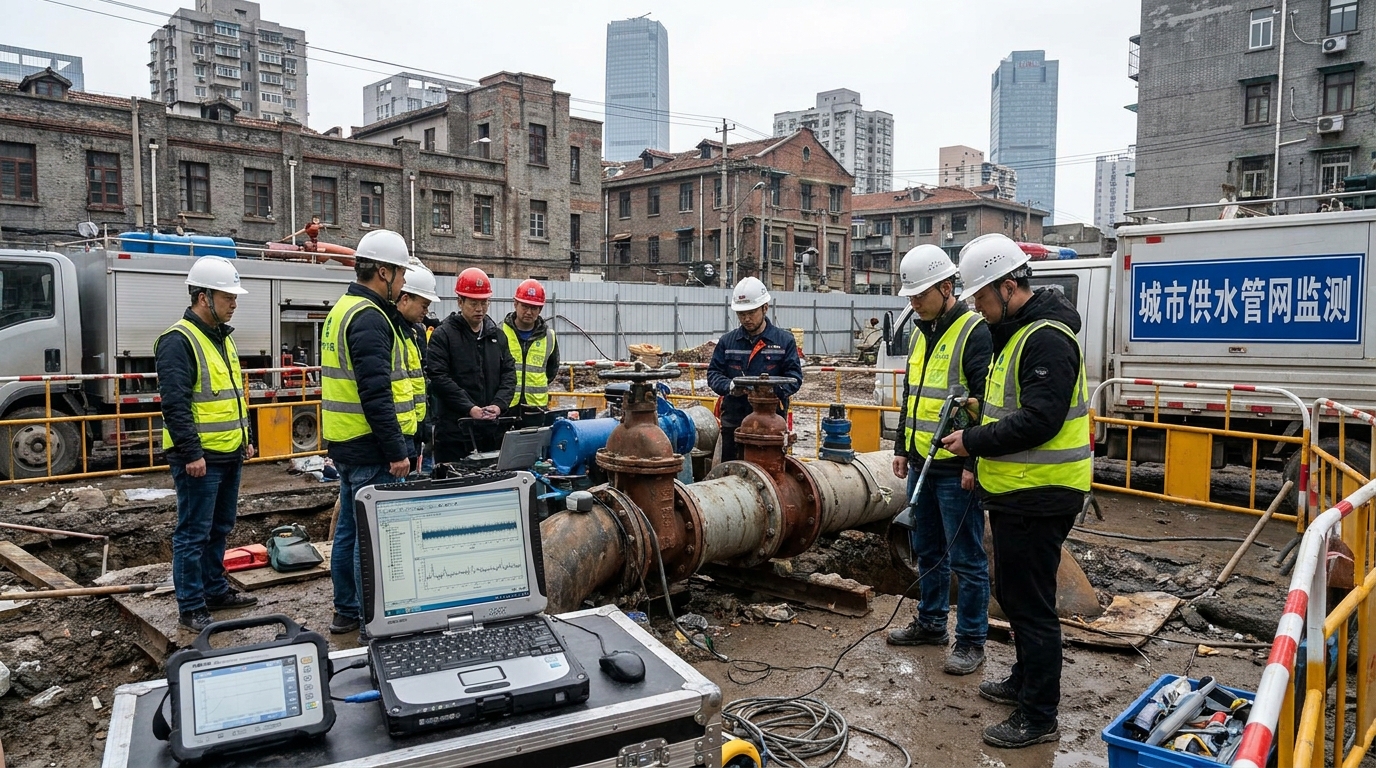
As global urbanization accelerates, the demand for advanced city water supply network monitoring technologies has become critical. This article provides an in-depth analysis of the latest technological advances in urban pipe network management, focusing on how digitalization transforms leak detection, pressure control, and Non-Revenue Water (NRW) reduction to ensure sustainable infrastructure.
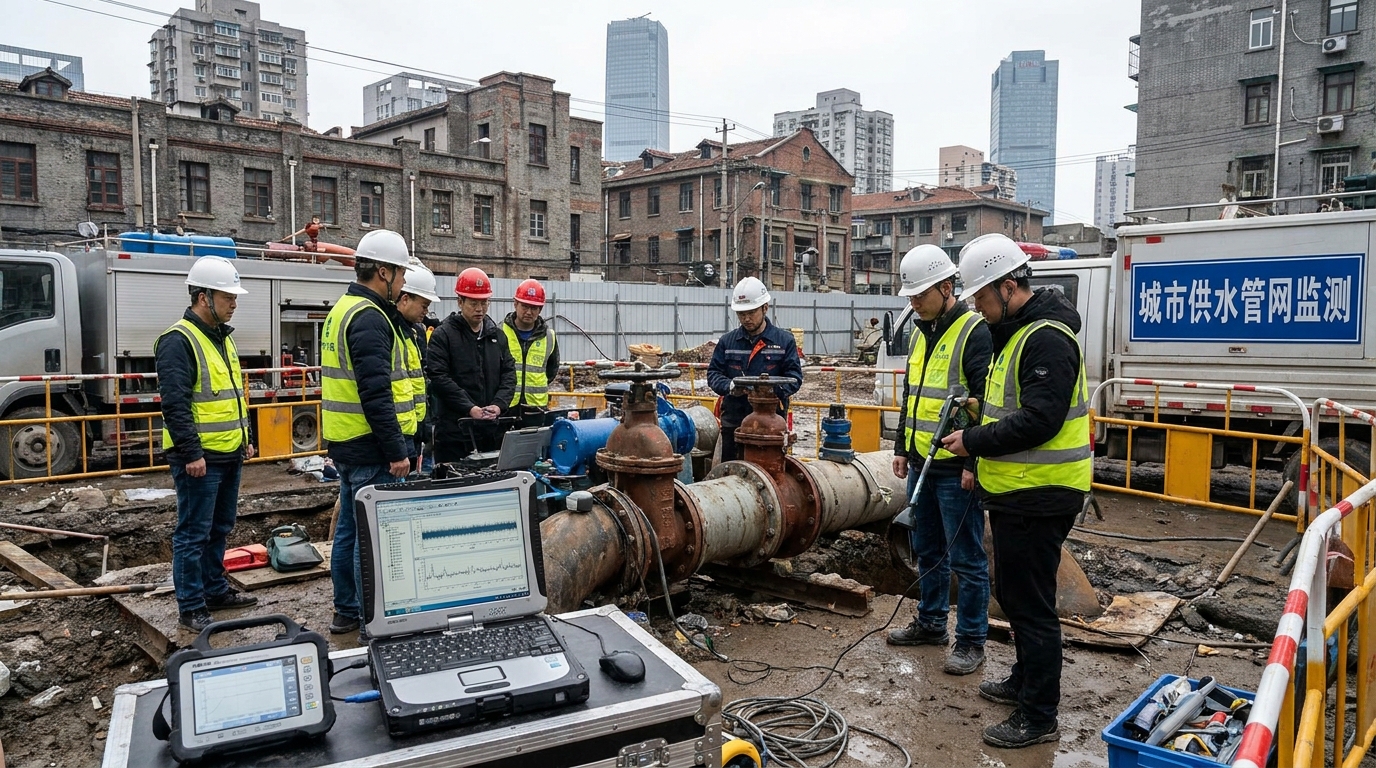
Technological Landscape: Shifting from Reactive to Proactive Monitoring
Traditional water network management often relied on passive models characterized by "manual listening for leaks" or "post-failure repair." Such approaches are not only inefficient but also struggle to detect hidden leaks buried deep underground. In recent years, driven by advancements in the Internet of Things (IoT), sensor technologies, and data science, the industry has comprehensively transitioned to a data-driven stage of proactive network monitoring.
The following three core technologies currently form the bedrock of this modern monitoring framework, enabling utilities to manage complex urban systems with unprecedented precision.
District Metered Area (DMA)
Decomposes networks into independent zones to accurately identify high-leakage areas through flow comparison.
Pressure Management
Uses smart sensors and valves to dynamically regulate pressure, reducing background leakage and pipe fatigue.
Big Data Analysis
Leverages Minimum Night Flow (MNF) and transient analysis to shift from empirical guesses to scientific quantification.
Advanced Leak Detection via DMA Technology
First is the widespread adoption of District Metered Area (DMA) technology. The core logic of DMA lies in "decomposing the whole into parts." By installing high-precision flow meters and valves at network nodes, complex urban water supply networks are divided into several relatively independent and appropriately scaled metering zones.
The system accurately identifies high-leakage areas by continuously comparing the volume of water supplied to each zone against the volume sold or legally consumed. This grid-based management approach significantly narrows the physical scope of leak investigation and remains the most effective foundational method internationally recognized for controlling network leakage.
Refined Network Pressure Management Strategies
Second is refined network pressure management. Fluid dynamics principles indicate that network leakage volume is positively correlated with network pressure. Excessively high pressure not only causes unnecessary water loss but also accelerates pipe material fatigue, increasing the risk of catastrophic bursts; conversely, pressure that is too low leads to water supply difficulties for end-users.
Modern network monitoring systems deploy intelligent pressure sensors at key nodes to collect real-time pressure data. Coupled with smart pressure-reducing valves, water utility managers can implement dynamic pressure regulation based on varying water demand patterns across different time periods, such as peak and valley fluctuations between day and night. This technology, which dampens pressure fluctuations, effectively reduces background leakage while significantly extending the service life of the network.
Big Data-Driven Leakage Analysis Techniques
Third is big data-driven leakage analysis technology. With the acquisition of massive amounts of flow, pressure, and even acoustic monitoring data, the critical challenge lies in extracting valuable information from the complexity. Contemporary leakage analysis has moved beyond simple threshold-based alerts toward the establishment of sophisticated hydraulic models and algorithmic analysis.
For instance, through "Minimum Night Flow" (MNF) analysis, normal nighttime consumption is filtered out to accurately assess the background leakage level of a region. Similarly, pressure transient analysis allows for the rapid localization of minor pipe ruptures. The application of these algorithmic models has shifted leakage analysis from an empirical discipline to one of scientific quantification.
Application Scenarios: Multi-dimensional Network Health Management
The aforementioned monitoring technologies have evolved into various highly business-aligned application scenarios within actual urban water utility operations. These solutions address specific challenges faced by cities worldwide.
In the context of old residential area renovation and water supply assurance, DMA zoning and leakage analysis play pivotal roles. Old urban districts often feature intricate piping networks and severely aged materials, making them "hotspots" for leakage. By implementing DMA retrofits combined with nighttime flow monitoring, managers can quickly identify pipe sections harboring hidden leaks, guiding engineering teams to perform precise repairs. This process dramatically reduces Non-Revenue Water (NRW).
Dynamic Control for Complex Topography and High-Rise Areas
In water supply scheduling for areas with complex topography and high-rise building density, network pressure monitoring and dynamic control serve as core applications. In cities with significant elevation changes, networks in low-lying areas often bear excessive static water pressure.
By deploying intelligent pressure monitoring networks, systems can generate real-time "pressure contour maps" of the entire city, assisting dispatch centers in optimizing pump station operation strategies. This prevents localized pressure overload from triggering catastrophic bursts while ensuring stable water supply to high-elevation regions.
Future Trends: Intelligent Integration and Predictive Maintenance
Looking ahead, urban water supply network monitoring technologies will evolve towards greater intelligence, integration, and predictability. The first trend is the deep integration of Artificial Intelligence (AI) and machine learning. Future leakage analysis will no longer rely solely on static hydraulic models.
Instead, AI algorithms will perform multi-dimensional deep learning on historical leakage data, pipe material information, soil geology, and even climatic conditions. Systems will possess "predictive maintenance" capabilities, enabling them to forecast high-risk pipe sections and issue warnings before substantial ruptures occur, truly achieving a leap from "proactive discovery" to "preventive anticipation."
Digital Twins and Edge Computing in Smart Cities
The second trend is the comprehensive implementation of Digital Twin technology. In the future, urban water supply systems will construct fully mapped three-dimensional digital models in virtual space that mirror their physical counterparts. Real-time dynamic data, including flow, network pressure, and water quality, collected via IoT sensors, will be fed into these digital models.
Managers can conduct immersive inspections of network operating statuses on virtual platforms and even simulate sudden events like burst pipes or power outages. The system will automatically generate optimal emergency valve closure schemes and network dispatch plans. Additionally, edge computing and Low-Power Wide-Area Networks (LPWAN) will allow for preliminary data cleaning directly at the sensor node, drastically reducing latency.
Conclusion
Urban water supply network monitoring is not merely an engineering task but a core guarantee for achieving sustainable urban water resource utilization. Relying on cutting-edge technologies such as DMA zoning, dynamic network pressure management, and intelligent leakage analysis, the water industry is undergoing a profound digital transformation.
As various new-generation information technologies integrate deeply, future urban water supply networks will inevitably become more resilient, intelligent, and efficient, laying a solid foundation for building water-conserving and green modern cities.

