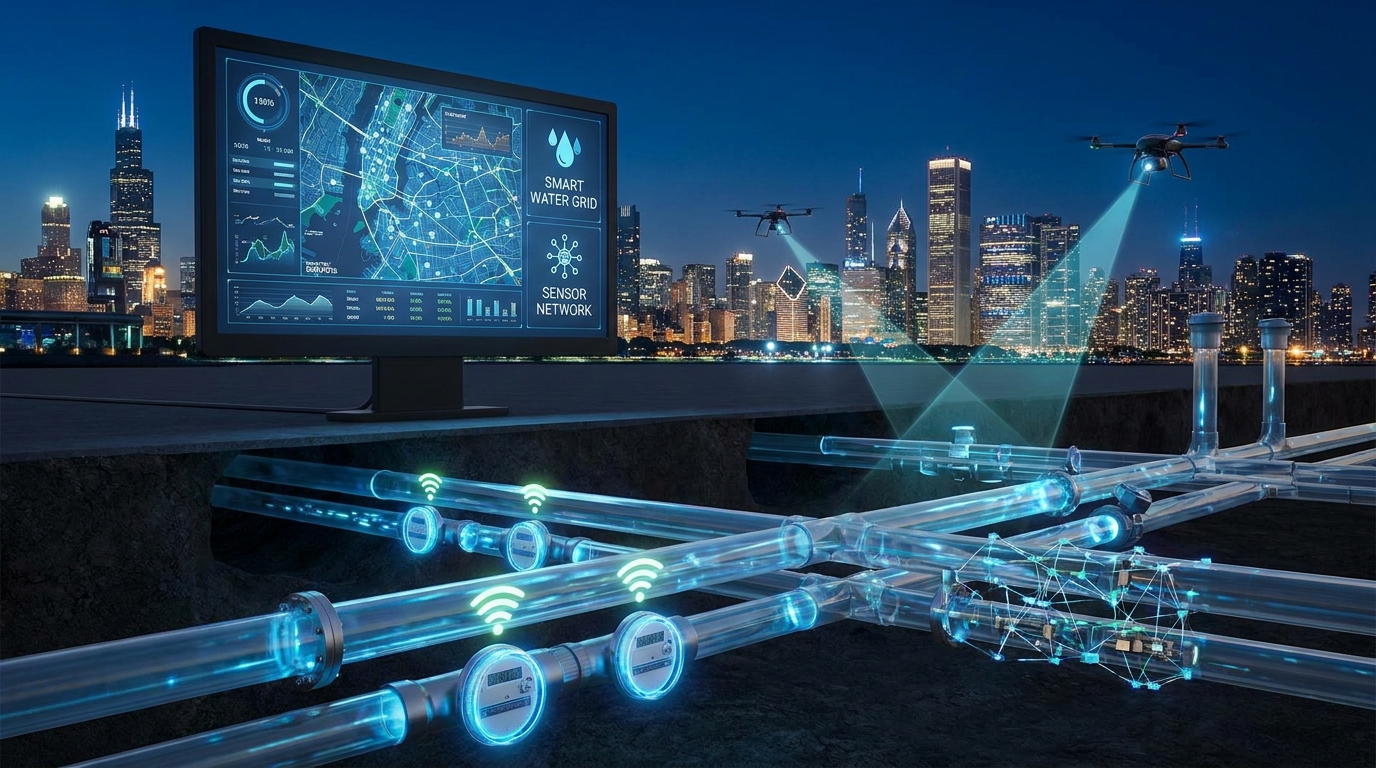
Water Distribution Network Monitoring ROI Analysis: Cost-Benefit Comparison in Smart Water Projects
As urbanization accelerates globally, underground infrastructure—including water distribution networks—is under mounting operational stress. As the lifeline of modern cities, water supply systems must operate safely, reliably, and efficiently—directly impacting public health, economic resilience, and environmental sustainability. Driven by the rapid advancement of smart water initiatives, online monitoring technologies for water distribution networks have experienced substantial growth in both capability and deployment scale. This article provides a comprehensive analysis of the current market landscape, delineates equipment price bands and long-term operational expenditures (OPEX), and delivers pragmatic, evidence-based procurement recommendations tailored for water utilities, municipal authorities, and engineering contractors.
I. Industry Pain Points and Core Monitoring Requirements
Globally, water utilities confront persistent challenges—including aging infrastructure, non-revenue water (NRW) losses exceeding 25–30% in many developing cities, and growing concerns over drinking water safety during conveyance. In such complex hydraulic environments, establishing a multi-layered, real-time sensing infrastructure is foundational to effective asset management. Among all parameters, pressure monitoring remains the cornerstone for maintaining hydraulic balance, detecting abnormal transients, and preventing catastrophic pipe bursts. High-accuracy pressure sensors deployed at strategic nodes—such as zone boundaries, pump stations, and critical junctions—enable operators to visualize system-wide load distribution and identify weak links before failure occurs.
Equally critical is NRW reduction. With global average NRW estimated at 30% (World Bank, 2023), leakage detection has become a top priority. Modern monitoring systems integrate flow data, acoustic leak detection, and Nighttime Minimum Flow (NMF) analytics to localize suspected leaks with sub-meter precision—reducing field investigation time by up to 70% compared to traditional methods. Concurrently, heightened public awareness of water quality has elevated demand for end-point and secondary-supply monitoring. Parameters including turbidity, free chlorine residual, pH, and total coliforms are now routinely tracked to detect biofilm regrowth, disinfectant decay, or cross-contamination—ensuring compliance with WHO guidelines and national standards (e.g., China’s GB 5749-2022).
II. Product Architecture and Price Band Analysis
The market offers diverse monitoring solutions differentiated by parameter scope, sensor accuracy, communication protocols, and integration depth. Pricing reflects these technical tiers—forming a distinct three-tier structure:
Single-Parameter Devices
- NB-IoT remote pressure gauges
- Basic electromagnetic flow meters
- Low CAPEX, plug-and-play
- Ideal for legacy network coverage
Multi-Parameter Stations
- High-stability pressure + flow
- Optional acoustic leak detection
- IP68, 3-5 year battery life
- Target: 15-25% NRW reduction
Integrated Micro-Stations
- High-frequency sampling (≥100Hz)
- Precision ultrasonic flow (±0.5%)
- Multi-parameter water quality
- For trunk mains & high-risk zones
III. Hidden Costs: A Realistic View of Lifecycle OPEX
Procurement decisions often focus narrowly on upfront hardware costs—overlooking recurring operational expenses that can exceed initial investment over a 5-year horizon. Key OPEX components include:
Sensor Calibration & Consumables
Electrochemical and optical water quality sensors require quarterly (or even monthly) cleaning, standard solution recalibration, and periodic replacement of membranes, electrolytes, or light sources. Annual consumables + labor may range from RMB 2,000 to RMB 8,000 per station—scaling significantly across large deployments.
Power System Maintenance
Battery-powered underground devices face accelerated degradation under high humidity, temperature extremes, or frequent data transmission cycles. Field reports indicate actual battery life averaging 2–3 years—not the advertised 5. Replacement of industrial-grade battery packs plus confined-space entry labor adds RMB 1,500–3,000 per unit every 2–3 years.
Connectivity & Platform Fees
Cellular IoT subscriptions (NB-IoT/LTE-M) incur annual SIM/data plan fees (~RMB 120–300/unit). Cloud-based SaaS platforms charge RMB 800–2,500/year per monitored node for data ingestion, visualization, AI-driven analytics, and API access—costs that compound rapidly in citywide deployments.
IV. Strategic Procurement: Evidence-Based Selection Criteria
Drawing on insights from 32 utility case studies and expert interviews, Ecolor Technology recommends the following procurement principles:
Prioritize Use-Case Alignment
Avoid “gold-plating” every node. Allocate budget based on verified operational needs: e.g., invest in acoustic leak loggers with edge AI for high-loss DMAs; deploy compact pressure/quality combo units at residential building inlets; use low-cost pressure-only nodes for hydraulic model boundary condition calibration.
Demand Verified Environmental Resilience
Underground installations demand genuine IP68 certification—not just marketing claims. Require third-party test reports verifying submersion resistance (>1 m for 72 h), corrosion resistance (ISO 9223 C5-M rating), and thermal stability (-20°C to +60°C).
Insist on Open, Standardized Protocols
Hardware must support MQTT/CoAP over TLS, RESTful APIs, and IEC 62541 (OPC UA) compatibility. Closed proprietary protocols risk vendor lock-in, hinder integration with SCADA/BMS platforms, and impede future digital twin development.
Evaluate Total Cost of Ownership (TCO)
Incorporate 3–5 year OPEX projections—including battery replacements, calibration kits, cloud service fees, and OEM support contracts—into tender evaluation criteria. Favor vendors with ≥5 years of field-proven reliability, local service centers, and transparent spare parts pricing.
Intelligent monitoring of water distribution networks is not a one-time project—it is a strategic, multi-decade capability-building initiative. A well-designed, tiered monitoring architecture delivers measurable ROI: reducing NRW by 15–35%, extending pipe service life through predictive maintenance, enhancing regulatory compliance, and strengthening public trust via transparent water quality reporting.
As MEMS sensors, low-power wide-area networks (LPWAN), and embedded AI continue to mature, next-generation monitoring devices will grow smaller, more energy-efficient, and increasingly autonomous—ushering in a new era of resilient, data-driven water infrastructure.
(Prepared by the Ecolor Technology News Editorial Team — delivering objective, technically grounded industry intelligence)

