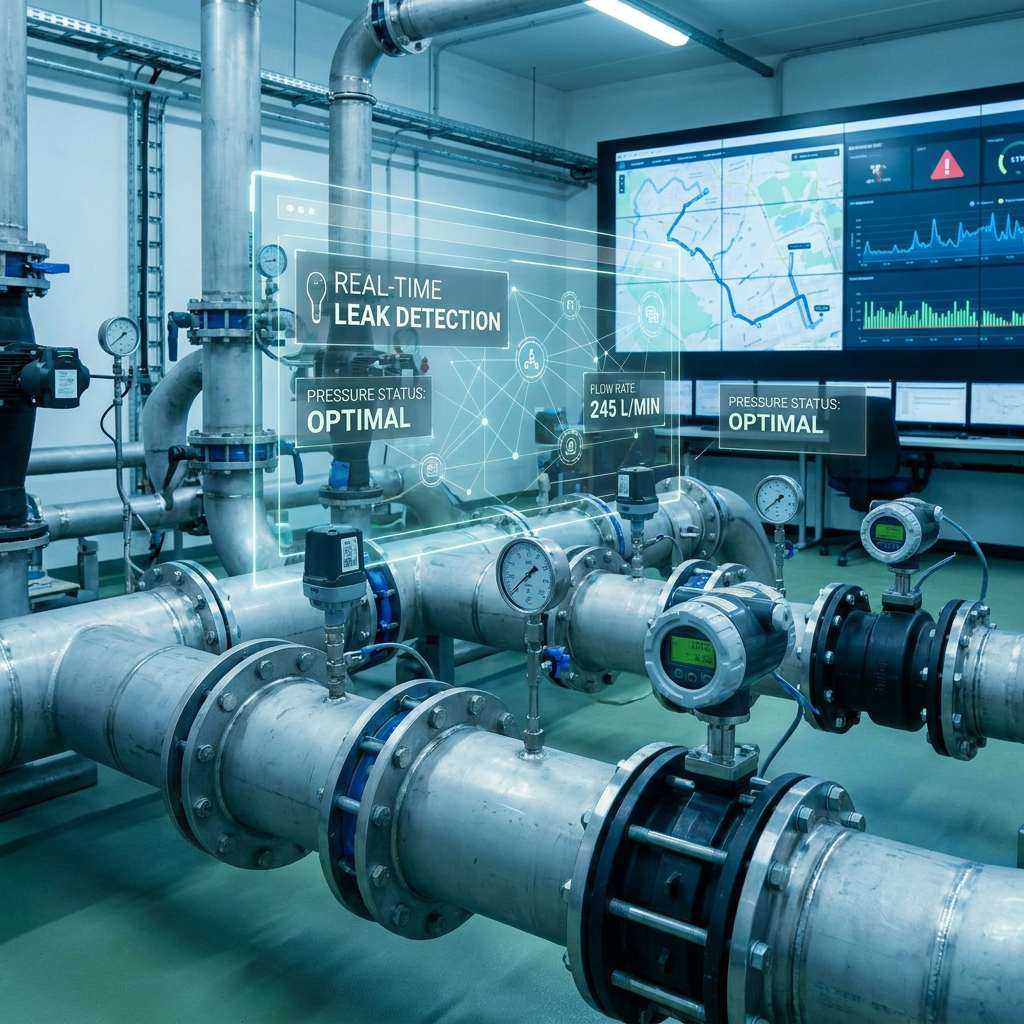
Ecolor Technology Successfully Completes Intelligent Retrofit of Water Supply Network: A Practice in Leakage Control and Network Optimization
Ecolor Technology has successfully concluded the intelligent upgrade of a prefecture-level city's water supply network, delivering a comprehensive solution for leakage control, hydraulic pressure balancing, and water quality assurance. By constructing an advanced IoT monitoring framework coupled with data analysis models, this project provides scientific engineering support that significantly enhances the efficiency and safety of urban water distribution infrastructure.

Project Background and Operational Pain Points
City S, a pivotal industrial and residential hub in East China, boasts a daily water supply capacity of 650,000 cubic meters across over 200 square kilometers. However, rapid urbanization has exposed critical vulnerabilities in its aging underground infrastructure, where outdated installation eras and severe material degradation have led to escalating operational challenges.
Prior to this retrofit, the city's comprehensive non-revenue water (NRW) rate had reached 18.5%, a figure substantially exceeding current national standards for urban water supply leakage control. The complex topology created persistent blind spots in pressure monitoring, particularly at network extremities and high-altitude zones, resulting in unstable hydraulic conditions.
Key Technical Challenges in Legacy Networks
During the survey phase, Ecolor Technology identified three primary hurdles. First, the intricate layout of underground pipelines combined with a 30% loss rate of historical as-built drawings resulted in a weak Geographic Information System (GIS) data foundation.
Second, harsh environmental conditions such as the absence of municipal power access, high humidity, and potential flooding posed severe hardware challenges for sensing devices. Finally, the sheer volume of raw monitoring data lacked professional algorithmic modeling, meaning simple aggregation could not directly assess leakage or burst risks.
Comprehensive Solution: Multi-Dimensional IoT Sensing
To address these complexities, Ecolor Technology implemented a closed-loop solution integrating "Multi-Dimensional IoT Sensing" with "Digital Twin Analysis." The project team scaled the installation of 450 sets of high-precision intelligent monitoring terminals across key nodes, enabling minute-level, even second-level, high-frequency data acquisition.
Online water quality monitoring equipment was deployed at 35 critical secondary water supply pump rooms, capturing real-time parameters such as turbidity, residual chlorine, and pH levels. All underlying hardware adhered to the highest IP68 protection rating and were equipped with low-power IoT transmission modules, ensuring a continuous battery life of over five years.
DMA Zoning and Minimum Night Flow Analysis
On the software front, Ecolor collaborated to develop an intelligent scheduling platform incorporating District Metered Areas (DMA) and the Minimum Night Flow (MNF) model. The city was physically divided into 45 Level-1 DMA zones and 120 Level-2 DMA zones using high-precision electromagnetic flowmeters on trunk mains.
The system automatically identifies suspected physical leak areas by comparing inflow-outflow discrepancies in real-time. It combines flow and pressure fluctuation characteristics during low-demand night periods to filter out normal background consumption values, ensuring precise leak detection.
Implementation Timeline
The project spanned eight months, progressing through four critical stages: network census, hardware construction, platform integration, and grid operation.
Data Correction
Technicians utilized ground-penetrating radar to remap nearly 120 kilometers of core pipelines, correcting spatial data for the GIS foundation.
Algorithm Training
A 45-day baseline data collection period allowed machine learning algorithms to continuously refine leakage analysis and pressure prediction models.
Results: Significant Cost Reduction and Efficiency Gains
After six months of grid operation, all engineering indicators met or exceeded design expectations. Leveraging the precise leakage analysis enabled by DMA zoning, City S reduced its comprehensive NRW rate from 18.5% to 11.2%. This reduction equates to an annual saving of approximately 17.5 million cubic meters of water resources.
In terms of pressure monitoring, the average fluctuation rate decreased by 25.4%. The dispatch center utilized real-time data to implement "peak shaving and valley filling" variable frequency regulation, reducing pipeline bursts by 42% year-on-year and lowering comprehensive energy consumption by approximately 8.5%.
Water Quality Assurance and Safety
Regarding water quality assurance, the round-the-clock operation of the online monitoring system has maintained the pass rate of water quality indicators at the network tail ends steadily above 99.9%. During the high-temperature summer period, the system successfully issued warnings regarding the rapid attenuation of residual chlorine in localized sections.
Dispatch personnel promptly performed remote secondary chlorination adjustments and network flushing based on these warnings, completely eliminating potential water quality safety hazards. This proactive approach ensures consistent compliance with drinking water standards across the entire distribution network.
Conclusion: Validating IoT Value in Urban Water Management
The successful delivery of this intelligent retrofit project objectively validates the practical engineering value of IoT sensing technology, DMA leakage analysis models, and real-time pressure monitoring systems in modern urban water management.
Ecolor Technology will continue to deepen its expertise in the industry, focusing on the fusion of underlying hard technology and professional algorithms, providing professional, reliable technical products and engineering services for the digital transformation and refined operation of the global water sector.

