Digital Wave Reshapes the Landscape of Smart Water: Technological Innovation Drives Efficient Resource Utilization
In the macro context of global climate change, the digital transformation of the traditional water industry has evolved from an exploratory "optional question" into a critical "mandatory question" concerning national resource security. As a cornerstone of national critical infrastructure, smart water is witnessing unprecedented opportunities for development and a fundamental reconstruction of operational models under the dual carbon goals.

Policy Cornerstone: Top-Level Design Driving Deepening Water Informationization
The "14th Five-Year Plan for Water Security Assurance" explicitly calls for the construction of a smart water system, with digitization, networking, and intelligence as the main threads to comprehensively enhance water governance capabilities. The core driver of these policies lies in achieving efficient allocation and intensive utilization of water resources at the intersection of the "Dual Carbon" goals.
Current policy orientation demands the improvement of flood control and disaster reduction early warning systems while emphasizing the scientific nature of water resource scheduling through information technology. Water management departments must break down historical information silos to establish data sharing mechanisms across administrative levels and river basins.
Market Trends: Intelligent Irrigation and Refined Management as Core Growth Engines
Agriculture accounts for over 60% of total national water consumption, holding the greatest potential for improving water use efficiency. With the continuous promotion of high-standard farmland construction, the extensive model of traditional flood irrigation is being replaced by modern modes characterized by supply-on-demand and precise regulation.
Market requirements have surpassed simple remote valve switching; there is a pressing need for integrated systems capable of real-time docking with soil moisture data and meteorological forecasts. Through cloud computing, these systems automatically generate optimal irrigation strategies based on crop physiological water requirement models.
Technological Evolution: Precision Measurement and Digital Twins Building Core Barriers
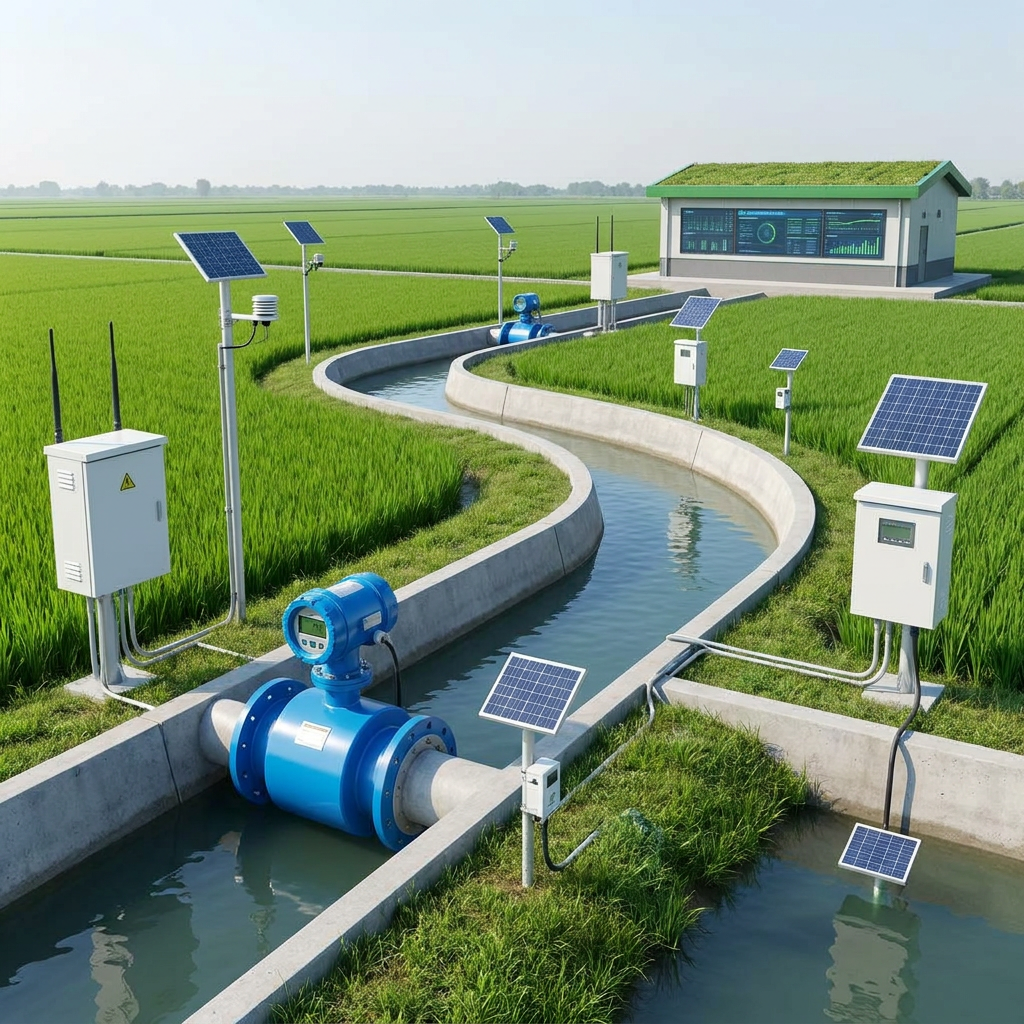
The iterative upgrade of front-end water measurement technology has become the primary direction for breakthroughs in smart water solutions. Widespread deployment of new-generation high-precision IoT sensing devices, such as multi-channel Doppler ultrasonic flowmeters and non-contact radar water level gauges, ensures accurate data collection under complex conditions.
A high-precision water measurement system serves as the digital foundation for fine-tuned water resource scheduling and water rights trading. Building upon this precise perception, IoT, big data analytics, and digital twin technologies are deeply integrating to create 3D virtual models of physical water hubs.
Key Technological Metrics & Capabilities
Multi-channel Doppler ultrasonic, Radar, Electromagnetic
Reduced transmission latency via edge computing
Advanced deduction for flood drills and dry season optimization
Self-learning capabilities for agricultural modernization
Forward-Looking Outlook: Ecological Integration, Standardization, and Intelligence
Looking ahead five to ten years, smart water will evolve into a highly integrated, open, and collaborative industry ecosystem rather than isolated projects. Artificial intelligence will play a decisive role in complex fields such as intelligent water condition prediction and groundwater over-exploitation assessment.
Comprehensive solution providers possessing full-stack capabilities—integrating "intelligent hardware sensing + professional software platforms + water data algorithms"—will emerge as leaders. The essence of smart water is reshaping the relationship between humans and water, and between development and ecology, through modern technological means.