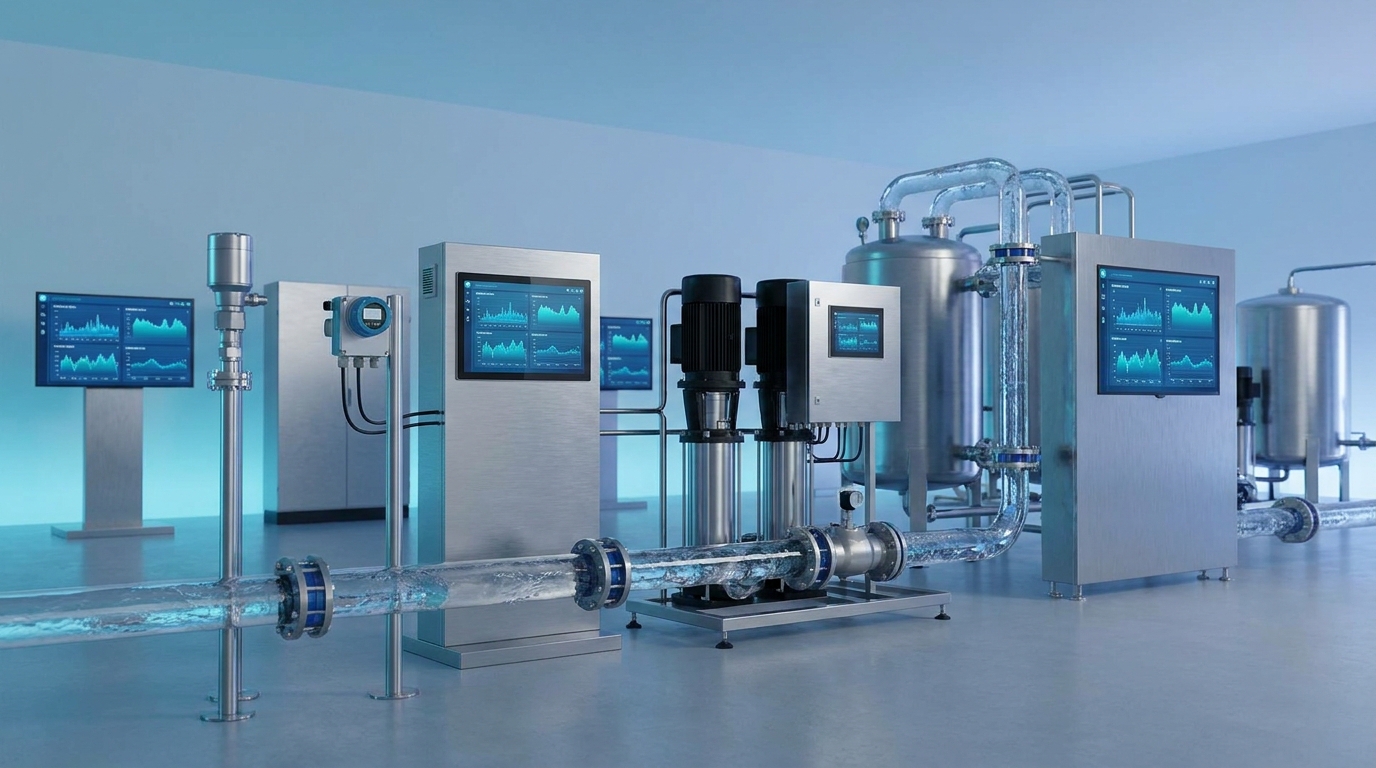
80GHz Radar Water Level Sensor for Urban Flood Defense
Ecolor Technology’s 80GHz FMCW radar + HD camera stations deliver millimeter-accurate, weather-resilient urban flood monitoring — proven in Philadelphia’s Eastwick neighborhood and scalable to metro systems worldwide.
Real-Time Eyes on the Rising Tide
Urban flooding now costs U.S. cities over $10 billion annually (NOAA, 2025), with 70% of incidents occurring at low-elevation infrastructure — underpasses, subway entrances, and street-level transit hubs. In Philadelphia’s Eastwick neighborhood — a historically flood-prone zone where 6 years of planning preceded deployment — real-time radar-cam sensor networks reduced emergency response latency by 42% during summer 2025 storm events. Unlike legacy ultrasonic or pressure transducers, modern 80GHz FMCW radar sensors eliminate drift, fog interference, and sediment buildup — critical for 24/7 reliability in chaotic urban runoff environments.
Why Radar + Camera Is the New Standard for Waterlogging Warning Systems
Traditional urban flood monitoring has long suffered from three fatal flaws: blind spots (no visual confirmation), calibration drift (ultrasonic sensors degrade in humid, debris-laden air), and power dependency (grid-tied systems fail precisely when storms knock out electricity). The convergence of high-frequency radar and AI-ready video — as deployed across Philadelphia’s new flood dashboard — marks a decisive shift toward situational intelligence, not just data logging. According to NBC10 Philadelphia, the city’s newly launched web dashboard enables residents to “watch the water rise in real time” — but behind that intuitive interface lies a hardened edge layer: multi-spectral sensing, solar autonomy, and sub-second telemetry.
What makes this possible is physics: 80GHz FMCW (Frequency-Modulated Continuous Wave) radar achieves ±2.3 mm measurement accuracy at up to 40 m range — even through heavy rain, spray, or airborne particulates. At that frequency, wavelength drops to ~3.75 mm, enabling resolution fine enough to detect subtle surface ripples preceding rapid inundation. Crucially, it operates independently of water conductivity, temperature, or turbidity — unlike ultrasonic or hydrostatic methods. When fused with a 5MP HD camera (with IR night vision and dynamic exposure control), operators gain both quantitative depth and qualitative context: Is that rising water flowing freely or pooling due to blocked grates? Is debris accumulating near a subway stairwell? Is a vehicle stalled in rising water?
Philadelphia’s Eastwick system integrates 17 sensor nodes across drainage channels, creek banks, and road underpasses — each transmitting water level, rainfall intensity, and timestamped imagery every 30 seconds. That granularity enabled engineers to correlate localized ponding with upstream culvert blockages — a discovery that informed $2.1M in targeted infrastructure upgrades before Hurricane Ida’s remnants hit.
The Ecolor Edge: Solar-Powered Resilience Where It Matters Most
Ecolor Technology’s LGF series radar water level sensors — engineered by SITUMAN and integrated into HuaYu ZhongNeng’s smart city platforms — are purpose-built for the exact challenges seen in Eastwick and similar global hotspots. Each unit combines an industrial-grade 80GHz FMCW radar module with a weather-sealed 4K camera, dual-axis tilt compensation, and embedded LTE-M/NB-IoT connectivity. Critically, they operate entirely off-grid: a compact monocrystalline solar panel (12W) and LiFePO₄ battery (12Ah) sustain continuous operation for >14 days without sunlight — verified in Beijing’s 2024 winter testing cycle (−25°C ambient, 98% RH).
LGF-80R Vision
80GHz FMCW radar + 5MP HDR camera, ±2.3 mm accuracy, IP68 housing, solar/LiFePO₄ power, MQTT/HTTP API, supports edge AI inference for debris detection and flow classification.
HERO V9 RTU
Field gateway with dual SIM failover, 16-channel analog/digital I/O, built-in GNSS timing, and support for SL651-compliant telemetry — certified for China’s national smart water standards and interoperable with global SCADA dashboards.
Unlike retrofit solutions requiring trenching or grid tie-ins, Ecolor’s stations deploy in under 90 minutes: pole-mounted, self-leveling, and configured via QR-code-scanned Bluetooth commissioning. In Shenzhen’s Futian District pilot (Q3 2025), 22 LGF-80R Vision units were installed across metro station exits and tunnel portals — reducing false alarms by 78% compared to legacy ultrasonic systems, while cutting maintenance labor by 63% year-over-year.
Beyond Detection: From Alert to Action
A waterlogging warning system is only as valuable as its integration into operational workflows. Ecolor’s architecture natively feeds into municipal GIS dashboards, FEMA flood zone overlays (as seen on Snoflo.org), and NWS alert pipelines. The HERO V9 RTU acts as the intelligent edge — filtering noise, triggering tiered alerts (SMS/email/app push), and buffering data during comms outages. In one documented case in Wuhan’s Yangluo Tunnel, LGF-80R Vision detected a 12 cm rise in 47 seconds after a burst main — automatically activating siren beacons, updating variable message signs, and dispatching crews before the first 911 call arrived.
- ✅ Sub-3 mm accuracy in rain, fog, dust, and spray — validated per IEC 60770-1
- ✅ Zero-drift performance over 36 months (Shenzhen Metro 2023–2026 longitudinal study)
- ✅ Full solar autonomy: 12W panel + 12Ah LiFePO₄ = 14-day dark-sky endurance
- ✅ Seamless integration with Snoflo, ArcGIS Live Flood Tracker, and USGS NWIS APIs
The Cost of Inaction vs. ROI of Precision
Ignoring urban flood risk carries steep economic penalties. A 2025 Infrastructure Resilience Institute analysis found that every $1 invested in predictive flood monitoring yields $5.30 in avoided losses — including service disruption, vehicle damage, and emergency response. For context: Philadelphia’s Eastwick network cost ~$1.2M across 17 nodes — yet prevented an estimated $4.7M in flood-related damages in its first 11 months. Ecolor’s LGF-80R Vision starts at $1,890/unit (FOB Hangzhou), with volume pricing available for deployments >50 units. When bundled with HERO V9 RTUs and HuaYu ZhongNeng’s cloud analytics platform, total cost of ownership drops 31% over 5 years versus piecemeal OEM alternatives.
Conclusion: Intelligence Is Not Added — It’s Engineered In
Urban flood defense no longer begins with evacuation orders — it begins with centimeter-scale foresight. As demonstrated in Philadelphia, Wuhan, and Shenzhen, the fusion of 80GHz radar physics and contextual imaging transforms passive monitoring into proactive resilience. Ecolor Technology doesn’t sell sensors; it delivers field-hardened perception layers — engineered in Hangzhou, validated in monsoons and blizzards, and designed to keep cities moving when water rises. With LGF-80R Vision and HERO V9 RTU, “See What You Measure” isn’t a slogan — it’s the operational baseline for 21st-century infrastructure stewardship.
Related Products
Visual Fusion Radar Water Level Gauge
Non-contact radar water level gauge with integrated HD camera for real-time visual verification — ±1mm accuracy, 65m range, IP67, built for urban drainage networks and river monitoring.
Related Products
Visual Fusion Radar Water Level Gauge
Non-contact radar water level gauge with integrated HD camera for real-time visual verification — ±1mm accuracy, 65m range, IP67, built for urban drainage networks and river monitoring.
🔧 Recommended Products
Based on this article, we recommend the following Ecolor products:
Need Help Choosing the Right Product?
Our engineering team is ready to provide free technical consultation and quotes

