Low-Carbon Park Market Trends: 2026 Carbon Emission Monitoring Price Trends and Selection Recommendations
Introduction: Against the backdrop of the "Dual Carbon" goals, the expansion of the national carbon market, and increasingly stringent supply chain carbon disclosure requirements, carbon emission monitoring is shifting from an extensive model primarily reliant on manual record-keeping and annual verification to a refined management model centered on online monitoring, carbon accounting, and carbon footprint tracking. The industry's focus is no longer solely on "whether there is equipment," but on whether the data can meet the accounting boundaries for greenhouse gas emissions, pass third-party verification, and support energy efficiency optimization and carbon asset management.
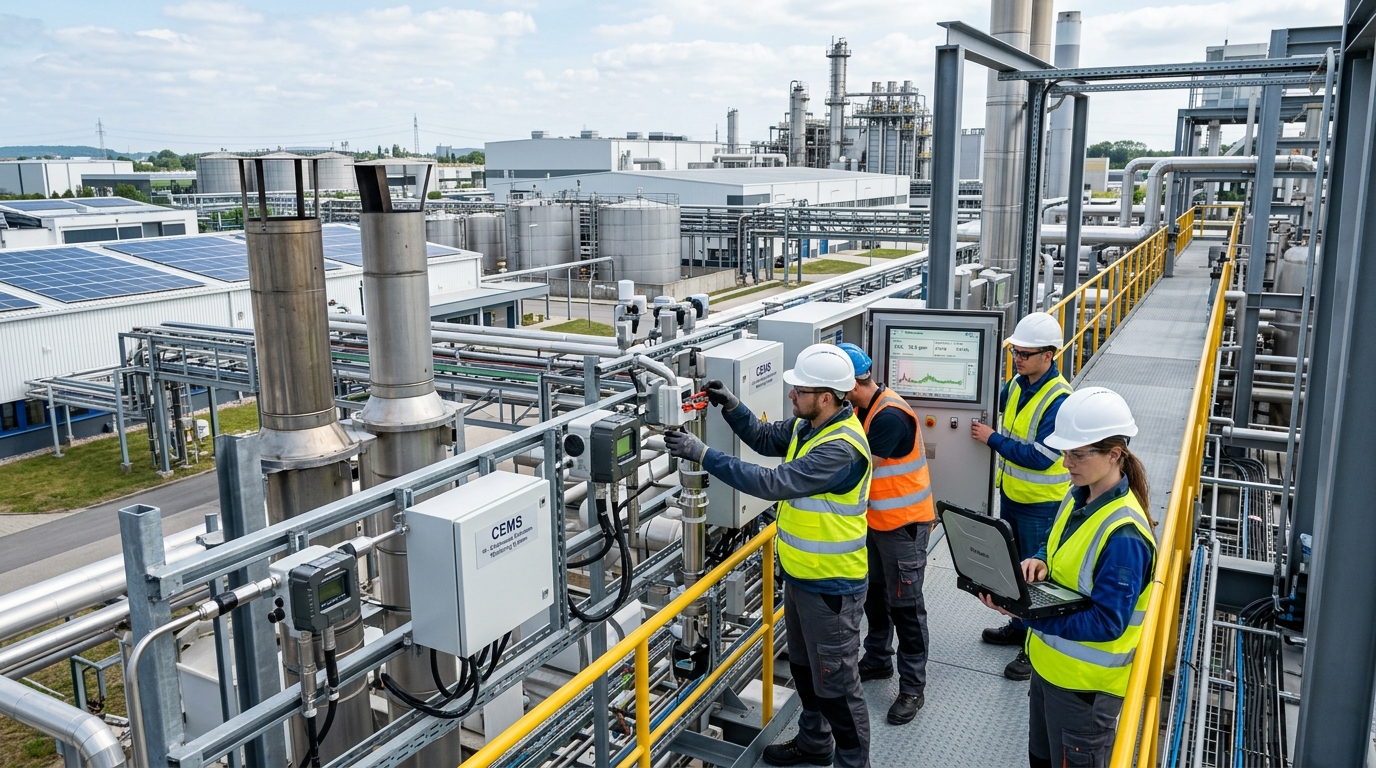
Comprehensive industry research shows that the carbon emission monitoring market has formed a complete chain from sensors and analyzers to continuous emission monitoring systems (CEMS) for flue gas, and further to data platforms and verification services. Prices range from thousands to millions of yuan, and the purchasing logic has shifted from single hardware parameters to data quality, O&M capabilities, and compliance adaptability.
I. Market Size and Demand Structure: Three-Tier Growth Driven by Policy
In terms of demand structure, the carbon emission monitoring market can be divided into three tiers:
- Tier 1: Compliance Monitoring for Key Emitting Units. Covering industries such as thermal power, steel, cement, electrolytic aluminum, chemicals, waste incineration, and wastewater treatment. The core targets are greenhouse gases such as carbon dioxide, methane, and nitrous oxide. Taking thermal power as an example, a single coal-fired unit typically requires measurement points in the flue for parameters such as CO2, oxygen content, flow velocity, temperature, and pressure. A complete CEMS can have 4 to 12 measurement points.
- Tier 2: Park- and City-Level Greenhouse Gas Monitoring. The demand comes from local authorities and industrial parks, usually adopting a combination of fixed stations, micro stations, mobile monitoring vehicles, and remote sensing equipment to form a kilometer- or hundred-meter-level grid.
- Tier 3: Enterprise Supply Chain Carbon Footprint Management. This requires integrating data on energy consumption, production processes, transportation, and purchased materials into carbon accounting, promoting the integration of monitoring data with ERP, MES, and energy management systems.
According to comprehensive estimates by multiple industry institutions, the market size for carbon emission monitoring-related hardware, software, and services in China in 2024 is approximately in the range of 18 billion to 26 billion yuan. If the industries covered by the carbon market continue to expand and methane monitoring requirements are raised, it is expected to reach 40 billion to 55 billion yuan by 2027.
II. Divergence of Technical Routes: Synergy of CEMS, NDIR, TDLAS, Remote Sensing, and Carbon Accounting Platforms
In terms of technical routes, carbon emission monitoring is not a single device but a systematic engineering process of "sampling - analysis - flow measurement - accounting." CEMS is currently the most mature application direction, typically using Non-Dispersive Infrared (NDIR), Fourier Transform Infrared (FTIR), or Tunable Diode Laser Absorption Spectroscopy (TDLAS) to measure CO2.
For high-concentration flue gas, the CO2 range is often set at 0-20% volume fraction, with the indication error required to be controlled within ±1% to ±2% of the full scale; for ambient air or park boundary monitoring, ppm or even ppb-level resolution is required.
For example, methane monitoring often requires a 0-100 ppm range and a detection limit below 0.1 ppm. Low-concentration, high-global-warming-potential gases such as nitrous oxide, sulfur hexafluoride, and perfluorocarbons rely more on gas chromatography, cavity ring-down, or high-sensitivity spectroscopic technologies.
Key Insight: The value of online monitoring lies in improving time resolution, but it must be combined with carbon accounting data such as fuel calorific value, carbon content, oxidation rate, output, and power consumption to form verifiable emission results. In other words, hardware only solves "measurability," while platforms and models solve "calculability."
III. Product Price Ranges: Stratification from Single-Point Sensors to System-Level Solutions
The price range is one of the indicators purchasers care about most. Depending on configuration, certification, explosion-proof rating, and installation difficulty, carbon emission monitoring products can be roughly divided into seven categories:
Single-Point & Industrial Monitors
- Single-point CO2 transmitters: ¥2,000 - ¥20,000 (Buildings/Labs)
- Industrial fixed GHG monitors: ¥20,000 - ¥120,000 (Plant boundaries)
CEMS & High-Precision Stations
- Flue gas CEMS: ¥150,000 - ¥800,000/set
- High-precision GHG stations: ¥500,000 - ¥3M/station
Grid & Software Solutions
- Park grid micro stations: ¥10,000 - ¥80,000/point
- Carbon accounting software: ¥30,000 - ¥500,000/year
Advanced Services
- Satellite/UAV/Laser telemetry: ¥200,000 - ¥2M/project
The procurement budget should not only look at the equipment quote but also reserve 10%-25% for installation, commissioning, communication, and training costs.
IV. Purchasing Recommendations: First Clarify the Accounting Boundary, Then Select Monitoring Accuracy and Data Link
When purchasing carbon emission monitoring equipment, it is recommended to first clarify the accounting boundary and then determine the monitoring plan.
- Carbon Market Compliance: Priority should be given to meeting the monitoring requirements of national or local authorities for key emitting units, focusing on data completeness, traceability, and alignment with carbon accounting guidelines.
- Internal Control & Energy Conservation: Attention should be paid to whether the measurement points can reflect key energy consumption links, such as boilers, kilns, air compressor stations, refrigeration stations, and drying lines.
- Product Carbon Footprint: It is not enough to only monitor emission outlets; data on raw materials, purchased electricity, transportation, packaging, and waste must also be collected to support ISO 14067 or similar product carbon footprint standards.
Accuracy selection should avoid the misconception of "the higher, the better": high-concentration flue gas scenarios are more suitable for analyzers with good stability and strong anti-interference capabilities; low-concentration environmental scenarios require lower detection limits and higher calibration frequencies.
Procurement Specification Tips: Clearly specify response time (e.g., ≤30s for CO2), data valid capture rate (≥95%), and communication protocols (Modbus, 4-20mA, MQTT, OPC UA). For complex environments (chemicals, gas, waste incineration), confirm explosion-proof, anti-corrosion, high-temperature resistance, and anti-clogging capabilities.
V. Maintenance Cost Analysis: Hardware Lifecycle and Data Quality Investment
Maintenance costs often determine the long-term success or failure of carbon emission monitoring projects. Industry experience shows that the annual maintenance cost of conventional monitoring systems is usually 8%-18% of the initial investment.
Taking a 450,000-yuan flue gas CEMS as an example, the annual maintenance cost is about 36,000 to 81,000 yuan, mainly including standard gases, filter elements, pumps and valves, sampling lines, manual inspections, and annual calibration. If the system includes multiple measurement points, redundant analyzers, or high-temperature heated lines, the maintenance cost may approach 100,000 yuan.
| Component Type | Typical Lifespan |
|---|---|
| Electrochemical Sensors | 2-3 Years |
| Infrared Light Sources | 5-8 Years |
| Laser Light Sources & Optical Components | 8-10 Years |
Regarding calibration frequency, industrial online monitoring is generally recommended to perform zero and span calibration every quarter or half year, while high-precision stations may require monthly or even more frequent calibrations. Software annual fees usually account for 15%-25% of the initial software cost.
VI. Typical Application Scenarios and Input-Output: From Thermal Power Flue Gas to Park Carbon Footprints
From application cases, the input-output differences across different scenarios are quite large:
- Large Coal-Fired Power Plant: Total investment ~1.2 million yuan. Integrated real-time data reduced manual ledger entry time by ~70% and shortened verification preparation cycle from weeks to days.
- Steel Park: Investment ~3.8 million yuan for 60 grid points and 2 mobile vehicles. Identified leaks/anomalies achieving energy-saving benefits of 800,000 to 1.2 million yuan annually.
- Chemical Enterprise: Laser telemetry for methane leakage (0.1 ppm detection limit) helped establish Leak Detection and Repair (LDAR) processes, reducing material loss and safety risks.
- Consumer Goods Manufacturer: Supply chain carbon footprint platform (~180k yuan/year) covering 200+ suppliers, reducing accounting cycle from 4 months to less than 1 month.
VII. Risks and Standards: Data Credibility, Metrological Traceability, and Compliance Boundaries
While the market is expanding rapidly, data quality and compliance risks cannot be ignored. The core of carbon emission monitoring is not "displaying a value," but forming an auditable chain of evidence. Common problems include insufficient representativeness of sampling points, water accumulation in sampling lines, analyzer drift, missing calibration records, flow measurement errors, and data silos.
If only online monitoring is relied upon while ignoring fuel testing, production reports, and energy bills, the emission results may deviate from the actual situation by 5%-20%.
Therefore, the industry generally recommends cross-verifying online monitoring with carbon accounting, energy metrology, and production operation data. In terms of the standards system:
- Organizational Level: ISO 14064, GHG Protocol
- Product Level: ISO 14067
- Equipment Level: Relevant metrological verification regulations and environmental protection online monitoring standards
- Compliance: MRV (Monitoring, Reporting, Verification) requirements stipulated by authorities
VIII. Future Outlook: From "Visible" to "Accurately Calculated and Effectively Managed"
Looking ahead, carbon emission monitoring will move from being "visible" to being "accurately calculated, effectively managed, and well utilized." On the one hand, the decline in sensor costs and the maturation of laser spectroscopy and remote sensing technologies will promote the expansion of greenhouse gas monitoring from key emission outlets to factories, parks, cities, and supply chain networks.
On the other hand, carbon accounting platforms will be deeply integrated with energy management, production scheduling, and carbon asset management systems, forming real-time emission factors, dynamic carbon footprints, and marginal abatement cost analysis. It is expected that in the next three to five years, the market's sensitivity to low-cost hardware will decrease, while attention to data credibility, O&M response, standard adaptability, and total lifecycle costs will increase.
Conclusion: Carbon emission monitoring is not a one-time project, but the infrastructure for low-carbon transition. Only by integrating equipment, standards, processes, and personnel capability building can we truly support greenhouse gas emission reduction decisions and enable carbon accounting, carbon footprints, and carbon management to generate long-term value.