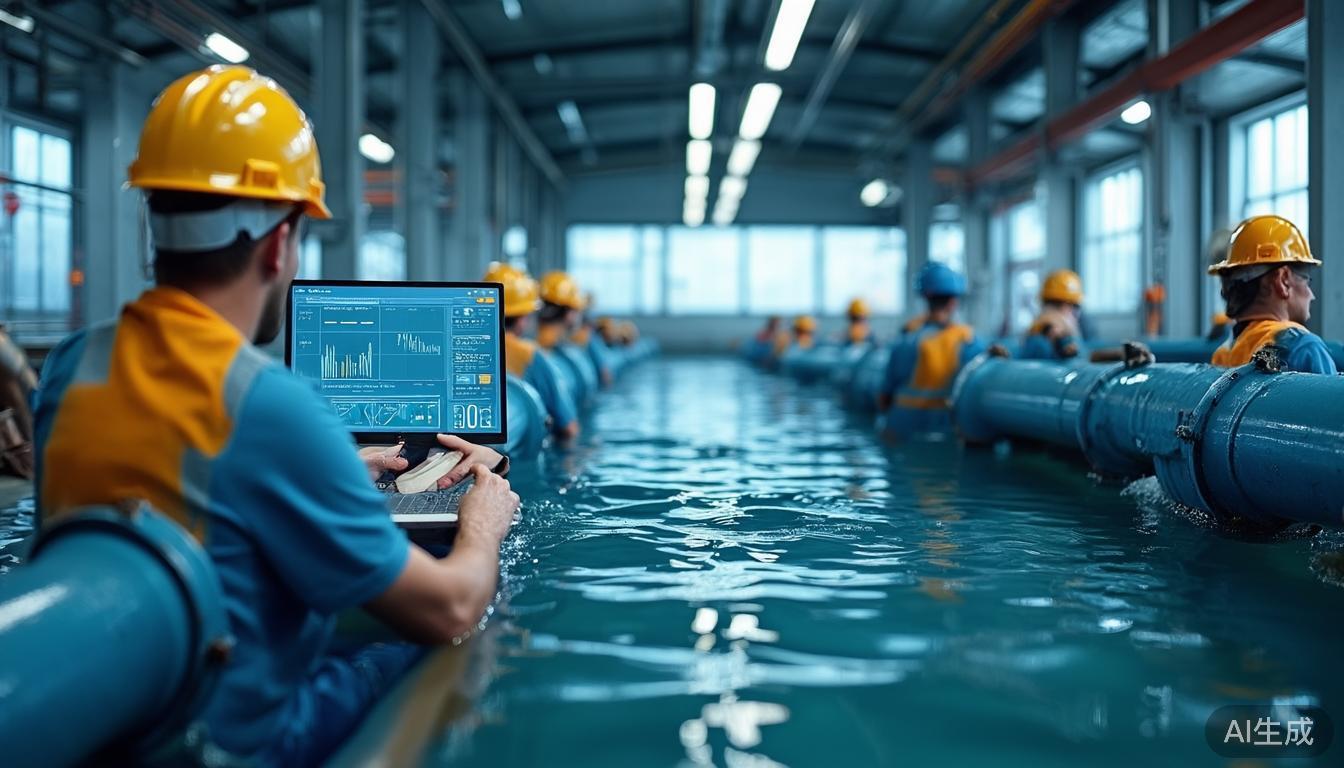
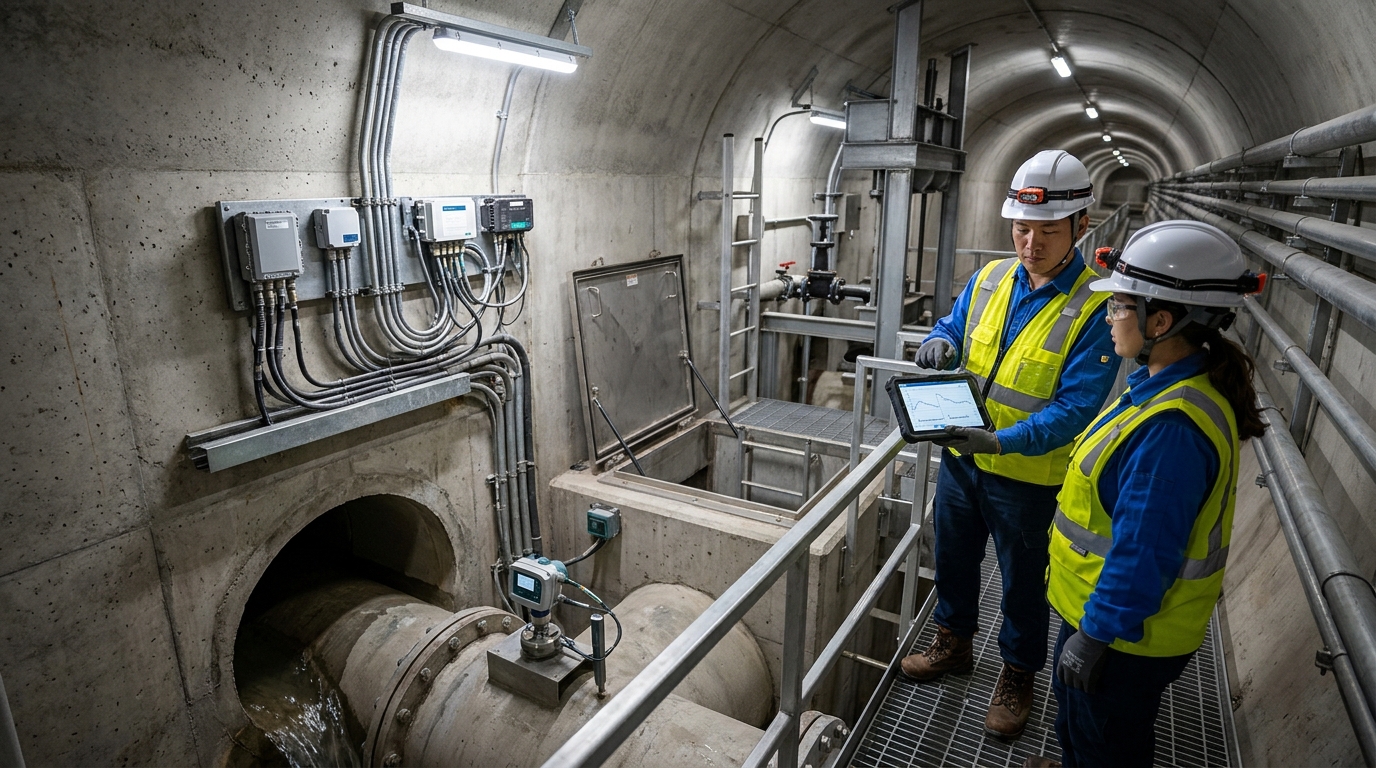
How a Water Utility Group Achieves Cost Reduction and Efficiency Improvement through DMA District Metering
Transitioning from extensive leak detection to data-centric refined operations, this case study explores how the Binjiang District water utility reduced leakage rates by 8.4 percentage points through strategic District Metered Area (DMA) implementation.
Introduction: Refined Transformation from Extensive Leak Detection to District Metering
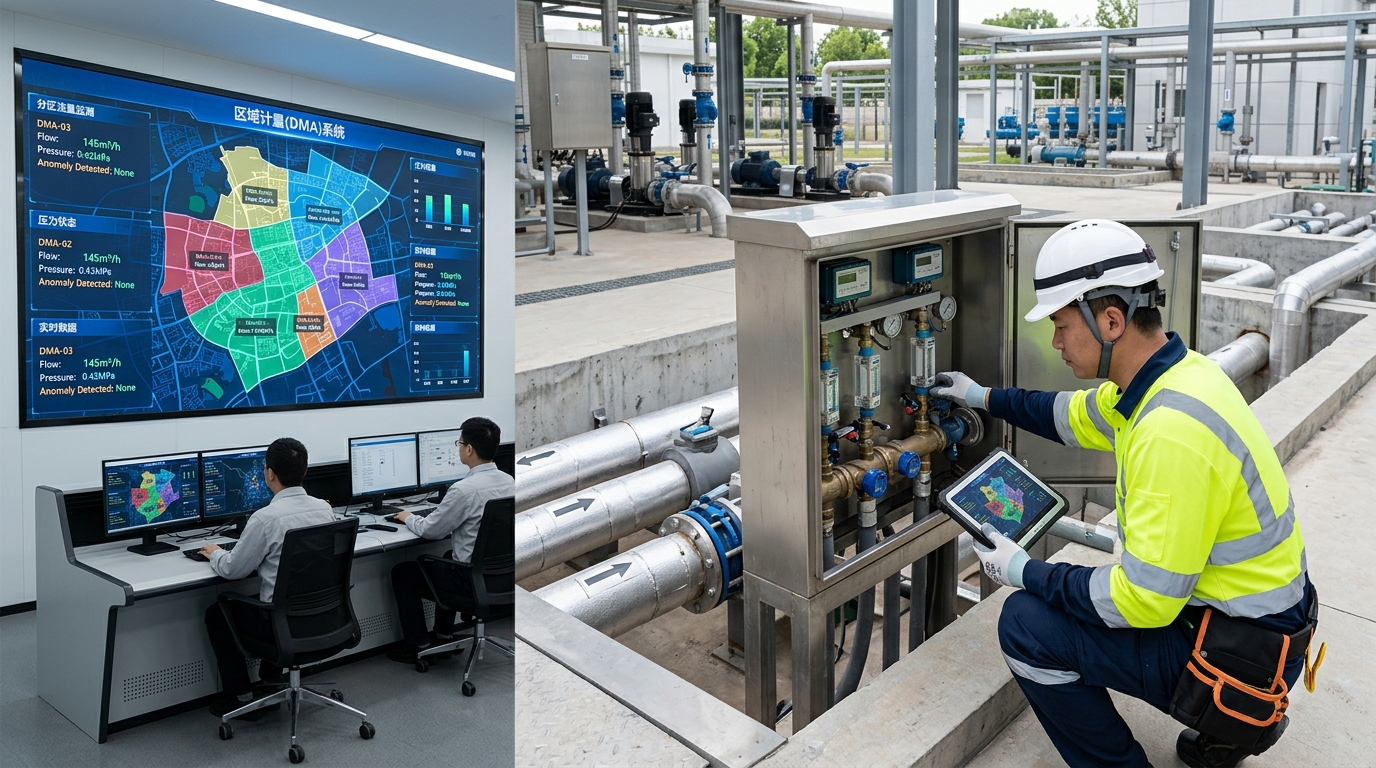
The management of leakage in urban water supply networks is shifting from the traditional model reliant on manual inspections and passive emergency repairs to data-centric refined operations. In the water supply industry, network leakage not only signifies water resource waste but also directly drives up water treatment costs, increases energy consumption, and may induce secondary disasters. District Metered Area (DMA) management has thus become a crucial approach for water utilities worldwide to reduce leakage rates and enhance network operational efficiency. Its fundamental logic is to divide the vast and complex water supply network into several independent areas that are meterable, monitorable, and evaluable. By continuously comparing flow, pressure, and water consumption, abnormal leakage can be quickly identified.
This article takes the DMA district metering project for the water supply network in Binjiang District of a city in East China as an example to restore a representative industry practice. The project covers a water supply area of approximately 41.2 square kilometers, serving a population of about 528,000, and involves a total length of about 536 kilometers for municipal and community networks. Prior to project implementation, the network leakage rate in this area was 20.7%, the non-revenue water rate was 18.9%, and the annual leakage volume was approximately 14.1 million cubic meters. By constructing a three-tier DMA zoning, improving metering facilities, integrating an online monitoring platform, and establishing a closed-loop leakage disposal mechanism, the project reduced the leakage rate to 12.3% and the non-revenue water rate to 13.6% within 18 months, saving approximately 5.12 million cubic meters of water annually.
"The value of this case lies not only in the reduction of leakage rate indicators but also in the water utility's initiation of an operational closed loop of 'using data to detect leaks, using data to verify repairs, and using data to evaluate management.'"
Project Background: Multiple Pressures Behind High Leakage in the Old City
Binjiang District is a typical mixed area of old and new cities, featuring both old residential areas built over 30 years ago and newly built commercial complexes and high-rise residences in the past decade. The water supply system has long been operating under high load. According to statistics before the project launch, the total water supply in the area in 2023 was approximately 68.2 million cubic meters, of which residential water accounted for about 62%, commercial and public service water for about 27%, and industrial and other water for about 11%. While the water supply scale continues to grow, the limited pace of network infrastructure renewal has led to the continuous accumulation of leakage risks.
Network Composition
- DN75+ Mains: ~418 km total length
- Gray Cast Iron: ~31%
- Ductile Iron: ~29%
- Prestressed Concrete: ~17%
- PE & Others: ~23%
Leakage Profile (Pre-Project)
- Total Incidents: 217/year
- Hidden Leaks: ~64% of incidents
- Physical Losses: ~68% of NRW
- Metering/Management Errors: ~32%
The complex network structure is a major feature of this area. The total length of water supply mains with a diameter of DN75 and above in the area is about 418 kilometers, of which gray cast iron pipes account for about 31%, prestressed concrete pipes for about 17%, ductile iron pipes for about 29%, and PE and other pipes for about 23%. Pipes in service for over 20 years account for about 38.6%, with some gray cast iron and galvanized steel pipes showing obvious corrosion, joint aging, and reduced pressure-bearing capacity. Due to inconsistent historical construction standards, there are many cross-connections of pipes from different eras, and some local areas have multiple pipes serving as backups for each other, increasing the difficulty of leakage identification.
Technical Challenges: Data Deficiency, Complex Boundaries, and Metering Accuracy Compounding
In the early stages of project promotion, the biggest challenge came from incomplete basic data. Although a preliminary GIS pipeline network system had been established locally, data for some old residential areas, branch roads, and courtyard networks were severely lacking, with deviations in pipe diameter, burial depth, material, and valve locations compared to the field. During the preliminary investigation, the project team found that about 12.4% of the drawing pipelines were inconsistent with field detection results. Some valve chambers were encroached upon, buried, or unmaintained for a long time, making it impossible to accurately close the district boundaries. If the topological relationship of the pipeline network cannot be clarified, DMA zoning may result in "zoning without closure," and the metering data will lose its analytical significance.
The second challenge is the difficulty in controlling district boundaries. Binjiang District has a dense road network and many looped pipe networks, with multiple connecting pipes between different areas. Relying solely on closing valves to form independent metering areas may affect the water pressure and supply safety of surrounding users; retaining connections, however, will cause flow crossover, making it difficult to determine the attribution of leakage. In addition, some old valves are not tightly closed, exhibiting internal leakage. Preliminary tests showed that among the 46 planned Tier-3 DMAs, 23 boundary valves had varying degrees of seepage or opening/closing abnormalities, with the maximum single-valve internal leakage estimated at 9 cubic meters per hour, which would directly interfere with the minimum night flow analysis results.
The third challenge lies in metering accuracy and data stability under low-flow conditions. DMA leakage analysis highly relies on minimum night flow, as user water consumption is lower at night, making the proportion of leakage water in the total flow more apparent. However, the night flow in some DMAs in Binjiang District is only a few to over ten cubic meters per hour. If the flow meter range is too large or the installation conditions are not ideal, it is easy to encounter undercounting of small flows, drift, and noise interference. Meanwhile, non-residential water usage behaviors such as pressure fluctuations, firefighting water use, landscaping irrigation, and water tank refilling may also cause abnormal flow curves. How to ensure that metering data is authentic, continuous, and comparable under complex working conditions is a key issue the project must solve.
Solutions: Building a Three-Tier Zoning, Four-Tier Metering, and Data Closed-Loop System
In response to the above challenges, the project team did not simply adopt the linear model of "install meters—read data—find leaks," but first established a complete district metering system. The overall scheme was designed according to "Tier-1 plants and stations, Tier-2 districts, Tier-3 DMAs, and Tier-4 communities and large users." Tier-1 metering focuses on the outlet of water plants and the inlet and outlet of booster pump stations for total volume accounting; Tier-2 metering covers 5 water supply districts for inter-district water balance; Tier-3 DMAs are the core of leakage management, with a total of 46 independent metering areas delineated; Tier-4 metering extends to key communities, large commercial complexes, and industrial users to refine the water usage structure.
Key Hardware Configuration
- • Flow Meters: Added/replaced 86 boundary electromagnetic flow meters (DN50–DN600). Small-diameter DN50/DN80 meters accounted for 41%.
- • Sensitivity: High-sensitivity electromagnetic/ultrasonic meters prioritized for night flows <5 m³/h, with errors controlled within ±1%.
- • Pressure Monitoring: 132 points deployed at key nodes, collecting data every 15 minutes.
- • Smart Meters: Replaced 23,600 remote-reading water meters for user-side comparison.
Regarding the data platform, the project integrated flow, pressure, water meter readings, valve status, work order maintenance, user registration, and GIS pipeline network data into the district metering management platform. The platform establishes a water balance table for each DMA, calculating water supplied, water billed, unbilled authorized consumption, physical losses, and apparent losses. The system automatically generates minimum night flow curves daily and issues alerts for DMAs exceeding the set threshold for three consecutive days. Through this approach, leakage management shifts from "judging by experience" to "decision-making by data." Meanwhile, the platform also sets up a data quality review mechanism to flag abnormal zero values, sudden changes, and communication interruption data, ensuring that analysis results are not affected by bad data points.
Implementation Process: From Pipeline Network Census to Closed-Loop Leak Disposal
The project implementation was divided into five phases. The first phase was the pipeline network census and boundary confirmation, lasting about 3 months. The project team conducted a comprehensive survey of valve chambers, connecting pipes, fire hydrants, and courtyard branch pipes in the area, inspecting a total of 2,865 valves, repairing or replacing 217 failed valves, clearing 142 encroached valve chambers, and supplementing and correcting about 67 kilometers of GIS pipeline information. For areas where closure could not be achieved by closing valves, boundary flow meters were added and local disconnections were made to ensure each DMA had clear boundaries.
The second phase was district design and equipment installation, lasting about 4 months. Based on the pipeline network topology, user distribution, pressure zoning, and construction conditions, 18 Tier-2 districts and 46 Tier-3 DMAs were finally formed. Each DMA serves an average area of about 0.9 square kilometers with an average network length of about 11.6 kilometers, a moderate scale facilitating subsequent analysis. The installation phase focused on controlling the straight pipe sections of flow meters, waterproofing in chambers, power supply and communication, and lightning protection and grounding. For metering chambers without access to municipal power, battery power and NB-IoT remote transmission were used; for important metering points on main pipes, dual power supplies and 4G/5G dual-channel communication were configured to ensure the completeness rate of data upload.
The third phase was data joint debugging and trial operation, lasting about 3 months. The project team conducted zero-point verification, pressure linkage testing, and minimum night flow baseline establishment for each DMA. During the trial operation, the platform collected approximately 2.18 million flow data records, 3.56 million pressure data records, and 18.9 million water meter data records. Through comparison, it was found that initially 11 DMAs had boundary seepage or metering anomalies, and their boundaries were re-corrected after re-testing; 6 DMAs experienced night flow fluctuations due to landscaping irrigation and firefighting tests, and the platform subsequently incorporated such temporary events into exclusion rules to avoid misjudgment.
The fourth phase was leakage diagnosis and closed-loop disposal, running through the latter half of the project. Based on the minimum night flow, leakage per unit pipe length, and pressure fluctuations, the platform issued red, yellow, and green three-level alerts for DMAs. For red-alert areas, acoustic noise loggers and pressure correlators were first used for leak point location, followed by excavation and repair. The project cumulatively deployed 320 noise loggers and conducted 86 correlator detections, forming a closed-loop process of "monitoring—alerting—locating—repairing—verifying." After repair, the system continued to track the flow changes of the DMA for 14 consecutive days to confirm whether the leakage was truly eliminated.
Typical Case: DMA-07 from Abnormal Flow to Precise Repair
Among all districts, DMA-07 is the most representative high-leakage area. Located in the core of the old city, it covers an area of 1.82 square kilometers with a pipeline length of 26.8 kilometers, serving about 12,400 users, of which old residential areas account for over 70%. At the initial stage of the project launch, the minimum night flow of this DMA was 18.6 cubic meters per hour, while the night baseline for similar mature DMAs was usually between 4 and 6 cubic meters per hour. Combined with the user water consumption model, the platform estimated that the legal night water consumption in this area was about 4.2 cubic meters per hour, with suspected leakage reaching 14.4 cubic meters per hour, and the leakage risk level was marked as red.
DMA-07 Intervention Results
Initial Night Flow
18.6 m³/h
Post-Repair Night Flow
6.2 m³/h
The project team deployed 12 acoustic noise loggers, identifying a stable abnormal noise near a DN200 gray cast iron pipe. Excavation confirmed a hidden leak at the socket joint with a measured leakage of about 28.5 cubic meters per hour.
After the repair, the minimum night flow of DMA-07 dropped from 18.6 cubic meters per hour to 6.2 cubic meters per hour, a decrease of about 66.7%. After 14 consecutive days of monitoring, the leakage rate in the area dropped from 18.9% to 11.6%, reducing the monthly leakage volume by about 20,500 cubic meters. Subsequently, the platform detected low-speed seepage in a DN150 branch pipe within the DMA, with a leakage of about 3.1 cubic meters per hour. After timely repair, the regional flow curve stabilized. This case illustrates that district metering is not simply about finding "where the leak is," but through continuous data comparison, transforms leakage from vague empirical judgment into an engineering problem that is locatable, quantifiable, and verifiable.
Final Results: Synchronous Improvement in Leakage Rate Reduction and Operational Efficiency
After 18 months of construction and operation, the DMA district metering project in Binjiang District has achieved remarkable results. The network leakage rate in the district dropped from 20.7% to 12.3%, a decrease of 8.4 percentage points; the non-revenue water rate dropped from 18.9% to 13.6%, a decrease of 5.3 percentage points. Calculated based on the annual total water supply, the project achieved an annual water saving of approximately 5.12 million cubic meters, equivalent to reducing the annual water supply loss by about 4.2%. Factoring in raw water costs, water treatment power consumption, chemical costs, and manual emergency repair costs, the comprehensive economic benefit is about 15.36 million RMB. For the water utility, this not only improves financial indicators but also alleviates the pressure of peak water supply and emergency dispatching.
8.4%
Leakage Rate Reduction
5.12M
Annual Water Saved (m³)
¥15.36M
Economic Benefit (RMB)
The changes in operational efficiency are equally significant. Before the project implementation, the average detection time for hidden leaks was about 72 hours, with some leak points even remaining undetected for weeks; after implementation, through minimum night flow alerts and acoustic monitoring linkage, the average detection time for hidden leaks was shortened to within 6 hours. The proportion of actively detected leak points increased from 32% to 78%, and the proportion of passive emergency repairs significantly decreased. The average handling time for work orders related to pipe bursts and seepage was shortened from 36 hours to 5.5 hours, and user complaints about water pressure dropped by 41.3% year-on-year. Meanwhile, due to the increase in pressure monitoring points, the qualified rate of network pressure improved to 99.1%, and local low-pressure and high-pressure fluctuation issues were more effectively controlled.
The metering foundation and data governance have also improved synchronously. Upon project completion, the completeness rate of district metering data reached 99.6%, the validity rate of flow data reached 98.9%, and the successful reading rate of smart water meters reached 99.2%. More importantly, the enterprise established a monthly water balance analysis system. Each month, the water supplied, water billed, unmetered water, and leakage volume of each DMA are reviewed, and the results are incorporated into operation and maintenance assessments. For DMAs whose leakage rate exceeds the control target for two consecutive months, special investigation tasks are automatically generated. This mechanism transforms district metering from a one-time engineering project into a long-term management tool.
Concluding Outlook: District Metering Enters the Stage of Long-Term Operation and Intelligent Analysis
The Binjiang District project demonstrates that DMA district metering is not merely about installing flow meters, but a systematic engineering involving pipeline network census, boundary governance, metering selection, data platforms, leak point location, and maintenance closed loops. Its core value lies in transforming the past fragmented, lagging, and experience-based leakage management into a continuous, quantifiable, and traceable operational system. For the industry, the promotion of district metering not only helps reduce the network leakage rate but also provides a data foundation for refined assessment, pressure optimization dispatching, and asset renewal decision-making for water utilities.
In the future, with the development of intelligent sensing, edge computing, and digital twin technologies, DMA district metering is expected to further evolve towards intelligence. On the one hand, flow, pressure, noise, water quality, and user water consumption data will be more deeply integrated, and leakage identification will shift from single minimum night flow analysis to multi-parameter joint diagnosis. On the other hand, leakage prediction models based on machine learning can identify high-risk pipe sections in advance, promoting the maintenance strategy from "post-event repair" to "predictive maintenance." It is foreseeable that district metering will become important infrastructure for the high-quality development of urban water supply networks and a key support for the water industry to achieve water conservation, carbon reduction, and sustainable operations.