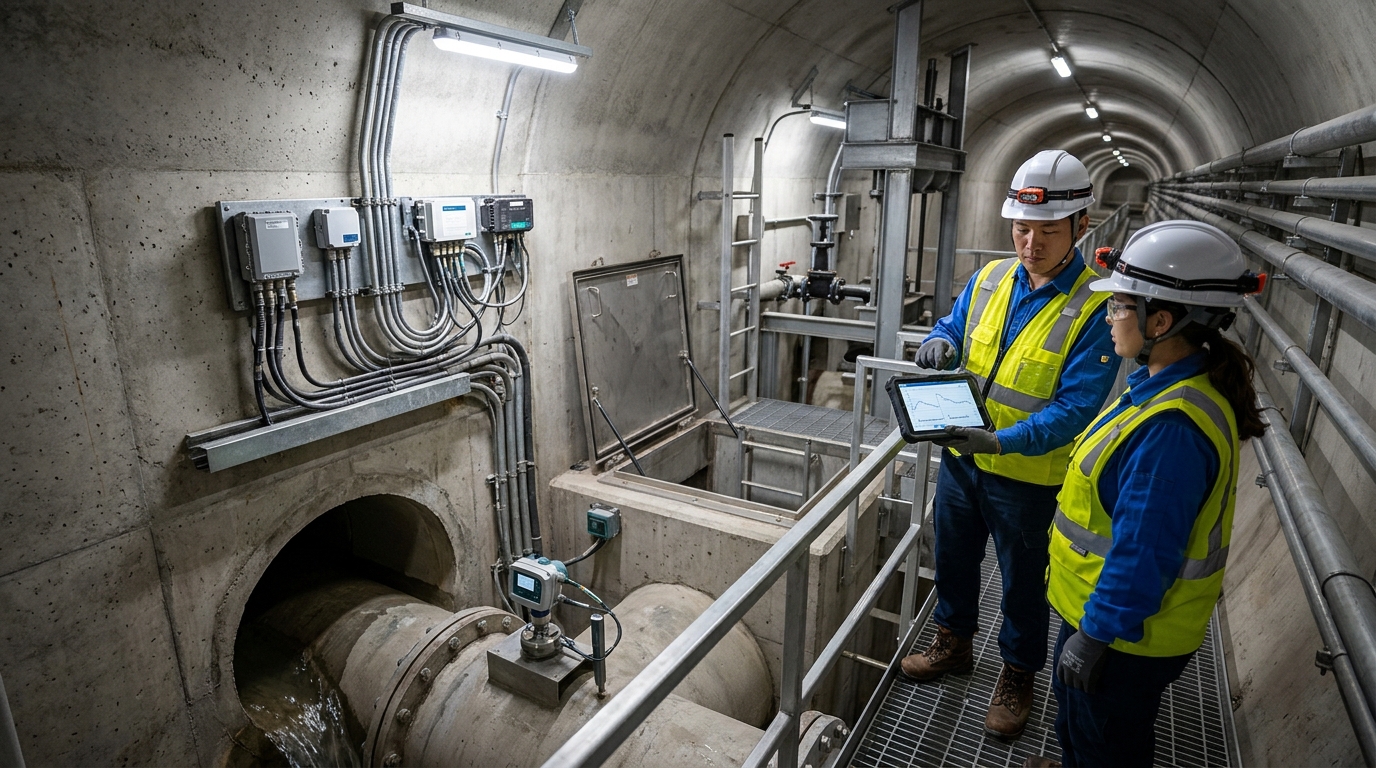
Comprehensive Guide to the Full Installation and Commissioning Process for DMAs (Including FAQs)
Against the backdrop of urban water supply systems transitioning from "scale expansion" to "refined operations," pipe network leakage has become a critical indicator affecting the efficiency, energy consumption, and service stability of water utilities. In the past, many cities relied primarily on monthly non-revenue water rates, user repair reports, and passive acoustic leak detection to assess leakage, which often suffered from delayed discovery, difficult localization, unclear accountability, and hard-to-verify results.
The value of DMA district metering lies precisely in dividing the massive, concealed, and series-connected water supply network into several independent units that are monitorable, accountably calculable, and assessable, shifting pipe network leakage management from "empirical judgment" to "data-driven judgment."
DMA (District Metered Area) is typically formed by closing boundary valves and installing master meters and pressure monitoring points to create a relatively closed metering unit within a specific water supply zone. Its core logic is not complex: the water entering the area, the billed water within the area, the unbilled authorized consumption, and the leakage volume should form a traceable balance relationship. If the master meter flow continuously exceeds the sum of billed water and reasonable consumption, and the minimum night flow is abnormally high, it indicates potential real leakage, metering errors, or unauthorized consumption in that zone.
It must be emphasized that DMA is not simply about installing a few flowmeters, nor is it just drawing a few circles on a pipe network map. It is a systematic engineering project involving network zoning, boundary isolation, metering configuration, data acquisition, leakage rate calculation, emergency repair coordination, and performance evaluation.
I. Zoning Design: First Ensure "Clear Boundaries," Then Pursue "Accurate Metering"
The first step in DMA construction is not procuring equipment, but zoning design. The rationality of the zoning directly determines the stability of subsequent metering, the credibility of the leakage rate, and the efficiency of troubleshooting. Generally, a DMA should have a relatively independent water supply path, controllable boundary valves, relatively complete internal pipe network data, and conditions suitable for installing master meters and pressure monitoring points.
Recommended Parameters
- Population Served: 5,000 – 20,000 people (or 800–3,000 households).
- Pipeline Length: Ideally 5 km – 25 km.
- Master Meter Size: Mostly DN100 to DN300.
- Branch Pipes: DN50 to DN150 based on actual conditions.
Boundary Priorities
- Physical Boundary: Defined by valve chambers, tees, crosses, and connection relationships.
- Metering Boundary: Ensures all incoming water is covered by master/sub-meters (no blind spots).
- Management Boundary: Aligns with billing, emergency repair, and pressure regulation districts.
In actual operation, it is recommended to establish a four-level metering framework: "Level 1: water plant outlet metering, Level 2: DMA master meter, Level 3: community or district branch meter, Level 4: large user or building meter."
II. Installation Steps: From Site Survey to Equipment Deployment
The core task during the DMA installation phase is to transform design drawings into an operable, data-collectable, and maintainable on-site system. The process includes data verification, site survey, boundary isolation, metering chamber renovation, flowmeter installation, pressure gauge installation, data acquisition terminal installation, and identification/archiving.
Flowmeter Installation Details
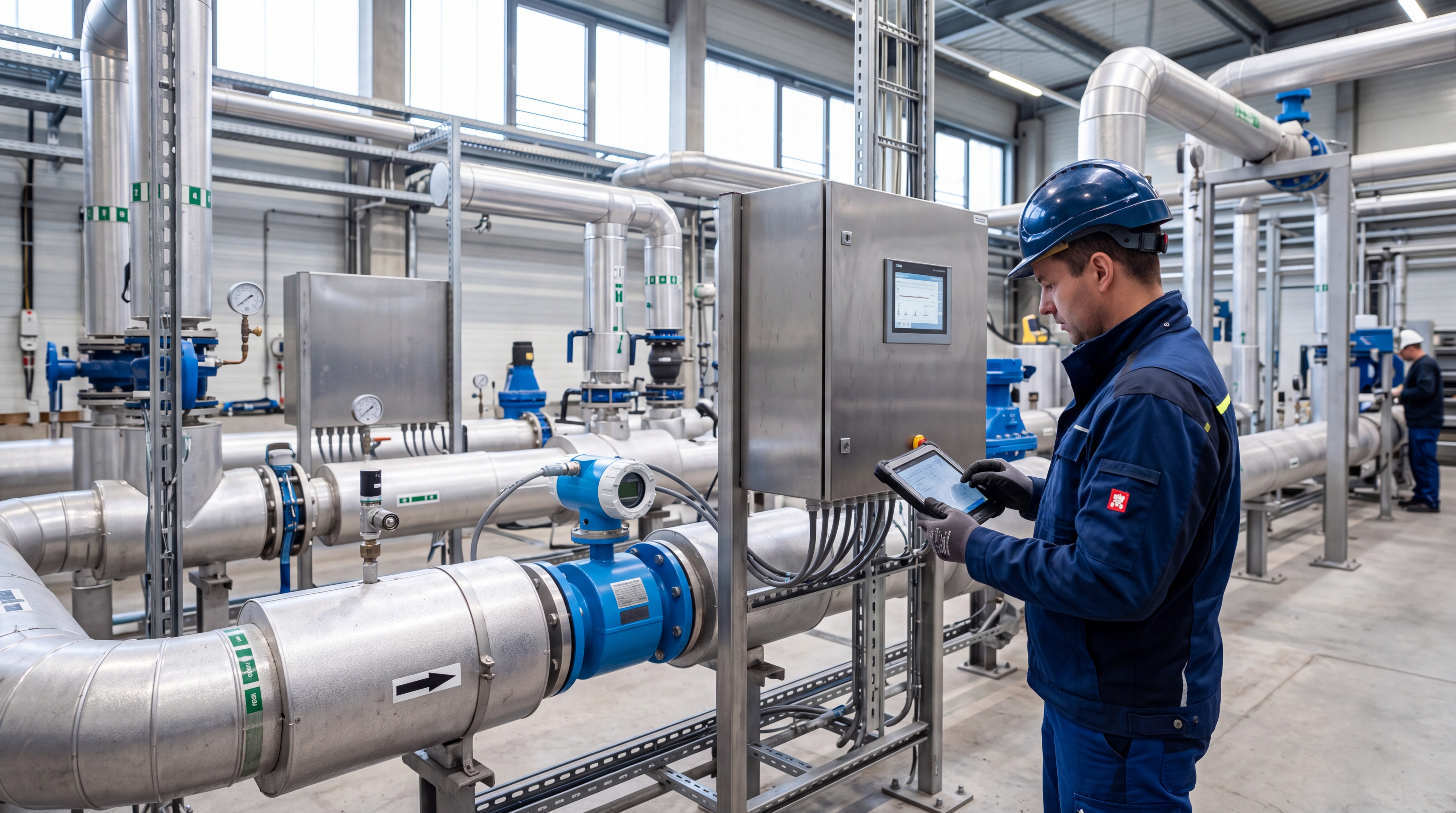
DMA master meters commonly use electromagnetic or ultrasonic flowmeters. Regardless of the method, attention must be paid to straight pipe sections, full pipe conditions, grounding, and protection.
- Electromagnetic Flowmeters: Upstream straight pipe section generally required to be no less than 5D, downstream no less than 3D. If there are flow-disturbing components upstream, increase to 10D upstream and 5D downstream. Grounding resistance should be controlled within 10Ω.
- Clamp-on Ultrasonic Flowmeters: Suitable where excavation is not feasible. Signal strength should reach manufacturer thresholds (commonly >60), and sound velocity deviation controlled within ±2%.
Pressure & Data Acquisition
Each DMA should be equipped with at least one pressure monitoring point. Pressure gauges typically range from 0-1.0 MPa or 0-1.6 MPa with accuracy class ≥0.25. Data acquisition terminals should support multi-parameter acquisition (flow, pressure, battery voltage) with intervals set to 15 minutes. Communication methods can include 4G, NB-IoT, or wired networks.
III. Commissioning Methods: Calibration to Water Balance Verification
After equipment installation is completed, systematic commissioning must be conducted. The goal is to confirm accurate device measurement, continuous data, stable communication, and the preliminary establishment of the DMA water balance relationship.
Commissioning Stages
- Single-device commissioning: Parameter setting and zero-point calibration. Zero-point drift for electromagnetic flowmeters should not exceed 0.5% of full scale.
- Communication commissioning: Run continuously for 72 hours. Data completeness rate should be ≥98%.
- Zone isolation verification: Observe flow changes in adjacent zones after closing boundary valves to detect cross-connections.
- Leakage baseline establishment: Use the Minimum Night Flow (MNF) method, analyzing data between 2:00 AM and 4:00 AM.
IV. Routine Maintenance: Data Quality & Equipment Inspection
Many projects fail not because the equipment is not advanced, but because issues such as missing data, unmanaged valves, depleted batteries, and meter drift are left untreated. Routine maintenance should revolve around four main lines: data quality, equipment status, valve status, and metering accuracy.
Data Checks
Check anomalies daily, continuity weekly, and balance monthly. Maintain data completeness rate above 98%.
Equipment Inspection
Monthly checks for chamber cover damage, water accumulation, damp converters, obstructed antennas, and blocked tapping ports.
Valve Maintenance
Verify boundary valve status monthly. Perform open/close checks quarterly on interconnection valves to prevent rusting shut.
Periodic Calibration
Pressure gauges: every 6-12 months. Flowmeters: every 12-24 months. Comparison error should not exceed ±5%.
V. Common Troubleshooting: Anomalies & Faults
During DMA operation, faults are inevitable. The key is to establish a standardized troubleshooting process to avoid misjudging equipment faults as leakage.
- Sudden Flow Increases: Check pressure data first. If accompanied by significant pressure drop and high night flow, suspect real leakage. If pressure is stable with instantaneous jumps, suspect metering or signal issues (e.g., damp junction box).
- Zero/Low Flow: Check for sensor damage, converter failure, parameter errors, empty pipes, or power interruption. Do not assume reduced leakage without verifying meter status.
- Pressure Anomalies: Drift may be caused by sensor aging or blockage. Sudden changes may indicate pump start/stop or bursts. Compare with standard pressure pumps if deviation exceeds 0.01 MPa.
- Communication Interruption: Check platform reception, single-point vs. zonal fault, terminal online status, RSSI signal strength (< -95dBm requires antenna adjustment), SIM card status, and battery voltage.
VI. Leakage Rate Calculation & Closed-Loop Disposal
The ultimate purpose of DMA district metering is not to generate reports, but to drive closed-loop leakage control. A complete closed loop includes: anomaly discovery, priority judgment, on-site investigation, leak localization, repair verification, and review archiving.
Anomaly priority can be determined based on MNF trends, leakage rate changes, and pressure drops. For high-priority DMAs, on-site verification should be initiated within 24 hours. Post-repair verification requires observing MNF for at least 7 days to ensure the drop is sustained and not due to temporary factors.
VII. Case Review & Outlook
From practices in multiple regions, DMA district metering has clear value for pipe network leakage control. In a southern old urban area project, implementing 16 DMAs led to the discovery and repair of 127 leaks within 6 months. The regional leakage rate dropped from 19.3% to 11.4%, and average minimum night flow decreased by 41%.
Another case from an industrial park demonstrated that in areas with high proportions of industrial users, metering accuracy and bypass management are often more critical than acoustic leak detection alone. By rectifying metering errors and replacing leaking bypass valves, the DMA leakage rate dropped from 15.6% to 8.9%.
Key Takeaway
DMA is not a one-time project, but a long-term operational mechanism. Its value lies not in how many flowmeters are installed, but in whether it continuously generates credible data, stably calculates leakage rates, and supports efficient closed-loop management. Only by solidifying "clear boundaries, accurate metering, continuous data, clear accountability, and efficient closed-loop management" can district metering transform from a dashboard into tangible leakage reduction results.