Pipe Network Leakage vs. District Metered Areas: A Selection Guide for Urban Pipe Network Scenarios
As urban water supply network leakage control enters a refined stage, District Metered Area (DMA) metering has evolved from a simple technical tool into a comprehensive approach covering leakage identification, district management, metering diagnostics, leakage-rate assessment, and maintenance dispatch. A DMA operates on the core logic of defining measurable boundaries within complex pipe networks. By coordinating flow, pressure, customer data, geographic information, and leak detection technologies, it transforms network leakage that is "invisible, indistinct, and difficult to quantify" into management objects that are locatable, quantifiable, and actionable.
Industry practice shows that the value of DMA metering lies not merely in installing several flow meters, but in forming a closed loop with clear boundaries, continuous metering, comparable data, traceable leaks, and verifiable repairs. Water utilities must select solutions based on current network conditions, leakage levels, budget constraints, and digital foundations.
Fixed-Boundary DMA Metering: A Stable Foundation
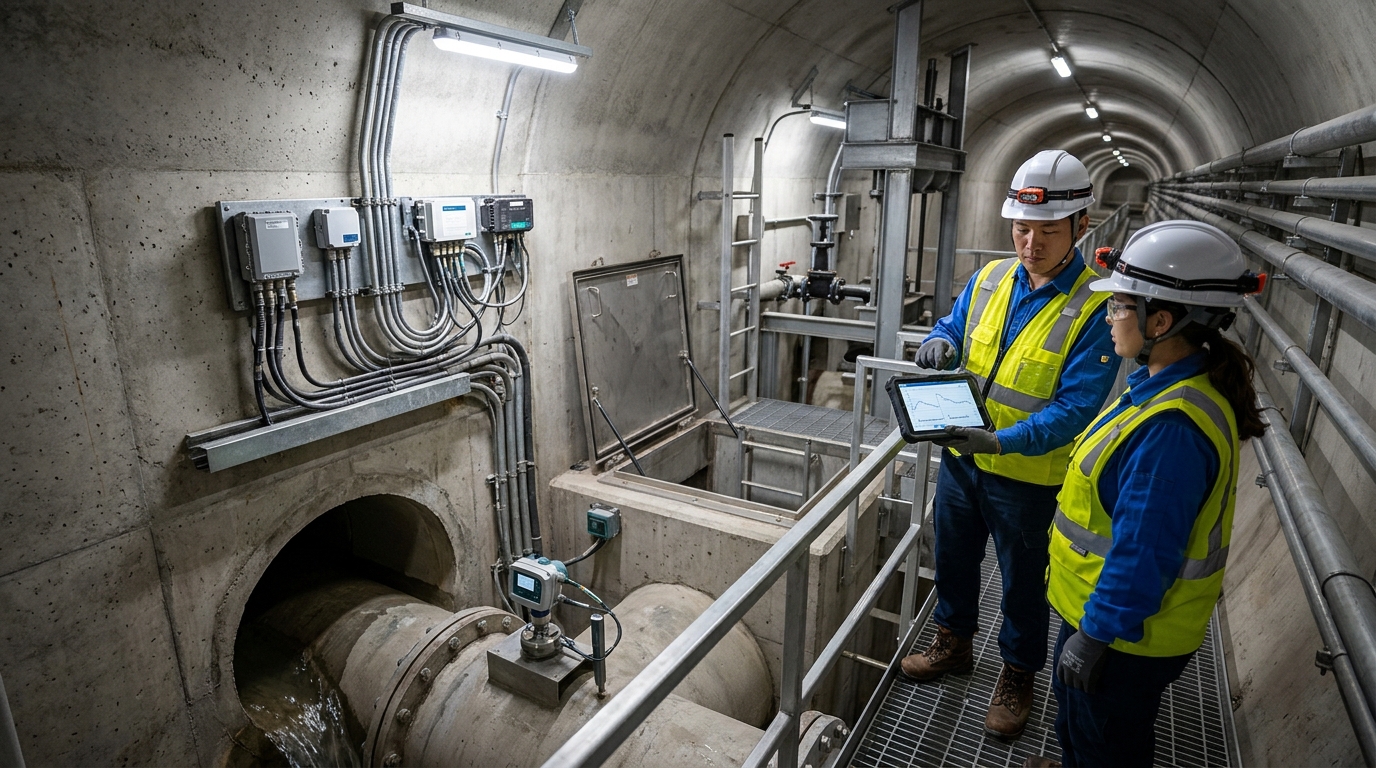
Fixed-boundary DMA metering is currently the most mature technology route and is most commonly used for leakage-rate assessment. It involves installing flow meters, pressure monitoring points, data acquisition terminals, and necessary valves at the boundaries of a district metered area to form a closable, meterable, and comparable boundary between the area and adjacent areas. Common boundary pipe diameters range from DN80 to DN300. Electromagnetic or ultrasonic flow meters typically achieve accuracy of ±1% to ±2% of reading. Pressure sensors usually have ranges of 0 to 1.6 MPa or 0 to 2.5 MPa, with sampling intervals set from 1 to 5 minutes.
The greatest advantages of fixed DMA are stable data, controllable boundaries, facilitation of minimum night flow (MNF) analysis, and ease of incorporating leakage rates into district assessment. For example, a city water utility simultaneously implemented the first-phase DMA construction in old city and newly developed districts, deploying 120 district metered areas covering approximately 450,000 households. After one year, the overall non-revenue water (NRW) rate decreased from 19.6% to 12.3%, annual water losses were reduced by approximately 2.6 million cubic meters, and the network leakage rate fell by more than 7 percentage points.
- Applicability: Areas with leakage rates above 15%, new/semi-new pipe networks, districts with complete boundary valves.
- Investment: Single DMA renovation costs approx. CNY 150,000–600,000; payback period ~4.2 years.
- Limitations: High construction difficulty; requires clear GIS data; not suitable for short-term emergency response.
Portable & Temporary DMA: Rapid Screening Route
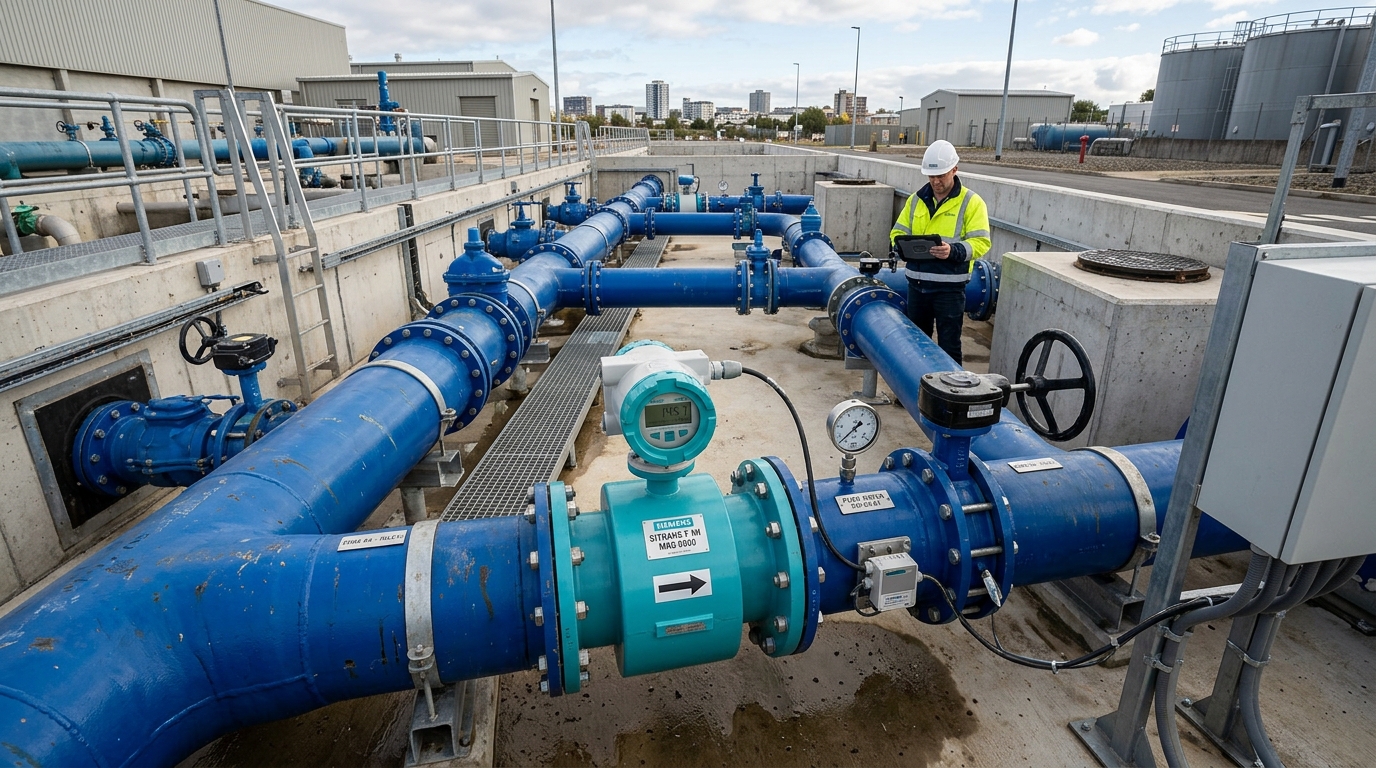
Portable and temporary DMA metering serves as an important supplementary route. Its core method involves temporarily installing clamp-on flow meters, external ultrasonic flow meters, or portable electromagnetic flow meters at the boundaries of suspected high-leakage areas. This equipment does not require permanent taps or prolonged shutdowns; deployment cycles range from hours to days, with single-point investment of approx. CNY 5,000–50,000.
A city utility carried out temporary DMA monitoring in 32 suspected high-leakage districts. Monitoring found that minimum night flow in four districts was clearly abnormal (2.5–3.5 times normal reference). Prioritizing these districts led to a leakage rate drop of ~4.1 percentage points after repairs. However, clamp-on meters are sensitive to pipe wall conditions (accuracy ±2%–±5%), making them less reliable for old cast iron or scaled pipes.
Use portable DMA to "screen first, then formalize." Identify high-risk districts with temporary metering, then implement fixed DMA renovation in priority areas. Do not mistake temporary DMA for a permanent solution.
Pressure-Managed DMA: Reducing Background Leakage
Pressure-managed DMA combines pressure monitoring, reduction control, SCADA dispatch, and repair. Network leakage volume has a nonlinear relationship with pressure; industry experience suggests each 10% reduction in pressure may reduce leakage by 15%–25%.
In one case, after implementing boundary metering in 30 DMAs, average pressure exceeded 0.35 MPa. By adding pressure sensors (range 0–1.0 MPa, accuracy ±0.5% FS) and adjusting valve setpoints to lower average pressure to 0.28 MPa, minimum night flow decreased by ~18%, pipe bursts fell from 46/year to 31/year (~32% reduction), and leakage rate dropped by 3.6 percentage points.
- Best For: High-pressure districts, areas with frequent bursts, low night-time use.
- Requirement: Complete hydraulic model, pressure monitoring network, and SCADA system.
- Risk: Improper control can cause insufficient pressure for low-zone customers.
Acoustic Leak Detection Integrated with DMA
DMA answers "which district has abnormal leakage," while acoustic detection answers "where is the leak." Noise recorders (sampling 100 Hz–5 kHz, battery life 1–3 years) and correlators (positioning accuracy ±1–3 meters in metal pipes) form an integrated route.
During operation, a DMA boundary night flow increased from 0.4 m³/h to 1.2 m³/h over 7 days. Deploying 48 noise recorders and using correlators located two leaks with combined loss of ~32 m³/h. Repairs reduced minimum night flow by 72%, dropping district leakage rate from 14.8% to 9.6%.
Limitations: Acoustic signals attenuate significantly in plastic/PVC/ductile iron pipes. Environmental noise (traffic, pumps) interferes with detection. Cost per detected leak is CNY 1,000–5,000+.
Recommended Sequence: Discover abnormalities via metering → Narrow scope using pressure/GIS → Locate leaks using acoustic equipment. Concentrate resources in high-probability districts.
Data Intelligence & Minimum Night Flow Analysis
With smart meters and big data, DMA extends from "meter installation" to "data-driven intelligent diagnosis." Minimum Night Flow (MNF) is a key indicator. In residential areas (2:00–4:00 AM), boundary flow approaches background leakage. Normal MNF is ~0.03–0.08 m³/h per thousand households. Higher values indicate leakage, cross-connection, or metering errors.
A smart water platform analyzing 180 DMAs identified 26 suspected abnormal districts; 14 were confirmed actual leaks. The identification cycle shortened from 14 days to 5 days, reducing leakage rates by 2.8 percentage points.
- Prerequisite: Reliable data quality (time sync, >90% communication online rate).
- Value: Converts dispersed data into comparable, alertable indicators.
- Note: Data intelligence is a hub for discovery and evaluation, not a replacement for field detection.
GIS & Hydraulic Model Optimization
DMA effectiveness depends on reasonable boundaries. Traditional zoning by roads/administrative lines often fails due to cross-connections. GIS and hydraulic models simulate boundary schemes to evaluate flow distribution and meterability.
One utility planned 180 DMAs but model calibration revealed unreliable valves. Optimizing to 126 DMAs and reducing boundary valves from 650 to 480 lowered renovation costs by ~35% while stabilizing night-flow baselines. Key node pressure residuals were controlled within 0.05 MPa.
Selection Logic: Avoid "zoning for the sake of zoning." More DMAs are not necessarily better. Focus on independent metering, assessment, and repair capability. Suitable for complex networks; small utilities should start with simplified road/valve-based boundaries verified by temporary DMA.
Technology Route Comparison & Selection Guide
| Route | Best Application | Key Advantage | Main Limitation |
|---|---|---|---|
| Fixed DMA | Long-term assessment, Leakage >15% | Stable data, Controllable boundaries | High investment, Complex construction |
| Portable/Temporary | Rapid screening, Budget limits | Fast deployment, Low cost entry | Lower accuracy, Sensitive to pipe condition |
| Pressure-Managed | High pressure zones, Frequent bursts | Reduces background leakage source | Risk of low pressure complaints |
| Acoustic + DMA | Locating leaks in established DMAs | High localization efficiency | Ineffective in plastic pipes, Noise interference |
| Data Intelligence | Utilities with SCADA/AMI/GIS | Predictive capability, Work-order closure | Requires high data quality (>90% online) |
| GIS/Hydraulic Opt. | Complex networks, Large-scale projects | Scientific zoning, Cost optimization | High initial data governance cost |
Key Parameters for Selection
Executable plans require specific parameters beyond conceptual understanding:
- Boundary Flow Accuracy: Fixed meters ±1%–2%; Clamp-on ±2%–5%.
- DMA Customer Scale: Residential 1,000–5,000 households; adjust for industrial/commercial fluctuations.
- MNF Baseline: Residential reference 0.03–0.08 m³/h per thousand households.
- Pressure Monitoring: Sensors at boundaries/terminals/high-rises, accuracy ±0.5%–1% FS.
- Communication Online Rate: Must be ≥90% for effective data intelligence.
- Leak Localization: Correlators ±1–3m in metal pipes; combine with tracer gas/excavation for plastics.
- Payback Period: Typically 3–6 years if sustained water-saving benefits are achieved.
Conclusion: From "Seeing Leakage" to "Managing Leakage"
DMA technology drives leakage control from experience-based to data-driven. By dividing networks into measurable units, it shifts management from "overall averages" to "district-specific differences" and from "reactive repair" to "proactive early warning." Future integration with IoT, digital twins, and AI will make DMA a core node of asset management.
Success depends not just on installing flow meters, but on ensuring each DMA is stably metered, accurately localized, timely repaired, and continuously verified. Integrating zoning, metering, pressure management, acoustic detection, and data intelligence transforms leakage control from project-based governance into long-term operational capability.